Determine the necessary mass, volume, or concentration for preparing a solution.
Bioactive, ActiBioPure™, Native, High Performance, EnzymoPure™, from Porcine Erythrocytes; ≥1000 U/mg protein; Protein concentration: See COA ActiBioPure™,Bioactive,High Performance,Native,EnzymoPure™ for sensitive chromatographic and analytical workflows requiring minimal baseline interference.
Store at -80°C,Avoid repeated freezing and thawing Ships Dry ice packs + Cold packs Check lot-specific COA for exact specifications.
SDS, COA, datasheet, and spec sheet available for download. Lot-specific COA accessible via lot number lookup.
Cited in 0 peer-reviewed publications across chromatography, organic synthesis, and cross-coupling reactions.
Native calpain-1 from porcine erythrocytes. Calpains are a family of calcium-dependent thiol-proteases that degrade a wide variety of cytoskeletal, membrane-associated, and regulatory proteins. The two major isoforms, calpain I (µ-form) and calpain II (m-form), differ in their calcium requirement for activation. Calpain I requires only micromolar amounts of calcium (EC50 = 2 µM), while calpain II requires millimolar amounts (EC50 = 1 mM).
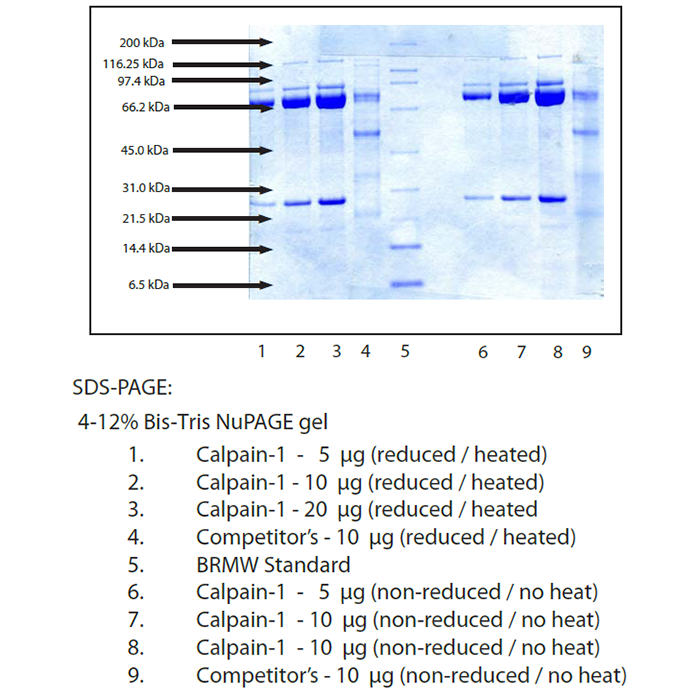
Calpains are heterodimers of 80 kDa and 30 kDa subunits. The 80 kDa unit has the catalytic site and is unique to each isozyme. The 30 kDa unit is a regulatory subunit and common to both calpain I and calpain II. The 80 kDa unit consists of four domains (I-IV). The 30 kDa unit has two domains (V and VI).
• Domain I is partially removed during autolysis.
• Domain II is the protease domain.
• Domain III exhibits a homology with typical calmodulin binding proteins and interacts with calcium binding domains (IV and VI) and frees domain II for protease activity.
• Domain IV is a calcium binding domain.
• Domain V contains a hydrophobic region and is essential for calpain interaction with membranes.
• Domain VI is a calcium binding domain.
More recently, attention has been focused on the pathological significance of calcium accumulation in the central nervous system following cerebral ischemia and traumatic brain injury. Over-activation of NMDA, kainate, and AMPA receptors in the brain leads to sustained influx in Ca²⁺ through voltage gated Ca²⁺ channels. Disturbances in calcium homeostasis result in the activation of several calcium-dependent enzymes including calpains. Over-expression of calpains has been positively linked to both acute and chronic neurodegenerative processes including ischemia, trauma, and Alzheimer′s disease. In Alzheimer′s disease the ratio of active (76 kDa) to inactive (80 kDa) calpain I is reported to be much higher. Calpain proteolysis is usually the late-stage common pathway towards cell death induced by excitotoxic compounds.
Comprehensive hazard, handling, storage, and regulatory compliance document.
Download SDS →Lot-specific quality data. Enter your lot number to retrieve the exact COA.
Look up COA →Full quality attributes and acceptance criteria for this grade.
View spec sheet →Our grade selection guide covers purity, stabilizer status, and application suitability for all variants in our catalog.
View Bioactive grade guide → View ActiBioPure™ grade guide → View Native grade guide → View High Performance grade guide → View EnzymoPure™ grade guide →