Determine the necessary mass, volume, or concentration for preparing a solution.
≥99% for sensitive chromatographic and analytical workflows requiring minimal baseline interference.
Store at -20°C Ships Ice chest + Ice pads Check lot-specific COA for exact specifications.
SDS, COA, datasheet, and spec sheet available for download. Lot-specific COA accessible via lot number lookup.
Cited in 0 peer-reviewed publications across chromatography, organic synthesis, and cross-coupling reactions.
Information
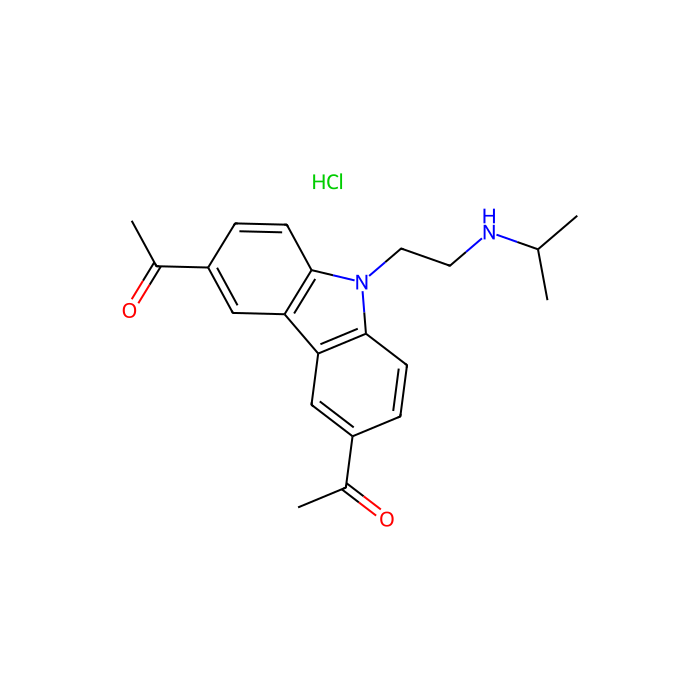
CBL0137 HCl CBL0137 (CBLC137, Curaxin 137) HCl activates p53 and inhibits NF-kB with EC50s of 0.37 μM and 0.47 μM in the cell-based p53 and NF-kB reporter assays, respectively. It also inhibits histone chaperone FACT (facilitates chromatin transcription complex).
Targets
FACT ; p53 (Cell-free assay); NF-κB (Cell-free assay) ; 0.37 μM(EC50); 0.47 μM(EC50)
In vitro
CBL0137 is a potent inducer of apoptosis in pancreatic cancer cell lines and is toxic not only for proliferating bulk tumor cells, but also for pancreatic cancer stem cells. CBL0137 and related molecules can simultaneously activate p53 and inhibit cellular stress pathways mediated by NF-κB and HSF-1. CBL0137 binds DNA but does not cause any sort of chemical modifications in DNA and therefore lacks genotoxicity. However, CBL0137 binding to DNA leads to functional inactivation of the Facilitates Chromatin Transcription (FACT) complex, a chromatin remodeling complex involved in transcription, replication, and DNA repair. In CBL0137-treated cells, FACT is lost from the nucleoplasm and trapped in chromatin, resulting in the inhibition of FACT-dependent transcription, including NF-kB-mediated transcription. Additionally, chromatin trapping of FACT leads to casein kinase 2 (CK2)-dependent phosphorylation and activation of p53.
In vivo
In mice, CBL0137 is effective against several Pancreatic ductal adenocarcinoma (PDA) models, including orthotopic gemcitabine resistant PANC-1 model and patient derived xenografts, in which CBL0137 anti-tumor effect correlated with overexpression of FACT. CBL0137 targets glioblastoma (GBM) according to its proposed mechanism of action, crosses the blood-brain barrier, and is efficacious in both TMZ-responsive and -resistant orthotopic models. The property of crossing the blood-brain barrier, especially when administered i.v, bodes well for the potential of this drug to treat CNS tumors. In orthotopic models, i.v. administration leads to greater tumor tissue accumulation than oral dosing, leading to greater bioavailability. Normal brain tissue accumulation of CBL0137 does not cause observable neurotoxicity.
Cell Research(from reference)
Cell lines:tumor (HT1080, RCC45, MiaPaca) and normal cells (Wi38, NKE-hTERT)
Concentrations:2 μM
Incubation Time:24 h
Comprehensive hazard, handling, storage, and regulatory compliance document.
Download SDS →Lot-specific quality data. Enter your lot number to retrieve the exact COA.
Look up COA →Full quality attributes and acceptance criteria for this grade.
View spec sheet →Taxonomy Tree
| Kingdom | Organic compounds |
|---|---|
| Superclass | Organoheterocyclic compounds |
| Class | Indoles and derivatives |
| Subclass | Carbazoles |
| Intermediate Tree Nodes | Not available |
| Direct Parent | Carbazoles |
| Alternative Parents | N-alkylindoles Indoles Acetophenones Aryl alkyl ketones Substituted pyrroles Heteroaromatic compounds Dialkylamines Azacyclic compounds Organic oxides Hydrochlorides Hydrocarbon derivatives |
| Molecular Framework | Aromatic heteropolycyclic compounds |
| Substituents | Carbazole - N-alkylindole - Acetophenone - Indole - Aryl ketone - Aryl alkyl ketone - Substituted pyrrole - Benzenoid - Heteroaromatic compound - Pyrrole - Ketone - Secondary amine - Secondary aliphatic amine - Azacycle - Hydrocarbon derivative - Amine - Organic nitrogen compound - Organooxygen compound - Organonitrogen compound - Organic oxide - Organic oxygen compound - Hydrochloride - Aromatic heteropolycyclic compound |
| Description | This compound belongs to the class of organic compounds known as carbazoles. These are compounds containing a three ring system containing a pyrrole ring fused on either side to a benzene ring. |
| External Descriptors | Not available |
| Solubility | Solubility (25°C) In vitro DMSO: 20 mg/mL (53.63 mM); Water: 20 mg/mL (53.63 mM); Ethanol: Insoluble; |
|---|---|
| Sensitivity | Moisture sensitive |
| Molecular Weight | 372.900 g/mol |
| XLogP3 | |
| Hydrogen Bond Donor Count | 2 |
| Hydrogen Bond Acceptor Count | 3 |
| Rotatable Bond Count | 6 |
| Exact Mass | 372.16 Da |
| Monoisotopic Mass | 372.16 Da |
| Topological Polar Surface Area | 51.100 Ų |
| Heavy Atom Count | 26 |
| Formal Charge | 0 |
| Complexity | 466.000 |
| Isotope Atom Count | 0 |
| Defined Atom Stereocenter Count | 0 |
| Undefined Atom Stereocenter Count | 0 |
| Defined Bond Stereocenter Count | 0 |
| Undefined Bond Stereocenter Count | 0 |
| The total count of all stereochemical bonds | 0 |
| Covalently-Bonded Unit Count | 2 |
No item-specific, validated application protocols are provided for this catalog entry.
General protocol framework for cell-based studies (research use only):
These are general research guidelines only; adapt to your assay and institutional SOPs.
Literature/general description (non-clinical; mechanism-focused):
Note: All uses are for research only. No medical or clinical claims are made or implied.
This product is a bioactive small molecule, not a buffering reagent. It does not serve as a pH buffer or electrophoresis buffer component.
Practical notes for buffer preparation in assays (general):
Because CBL0137 HCl is a specific bioactive small molecule (not a solvent or process reagent), “green replacement” considerations are limited. Nonetheless, greener practices can be applied to its handling and experimental design.
Scope and limitations:
Greener handling strategies (general):
Comparison table (contextual)
Documentation:
This product is supplied strictly for research use only. No therapeutic or clinical use is intended or permitted.
Relevant non-clinical, pre-formulation contexts (literature/general):
Regulatory note:
Item-specific (from Product Data):
Literature/general expectations for this chemotype (non-specification):
Practical handling notes (general):
Context and implications (general guidance for users procuring screening compounds):
Recommendation: Use the CoA/Spec Sheet accompanying your lot for precise purity, identity, and assay preparation details. Document lot numbers in screening data for reproducibility.
This product is supplied as a finalized screening compound rather than a synthetic reagent; it is not typically used as a stoichiometric reagent or catalyst in preparative organic synthesis.
Applicable research uses (non-clinical; literature/general):
Not typically applicable:
Practical assay tips (general):
Not typically applicable. CBL0137 HCl is not used as a reagent or catalyst in standard organic reactions; therefore, there are no conventional “reaction conditions” to report for its use in synthesis.
Assay preparation conditions (general/literature guidance for bioactive small molecules):
These recommendations are general and should be tailored to the specific biological assay and institutional SOPs.
Item-specific hazard information from Product Data:
General laboratory safety guidance for aromatic, cationic small molecules (not a substitute for the SDS):
Always consult the product’s SDS for definitive hazard, handling, and exposure limit information.
Given its hydrochloride salt form and polyaromatic character, CBL0137 HCl is generally treated as a cationic, moderately lipophilic small molecule with good compatibility with polar aprotic solvents.
Practical solvent choices (literature/general):
Polarity class and miscibility (general):
Tips to prevent precipitation and adsorption:
Comparison (general):
Item-specific (from Product Data):
General guidance for this chemotype (non-specification):
Always refer to the CoA/Spec Sheet and SDS accompanying your lot for definitive storage duration, re-test intervals, and handling instructions.
CBL0137 HCl is a bioactive small-molecule hydrochloride salt from the curaxin chemotype, supplied for research screening and mechanistic studies.
Item-specific (from Product Data):
Structural features (general/literature description of the chemotype, not item-specific):
2D structure (verbal depiction; literature/general):
CBL0137 HCl is a finalized, bioactive small molecule and is not typically used as a building block or reagent in organic synthesis.
General retrosynthetic/contextual notes (literature/general):
Conclusion: For synthetic chemistry purposes, treat this material as an endpoint probe compound. If analogs are desired, design de novo routes targeting the core heteroaromatic framework rather than attempting late-stage diversification of the HCl salt.
Item-specific, tested biological target data are not provided for this catalog entry.
Literature/general description (for background only):
Important: