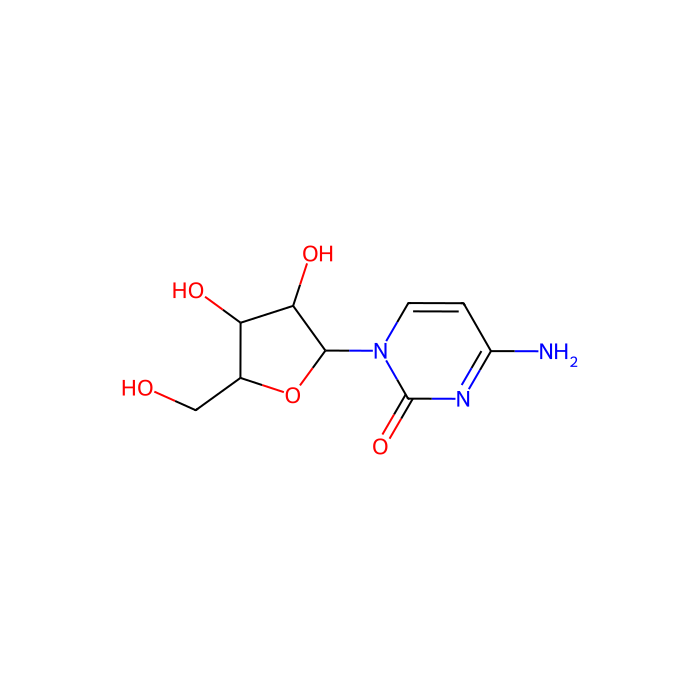
Cytidine - Moligand™, 10mM in DMSO , CAS No.65-46-3

CAS: 65-46-3 Cat. No.: C409115 Formula: C9H13N3O5 Molecular Weight: 243.22 Beilstein Registry Number: 89173 EC Number: 200-610-9
AVAILABLE TO ORDER
GRADE & PURITY Moligand™ ? Moligand™ — Aladdin's line of ligands and bioactive small molecules. Use for receptor, pathway, and binding studies needing defined small-molecule tools. 10mM in DMSO
Synonyms
4-amino-1-((2R,3R,4S,5R)-3,4-dihydroxy-5-(hydroxymethyl)-tetrahydrofuran-2-yl)pyrimidin-2(1H)-one
Storage
Store at -80°C
Shipped In
Dry ice packs + Cold packs
★
Size
USA
Germany (EU)*
Price
Qty
1ml
C409115-1ml
1 In stock
—
$26.90
Enter a quantity for the sizes you want to add.

Overview

Information

Cytidine is a nucleoside molecule that is formed when cytosine is attached to a ribose ring, cytidine is a component of RNA.
In vitro


In vivo


Cell Data

cell lines:

Concentrations:

Incubation Time:

Powder Purity:≥99%

Specifications

Synonyms
4-amino-1-((2R,3R,4S,5R)-3,4-dihydroxy-5-(hydroxymethyl)-tetrahydrofuran-2-yl)pyrimidin-2(1H)-one
Specifications & Purity
Moligand™, 10mM in DMSO
Biochemical and Physiological Mechanisms
Cytidine is a nucleoside molecule that is formed when cytosine is attached to a ribose ring, cytidine is a component of RNA.
Storage
Store at -80°C
Shipped In
Dry ice packs + Cold packs
This product requires cold chain shipping. Ground and other economy services are not available.
Grade
Moligand™
Names and Identifiers
Isomeric SMILES
C1=CN(C(=O)N=C1N)[C@H]2[C@@H]([C@@H]([C@H](O2)CO)O)O
WGK Germany
3
RTECS
UW7370000
Molecular Weight
243.22
Beilstein
89173
Reaxys
753984
Reaxys-RN_link_address
https://www.reaxys.com/reaxys/secured/hopinto.do?context=S&query=IDE.XRN=753984&ln=

Advanced Data

Certificates (CoA,COO,BSE/TSE and Analysis Chart)
C of A & Other Certificates(BSE/TSE, COO):
Analytical Chart:
Chemical and Physical Properties
Specific Rotation[α]34 ° (C=0.7, H2O)
Melt Point224-225°C
Safety and Hazards(GHS)
Pictogram(s)
GHS02,   GHS07
Signal
Warning
Hazard Statements

H227:Combustible liquid

H315:Causes skin irritation

H319:Causes serious eye irritation

H335:May cause respiratory irritation

Precautionary Statements

P261:Avoid breathing dust/fume/gas/mist/vapors/spray.

P264:Wash hands [and …] thoroughly after handling.

P271:Use only outdoors or in a well-ventilated area.

P280:Wear protective gloves/protective clothing/eye protection/face protection.

P321:Specific treatment (see ... on this label).

P302+P352:IF ON SKIN: wash with plenty of water.

P304+P340:IF INHALED: Remove person to fresh air and keep comfortable for breathing.

P305+P351+P338:IF IN EYES: Rinse cautiously with water for several minutes. Remove contact lenses if present and easy to do - continue rinsing.

P362+P364:Take off contaminated clothing and wash it before reuse.

P405:Store locked up.

P403+P233:Store in a well-ventilated place. Keep container tightly closed.

P501:Dispose of contents/container to an approved waste disposal plant.

P264+P265:Wash hands [and …] thoroughly after handling. Do not touch eyes.

P337+P317:If eye irritation persists: Get medical help.

P332+P317:If skin irritation occurs: Get medical help.

P319:Get medical help if you feel unwell.

WGK Germany
3
RTECS
UW7370000
Reaxys
753984
Reaxys-RN_link_address
https://www.reaxys.com/reaxys/secured/hopinto.do?context=S&query=IDE.XRN=753984&ln=
Merck Index
2786
Documents & Articles
Pyrimidine Research Selection Guide: Structural Features, Typical Applications, and a Reagent/Building-Block Classification Navigator (Tables 1–5)
Functional Systems of Nucleoside Metabolism-Related Enzymes in Drug Response and Disease Biology
The Methodological Value of TPS-Cl: The Logic of Selective Activation and Representative Transformations in Nucleoside and Nucleotide Chemistry
Coupling Activators, Nucleoside Building Blocks, and Modification Design in Oligonucleotide Chemical Synthesis: Their Effects on Synthetic Efficiency, Purity, and Product Properties
Porous Graphitic Carbon (PGC) Chromatography Columns: Creating New Selectivity for Challenging Separations through Molecular Shape and the π-Electron Cloud on the Graphitic Surface
From Tumor Sequencing to “One Patient, One Drug”: Machine-Learning-Assisted Design of V940 Individualized Neoantigen mRNA and the Phase III Breakthrough in Melanoma
Glycosidic Bond Structure and Cleavage Mechanisms—Chemical and Enzymatic Cleavage of O-, N-, S-, and C-Glycosides
Citations of This Product
Solution Calculators
Reviews

Customer Reviews

Shall we send you a message when we have discounts available?

Remind me later

Thank you! Please check your email inbox to confirm.

Oops! Notifications are disabled.