
Determine the necessary mass, volume, or concentration for preparing a solution.
| Activity Type | Activity Value -log(M) | Mechanism of Action | Activity Reference | Publications (PubMed IDs) |
|---|
Moligand™, 10mM in DMSO Moligand™ for sensitive chromatographic and analytical workflows requiring minimal baseline interference.
Store at -80°C Ships Dry ice packs + Cold packs Check lot-specific COA for exact specifications.
SDS, COA, datasheet, and spec sheet available for download. Lot-specific COA accessible via lot number lookup.
Cited in 1 peer-reviewed publications across chromatography, organic synthesis, and cross-coupling reactions.
Information
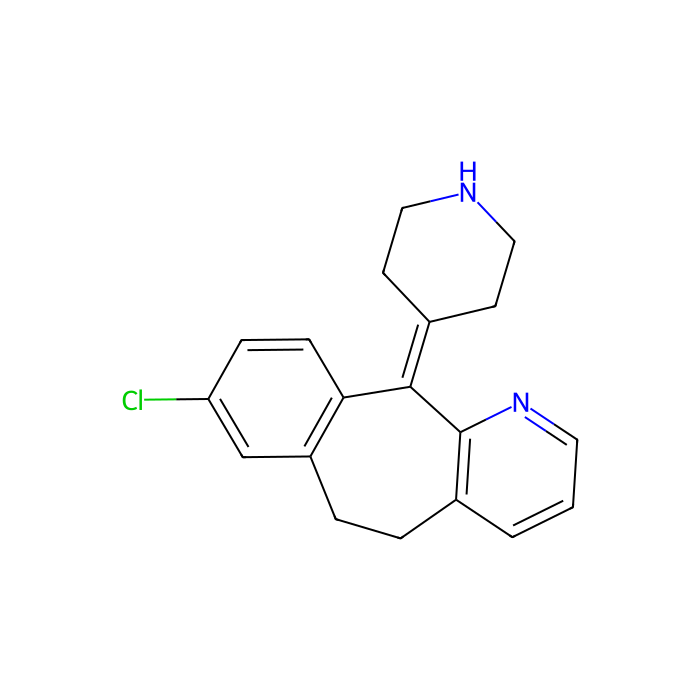
Desloratadine (SCH-34117, NSC 675447) is a potent antagonist for humanhistamine H1receptor withIC50of 51 nM.
In vitro
Desloratadine is a competitive antagonist of carbachol-induced contractions in isolated rabbit iris smooth muscle with pA2 of 6.67. Desloratadine binds to the human H1 receptor with Ki value of 0.87 nM in displacing tritiated mepyramine. Desloratadine (100 nM to 10 μM) inhibits both IgE-mediated and non–IgE-mediated generation of the cytokines IL-4 and IL-13 by human basophils. Desloratadine (300 nM to 100 μM) inhibits both IgE and non–IgE-mediated histamine release from human peripheral blood basophils. Desloratadine (0.1 μM to 10 μM) is also shown to inhibit platelet-activating factor-induced eosinophil chemotaxis and TNF-α-induced eosinophil adhesion in eosinophils obtained from patients with allergic rhinitis or allergic asthma. Desloratadine (1 μM-10 μM) dose-dependently inhibits the release of histamine and LTC4 from human basophils. Desloratadine (0.1 μM-10 μM) dose-dependently inhibits IL-13 secretion from basophils activated with IL-3 and PMA from human basophils. Desloratadine (10 μM) pretreatment results in a substantial decrease of the induced cytokine message in cultured basophils. Desloratadine (10 μM) pretreatment causes approximately an 80% reduction in the IL-4 message accumulated with anti-IgE activation in cultured basophils. Desloratadine (10 μM) also inhibits the histamine and IL-4 protein secreted into the supernatants of cultured basophils. [3H]Desloratadine binds to the human histamine H1 receptor expressed in CHO cells with Kd of 1.1 nM. Desloratadine is 52, 57, 194, and 153 times more potent than cetirizine, ebastine, fexofenadine, and loratadine, respectively, in competition-binding studies.
In vivo
Desloratadine (1 mg/mL, 3 mg/mL and 10 mg/mL) induces a dose-dependent and long lasting mydriasis in the guinea-pig in vivo. Desloratadine inhibits histamine-induced paw edema with ED50 of 0.15 mg/kg in mice. Desloratadine inhibits an increase in microvascular permeability in response to a histamine challenge to the upper airway of guinea pigs with ED50 of 0.9 μg. Desloratadine (5 mg/kg) causes inhibition of oxotremorine-induced tremor by disrupting blood-brain barrier in conscious mice. Desloratadine (1.0 mg/kg) significantly inhibits oxotremorine-induced (0.00125 mg/kg, 0.0025 mg/kg, and 0.02 mg/kg) decreases in dP/dt indicated by a shift in the dose-response curve to the right in the pithed rat. Desloratadine (1.0 mg/kg) significantly inhibits oxotremorine-induced (0.00125 mg/kg, 0.0025 mg/kg, and 0.02 mg/kg) decreases in dP/dt indicated by a shift in the dose-response curve to the right in the pithed rat.
Cell Data
cell lines:
Concentrations:
Incubation Time:
Powder Purity:≥99%
Comprehensive hazard, handling, storage, and regulatory compliance document.
Download SDS →Lot-specific quality data. Enter your lot number to retrieve the exact COA.
Look up COA →Full quality attributes and acceptance criteria for this grade.
View spec sheet →| Activity Type | Activity Value -log(M) | Mechanism of Action | Activity Reference | Publications (PubMed IDs) |
|---|
| Activity Type | Activity Value -log(M) | Mechanism of Action | Activity Reference | Publications (PubMed IDs) |
|---|
| Activity Type | Activity Value -log(M) | Mechanism of Action | Activity Reference | Publications (PubMed IDs) |
|---|
| Activity Type | Activity Value -log(M) | Mechanism of Action | Activity Reference | Publications (PubMed IDs) |
|---|
| Activity Type | Activity Value -log(M) | Mechanism of Action | Activity Reference | Publications (PubMed IDs) |
|---|
| Activity Type | Activity Value -log(M) | Mechanism of Action | Activity Reference | Publications (PubMed IDs) |
|---|
| Activity Type | Activity Value -log(M) | Mechanism of Action | Activity Reference | Publications (PubMed IDs) |
|---|
| Activity Type | Activity Value -log(M) | Mechanism of Action | Activity Reference | Publications (PubMed IDs) |
|---|
| Activity Type | Activity Value -log(M) | Mechanism of Action | Activity Reference | Publications (PubMed IDs) |
|---|
| Solubility | Solubility (25°C) In vitro DMSO: 18 mg/mL (61.15 mM); Ethanol: 3 mg/mL (10.19 mM); Water: Insoluble; |
|---|---|
| Melt Point(°C) | 157 °C |
Our grade selection guide covers purity, stabilizer status, and application suitability for all variants in our catalog.
View Moligand™ grade guide →