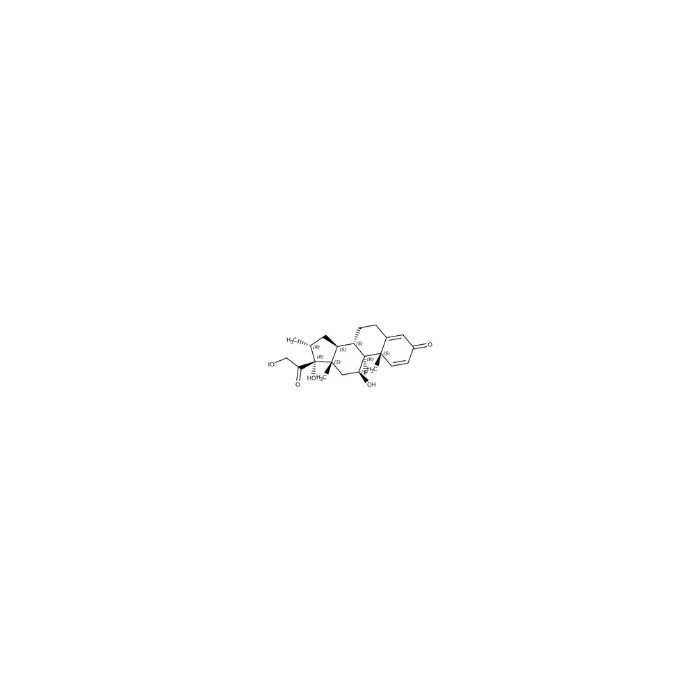
Dexamethasone - BioReagent, Moligand™, for cell culture, ≥97%, powder , CAS No.50-02-2

CAS: 50-02-2 Cat. No.: D754934 Formula: C22H29FO5 Molecular Weight: 392.46 Beilstein Registry Number: 2066651 EC Number: 200-003-9
AVAILABLE TO ORDER
GRADE & PURITY BioReagent ? BioReagent grade — tested suitable for life-science and molecular-biology use. Use for cell culture, assays, and biochemical work needing biological compatibility. Moligand™ ? Moligand™ — Aladdin's line of ligands and bioactive small molecules. Use for receptor, pathway, and binding studies needing defined small-molecule tools. for Cell culture ? Cell-culture grade — low endotoxin and contaminants to support viable cell growth. Use in mammalian/other cell culture media and supplements. ≥97% powder
Synonyms
Prednisolone F|9α-Fluoro-16α-methyl-11β,17α,21-trihydroxy-1,4-pregnadiene-3,20-dione|(11β,16α)-9-Fluoro-11,17,21-trihydroxy-16-methylpregna-1,4-diene-3,20-dione|9α-Fluoro-16α-methylprednisolone|MK 125
Storage
Store at 2-8°C,Protected from light
Shipped In
Wet ice
★
Size
USA
Germany (EU)*
Price
Qty
25mg
D754934-25mg
In stock ≥10
—
$152.90
100mg
D754934-100mg
3 In stock
—
$387.90
500mg
D754934-500mg
3 In stock
—
$839.90
1g
D754934-1g
3 In stock
—
$1,245.90
Enter a quantity for the sizes you want to add.

Overview

Dexamethasone is used to study apoptosis, cell signaling pathways, cell differentiation and gene expression.

Specifications

Synonyms
Prednisolone F | 9α-Fluoro-16α-methyl-11β,17α,21-trihydroxy-1,4-pregnadiene-3,20-dione | (11β,16α)-9-Fluoro-11,17,21-trihydroxy-16-methylpregna-1,4-diene-3,20-dione | 9α-Fluoro-16α-methylprednisolone | MK 125
Specifications & Purity
BioReagent, Moligand™, for cell culture, ≥97%, powder
Biochemical and Physiological Mechanisms
Dexamethasone (Hexadecadrol) is a glucocorticoid receptor agonist, apoptosis inducer, and common disease inducer in experimental animals, constructing models of muscle atrophy, hypertension, and depression. Dexamethasone can inhibit the production of inflammatory miRNA-155 exosomes in macrophages and significantly reduce the expression of inflammatory factors in neutrophils and monocytes. Dexamethasone also has potential for use in COVID-19 research.
Storage
Store at 2-8°C,Protected from light
Shipped In
Wet ice
This product requires cold chain shipping. Ground and other economy services are not available.
Grade
BioReagent, for Cell culture, Moligand™
Purity
≥97%
Product Properties
ALogP
1.9
Names and Identifiers
Pubchem Sid
SMILES
CC1CC2C3CCC4=CC(=O)C=CC4(C3(C(CC2(C1(C(=O)CO)O)C)O)F)C
IUPAC Name
(8S,9R,10S,11S,13S,14S,16R,17R)-9-fluoro-11,17-dihydroxy-17-(2-hydroxyacetyl)-10,13,16-trimethyl-6,7,8,11,12,14,15,16-octahydrocyclopenta[a]phenanthren-3-one
InChIKey
UREBDLICKHMUKA-CXSFZGCWSA-N
InChI
1S/C22H29FO5/c1-12-8-16-15-5-4-13-9-14(25)6-7-19(13,2)21(15,23)17(26)10-20(16,3)22(12,28)18(27)11-24/h6-7,9,12,15-17,24,26,28H,4-5,8,10-11H2,1-3H3/t12-,15+,16+,17+,19+,20+,21+,22+/m1/s1
Isomeric SMILES
C[C@@H]1C[C@H]2[C@@H]3CCC4=CC(=O)C=C[C@@]4([C@]3([C@H](C[C@@]2([C@]1(C(=O)CO)O)C)O)F)C
WGK Germany
2
RTECS
TU3980000
Alternate CAS
23495-06-9,50-02-2
NSC Number
34521
MeSH Entry Terms
Decaject;Decaject L.A.;Decaject-L.A.;Decameth;Decaspray;Dexamethasone;Dexasone;Dexpak;Hexadecadrol;Hexadrol;Maxidex;Methylfluorprednisolone;Millicorten;Oradexon
Molecular Weight
392.46
Beilstein
2066651
Reaxys
2341697
Reaxys-RN_link_address
https://www.reaxys.com/reaxys/secured/hopinto.do?context=S&query=IDE.XRN=2341697&ln=

Advanced Data

Taxonomic Classification

Taxonomy Tree

KingdomOrganic compounds
SuperclassLipids and lipid-like molecules
ClassSteroids and steroid derivatives
SubclassHydroxysteroids
Intermediate Tree Nodes Not available
Direct Parent21-hydroxysteroids
Alternative Parents Gluco/mineralocorticoids, progestogins and derivatives  20-oxosteroids  11-beta-hydroxysteroids  17-hydroxysteroids  3-oxo delta-1,4-steroids  Halogenated steroids  Delta-1,4-steroids  Tertiary alcohols  Alpha-hydroxy ketones  Secondary alcohols  Fluorohydrins  Cyclic ketones  Cyclic alcohols and derivatives  Alkyl fluorides  Hydrocarbon derivatives  Organic oxides  Organofluorides  Primary alcohols  
Molecular FrameworkAliphatic homopolycyclic compounds
Substituents Progestogin-skeleton - 21-hydroxysteroid - Pregnane-skeleton - 20-oxosteroid - 3-oxo-delta-1,4-steroid - 3-oxosteroid - 17-hydroxysteroid - 11-hydroxysteroid - 11-beta-hydroxysteroid - 9-halo-steroid - Halo-steroid - Oxosteroid - Delta-1,4-steroid - Alpha-hydroxy ketone - Cyclic alcohol - Tertiary alcohol - Ketone - Fluorohydrin - Halohydrin - Secondary alcohol - Cyclic ketone - Organooxygen compound - Alcohol - Primary alcohol - Hydrocarbon derivative - Organic oxide - Carbonyl group - Organic oxygen compound - Alkyl halide - Alkyl fluoride - Organohalogen compound - Organofluoride - Aliphatic homopolycyclic compound
DescriptionThis compound belongs to the class of organic compounds known as 21-hydroxysteroids. These are steroids carrying a hydroxyl group at the 21-position of the steroid backbone.
External Descriptors Pregnane and derivatives [Fig]
3D Structure
Interactive Chemical Structure Model


Certificates (CoA,COO,BSE/TSE and Analysis Chart)
C of A & Other Certificates(BSE/TSE, COO):
Analytical Chart:

Find and download the COA for your product by matching the lot number on the packaging.

9 results found

Lot NumberCertificate TypeDateItem
A2514338A2514338Certificate of AnalysisDec 27, 2024 D754934
A2514339A2514339Certificate of AnalysisDec 27, 2024 D754934
A2514340A2514340Certificate of AnalysisDec 27, 2024 D754934
A2514356A2514356Certificate of AnalysisDec 27, 2024 D754934
B2626140B2626140Certificate of AnalysisDec 27, 2024 D754934
E2529216E2529216Certificate of AnalysisDec 27, 2024 D754934
H2605073H2605073Certificate of AnalysisDec 27, 2024 D754934
H2620022H2620022Certificate of AnalysisDec 27, 2024 D754934
J2511044J2511044Certificate of AnalysisDec 27, 2024 D754934
Chemical and Physical Properties
Solubilitymethanol: 25 mg/mL
SensitivityLight sensitive
Melt Point262-264°C
Molecular Weight392.5
XLogP31.900
Hydrogen Bond Donor Count3
Hydrogen Bond Acceptor Count6
Rotatable Bond Count2
Exact Mass392.2 Da
Monoisotopic Mass392.2 Da
Topological Polar Surface Area94.800 Ų
Heavy Atom Count28
Formal Charge0
Complexity805.000
Isotope Atom Count0
Defined Atom Stereocenter Count8
Undefined Atom Stereocenter Count0
Defined Bond Stereocenter Count0
Undefined Bond Stereocenter Count0
The total count of all stereochemical bonds0
Covalently-Bonded Unit Count1
Safety and Hazards(GHS)
Signal
Danger
Hazard Statements

H360D:May damage the unborn child

H373:May causes damage to organs through prolonged or repeated exposure

H410:Very toxic to aquatic life with long lasting effects

WGK Germany
2
RTECS
TU3980000
Reaxys
2341697
Reaxys-RN_link_address
https://www.reaxys.com/reaxys/secured/hopinto.do?context=S&query=IDE.XRN=2341697&ln=
Documents & Articles
3T3-L1 Adipocyte Differentiation Protocol
For Cell Culture
Glucocorticoids (GCs) and the Glucocorticoid Receptor (GR): Mechanisms, Classification Frameworks, and the Latest Advances (with a Product Selection Table)
Glucocorticoids: Scientific Overview and Key Application Considerations
How to Map the NF-κB Pathway and Choose Inhibitors: Bringing Inflammatory Transcriptional Output into a “Controllable Range” (Tables A–F)
Mechanisms and Experimental Applications of β-GP, Ascorbic Acid, and Dexamethasone in Osteogenic Induction Systems
Neuropathological Mechanisms of Cerebral Infarction
Establishment and Evaluation Methods of Diabetic Animal Models
Inflammatory Signaling Pathway Research Guide: Danger Signal Recognition, Core Signaling Modules, Detection Readouts, and Representative Research Reagents
Applications of Endocrinology/Hormones in Metabolic Regulation, Reproductive Function, and Disease Research
Culture Systems, Molecular Markers, and Research Applications of Major Human Organ Organoids
Standard Operating Procedure for Osteogenic Differentiation of Mesenchymal Stem Cells and Evaluation by ALP and Alizarin Red S Staining
Standard Operating Procedure for Chondrogenic Differentiation of Mesenchymal Stem Cells and Evaluation by Alcian Blue Staining
Standard Operating Procedure for Adipogenic Differentiation of Mesenchymal Stem Cells and Evaluation by Oil Red O Staining
Gentiana Root Extract and Gentiopicroside: Chemical Composition, Antioxidant and Inflammation-Modulating Mechanisms, and Their Potential Effects on Skin Barrier Homeostasis
Antidiabetic Mechanisms, Representative Bioactive Compounds, and Research Applications of Natural Products
Bone Metabolic Disease Animal Models: Modeling Methods and Experimental Evaluation
Skin-Soothing Mechanisms of Avenanthramides: From Natural Oat Defense Molecules to Inflammatory Signaling and Mast Cell Regulation
Citations of This Product
Solution Calculators
Reviews

Customer Reviews

Shall we send you a message when we have discounts available?

Remind me later

Thank you! Please check your email inbox to confirm.

Oops! Notifications are disabled.