
Indole Product Navigation: How N-Position State, the C3 Connection Handle, and Core Scaffold Variants Map to Synthetic Interfaces and Research Uses (Tables A–E)
Indole Product Navigation: How N-Position State, the C3 Connection Handle, and Core Scaffold Variants Map to Synthetic Interfaces and Research Uses (Tables A–E)
I.Why do “all indoles” lead to different downstream routes?
In drug discovery, chemical biology, and natural-product-related synthesis, “indoles” are often treated as a general heteroaromatic scaffold to purchase and use. In practice, the most common bottleneck is not “whether you have an indole,” but whether this specific indole matches the next reaction step and the branching points of the route:
1. Same indole scaffold, very different reactivity: Some can be directly substituted/functionalized, while others require N-protection first or steering reactivity to a specific position—otherwise selectivity suffers and side reactions increase.
2. Same “indole intermediate,” different viable branches: For example, halides/boronates are better suited for cross-coupling and library building; whereas C3 aldehydes/acids/amides behave more like side-chain connection points, better for assembling and extending a target framework.
3. Same “indole-containing biomolecule,” different experimental goals: For mechanistic studies and controls, what matters more is structural identity, provenance/traceability, and an interpretable impurity profile, rather than “maximum reactivity” or “easy modification.”
This article uses three high-frequency structural “knobs”—N-position state, the C3 connection handle, and substitution at the benzene ring positions 4–7—to explain how they determine whether N-protection/blocking is needed, the common reactive hot spots and site-directing logic, and the feasibility and route branching of downstream functionalization and cross-coupling. On this basis, it further adds a fourth dimension—“scaffold state switching” (indole / indoline / oxindole systems)—to clarify why, even among indole-related cores, basicity/salt-forming ability and key reactivity concerns can differ substantially (see representatives such as dihydroindoles, 2-indolinones, and isatin in Table C).
II.What is indole? What are “indole products”?
2.1 What is indole?
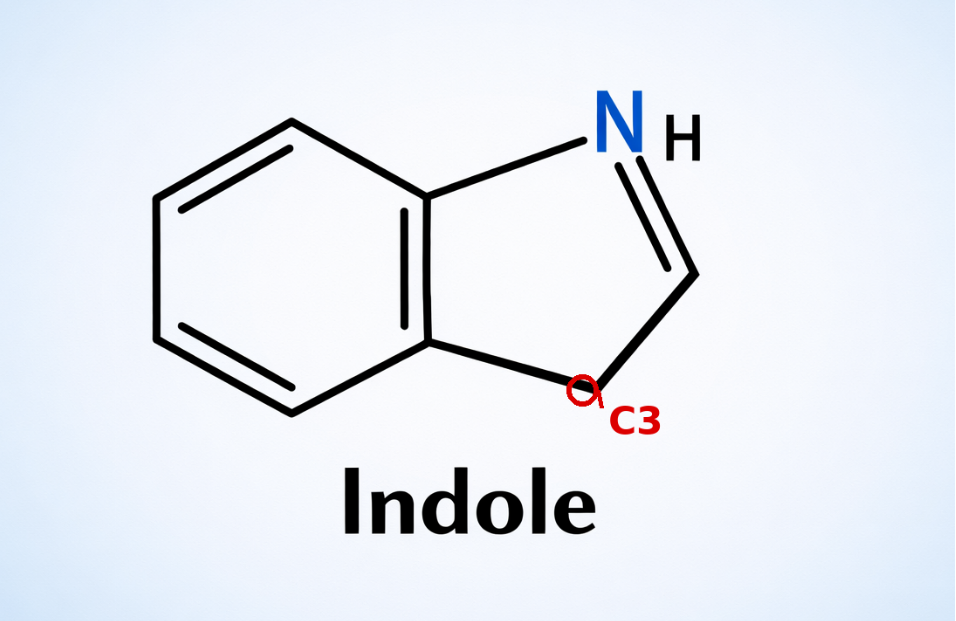
Indole is an aromatic heterocycle formed by fusion of a benzene ring and a five-membered nitrogen-containing ring. The indole nitrogen is pyrrolic; its lone pair participates in aromaticity. Therefore, indole is an extremely weak base (literature summaries give pKaH ≈ −3.6), and it typically remains neutral under common neutral or moderately acidic conditions.
Because this fused system is relatively electron-rich, indole more readily undergoes electrophilic aromatic substitution (EAS); under many classical conditions, substitution often occurs preferentially at the 3-position (C3)—one of the most widely used regioselectivity rules in indole chemistry.
It should be emphasized that “C3 preference” mainly refers to classical reaction modes of electron-rich indoles such as EAS. When moving into directed metalation or transition-metal-catalyzed direct C–H functionalization, site selectivity may change; a common strategy is to achieve C2-directed functionalization after N-protection.
2.2 What do “indole products” refer to?
“Indole products” usually refer to compounds that contain an indole moiety and their direct derivatives. Their shared feature is “containing an indole structural unit,” but they typically diverge into several common product forms by use case:
1. Parent core and substituted derivatives: For structure–property/structure–activity studies or as synthetic starting points;
2. Protected/activated derivatives: To improve selectivity, reduce side reactions, or match specific reaction conditions;
3. Intermediates bearing reactive handles: e.g., halogens, carboxylic acids/aldehydes, etc., enabling downstream coupling, functional-group interconversion, and annulation;
4. Bioactivity-related reference/tool molecules: For mechanistic studies, method development, activity benchmarks, and structure confirmation.
2.3 Why are indoles especially common?
Indoles repeatedly appear in natural products, drug molecules, and many “synthesis-ready intermediates,” typically for four direct reasons:
1. Inherently abundant in nature: Indoles are widespread across natural products and bioactive molecular lineages (including many biomolecules related to tryptophan metabolism), providing abundant core templates for drug and functional-molecule design.
2. Interaction features that are both general and tunable: Indoles combine an aromatic π system with an N–H motif, enabling diverse noncovalent interactions across different target environments; in medicinal chemistry they are often regarded as a privileged scaffold that can cover many receptor/enzyme targets.
3. Many modifiable sites and large SAR space: The fused system provides multiple substitution positions to tune electronic effects, hydrophobicity, and metabolic stability; it also allows functional groups to be installed as standardized “coupling/extension” handles, supporting systematic optimization.
4. Mature synthesis and functionalization methods: Robust methodologies exist for indole construction and site-selective functionalization, lowering the cost of translating “natural templates” into “iterable, scalable chemical scaffolds,” which further increases their frequency in product catalogs.
III.Structure determines use: the three key structural points for indole products (N position, C3 position, benzene-ring substitution)
Key structural point | What changes in “properties/reactivity” (what differences you will encounter) | Common “product forms” | Common research tasks |
N position: N–H vs N-substituted/protected | In strong-base/metalation reagents or base-requiring coupling systems, N–H may be deprotonated and trigger competing reactions (e.g., N-alkylation, N-acylation, or competition with metals/electrophiles). N-substitution/protection is often used to reduce N-site interference, improve site selectivity, and simultaneously affect solubility and stability. | N–H indoles; N-alkyl indoles; N-protected indoles (e.g., Boc/Cbz/Ts, etc.) | Preserve/remove HBD to tune ADME; avoid side reactions to improve selectivity; “route management” before downstream C2/C3 functionalization |
C3 position: the most common reactive hot spot/connection handle | Indoles are typically most reactive at C3 in EAS, so C3 functionalization is often the key node for “attaching a side chain.” The functional-group type at C3 directly determines downstream transformations (chain extension, heteroatom introduction, annulation, etc.). | 3-aldehydes, 3-acids/esters, 3-nitriles (and some 3-halides/3-acyl groups, etc.) | Rapid construction of “indole–side chain” frameworks; fragment linking, annulation/cyclization precursors; SAR side-chain swapping for length and polarity |
Benzene ring substitution at 4/5/6/7: fine-tuning and site steering | Mainly used to fine-tune hydrophobicity, electronic effects, sterics, and metabolic stability; it can also affect regioselectivity and the reaction window of subsequent functionalization. | Series products with multi-site substitution (e.g., common substituents such as 5-halo/6-halo, methoxy, fluoro, nitro, trifluoromethyl, etc.) | Library building/SAR: fine-tune activity and selectivity by “switching position/switching substituent”; use halogens, etc. as “handles” for downstream coupling |
IV.Overview of Indole Product Classification (Scaffold State → Downstream Synthetic Interface → Use Scenario)
Classification dimension | Subcategory | Typical product form | Primary use | Key identification points |
Scaffold state | Indole | Indole core; simply substituted indoles; N–H indoles | General core starting point; C3 functionalization and scaffold derivatization | Electron-rich aromatic heterocycle; strong C3 nucleophilicity and often a hotspot for electrophilic substitution; N is essentially non-basic (pyrrolic nitrogen) |
Scaffold state | Indoline (2,3-dihydroindole) | “More sp³” indole series; often N-substituted / salt-forming forms | Tune solubility and properties via conformation and basicity/salt formation; a module for further oxidation/functionalization | A secondary amine core; clearly different from indole in acidity/basicity, reactivity, and conformation; more like a “salt-forming sp³ module” |
Scaffold state | Oxindole / Indolinone | Carbonyl-containing indole variants (commonly lactam-type) | Introduce a polar center and H-bonding patterns; often used for specific pharmacophore combinations and 3-position construction | Switches from “electron-rich aromatic” to a carbonyl-containing lactam; reactivity focus often shifts to the carbonyl and adjacent positions (e.g., C3 chemistry) |
Downstream synthetic interface | Cross-coupling entry (library-first) | 2-/3-haloindoles (Br/I/Cl); indole boronic acids/boronates (e.g., Bpin) | Rapidly expand substitution diversity: Suzuki, etc. (halo ↔ boronic acid/ester pairing); haloindoles also serve as electrophiles for Negishi, etc. | For “rapid library build / SAR scan,” prioritize these; note that 2- vs 3-position handles affect downstream site planning; for boronic acids/boronates, watch stability/side reactions (e.g., in situ hydrolysis, protodeboronation) |
Downstream synthetic interface | C3 side-chain connection entry (side-chain-first) | Indole-3-carboxaldehyde; indole-3-carboxylic acids/esters; indole-3-nitriles | Attach a side chain: aldehyde → condensation/reductive amination; acid/ester → amidation or hydrolysis/interconversion; nitrile → reduction to amine / hydrolysis to amide/acid (condition-dependent) | “Which entry you choose” largely determines the main reaction(s) of the next 1–2 steps: aldehyde = amination/condensation; acid/ester = amidation; nitrile = reduction or hydrolysis route |
Downstream synthetic interface | N-position state & protection (route controllability-first) | N–H indoles; N-protected indoles (Boc/Cbz/Ts, etc.); N-alkylated indoles | Control N-related side reactions/selectivity; tune solubility, stability, and interaction patterns via N-substitution/protection | Without handling N–H, common issues include “N deprotonates first / is consumed by electrophiles first.” When choosing protecting groups, incorporate deprotection needs and mildness early in route design (e.g., Ts is often “harder to remove,” while Boc/Cbz are more common in milder routes) |
Use scenario | Library build / SAR iteration | Halo/boronic acid (ester) series; position scans (a full 4/5/6/7-substitution set) | Rapidly generate a set of comparable structures for SAR / property–activity relationships (including solubility, metabolic stability, etc.) | Keywords: “same scaffold, multiple positions, multiple substituents.” Prefer broadly transformable reaction entries (most commonly coupling entries; can also include interconvertible functional groups) |
Use scenario | Side-chain connection / annulation & scaffold extension | C3-aldehydes/acids/esters/nitriles; when needed, dual-handle building blocks (e.g., halo + aldehyde/acid together) | Introduce side chains in the fewest steps and preserve a connection point for subsequent annulation/cyclization | Keywords: “clear connection handle, clear next-step pathway” (amination/condensation/reduction/hydrolysis/amidation, etc.); dual-handle entry = obtain two serializable handles at once |
Use scenario | Biology-related references / tool molecules | Functionalized molecules such as tryptamine / hydroxyindoles / methoxyindoles (and derivatives) | Mechanism validation, control experiments, analytical method evaluation (quantitation/recovery/matrix effects, etc.) | Keywords: “traceable structure + use matching.” Prioritize purity grade and reference/isotope attributes; do not treat “reactivity” as the first selection criterion |
V.Three Application Mainlines: Why Indoles Appear So Often in R&D and the Corresponding Product Forms
Application mainline | Indole’s core value | Typical research/development actions | Common catalog product forms |
Drug discovery: turning a “high-frequency scaffold” into an iterable SAR platform | Indole is a classic privileged heterocycle in medicinal chemistry: it supports π–π / hydrophobic interactions, while multi-site substitution enables systematic tuning of properties and activity; N–H can serve as an H-bond donor (or be shut off/rewired via N-substitution). | Position scans (4/5/6/7…); side-chain expansion (often around C3); property optimization (solubility / metabolic stability / selectivity) | Halo/boronic acid(ester) indoles (coupling & library build); C3-aldehydes/acids/esters/nitriles (side-chain attachment); N-protected / N-substituted indoles (route management) |
Life chemistry: a high-frequency “bio-relevant structural unit” and carrier for controls/standards | Indoles are widespread in key endogenous molecules; for example, HMDB classifies serotonin (5-HT) as an indoleamine and gives the definition “indole ring + amino (alkylamino) side chain.” | Mechanistic control studies (receptors/pathways); analytical calibration (quantitation/recovery/matrix-effect evaluation); metabolite/signaling-molecule research | Bio-relevant “functionalized endogenous-like molecules” such as indoleamines / hydroxyindoles / methoxyindoles |
Synthesis & methodology: from C3 electrophilic substitution to C2/C3 functionalization platforms | Indoles often feature C3 as a hotspot in electrophilic substitution, making them naturally suited as a “rapid side-chain attachment platform.” Meanwhile, extensive work has developed transition-metal-catalyzed direct C2/C3 arylation methods to reduce prefunctionalization steps. | C3 functionalization (precursors for condensation/reductive amination/amidation); direct C2/C3 arylation and downstream derivatization | C3-handle types (3-aldehydes/3-acids/3-nitriles, etc.); halo/boronic acid(ester) types (coupling / site expansion); series related to “direct arylation precursors” |
VI.Product Navigation Table: Locate Indole Products by Research Task / Experimental Need (Tables A–E)
Research task / experimental need | Recommended table to check first | Why this table first | Typical chemicals / use examples |
Plant tissue culture: rooting/callus/elongation; auxin-effect controls | Table A: Plant auxins / plant-related indoles | The core of these experiments is auxin activity and dose window; you directly need IAA/IBA and related precursors/derivatives | IAA, IBA; plus IAM, IAN, indole-3-methanol (I3C) for pathway/conversion studies |
Plant–microbe interactions: validate IAA biosynthesis branches, precursor conversion (amide/nitrile → acid) | Table A: Plant auxins / plant-related indoles | You need IAA-pathway intermediates/precursors to verify conversion routes and serve as analytical controls | Indole-3-acetamide (IAM), indole-3-acetonitrile (IAN), IAA; often paired with LC–MS/standard curves |
Tryptophan metabolism / gut microbiome metabolism: metabolite standards, quantitation, metabolomics controls | Table B: Tryptophan platform & indole metabolites | These workflows prioritize metabolite standards and quantitation; Table B concentrates common indoleamines and indole metabolites | L-tryptophan, tryptamine, serotonin (5-HT), 5-HTP, melatonin, IPA, ILA, indole-3-pyruvic acid, tryptophol, skatole (3-methylindole) |
Neurotransmitters / receptor pharmacology: in vitro/cell controls for 5-HT and melatonin systems | Table B: Tryptophan platform & indole metabolites | The key is receptor/transporter ligands and hormone controls; Table B provides the most commonly used bioactive molecules | Serotonin (5-HT), melatonin, tryptamine, 5-HTP (precursor) |
Flavor/off-odor + environmental/biological sample testing: GC/GC–MS quantitation of markers such as skatole | Table B: Tryptophan platform & indole metabolites | The target is measurable, calibratable marker compounds; Table B includes common indole volatiles/odor-related representatives | Skatole (3-methylindole), tryptophol, etc. (with standard curves/method validation) |
Medicinal chemistry: indole-scaffold lead optimization (not coupling-first); need parent cores/substituted “privileged scaffolds” | Table C: Parent cores / substitution / redox derivatives & natural products | When you need the core itself + functional-group comparators, Table C consolidates parent cores, substituted analogs, redox-switched cores, and common scaffolds | Indole, indoline, 1-methylindole, 2-methylindole, 5-hydroxy/5-methoxyindole, 4-aminoindole, oxindole (2-indolinone), isatin, indole-2/3-carboxylic acids, indole-3-carboxaldehyde, 7-azaindole, etc. |
Need a “privileged scaffold” for library build: oxindole/isatin platforms (common in kinase projects, etc.) | Table C: Parent cores / substitution / redox derivatives & natural products | The starting point is a scaffold platform rather than site-coupling, and Table C directly covers high-frequency scaffolds like oxindole/isatin | Oxindole (2-indolinone), isatin, and comparator scaffolds |
Organic synthesis / parallel synthesis: build substituted indole libraries rapidly via cross-coupling (Suzuki/alkynylation/amination, etc.) | Table D: Functionalized & cross-coupling building blocks | The core is “coupling handles (halo/boronic acids) + protection strategy”; Table D is organized specifically by coupling entry points | 2/3-bromoindole, 2/3-iodoindole, 4/5/6/7-bromoindole, 5-fluoro/5-chloro/5-nitroindole; (1H-indol-2-yl)boronic acid, 5-indoleboronic acid; 1-Boc-indole |
Site-selectivity comparison: systematically compare 4/5/6/7 substitution effects under the same route | Table D: Functionalized & cross-coupling building blocks | You need a series with “same handle type, different positions”; Table D is the most complete/clean for halo-position series and enables horizontal comparisons | 4-bromo, 5-bromo/chloro/fluoro/nitro, 6-bromo, 7-bromo, etc. (for same-condition coupling / same-condition reaction comparisons) |
N-position strategy: need N-protection / N–H blocking to control route or for controls | Table D (protection) + Table C (N-substituted controls) | Protection is for synthetic route control; N-substitution is for property/activity controls—the two tables serve different roles | 1-Boc-indole (protection, Table D); 1-methylindole (N–H-blocked control, Table C) |
Natural products / alkaloid controls: activity or exposure studies for β-carbolines / plant indole alkaloids | Table C: Parent cores / substitution / redox derivatives & natural products | These needs are usually “representative molecules for controls/mechanisms,” and Table C collects natural-product representatives | Harmane (β-carboline), gramine (a plant indole alkaloid) |
Dyes/color & materials examples: indigo/conjugated-system discussions or controls | Table C: Parent cores / substitution / redox derivatives & natural products | The goal is not synthetic building blocks but representative chromophores/conjugated systems; Table C includes indigo and related representatives | Indigo (and discussions/controls related to redox and conjugation) |
Quality/impurity/methodology/pharmacology verification for existing drug APIs/references | Table E: Drug APIs / reference standards | If your experiment centers on marketed drugs/standards, Table E is the fastest way to find common references | Indomethacin, sumatriptan, pindolol, fluvastatin sodium (hydrate) |
Anti-inflammatory / COX inhibition cell or enzyme assays: need positive controls | Table E: Drug APIs / reference standards | You need classic positive controls, and Table E provides the most commonly used indole NSAIDs | Indomethacin (NSC-77541) |
Migraine / 5-HT1 pharmacology & methodology: need triptan references | Table E: Drug APIs / reference standards (and optionally link to Table B) | Table E provides drug references; if you also need the 5-HT system background/pathway controls, revisit Table B for endogenous ligands | Sumatriptan (Table E); serotonin/precursors/melatonin (Table B, if system controls are needed) |
Table A | Plant Auxins / Plant-Related Indoles (IAA/IBA and Precursors/Related Compounds)
Category | CAS No. | Aladdin Cat. No. | Name | Spec / Purity | Product features & applications |
Plant hormone / auxin | IAA (tissue culture / growth regulation) | 87-51-4 | Indole-3-acetic acid (IAA) | For plant cell culture, ≥98% | Classic auxin standard: used in plant tissue culture (callus induction / rooting / elongation), auxin signaling pathways and transport mechanism studies; also commonly used as an activity control for plant growth regulators and for analytical method development. | |
Plant hormone / rooting agent | IBA (rooting / cutting treatment) | 133-32-4 | Indole-3-butyric acid (IBA) | ≥98% | Common rooting agent (auxin analog): used for cutting propagation rooting, rooting induction in tissue culture, and growth regulation experiments; also often used as an IAA comparator (more stable / different effect spectrum) for comparing hormone effects and evaluating formulations. | |
Auxin-related precursor/metabolite | IAM (IAA biosynthesis branch) | 879-37-8 | Indole-3-acetamide (IAM) | ≥98% | A common intermediate in IAA (indole-3-acetic acid) biosynthesis/microbial pathways: used in plant–microbe interaction and IAA metabolic pathway validation; also used as an analytical reference standard in studies of “indole-3-acetamide → acid/nitrile” conversions. | |
Auxin-related precursor/metabolite | IAN (nitrile → acid/amine routes) | 771-51-7 | Indole-3-acetonitrile (IAN) | ≥96% | A metabolite related to IAA biosynthesis/plant defense: commonly used to study “nitrile → acid/amide” conversion pathways, plant metabolism, and microbial transformation mechanisms; also a functional handle in synthesis that can undergo hydrolysis/reduction. | |
Natural-product-related / functional building block | Indole-3-methanol (I3C) | 700-06-1 | Indole-3-methanol (I3C) | Moligand™, ≥96% | A representative indole alcohol building block associated with cruciferous plants: commonly used in mechanistic studies of “dietary indole compounds” (e.g., pathway/receptor regulation); also serves as a synthetic starting point for further C3 functionalization (condensation, oxidation, derivatization). |
Table B | Tryptophan Platform and Indole Metabolites (5-HT/Melatonin Branch + Microbiota-Derived Indole Metabolism; Biochemical Standards)
Category | CAS No. | Aladdin Cat. No. | Name | Spec / Purity | Product features & applications |
Amino acid / biochemical platform | Tryptophan (cell culture / metabolic precursor) | 73-22-3 | L-Tryptophan | Animal-free, USP, JP, Moligand™, European Pharmacopoeia (Ph. Eur.), for cell culture, ≥99% | An essential amino acid and a common biochemical/cell-culture supplement: used in protein/peptide research and cell-culture supplementation; also a key precursor for the “indoleamine axis” (tryptamine/serotonin/melatonin) and many indole metabolites, supporting studies of metabolic pathways and nutritional regulation. | |
Amino acid derivative / precursor | 5-HTP (pathway studies) | 56-69-9 | H136196 | DL-5-Hydroxytryptophan (DL-5-HTP) | ≥99% | A racemic precursor for serotonin biosynthesis: used in enzymology/metabolism studies and method controls for the tryptophan → 5-HT pathway; also commonly used to build “precursor → product” conversion models and for analytical quantitation. |
Biogenic amine / synthetic building block | Tryptamine (indoleethylamine platform) | 61-54-1 | Tryptamine | Moligand™, ≥98% | A core indoleethylamine building block: used to synthesize diverse indole alkaloids/drug leads and receptor ligands; also used in neurotransmitter-related studies and as a substrate for derivatization reactions (N-alkylation, acylation, etc.). | |
Neurotransmitter / receptor ligand | Serotonin (5-HT) | 50-67-9 | Serotonin (5-Hydroxytryptamine, 5-HT) | Moligand™, ≥98% (HPLC) | A representative neurotransmitter standard: used in pharmacology experiments related to 5-HT receptors/transporters, neurobiology and signaling-pathway studies; also used to develop and calibrate quantitative methods (LC–MS/MS) for biological samples. | |
Neuroendocrine / antioxidant | Melatonin (circadian studies) | 73-31-4 | Melatonin | Moligand™, ≥98% | A classic circadian hormone: used in sleep/circadian rhythm studies, antioxidant and immune-regulation research; also widely used as a reference in MT1/MT2 receptor pharmacology and as a standard for biological-sample testing. | |
Indole metabolite / microbiome-related | IPA (antioxidant / gut metabolism) | 830-96-6 | Indole-3-propionic acid (IPA) | Moligand™, ≥98% | A representative tryptophan metabolite: commonly used in microbiome–host metabolism studies and antioxidant/neuroprotection research; also used as a metabolomics standard for method development and quantitative calibration. | |
Indole metabolite / microbiome-related | Indole-3-lactic acid (ILA) | 1821-52-9 | Indole-3-lactic acid (ILA) | ≥98% (HPLC) | A representative tryptophan metabolite: frequently encountered in microbe/host metabolism studies, used for microbiome metabolic profiling and mechanism exploration related to immunity/barrier function; also used as a metabolomics standard and quantitative reference. | |
Indole metabolite / biochemical intermediate | Indole-3-pyruvic acid (I3PA) | 392-12-1 | Indole-3-pyruvic acid (I3PA) | ≥95% | A key intermediate in tryptophan metabolism: used in enzymology and pathway studies (transamination/redox-related), as a metabolomics standard and for quantitation; also serves as an “α-keto acid handle” for derivatization-reaction research. | |
Indole alcohol / tryptophan metabolite | Tryptophol | 526-55-6 | Tryptophol | ≥97% (GC) | An indole alcohol related to tryptophan metabolism: commonly used in microbial metabolism/signaling-molecule studies, as a metabolomics standard, and for GC quantitation; also a functionalization starting point as “indole-3-ethanol” for derivatization. | |
Substituted indole | 3-Methyl (Skatole; odor / metabolic marker) | 83-34-1 | 3-Methylindole (Skatole) | ≥98% | A common reagent in indole-metabolism and flavor/odor studies: used for GC/GC–MS quantitation, gut microbial tryptophan metabolism research, and off-odor marker studies; also serves as a substituted-indole synthetic intermediate and a structural comparator. |
Table C | Parent Cores / Substitution / Oxidation Derivatives and Natural Products (Non-halo cross-coupling series)
Category | CAS No. | Aladdin Cat. No. | Name | Spec / Purity | Product features & applications |
Indole core / basic building block | Parent core (general for synthesis & mechanism) | 120-72-9 | Indole | Chemical Pure (CP), ≥98% | A foundational indole feedstock: used in Fischer indole synthesis, electrophilic substitution (C3 commonly), N-protection/functionalization and other general reactions; a starting point for many drug, natural-product, and functional-material intermediates. | |
Indoline / reduced scaffold | Indoline | 496-15-1 | Indoline (2,3-dihydroindole) | ≥99% | A general building block for reduced indole scaffolds: used to build drug leads and functional molecules containing indoline fragments; also used to compare how “aromatic indole vs saturated indoline” affects basicity, solubility, and conformation. | |
N-substituted indole | 1-Methyl (N-blocked control) | 603-76-9 | 1-Methylindole | ≥97% | An N-methylated “N–H-blocked” control: used to compare the influence of N–H H-bonding/acid–base behavior on activity, solubility, and reaction pathways; also a common N-substituted indole building block in synthesis and materials molecules. | |
Substituted indole building block | 2-Methyl (odor / synthetic intermediate) | 95-20-5 | 2-Methylindole | ≥98% | A basic substituted-indole scaffold: used for further functionalization (side-chain installation, oxidation/halogenation, etc.) and indole-derivative library building; also used as a structural comparator in fragrance/flavor and odor-related studies (some methylindoles have characteristic odors). | |
Indole core / functionalization building block | 5-Hydroxy-substituted indole | 1953-54-4 | 5-Hydroxyindole | Moligand™, ≥98% | A commonly used substituted indole building block: used to synthesize 5-hydroxyindole derivatives (neurotransmitter analogs, drug leads, fluorescent/chromogenic molecules, etc.); also used as a comparator substrate in oxidation/coupling and related reactions. | |
Indole core / functionalization building block | 5-Methoxy-substituted indole | 1006-94-6 | 5-Methoxyindole | ≥99% | A commonly used substituted indole building block: used to synthesize melatonin/5-methoxy series derivatives and receptor ligands; also used as a comparator substrate when studying how electron-donating aromatic substituents affect reactivity and spectroscopic properties. | |
Amino-substituted indole | 4-Amino (further acylation/coupling) | 5192-23-4 | 4-Aminoindole | ≥97% | –NH₂ is a high-throughput derivatization handle: used for amidation, urea/sulfonamide construction, and coupling-based expansion; suitable for drug-lead diversification and SAR exploration. | |
Indolinone / scaffold building block | Oxindole (2-indolinone) | 59-48-3 | Oxindole (2-indolinone) | ≥98% (GC) | One of the “privileged scaffolds” (oxindole): very common in medicinal chemistry such as kinase inhibitors, used for lead synthesis and structural diversification; also suitable for SAR and methodological exploration (C3 and aromatic-ring functionalization). | |
Indolinone / oxidation derivative | Isatin | 91-56-5 | Isatin (NSC 9262) | AR | A representative indole oxidation derivative and indolinone-type scaffold: used in studies of indole oxidation/rearrangement mechanisms; also a common heterocyclic scaffold intermediate in medicinal chemistry for building diverse substitutions. | |
Indole acids | 2-Carboxylic acid (scaffold/coordination & salt-forming handle) | 1477-50-5 | Indole-2-carboxylic acid | ≥98% | Carboxylic acid as a classic “salt-forming/coupling handle”: used for amidation, esterification, and annulation; also used to compare how a 2-position functional group influences indole reactivity and conformation/H-bond networks. | |
Indole acids | 3-Carboxylic acid (C3 functionalization representative) | 771-50-6 | Indole-3-carboxylic acid | ≥98% | A representative C3-functionalized building block: commonly used for amide/ester derivatization and SAR expansion; also used to develop analytical methods and references for indole carboxylic acids. | |
Indole aldehydes | 3-Carboxaldehyde (condensation / reductive amination handle) | 487-89-8 | Indole-3-carboxaldehyde | ≥97% | A widely used “C3-aldehyde” building block: used for reductive amination, Knoevenagel/condensation reactions, and constructing indolylmethylamine/alkenyl derivatives; also used for methodology screening and standard-curve establishment. | |
N-containing homologous scaffold | 7-Azaindole (common medicinal scaffold) | 271-63-6 | 7-Azaindole | ≥98% | Azaindole as a common “indole replacement scaffold”: introducing a ring nitrogen changes basicity, H-bonding, solubility, and coordination features; widely used in medicinal chemistry (e.g., kinase inhibitor leads) for scaffold hopping and SAR replacement. | |
Dye / chromogenic system | Indigo (dye / redox-related) | 482-89-3 | Indigo | Chemical Pure (CP), ≥85% | A representative indole dye: used in dyeing/coloration research and chromogenic material systems; also used as a “redox/conjugation system” example in discussions of electrochemistry, spectroscopy, and vat-dye reduction mechanisms. | |
Natural product / alkaloid | β-Carboline (neuroactivity studies) | 442-51-3 | Harmane | Moligand™, ≥98% | A representative β-carboline indole alkaloid: used in MAO-related neuropharmacology, exposure and neuroeffect studies of β-carbolines in food/tobacco; also used as a mechanistic comparator in natural products chemistry and metabolism/toxicology research. | |
Natural product / plant defense | Indole alkaloid (Gramine class) | 87-52-5 | Gramine | Moligand™, ≥98% | A representative plant-derived indole alkaloid: commonly used in plant chemical ecology/defense metabolism studies; also serves as an indoleamine-like platform for activity screening and structure modification (SAR) exploration. | |
Not an indole core | Substituted acetophenone (upstream intermediate for indole synthesis) | 455-91-4 | 3′-Fluoro-4′-methoxyacetophenone | ≥98% | A substituted acetophenone intermediate: commonly used to build substituted heterocycles/aromatic side chains; can serve as an upstream carbonyl substrate for ring-closing reactions such as Fischer indole synthesis, or to introduce an aromatic fragment bearing “F + OMe” to tune hydrophobicity and metabolic stability. |
Table D | Functionalized and Cross-Coupling Building Blocks (Halides / Boronic acids / Protection)
Category | CAS No. | Aladdin Cat. No. | Name | Spec / Purity | Product features & applications |
Haloindole building block | 2-halo (coupling / functionalization entry) | 139409-34-0 | 2-Bromo-1H-indole | ≥98% | A typical “coupling-ready” indole building block: 2-bromo enables Suzuki, Sonogashira, Buchwald–Hartwig and other cross-couplings to rapidly build substituted indole libraries; suitable for parallel synthesis in drug discovery and feasibility assessment for scale-up routes. | |
Haloindole building block | 3-bromo (general coupling entry) | 1484-27-1 | 3-Bromo-1H-indole | _ | One of the most common functionalization entries for indoles: used in Suzuki/amination/alkynylation and other cross-couplings to rapidly build C3-substituted indole derivatives; suitable for parallel synthesis and process condition screening. | |
Haloindole building block | 3-iodo (high-activity coupling entry) | 26340-47-6 | I725702 | 3-Iodo-1H-indole | ≥98% | 3-iodo facilitates Suzuki/Sonogashira/Buchwald and other cross-couplings and rapid diversification; suitable for parallel synthesis of indole libraries, route screening, and mapping reaction windows prior to scale-up. |
Haloindole building block | 2-iodo (high-activity coupling / site construction) | 26340-49-8 | 2-Iodoindole | ≥95% | Highly reactive at the 2-position: used in cross-couplings to rapidly build 2-substituted indoles; a key intermediate for “site-precise modification” in drug leads and materials molecules. | |
Haloindole building block | 4-bromo (site-specific functionalization) | 52488-36-5 | 4-Bromoindole | ≥98% | An important starting point for constructing “non-C3-substituted” indoles: used in coupling to introduce aryl/alkenyl/alkynyl groups or via amination, enabling lead modification and SAR expansion. | |
Haloindole building block | 5-fluoro (electronic / metabolic-stability knob) | 399-52-0 | 5-Fluoroindole | ≥98% | 5-F is a common medicinal-chemistry “fine-tuning knob”: used to evaluate changes in electronic effects, hydrophobicity, and metabolic stability; also serves as a comparator substrate for subsequent selective functionalization. | |
Haloindole building block | 5-chloro (common coupling / comparator substrate) | 17422-32-1 | 5-Chloroindole | ≥98% | A classic haloindole building block: used in cross-coupling or as a comparator in electrophilic substitution routes; often used as a “Cl-substituted” SAR control to compare halogen effects and stability. | |
Haloindole building block | 5-bromo (general coupling entry) | 10075-50-0 | 5-Bromoindole | ≥98% | Balances reactivity and availability: commonly used in Suzuki/amination/alkynylation and related couplings to rapidly build 5-substituted indole series; suitable for drug/material library construction. | |
Strong EWG-substituted indole | 5-nitro (reducible to amine / dye & spectroscopic knob) | 6146-52-7 | 5-Nitroindole | ≥98% | NO₂ is a “strong electronic effect / transformable handle”: used to study substituent effects on reactivity and spectroscopic properties; often reduced to 5-aminoindole, then diversified via acylation/sulfonylation/coupling to expand derivative space. | |
Haloindole building block | 6-bromo (regioselective construction) | 52415-29-9 | 6-Bromoindole | ≥98% | Enables construction of indole series substituted at “less common positions”: convenient for coupling to introduce diverse substituents, supporting positional-effect comparisons in drug leads/material molecules and structure scanning. | |
Haloindole building block | 7-bromo (site-modification entry) | 51417-51-7 | 7-Bromoindole | ≥98% | Used to build 7-substituted indoles via coupling/amination/alkynylation, enabling positional-effect studies and structural diversification; commonly used in medicinal chemistry and functional-material monomer modification. | |
Boronic-acid building block | Indol-2-boronic acid (Suzuki coupling) | 220396-46-3 | (1H-Indol-2-yl)boronic acid | ≥95% | A core boron source for Suzuki coupling: used to introduce aryl/heteroaryl fragments at the 2-position and rapidly build 2-substituted indole libraries; commonly used in medicinal parallel synthesis and route scale-up feasibility assessments. | |
Boronic-acid building block | 5-Indoleboronic acid (Suzuki coupling) | 144104-59-6 | 5-Indoleboronic acid | ≥95% | Used in Suzuki coupling to build 5-substituted series: enables rapid installation of aryl/heteroaryl fragments for SAR; also useful for methodological comparisons (stability and coupling-condition windows of boronic acids at different positions). | |
Protected indole core | N-Boc (selective reactions / site control) | 75400-67-8 | 1-Boc-indole | ≥95% | Boc protection reduces N-site interference and improves regioselectivity: advantageous for C3 electrophilic substitution, metalation, coupling, and related reactions; a general strategy for multi-step routes—“protect first, then functionalize.” |
Table E | Drug APIs / Reference Standards (Representative Indole-Scaffold Drugs)
Category | CAS No. | Aladdin Cat. No. | Name | Spec / Purity | Product features & applications |
Drug API / reference | β-blocker (indole scaffold) | 13523-86-9 | Pindolol | Moligand™, ≥99% | A β-blocker API/reference containing an indole scaffold: used in receptor pharmacology, activity/impurity and quality studies; also used as a comparator in analytical method development and metabolism studies for indole-containing drugs. | |
Drug API / reference | NSAID (COX-inhibition control) | 53-86-1 | Indomethacin (NSC-77541) | Moligand™, ≥99% | A classic NSAID (COX inhibitor) reference: used in anti-inflammatory/analgesic mechanism studies, as a positive control in cell/enzyme inhibition assays, and in drug analysis plus impurity/degradation studies; also widely used for method validation (HPLC/LC–MS). | |
Drug API / reference | Triptan class (5-HT1 agonist) | 103628-46-2 | Sumatriptan | Moligand™, ≥98% | A classic anti-migraine (triptan) reference: used in 5-HT1 receptor pharmacology and mechanism studies, as well as API quality/impurity testing and method development; also used as an analytical reference for formulation and dissolution behavior studies. | |
Drug API / reference | Statin class (HMG-CoA reductase inhibitor) | 93957-55-2 | Fluvastatin sodium hydrate | ≥98% | A statin lipid-lowering drug reference: used in mechanism studies related to HMG-CoA reductase inhibition; also used for API quality/impurity and assay method development (HPLC/LC–MS) and for formulation dissolution studies. |
Note: The above are representative Aladdin products. For additional specifications, please refer to the product list at the end of the article, or search the Aladdin website using “name / CAS / catalog number.”
For more related articles, please see below:
D-DTTA Salts of Azaindole Chiral Amines: New Options for Chemical Splitting
The process path of EBL-3183: from indole to preclinical inhibitor
Efficient synthesis of Fluorinated Azaindoles
Base hydrolysis and activation experiments by diindolyl carbonyls