
Monoclonal antibody technology
Monoclonal antibody technology
A monoclonal antibody (McAb), or monoclonal antibody for short, is an antibody that is made by only one type of cell, as opposed to a polyclonal antibody/multistrain antibody, which is an antibody made by more than one type of cell. Monoclonal antibodies are produced by fusing immune cells that can make such antibodies with tumor cells, and such fusion cells have both the ability of the tumor cells to keep dividing and the ability of the immune cells to produce antibodies. The fused hybridized tumor cells can produce large amounts of the same antibody. When used in medical treatments, the small changes, if any, shown in recognizing antigens help to minimize side effects.
Principle
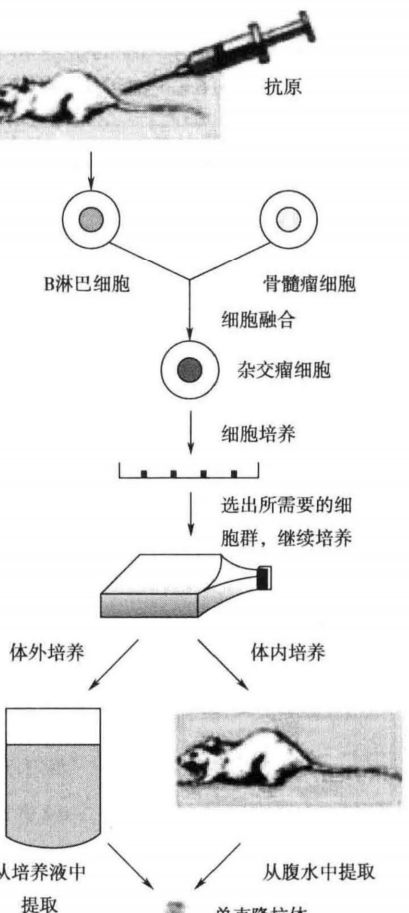
The basic principle of hybridoma monoclonal antibody preparation technology is to use polyethylene glycol as a cell fusion agent to fuse immunized mouse splenocytes with mouse myeloma cells that have the ability to continuously reproduce in vitro, and under the action of HAT selective medium, only the hybridoma cells that have successfully fused are allowed to grow, and after repeated immunological detection and screening and single cell culture (cloning), a hybridoma cell line that can produce the required monoclonal antibody and can also continuously reproduce can be obtained. After repeated immunological screening and individual cell culture (clonization), a hybridoma cell line that can produce the required monoclonal antibody and can be propagated continuously is finally obtained. This cell line is expanded in culture and inoculated into the peritoneal cavity of mice, and highly effective monoclonal antibody can be obtained in the ascites produced by the cell line.
Operation method
Monoclonal antibody technology
Principle
The basic principle of hybridoma monoclonal antibody preparation technology is to use polyethylene glycol as a cell fusion agent to fuse immunized mouse splenocytes with mouse myeloma cells that have the ability to continuously reproduce in vitro, and under the action of HAT selective medium, only the hybridoma cells that have successfully fused are allowed to grow, and after repeated immunological detection and screening and single cell culture (cloning), a hybridoma cell line that can produce the required monoclonal antibody and can also continuously reproduce can be obtained. After repeated immunological screening and individual cell culture (clonization), a hybridoma cell line that can produce the required monoclonal antibody and can be propagated continuously is finally obtained. This cell line is expanded in culture and inoculated into the peritoneal cavity of mice, and highly effective monoclonal antibody can be obtained in the ascites produced by the cell line.
Materials and Instruments
Equipment: Move The basic process of monoclonal antibody test can be divided into the following steps:
① centrifuge
② Incubator
③ Syringe
④ bacterial filter
Reagents:
①Material: mouse myeloma cells
②Polyethylene glycol
③Culture medium
④Antibiotics
(i) Monoclonal antibody preparation process
The main steps of lymphocyte hybridoma technology include: animal immunization, cell fusion, screening of hybridoma cells and monoclonal antibody detection, cloning of hybridoma cells, freezing and storage, and monoclonal antibody identification, etc. Figure 4-13 summarizes the main process of monoclonal antibody development by lymphocyte hybridoma technology.
(ii) Identification of McAb
In addition to antibody detection with immunogen (antigen), cross-testing should be performed with other antigens related to its antigenic components by ELISA and IFA methods. For example: ① Preparation of McAb against melanoma cells, in addition to reaction with melanoma cells, should also be used to cross-react with tumor cells and normal cells of other organs, in order to select monoclonal antibodies to tumor-specific or tumor-related antigens; ② Preparation of monoclonal antibodies against recombinant cytokines, should first consider whether there is a cross-reaction with the expression of the strain of protein, and then with other cytokines between cross-reactivity. The preparation of monoclonal antibodies against recombinant cytokines should first consider whether there is cross-reactivity with the protein of the expressed strain, and secondly whether there is cross-reactivity with other cytokines.
Identification of Ig class and subclass of McAb The Ig type of the antibody is usually determined when screening with enzyme-labeled or fluorescein-labeled secondary antibody. If enzyme-labeled or fluorescein-labeled rabbit anti-mouse IgG or IgM is used, the detected antibody is generally of the IgG or IgM type. Subclasses are determined by double-expansion or sandwich ELISA using a standard anti-subclass serum system. In the double-expansion test, the addition of an appropriate amount of PEG (3%) is more favorable to the formation of precipitation lines.
Identification of McAb Neutralizing Activity The biological activity of McAb is determined by animal or cell protection assays. For example, to determine the neutralizing activity of antiviral McAb, antibodies and viruses can be inoculated simultaneously in susceptible animals or sensitive cells to see if the animals or cells are protected by the antibodies.
Identification of antigenic epitopes recognized by McAb Determination of antigenic sites recognized by McAb by competition binding assay and summation index to determine whether the epitopes recognized by McAb are the same. 5.
5. Identification of McAb affinity The affinity of McAb to bind to the corresponding antigen is determined by ELISA or RIA.
For more product details, please visit Aladdin Scientific website.