
Pyridazine Research Selection Guide: Structural Features, Common Reaction Pathways, and a Reagent/Reference-Standard Navigation (Tables 1–4)
Pyridazine Research Selection Guide: Structural Features, Common Reaction Pathways, and a Reagent/Reference-Standard Navigation (Tables 1–4)
1.Why do you so often encounter “pyridazine” in research?
In medicinal chemistry, agrochemistry, and materials chemistry, nitrogen-containing aromatic heterocycles are frequently used to “fine-tune a molecule’s character”: while preserving the stability of an aromatic scaffold, introducing nitrogen atoms reshapes electron distribution, polarity, and hydrogen-bonding patterns—thereby influencing solubility, binding modes, and metabolic stability. Pyridazine is one representative of these tunable scaffolds.
From a historical perspective, because pyridazine frameworks are not commonly found in nature, early attention was relatively limited. However, since the 1970s, research interest in pyridazine has risen markedly, and derivatives have progressively accumulated validated activities and application cases in pharmaceutical and agrochemical directions. Review literature notes that pyridazine (1,2-diazine) has drawn sustained attention due to its biological activity and application potential, and it has been used in areas such as drug discovery and agrochemicals.
2.Definition, synonyms, and “family position” of pyridazine
Pyridazine is a six-membered aromatic heterocycle containing two adjacent nitrogen atoms on the ring (1,2-diazine, also called orthodiazine; sometimes described as 1,2-diazabenzene).
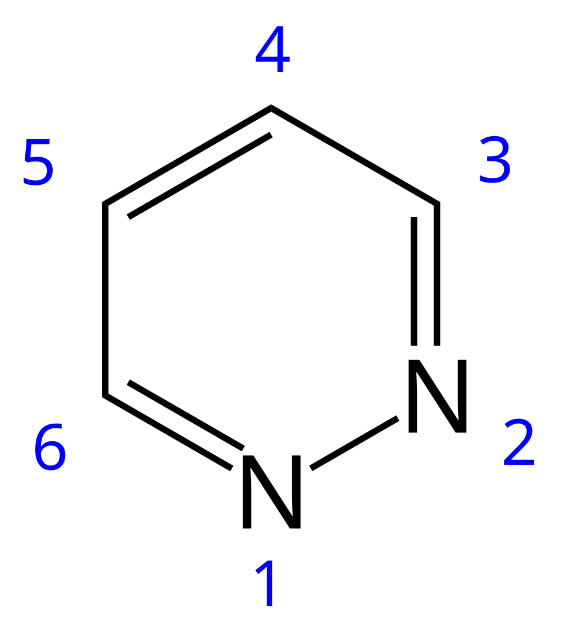

Pyridazine is a positional isomer of the other two “diazabenzenes”: pyrimidine (1,3-diazine) and pyrazine (1,4-diazine).
Name | N positions (numbering) | Common alias / note | One-line identification |
Pyridazine | 1,2-Diazine | Orthodiazine; 1,2-Diazabenzene | Two N atoms adjacent (1,2) |
Pyrimidine | 1,3-Diazine | “Meta” diazabenzene | Two N atoms separated by one carbon (1,3) |
Pyrazine | 1,4-Diazine | “Para” diazabenzene | Two N atoms opposite each other (1,4) |
3.How do the adjacent “two nitrogens” define pyridazine’s chemical character?
Pyridazine is “useful” largely because the two adjacent nitrogens jointly modulate the electronic structure:
1. Weaker basicity: Reviews and database data suggest that the conjugate-acid pKa (pKaH) of pyridazine is about 2.0–2.3 (with modest variation depending on solvent, ionic strength, temperature, and data source), which is clearly lower than pyridine’s ~5.2. As a result, pyridazine is overall less basic and less readily protonated.
2. Reactivity shift: suppressed EAS, favored SNAr/couplings: Compared with benzene/pyridine, the pyridazine ring is more electron-deficient, making it generally less reactive toward classical electrophilic aromatic substitution (EAS). In contrast, nucleophilic aromatic substitution (SNAr) (especially on halogenated pyridazines) and metal-catalyzed cross-coupling routes are more commonly employed, enabling efficient construction of substituted pyridazines.
3. Molecular-recognition advantages: Medicinal-chemistry reviews emphasize that pyridazine features weak basicity, a relatively high dipole moment, and reliable hydrogen-bond acceptor capacity. With an appropriate geometry, these features may enhance target binding or serve as a way to replace a phenyl ring to reduce hydrophobicity. Note that both nitrogens can act as H-bond acceptors, but acceptor strength depends on substituents, solvent, and protonation state. Because pyridazine itself is weakly basic, it often retains acceptor character across a broad pH range.
Pyridazine: “Structural elements → observable properties → R&D significance”
Structural element | Resulting property change | Impact at the experimental/design level | Why it matters |
Adjacent 1,2-dinitrogen (six-membered aromatic ring) | More electron-deficient aromatic ring; weaker basicity | More biased toward nucleophilic substitution pathways; often remains effectively neutral even under acidic conditions | Convenient for “electronic/polarity fine-tuning,” commonly used in lead optimization |
Larger dipole moment + dual H-bond acceptor potential | More pronounced intermolecular/intramolecular dipole and H-bond interactions | Can form clearer, more directional positioning interactions in binding pockets | Helps improve selectivity or address “unstable binding” issues |
Multiple substitution vectors (positions 3–6) | Substitution at different sites changes electronic and steric output | Facilitates SAR building: rapid scanning of diverse substituents on the same scaffold | Well-suited as a “scaffold platform” for SAR and structural diversification |
4.Why does pyridazine often appear as a “building block”?
In reagent and intermediate portfolios, pyridazine-related products are frequently used as programmable aromatic heterocycle building blocks, typically characterized by:
1. Halogenated pyridazines as efficient derivatization entry points
Reviews clearly indicate that pyridazine functionalization often relies on cross-coupling reactions (e.g., Suzuki, Buchwald–Hartwig, Stille, Negishi, Ullmann, etc.), while SNAr is also widely used for the synthesis of pyridazine derivatives. In polyhalogenated systems, the reactivity of halogens at different ring positions can often be differentiated.
Polyhalogenated pyridazines frequently enable selective stepwise substitution, but which position reacts first is usually strongly dependent on the position (e.g., 3/5/6), the halogen identity, and the specific reaction system (catalyst/ligand, base, solvent, temperature).
2. The parent pyridazine ring as a common starting material
Pyridazine can serve as a heteroaromatic building block and appears in a wide range of application-driven research routes. Its basic physical data (e.g., mp −8 °C, bp 208 °C) are also relatively well established. Therefore, the parent pyridazine is generally a liquid at room temperature, making it convenient as a baseline scaffold reference for solution preparation, dosing, and condition screening—especially during method development and reaction-window exploration.
3. Clear synthetic access, enabling scale-up and structural extension
Pyridazines are often prepared via routes such as condensation of 1,4-dicarbonyl compounds with hydrazines. This strategic accessibility also helps explain why pyridazine derivatives are abundant in methodology studies and intermediate libraries.
5.Classification and Selection of Pyridazine-Related Products
Product category | Key structural/property cues | Common derivatization modes | Typical use scenarios |
① Parent pyridazine and simple alkyl/aryl-substituted derivatives | Serve as a “scaffold starting point,” convenient for building a substitution landscape from scratch | Subsequent halogenation, oxidation, functional-group installation; can also be used directly for ligand/scaffold comparisons | Method development; scaffold benchmark experiments; starting points for intermediate libraries |
② Halogenated / polyhalogenated pyridazines (electrophilic building blocks) | More electron-deficient ring; halogens act as “replaceable handles” | SNAr (amines/alcohols/thiols, etc.); cross-couplings such as Suzuki, Buchwald–Hartwig, etc. | Rapid assembly of substituted pyridazines; parallel synthesis; SAR scanning |
③ Pyridazines bearing “further-transformable functional groups” (nitrile, carboxylic acid/ester, amide precursors, etc.) | Enable downstream grafting/coupling or introduction of polarity | Amidation, transesterification, reduction/oxidation, substitution reactions | Linker installation and property optimization; precursors for metabolic/analytical reference standards |
④ Pyridazine derivatives with nucleophilic sites (amino / hydroxy / thio, etc.) | Built-in bond-forming sites that facilitate further modification | Protect–deprotect strategies; coupling with acid chlorides/sulfonyl chlorides/isocyanates | Common “rapid assembly” modules in medicinal-chemistry optimization |
⑤ Pyridazinones / pyridazinediones (e.g., pyridazinone/pyridazinedione) | Can provide H-bond acceptor/donor features simultaneously (depending on substitution and tautomerism) | N-substitution, acylation; halogenation followed by coupling | Pharmacophore variants; also used in functional linker design (e.g., directions such as protein-conjugation studies) |
⑥ “Activated forms” such as N-oxides / quaternary ammonium salts | Alter electron distribution and reaction pathways; some systems are used for ionic liquids/corrosion inhibition, etc. | Selective functionalization, followed by reduction or further transformation | Mechanistic studies; specialized materials/surface-chemistry applications |
⑦ Fused pyridazine-related scaffolds (e.g., imidazo[1,2-b]pyridazine, phthalazinone, etc.) | More common in drugs; provide more complex binding geometries | Cross-coupling, ring construction, and late-stage modification | Direct alignment with drug leads or reference-drug research |
⑧ Agrochemical / environmental analytical reference standards (parent + metabolites) | Require unambiguous structures and residue definitions | Calibration curves and method validation (LC–MS/MS, etc.) | Pesticide-residue testing; environmental sample analysis (e.g., pyridate ↔ pyridafol) |
6.Typical Applications: “Where is pyridazine used?”
6.1 Medicine: from “scaffold replacement” to approved drugs
1. Pyridazine can serve as a replacement for phenyl rings or as a heteroaromatic bioisostere, helping to reduce hydrophobicity and introduce hydrogen-bond acceptors and dipole interactions—thereby improving molecular recognition and developability.
2. Publicly available drug-review/label information and related reviews indicate that FDA-approved drugs already directly contain a pyridazine ring. Frequently cited key examples include relugolix (approved December 2020) and deucravacitinib (approved September 2022). Some reviews treat relugolix and deucravacitinib as representative cases of “earlier/first introductions of the pyridazine ring” among FDA-approved drugs, using them to illustrate the developability of this scaffold in modern drug design.
3. Pyridazine-related fused rings are also common in drugs. For example, ponatinib and risdiplam contain an imidazo[1,2-b]pyridazine structural fragment.
6.2 Agrochemistry: herbicide scaffolds and metabolite/residue analysis
1. Pyridate is a post-emergence herbicide and is hydrolyzed in plants to the active component pyridafol (3-phenyl-4-hydroxy-6-chloropyridazine). In practical testing, it is often necessary to monitor both the parent compound and its metabolite.
2. In the “bleaching herbicide target” PDS (phytoene desaturase) area, the literature often cites norflurazon as one commercialized representative of the pyridazinone class, which in turn has driven R&D efforts on new pyridazine/pyridazinone-related herbicides.
3. Databases also classify credazine as a “pyridazine herbicide,” reflecting the real historical presence of this scaffold in agrochemicals.
6.3 Materials and coordination chemistry: ligands and functional molecules
Pyridazine derivatives can serve as ligands or functional motifs in research areas such as optical materials and catalytic ligands. The adjacent two nitrogens allow pyridazine to act as monodentate or bridging acceptor sites in coordination chemistry, supporting the construction of metal complexes and functional material systems.
7.A quick checklist: when you receive a pyridazine reagent, which three things should you check first?
1. Do you need a “replaceable handle,” or a “nucleophilic site for direct assembly”?
If you want rapid library construction, prioritize halogenated pyridazines (SNAr/coupling). If you want plug-and-play assembly, prioritize amino/hydroxy/carboxylic-acid derivatives, etc.
2. Are you doing “medicinal property optimization,” or “pesticide-residue/environmental analysis”?
Medicinal chemistry focuses more on tuning dipoles, hydrogen bonding, and hydrophobicity. Residue/environmental analysis focuses more on the parent–metabolite relationship and methodological reproducibility.
3. Is your required reaction type one of pyridazine’s “advantage lanes”?
Pyridazines typically favor nucleophilic substitution and cross-coupling routes. If your route depends on strong electrophilic aromatic substitution, you often need substituent activation or a different strategy.
8.Product Navigation Table|Locate Pyridazine-Related Reagents and Reference Standards by Research Task / Experimental Need (corresponding to Tables 1–4)
Research task / experimental need | Key structural / property cues needed | Recommended table(s) to check first | What you can find in the table (typical entries) |
Hydralazine-related work: assay, impurity profiling, release testing/reference control, metabolism and stability | Traceable API/reference standards; salt forms often used to improve solubility and weighing consistency | Table 1: Drug APIs / reference standards | Hydralazine, Hydralazine HCl; suitable for standard-curve setup (HPLC/LC–MS), impurity/degradation studies, and method development for PK samples; Hydralazine is a fused phthalazine scaffold derivative, representing “fused-ring systems within the pyridazine family” in drug/reference-standard scenarios. |
Scaffold screening / scaffold hopping with the “pyridazine ring” as the core; early SAR triage | Parent / fused scaffolds (pyridazine and fused systems) as “scaffold benchmarks” or lead cores | Table 2: Parent/fused scaffolds and ring-system platforms | Pyridazine, Phthalazine, Imidazo[1,2-b]pyridazine, Cinnoline, etc.; used to build scaffold benchmark sets and to tune H-bond acceptor layouts and planarity. |
Need an extensible synthetic platform: continuously swapping side chains to build a library | Handles for derivatization (–Cl/–Br/–NH2/–CN/–CHO/–CO2H/esters/Bpin, etc.), enabling stepwise assembly and parallel synthesis | Table 3: Synthetic building blocks (halogenated / coupling-ready / functionalized) | Chloro/bromo pyridazines (mono-/di-/tri-halogenated), amino/hydroxy pyridazines, nitriles/aldehydes/carboxylic acids/esters, Bpin boronate esters; for SNAr, Suzuki/Buchwald couplings, reductive amination, amide coupling. |
SNAr substitution (installing amines/alcohols/thiols) and you want smoother reactions | Prefer polyhalogenated, strongly activated pyridazines (polychloro/polybromo), or bifunctional substrates (“halogen + amino/nitrile”) for stepwise selectivity | Table 3 | 3,6-dichloro / 3,5-dichloro / 3,4,6-trichloro pyridazine; 3,6-dibromopyridazine; plus “stepwise” substrates such as 3,6-dichloro-4-amino and 6-chloro-3-carbonitrile, etc. |
Pd-catalyzed cross-coupling (Suzuki, Buchwald, etc.) to rapidly swap aryl/heteroaryl groups | Bromo/chloro substrates as coupling electrophiles, or boronate-ester donors (Bpin) to “graft” pyridazine onto a target scaffold | Table 3 | 3-/4-bromopyridazines (more reactive) and 3-/4-chloropyridazines; 4-Bpin-pyridazine (Suzuki donor); suitable for parallel synthesis and route scale-up. |
Building amide/urea/sulfonamide series from pyridazine-carboxylic acids/esters (common med-chem linkages) | Carboxylic acids (coupling platform) or esters (more stable, easier-to-store precursors) for rapid side-chain diversification | Table 3 | Pyridazine-3/4-carboxylic acid and methyl/ethyl esters; suitable for standard workflows such as EDC/HATU coupling and ester hydrolysis followed by recoupling. |
Introducing side chains using pyridazine aldehydes (amine side chains/solubilizing chains) | Aldehyde handle for reductive amination, Wittig/olefination, oxime/hydrazone derivatization (structure confirmation/labeling) | Table 3 | Pyridazine-3-/4-carbaldehyde; commonly used for rapid assembly of amine side chains and derivative-based confirmation. |
Using nitriles as “later-transformable handles” or as electron-withdrawing tuning groups (possibly to tetrazoles, etc.) | –CN (hydrolyzable to amides/acids, or convertible as a bioisostere) to tune polarity/metabolic stability | Table 3 | 3-/4-carbonitriles and 6-chloro-3-carbonitrile, etc.; suitable for tandem routes such as “install the ring first, then convert the nitrile into a functional group.” |
Pyridazinone / fused pyridazinone directions: tautomerism, N/O-selective alkylation, derivatization methodology | Pyridazinone platforms (and halogenated pyridazinones) to study selectivity and build series | Table 2 (platform scaffolds) + Table 3 (halogenated pyridazinones) | 3(2H)-Pyridazinone, Phthalazone (platforms); 4-chloro-dihydropyridazin-3-one (further substitution entry). |
Pesticide-residue / environmental testing: establish/validate LC/GC–MS methods, spike recovery, QC | Analytical standards and ready-to-use standard solutions (in different solvent matrices) for calibration and validation | Table 4: Pesticide/plant-growth-regulator standards and standard solutions | Chloridazon, Maleic hydrazide, Norflurazon (standards); plus 1000 µg/mL standard solutions in methanol/acetonitrile/acetone, etc. |
Tracking pesticide metabolites/impurities (environmental fate, degradation pathways, parent–metabolite differentiation) | Metabolite/transformation-product reference standards for LC–MS/MS identification/quantitation and peak assignment | Table 4 | Methyldesphenylchloridazon, etc.; used to distinguish parent vs metabolite, establish LOQ/recovery, and improve method reliability. |
Limited budget but need to “map the pyridazine system” first via condition scouting | Parent core / representative substrates as screening baselines (solvent, catalyst, base, temperature) | Table 2 + Table 3 | Table 2 provides “baseline scaffold benchmarks”; Table 3 provides the “most commonly reactive substrates” (halides, acids/esters, aldehydes, nitriles, etc.) to rapidly establish workable routes. |
Usage suggestions:
1. Drug quantitation / QC → check Table 1 first;
2. Scaffold selection / fused-ring exploration → check Table 2 first;
3. Library synthesis and functional-group operations → mainly check Table 3;
4. Pesticide residue testing and standard solutions/metabolite references → go straight to Table 4.
Table 1|Drug APIs / Reference Standards (including fused pyridazine scaffolds)
Category | CAS No. | Aladdin Cat. No. | Name | Specification / purity | Product features & applications |
Drug API / reference standard (fused pyridazine scaffold) | 86-54-4 | Hydralazine | Moligand™, ≥98% | (Scaffold note: Hydralazine is a phthalazine derivative and belongs to a fused pyridazine-related scaffold.) A classic antihypertensive vasodilator; commonly used as an API/reference standard for drug assay and impurity profiling (HPLC/LC–MS), and also as a benchmark in metabolism/stability and structure–activity relationship (SAR) studies representing a “fused pyridazine-family scaffold.” | |
Drug API / reference standard (salt form for easier preparation) | 304-20-1 | Hydralazine HCl | ≥99% | Hydralazine hydrochloride is commonly used in formulations and analytical method development; the salt form improves solubility and weighing consistency, making it suitable for calibration curves, system suitability, and quality-control (QC) validation. |
Table 2|Parent / Fused Scaffolds and “Ring-System Platforms” (for scaffold benchmarking, scaffold hopping, and platform derivatization)
Category | CAS No. | Aladdin Cat. No. | Name | Specification / purity | Product features & applications |
Parent pyridazine (baseline reference / starting scaffold) | 289-80-5 | Pyridazine | ≥98% | The most fundamental 1,2-diazine parent ring; suitable as an NMR/reactivity-selectivity benchmark substrate, and also used in teaching and methodology evaluation (rules of electrophilic vs nucleophilic substitution). | |
Fused diazine scaffold (phthalazine) | 253-52-1 | Phthalazine | ≥98% | A common fused diazine scaffold used to build more planar and rigid heterocyclic fragments; also a key intermediate source for multiple drug/functional-molecule scaffolds. | |
Fused heteroaromatic scaffold (med-chem common fused core) | 766-55-2 | Imidazo[1,2-b]pyridazine | ≥98% | A classic fused nitrogen heteroaromatic “core fragment,” often serving as the core of leads such as receptor/kinase inhibitors; used for scaffold hopping and optimization of hydrogen-bond acceptor arrays. | |
Fused diazine scaffold (cinnoline) | 253-66-7 | Cinnoline | ≥95% | A fused 1,2-diazanaphthalene-type scaffold; commonly used as a starting core for medicinal-chemistry scaffold exploration and for heterocycles in optoelectronic/dye-related research; suitable for substitution scanning and electronic-effect tuning experiments. | |
Fused pyridazinone scaffold (lactam platform) | 119-39-1 | Phthalazone | ≥98% | A fused pyridazinone (lactam) scaffold, commonly used in fused nitrogen-heterocycle exploration and ligand design; can be diversified via N-alkylation/acylation to build more rigid and planar candidate scaffolds. | |
Parent pyridazinone (tautomerism: N/O-selective alkylation) | 504-30-3 | 3(2H)-Pyridazinone | ≥98% | A classic pyridazinone platform: tautomerism often leads to N-alkylation vs O-alkylation selectivity issues, making it a frequent “test case” scaffold in methodology and lead optimization; also widely present in many pesticide/drug fragments. | |
N-oxide (directing/activation intermediate) | 1457-42-7 | Pyridazine N-oxide | ≥97% | N-oxides are often used to alter ring electron distribution to improve regioselectivity (e.g., directed substitution/activation), and can also serve as reversible intermediates reducible back to pyridazine; suitable for methodology and mechanistic studies. |
Table 3|Synthetic Building Blocks (Halogenated / Coupling-Ready / Functionalized: amino, hydroxy, nitrile, carboxylic acid/ester, aldehyde, boronate ester, etc.)
Category | CAS No. | Aladdin Cat. No. | Name | Specification / purity | Product features & applications |
Carboxylic-acid building block (coupling platform) | 50681-25-9 | Pyridazine-4-carboxylic acid | ≥98% (HPLC) | A typical heteroaryl carboxylic acid: used in amide coupling (EDC/HATU, etc.) to rapidly introduce a pyridazine fragment; commonly applied in lead optimization for drugs/agrochemicals to increase polarity and strengthen H-bond acceptor features. | |
Carboxylic-acid building block (coupling platform) | 2164-61-6 | Pyridazine-3-carboxylic acid | ≥97% | A widely used heteroaryl carboxylic acid: for building pyridazine-3-amide/urea/ester series; in medicinal chemistry it often helps enhance H-bond networks at binding sites and tune solubility. | |
Ester building block (carboxylic-acid precursor: convenient for amide formation) | 1126-10-9 | ethyl pyridazine-3-carboxylate | ≥97% | Esters are better suited for storage and multistep synthesis: can be hydrolyzed to the acid for coupling, or directly undergo hydrazinolysis/aminolysis to form amides; commonly used for fragment derivatization and scale-up synthesis. | |
Ester building block (carboxylic-acid precursor: rapid derivatization) | 39123-39-2 | Ethyl pyridazine-4-carboxylate | ≥97% | A “protected/precursor” form of the 4-carboxylic acid, convenient for parallel synthesis; can be hydrolyzed or converted to amides downstream to rapidly build 4-position side-chain diversity series. | |
Ester building block (carboxylic-acid precursor: convenient for small-scale parallel work) | 34231-77-1 | Methyl pyridazine-4-carboxylate | ≥97% | Methyl esters are commonly used for small-scale rapid derivatization and condition scouting; efficiently converted to amides/acylhydrazides, suitable for SAR scanning and introducing solubilizing groups. | |
Aldehyde building block (reductive amination / condensation) | 50901-42-3 | Pyridazine-4-carbaldehyde | ≥97% | A typical heteroaryl aldehyde: used for reductive amination (installing amine side chains), Wittig/olefination, or forming oximes/hydrazones (e.g., for structure confirmation or installing clickable/labeling motifs). | |
Aldehyde building block (reductive amination / condensation) | 60170-83-4 | Pyridazine-3-carbaldehyde | ≥95% | The 3-aldehyde is well-suited for rapid assembly of nitrogen-containing side chains via reductive amination, and for preparing oximes/hydrazones for structure confirmation and label-ready derivatives; commonly used in parallel synthesis. | |
Nitrile pyridazine (electron-withdrawing; handle for further transformation) | 53896-49-4 | Pyridazine-3-carbonitrile | ≥97% | The nitrile can be hydrolyzed to an amide/carboxylic acid or converted to “bioisosteres” such as tetrazoles; often used to improve metabolic stability and tune polarity; a common electron-withdrawing pyridazine building block. | |
Nitrile pyridazine (electron-withdrawing; handle for further transformation) | 68776-62-5 | pyridazine-4-carbonitrile | ≥97% | The 4-nitrile position can undergo hydrolysis/addition/cyclization; commonly used to introduce a “strong electron-withdrawing” effect and improve metabolic stability; also an important precursor for tetrazole and related bioisostere construction. | |
Aminopyridazine (nucleophilic building block: derivatization site) | 5469-70-5 | 3-Aminopyridazine | ≥98% (GC) | A typical “amino-bearing pyridazine” fragment: enables acylation/sulfonylation/urea formation to build common medicinal-chemistry linkages; also frequently used as a heteroaryl amine for subsequent coupling or ring-system extension. | |
Aminopyridazine (nucleophilic building block: bond-forming site) | 20744-39-2 | 4-Aminopyridazine | ≥97% | The 4-amino group readily forms key linkages such as amides/ureas/sulfonamides; commonly used for fragment assembly and SAR optimization where “pyridazine serves as the acceptor scaffold and the amino group as the connection point.” | |
Hydroxypyridazine (tautomerism; commonly used for O-derivatization) | 20733-10-2 | 4-Hydroxypyridazine | ≥97% | Hydroxy/keto tautomerism gives both H-bond donor/acceptor behavior and enables O-alkylation/acylation to form ethers/esters; often used to tune polarity and introduce solubilizing side chains. | |
Halogenated pyridazine (mono-halogen; common coupling substrate) | 17180-92-6 | 4-Chloropyridazine | ≥98% | The 4-chloro site can undergo SNAr or Pd-catalyzed coupling (Suzuki/Buchwald, etc.) to build 4-substituted pyridazines; commonly used as a starting halogenated intermediate for introducing pyridazine fragments in medicinal chemistry. | |
Halogenated pyridazine (mono-halogen; coupling/substitution substrate) | 1120-95-2 | 3-Chloropyridazine | ≥95% | The 3-chloro site supports SNAr or cross-coupling to build 3-substituted pyridazines; often used in fragment assembly and in comparative studies of “positional-isomer substitution effects.” | |
Halogenated pyridazine (bromo; coupling substrate) | 88491-61-6 | 3-Bromopyridazine | ≥97% | The 3-bromo site is well-suited for cross-coupling to introduce aryl/alkenyl groups; commonly used to rapidly probe how 3-substitution affects activity and physicochemical properties. | |
Halogenated pyridazine (bromo; more reactive for coupling) | 115514-66-4 | 4-Bromopyridazine | ≥95% | The 4-bromo site is more favorable for Pd-catalyzed coupling, enabling rapid installation of aryl/heteroaryl groups and optimization of the spatial directionality of pyridazine as an H-bond acceptor; suitable for library synthesis and route scale-up. | |
Halogenated pyridazine (strong electrophilic building block: SNAr/coupling) | 141-30-0 | 3,6-Dichloropyridazine | ≥98% (GC) | The 3,6-dichloro positions are strongly activated: allow stepwise SNAr to introduce amines/alcohols/thiols, and can also serve as Pd-coupling starting materials; used for rapid construction of 3,6-disubstituted pyridazine libraries. | |
Halogenated pyridazine (strong electrophilic building block: SNAr/coupling) | 1837-55-4 | 3,5-Dichloropyridazine | ≥98% | The 3,5-dichloro positions facilitate site-specific substituent installation: suitable as starting materials for SNAr or cross-coupling to build 3,5-disubstituted pyridazines and systematically scan substituent effects. | |
Highly halogenated pyridazine (multi-site stepwise substitution) | 6082-66-2 | 3,4,6-Trichloropyridazine | ≥97% (GC) | Highly activated polychloro sites make it ideal as a multi-substituted pyridazine platform for “stepwise SNAr/coupling”; used to quickly build substitution-combination matrices and screen reaction conditions. | |
Halogenated pyridazine (bromo; more reactive for coupling) | 17973-86-3 | 3,6-Dibromopyridazine | ≥97% | Bromo sites are more favorable for Pd-catalyzed couplings; suitable for Suzuki/Negishi/Stille to build 3,6-disubstituted pyridazines; enables more efficient parallel synthesis and library chemistry. | |
Bifunctional building block (halogen + amino: stepwise derivatization) | 823-58-5 | 3,6-Dichloropyridazin-4-amine | ≥98% | Combines an amino group (nucleophilic/bond-forming site) with two chloro electrophilic sites: supports stepwise routes such as “install one end first, then the other,” commonly used to rapidly assemble multi-substituted pyridazine lead series. | |
Bifunctional building block (halogen + amino: good regioselectivity) | 5469-69-2 | 6-Chloropyridazin-3-amine | ≥98% | The amino group enables rapid installation of amides/sulfonamides, while the chloro site remains available for SNAr/coupling for a second diversification step; suitable for “expandable” pyridazine fragments. | |
Bifunctional building block (halogen + nitrile: stepwise construction) | 35857-89-7 | 6-chloropyridazine-3-carbonitrile | ≥97% | Contains both a chloro site for coupling/substitution and a nitrile for further transformation; suitable for tandem routes such as “install one substituent first, then convert the nitrile to an amide/acid,” rapidly expanding chemical space. | |
Halogenated pyridazine (alkyl-substituted: pre-set for SAR) | 19064-64-3 | 3,6-Dichloro-4-methylpyridazine | ≥97% | A pre-installed 4-methyl group supports series exploring hydrophobicity/steric effects; the two chloro sites enable continued SNAr/coupling, allowing SAR strategies such as “fix one substituent, scan the remaining positions.” | |
Pyridazinone derivative (halogenated: substitutable at C-4) | 1677-79-8 | 4-chloro-2,3-dihydropyridazin-3-one | ≥97% | A pyridazinone platform bearing an activated 4-chloro site, enabling diverse substituent installation at C-4; commonly used to build 4-substituted pyridazinone series and evaluate how tautomerism/salt formation affects properties. | |
Boronate-ester coupling reagent (Suzuki donor) | 863422-41-7 | 4-(4,4,5,5-tetramethyl-1,3,2-dioxaborolan-2-yl)pyridazine | ≥97% | A Bpin-type boronate ester is a common “pyridazine donor” in Suzuki coupling, facilitating installation of the pyridazine-4-yl group onto aryl/heteroaryl scaffolds; suitable for parallel medicinal-chemistry synthesis and rapid scale-up. |
Table 4|Agrochemicals / Plant-Growth Regulation: Analytical Standards, Metabolite References, and Ready-to-Use Standard Solutions
Category | CAS No. | Aladdin Cat. No. | Name | Specification / purity | Product features & applications |
Pesticide/herbicide standard (pyridazinone class) | 1698-60-8 | Chloridazon | ≥95% | A typical pyridazinone herbicide; widely used for quantitative analysis and method validation of pesticide residues/environmental samples (LC/GC–MS), and as a reference for metabolite tracking and degradation studies. | |
Pyridazinone intermediate (herbicide scaffold precursor) | 6339-19-1 | 5-Amino-4-chloropyridazin-3(2H)-one | ≥95% | A core pyridazinone intermediate: the amino and chloro sites enable stepwise derivatization; commonly used to build pyridazinone-type agrochemical/drug analogs and study substitution–activity relationships. | |
Pesticide metabolite/impurity reference (method validation) | 17254-80-7 | Methyldesphenylchloridazon | ≥95% | A reference for chloridazon-related metabolites/transformation products: used to distinguish parent vs metabolite in residue analysis and to establish recovery and LOQ; suitable for LC–MS/MS quantitation and environmental fate studies. | |
Pesticide/plant growth regulator standard (pyridazinedione class) | 123-33-1 | Maleic hydrazide | Analytical standard | A commonly used plant growth regulator / sprout inhibitor with a pyridazinedione-type structure; used to establish residue-analysis methods, calibration curves, and QC (GC/LC). | |
Pesticide standard solution (quantitative calibration) | 123-33-1 | Maleic hydrazide Solution in Methanol | 1000 μg/mL in Methanol, uncertainty 2% | Ready-to-use standard solutions enable rapid preparation of calibration series; suitable for residue-method development, spike recovery, and evaluation of instrument response stability. | |
Pesticide/herbicide standard (pyridazine class) | 27314-13-2 | Norflurazon | Analytical standard | A typical herbicide reference: used for quantitative analysis and method validation of pesticide residues/environmental samples (LC/GC–MS); also used to study photostability/degradation pathways and metabolite tracking. | |
Pesticide standard solution (quantitative calibration) | 27314-13-2 | Norflurazon Solution in Methanol | 1000 μg/mL in Methanol, uncertainty 2% | A methanol-matrix standard solution is suitable for rapid LC–MS/MS calibration and routine QC; reduces weighing error and improves batch-to-batch consistency and traceability. | |
Pesticide standard solution (quantitative calibration) | 27314-13-2 | Norflurazon Solution in Acetonitrile | 1000 μg/mL in Acetonitrile, uncertainty 2% | The acetonitrile matrix better matches common mobile phases/sample-prep systems, supporting method transfer and matrix-effect evaluation; used for calibration curves and spike-recovery experiments. | |
Pesticide standard solution (quantitative calibration) | 27314-13-2 | Norflurazon Standard | 1000 ug/mL in Acetone | An acetone-matrix standard solution is compatible with multiple sample-prep workflows; used to rapidly establish external/internal standard quantitation schemes and confirm LOQ and linear range. |
Note: The above items are representative Aladdin products. For additional specifications, please refer to the product list at the end of the article, or search the Aladdin website using “product name / CAS / catalog number.”
For more related articles, please see below: