
Technical articles
Alkylsilanes: Structural Features, Surface Reactions, Applications, and Product Selection
Alkylsilanes: Structural Features, Surface Reactions, Applications, and Product Selection
1. Definition of Alkylsilanes and How They Differ from Silane Coupling Agents
The basic structural feature of an alkylsilane is that the silicon atom is bonded to one or more alkyl groups. If the molecule also contains hydrolyzable groups such as methoxy or ethoxy groups, it forms a commonly used class in practical applications, namely alkyl alkoxysilanes. For inorganic substrates such as glass, silica, mineral fillers, masonry, and concrete, the function of these molecules mainly comes from two parts: the silicon end can be anchored to the inorganic surface through hydrolysis and condensation, while the alkyl end primarily changes the surface energy, wettability, and water absorption behavior of the treated surface.
From the standpoint of molecular function, alkylsilanes that do not contain organic reactive functional groups are usually not classified as silane coupling agents in the typical sense. A typical silane coupling agent generally contains two types of reactive moieties in the same molecule: one that binds to inorganic materials and another that binds to organic materials. Even if an alkylsilane without such organic reactive functional groups can be fixed onto an inorganic surface, its organic end mainly provides hydrophobicity and surface energy adjustment, and it is generally not used primarily as a chemical bridge between the inorganic phase and the organic phase.
The table below compares the structural features, primary functions, and common application directions of these two classes of materials for easier distinction.
Type | Inorganic-End Features | Organic-End Features | Primary Function | Typical Application Focus |
Alkylsilanes without organic reactive functional groups | Contain hydrolyzable silyl groups and can form siloxane-type bonding layers on inorganic surfaces | Mainly alkyl groups, without typical organic reactive functional groups such as amino, epoxy, or methacryloxy groups | Lower surface energy, increase hydrophobicity, and adjust water absorption and wetting behavior | Hydrophobic treatment of building materials, hydrophobic surface modification of inorganic fillers and pigments, surface energy adjustment |
Typical functional silane coupling agents | Contain hydrolyzable silyl groups and can bind to inorganic surfaces | Contain amino, epoxy, vinyl, methacryloxy, or similar groups | Provide interfacial bonding or reactive sites between the inorganic phase and the organic phase | Interfacial reinforcement in composites, resin adhesion, coupling between inorganic fillers and polymer systems |
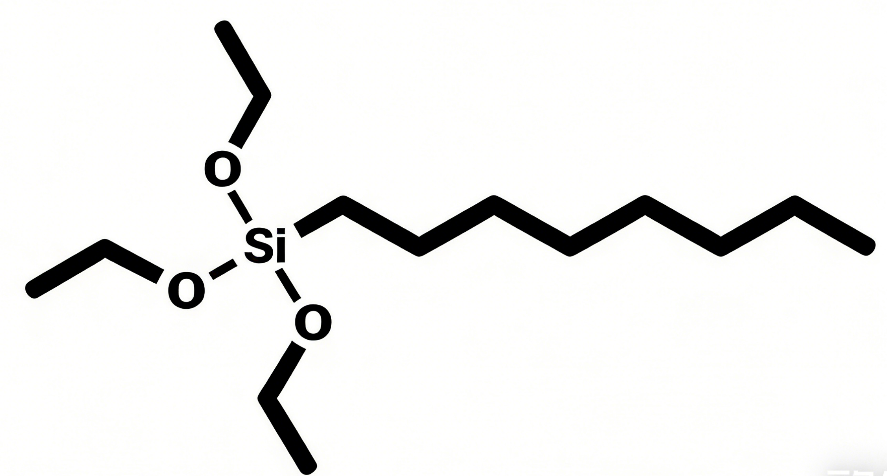
Taking octyltriethoxysilane, CAS 2943-75-1, as an example, the schematic molecular structure of this compound consists of two parts: an octyl end and a triethoxysilyl group. The octyl end reflects the organic-end characteristics of an alkylsilane, while the triethoxysilyl group can form silanols after hydrolysis and can further undergo condensation with inorganic surfaces.
2. Structural Composition of Alkylsilanes and Their Surface Reactions
Alkylsilanes can be understood in terms of two parts: the alkyl end and the hydrolyzable silicon end. The alkyl end mainly influences the degree of nonpolarity, surface energy, and wetting behavior of the treated surface, whereas the hydrolyzable silicon end determines whether the molecule can be fixed onto an inorganic surface through hydrolysis and condensation. In surface treatment, whether the hydrolyzable silicon end can form a stable surface-bonded layer affects the water resistance and durability of the treatment layer.
The action of alkylsilanes bearing hydrolyzable alkoxy groups on inorganic surfaces usually follows the main sequence of hydrolysis and condensation. The alkoxy groups in the molecule first hydrolyze to form silanols. The silanols then condense with hydroxyl groups on the substrate surface or with neighboring silanols, forming Si-O-substrate bonds or Si-O-Si structures. Materials such as glass, silica, mineral fillers, concrete, and masonry are commonly used as treatment targets, mainly because their surfaces usually contain hydroxyl groups or oxide surface sites that can participate in such reactions.
The type of hydrolyzable group affects the hydrolysis rate, the stability after incorporation into a formulation, and the structural features formed after condensation. Methoxy types usually hydrolyze more quickly. Ethoxy types usually hydrolyze more slowly, show higher stability after being added to a system, and release ethanol upon hydrolysis. Dialkoxy types generally show better stability after hydrolysis and tend to form more linear structures after condensation. Trialkoxy types are more reactive and more readily form networks with a higher degree of crosslinking. It should be noted that these differences can serve as a basis for selection, but their actual performance is still influenced by system composition, water addition method, pH, and catalytic conditions.
The table below summarizes how these structural factors correspond to property changes and selection guidance.
Structural Factor | Main Effect | Significance for Selection |
Alkyl end | Changes surface energy, wetting behavior, and hydrophobicity | Used to judge whether the emphasis is more on surface water repellency or on general surface energy adjustment |
Methoxy type | Faster hydrolysis | Suitable for systems requiring relatively rapid surface reaction, but places higher demands on water addition and application control |
Ethoxy type | Slower hydrolysis and higher stability after incorporation into the system | Suitable for systems that place greater importance on workable time and formulation stability |
Dialkoxy type | Better stability after hydrolysis and a more linear condensation structure | Suitable for situations where system stability and structural regularity are of concern |
Trialkoxy type | Higher reactivity and easier formation of structures with higher crosslink density | Suitable for situations that emphasize surface anchoring and treatment-layer stability |
3. Common Classifications of Alkylsilanes, Representative Products, and Their Main Characteristics
Classification Axis | Category | Representative Products (Examples) | Main Characteristics of This Category |
By hydrolyzable silicon end | Methoxy-type alkyl alkoxysilanes | Methyltrimethoxysilane, ethyltrimethoxysilane, propyltrimethoxysilane, octyltrimethoxysilane, hexadecyltrimethoxysilane, octadecyltrimethoxysilane | Usually hydrolyze relatively quickly and are suitable for systems requiring relatively rapid surface reaction, but they also place higher demands on the water addition method, formulation stability, and application control. |
By hydrolyzable silicon end | Ethoxy-type alkyl alkoxysilanes | Methyltriethoxysilane, ethyltriethoxysilane, n-propyltriethoxysilane, butyltriethoxysilane, octyltriethoxysilane, dodecyltriethoxysilane, hexadecyltriethoxysilane | Usually hydrolyze relatively slowly and show comparatively higher stability after incorporation into a system. They are very common in the hydrophobic treatment of building materials, mineral fillers, and pigments. |
By alkyl chain length | Low-carbon basic types | Methyltrimethoxysilane, methyltriethoxysilane, ethyltrimethoxysilane, ethyltriethoxysilane, propyltrimethoxysilane, n-propyltriethoxysilane, n-butyltrimethoxysilane, butyltriethoxysilane | More commonly used for basic surface treatment, organosilicon intermediate studies, and chain-length comparison. Their hydrophobicity is usually weaker than that of medium-chain and long-chain types. |
By alkyl chain length | Medium-chain hydrophobizing types | Hexyltrimethoxysilane, hexyltriethoxysilane, octyltrimethoxysilane, octyltriethoxysilane | Often strike a balance among hydrophobicity, application compatibility, and compatibility with organic phases. Among them, octyltriethoxysilane is a common representative product for this type of application. |
By alkyl chain length | Long-chain surface-modifying types | Dodecyltriethoxysilane, hexadecyltrimethoxysilane, hexadecyltriethoxysilane, octadecyltrimethoxysilane | More oriented toward low surface energy and highly hydrophobic surfaces. Commonly used for long-chain hydrophobic modification of substrates such as glass, silica, and oxide particles. |
By alkyl chain architecture | Linear alkyl types | n-Propyltriethoxysilane, n-butyltrimethoxysilane, hexyltriethoxysilane, octyltriethoxysilane, octadecyltrimethoxysilane | A very common class in both products and research. It is convenient for continuous comparison of surface wettability, hydrophobicity, and coating-layer properties as a function of chain length. |
By alkyl chain architecture | Branched alkyl types | Isobutyltrimethoxysilane, isobutyltriethoxysilane, triethoxy(2,4,4-trimethylpentyl)silane | Suitable for comparing how changes in chain architecture affect surface energy, wetting behavior, and dispersion performance, and often used as structural controls against linear-chain systems. |
By silicon-end precursor type | Alkyl chlorosilane types | Methyltrichlorosilane, ethyltrichlorosilane, n-octyltrichlorosilane, trichloro(hexadecyl)silane, trichloro(octadecyl)silane | Higher reactivity and greater moisture sensitivity. Commonly used for surface chlorosilylation under strictly controlled low-moisture conditions and for monolayer or thin-layer surface treatment. |
4. Typical Applications of Alkylsilanes and the Corresponding Product Categories
Typical Application | Alkylsilane Categories Often Considered First | Representative Product Examples | Main Role Played by Alkylsilanes |
Hydrophobic protection of porous inorganic substrates such as concrete, masonry, and natural stone | Medium-chain monomeric alkyl trialkoxysilanes | Octyltriethoxysilane, octyltrimethoxysilane | Mainly used to penetrate into the near-surface region of the substrate and form a hydrophobic zone, thereby reducing the ingress of liquid water and water-borne contaminants. Such treatment usually emphasizes penetration and bonding to the substrate surface rather than the formation of a thick surface coating. |
Hydrophobic surface modification of inorganic fillers, pigments, and mineral powders | Medium-chain alkyl alkoxysilanes | Hexyltrimethoxysilane, octyltriethoxysilane, octyltrimethoxysilane | Mainly used to impart hydrophobicity, reduce water absorption, adjust surface energy, and improve particle wetting, compatibility, and dispersion behavior in polymer or solvent systems. Octyltriethoxysilane is a representative product for this application. |
Low-surface-energy treatment of glass, silica, and oxide surfaces | Long-chain alkyl alkoxysilanes or long-chain alkyl chlorosilanes | Octadecyltrimethoxysilane, hexadecyltrimethoxysilane, trichloro(octadecyl)silane, trichloro(hexadecyl)silane | Mainly used to lower surface energy, increase hydrophobicity, and carry out surface-layer or thin-layer surface modification. Long-chain alkyl products are more common in this type of application. |
Introduction of alkyl groups in basic formulations and sol-gel systems | Low-carbon basic alkyl trialkoxysilanes | Methyltriethoxysilane, methyltrimethoxysilane, propyltrimethoxysilane, n-propyltriethoxysilane | Mainly used to introduce basic alkyl-derived hydrophobicity and to participate in siloxane network formation. These products are more commonly seen in basic formulations, precursor studies, and general surface treatment. |
Studies on hydrolysis-condensation behavior, chain-length effects, and structural controls | Methoxy-type, ethoxy-type, linear, and branched alkyl alkoxysilanes ranging from low-carbon to medium-chain types | Methyltrimethoxysilane, methyltriethoxysilane, n-propyltriethoxysilane, n-butyltrimethoxysilane, isobutyltrimethoxysilane, hexyltriethoxysilane | Mainly used to compare how hydrolyzable groups, chain length, and chain architecture affect hydrolysis-condensation behavior, surface hydrophobicity, and wetting behavior. Among them, methoxy types usually hydrolyze faster, whereas ethoxy types are usually more stable. |
Surface chlorosilylation under strictly controlled low-moisture conditions | Alkyl chlorosilane types | Methyltrichlorosilane, ethyltrichlorosilane, n-octyltrichlorosilane, trichloro(octadecyl)silane | Mainly used for moisture-sensitive surface treatment or studies on surface-layer construction. Compared with ordinary alkoxysilanes, these products usually require stricter moisture control and more demanding operating conditions. |
5. Main Synthetic Routes to Alkylsilanes
5.1 Hydrosilylation Route
This is one of the important synthetic routes to alkylsilanes. In this approach, a silane containing an Si-H bond is added across an alkene or alkyne to directly form an Si-C bond. If the silane used already contains alkoxy groups, the product can directly enter the alkyl alkoxysilane class. If chlorosilanes or other Si-H precursors are used, silicon-end conversion is carried out in a subsequent step. Hydrosilylation has long been regarded as an important reaction for forming organosilicon compounds in organosilicon chemistry, and it is also widely used in the preparation of silane coupling agents and other organosilicon materials.
5.2 Establish the Si-C Bond First, Then Convert the Silicon End
The core of this route is to first obtain an alkyl chlorosilane or another alkyl-containing silicon intermediate, and then convert Si-Cl or Si-H into Si-OR to obtain the methoxy-type or ethoxy-type alkylsilanes commonly used in practical applications. For products used in surface treatment and hydrophobic modification, the final products are usually alkoxysilanes rather than chlorosilanes, which hydrolyze more readily. Separating Si-C bond construction from silicon-end conversion into two steps is a very common organizational strategy in research and development.
5.3 Organometallic Substitution Route
This type of route is common in laboratory synthesis. A typical strategy is to first introduce the alkyl group onto the silicon center using a Grignard reagent or another organometallic reagent, and then obtain the target alkylsilane or its precursor. Its advantage lies in greater structural design flexibility, making it suitable for target molecules that are not convenient to access directly through hydrosilylation. However, in terms of industrial generality and atom economy, this type of method is usually less important than hydrosilylation or direct industrial processes.
5.4 Direct Synthesis Route
This route mainly corresponds to the industrial upstream preparation of organochlorosilanes, especially in low-carbon systems. A typical approach is the reaction of elemental silicon with organic chlorides under copper-catalyzed conditions to give a mixture of organochlorosilanes, followed by separation of the target product. Among these, the most classic industrial system is the methyl chloride route.
6. Navigation Table for Alkylsilanes and Related Surface Treatment Products (Choose Table 1 to Table 4 according to your research or experimental objective)
Research or Experimental Objective | Recommended Table to Read First | Why Start with This Table | Suggested Related Table(s) | Why Link to That Table |
To first distinguish whether the task at hand is “interfacial coupling” or “hydrophobic treatment” | Table 1, Table 2 | Table 1 focuses on functional silanes that can participate in reactions with the organic phase, while Table 2 focuses on basic alkyl alkoxysilanes from low-carbon to medium-chain types, making it easier to separate the application purposes of these two product classes at the outset | Table 3 | Table 3 can then be used to further compare the common roles of medium- and long-chain alkylsilanes in hydrophobic treatment |
The substrate is concrete, masonry, glass, silica, mineral filler, or pigment, and the goal is to study water absorption, wettability, or moisture protection | Table 3 | Table 3 concentrates on medium- and long-chain hydrophobic treatment types such as octyl, dodecyl, hexadecyl, and octadecyl derivatives, which are closely related to hydrophobic treatment of building materials and powders | Table 2 | Table 2 can supplement low-carbon to medium-chain basic products, making it easier to compare how chain length affects treatment performance and application compatibility |
To carry out surface modification of inorganic fillers or pigments, with emphasis on dispersion, water absorption, and surface energy | Table 2, Table 3 | Table 2 is suitable for initial screening, while Table 3 is suitable for comparing the hydrophobizing effects of medium- and long-chain products | Table 1 | If resin interfacial reactions also need to be introduced later, Table 1 can then be consulted in parallel |
To perform interfacial treatment for resins, adhesives, coatings, or composites, with attention to interfacial bonding or introduction of reactive sites | Table 1 | Table 1 contains typical functional silanes and can first be selected by type, such as amino, epoxy, vinyl, and methacryloxy silanes | Table 2, Table 3 | If surface energy adjustment or moisture protection is also needed, then consult Table 2 and Table 3 |
To compare methoxy-type and ethoxy-type products in terms of differences in hydrolysis, condensation, and workable time | Table 2 | Table 2 provides relatively complete coverage of basic methoxy-type and ethoxy-type products, making it suitable for fundamental comparison | Table 3 | Table 3 can extend the comparison to octyl and longer-chain products |
To study the effects of chain length on surface hydrophobicity, contact angle, particle dispersion, or surface-layer properties | Table 2, Table 3 | Taken together, Table 2 and Table 3 form a comparison series ranging from low-carbon to long-chain products | Table 4 | If chlorosilane routes are also to be compared, Table 4 can be consulted as well |
To construct self-assembled layers or perform surface treatment under strictly controlled low-moisture conditions on glass, silicon wafers, silica, or oxide surfaces | Table 4 | Table 4 focuses on alkyl chlorosilane precursors and surface-treatment products, which are common in experiments with stricter moisture-control requirements | Table 3 | Table 3 can serve as an alkoxy-type reference for comparing the differences between the two routes in operating conditions and application scenarios |
To understand the relationship between alkylsilanes and actual treatment agents starting from upstream precursors or intermediates | Table 4 | Table 4 helps first clarify the alkyl chlorosilane precursors | Table 2, Table 3 | Table 2 and Table 3 can then be used to connect these precursors with common alkoxy-type treatment products |
Table 1 | Typical Functional Silane Coupling Agents and Interfacial Reference Compounds
Classification | CAS No. | Aladdin Catalog No. | Name | Specification or Purity | Product Features and Applications |
Amino-functional silane coupling agent | 919-30-2 | (3-Aminopropyl)triethoxysilane (APTES) | ≥99% | Can be used for surface treatment of glass, silica, metal oxides, and mineral fillers, and also serves as a representative amino silane for studies on interfacial promotion in epoxy, polyurethane, sealant, and coating systems. | |
Vinyl-functional silane coupling agent | 2768-02-7 | Vinyltrimethoxysilane | ≥98% (GC) | Can be used in vinyl resins, water-crosslinked polyethylene systems, and surface treatment of inorganic fillers, and is also a common reference compound among vinyl-reactive silanes. | |
Methacryloxy-functional silane coupling agent | 2530-85-0 | 3-(Trimethoxysilyl)propyl methacrylate | ≥97%, contains 100 ppm BHT stabilizer | Can be used for interfacial treatment or related formulation studies in unsaturated polyesters, acrylic resins, resin concrete, dental resins, and glass fiber reinforced materials. | |
Epoxy-functional silane coupling agent | 2530-83-8 | 3-Glycidyloxypropyltrimethoxysilane | ≥97% | Can be used for surface treatment of epoxy resins, inorganic fillers, glass, and metal oxides, and is also a common epoxy-type interfacial agent in coatings, adhesives, and composite materials. |
Table 2 | Basic Alkoxy Alkylsilanes from Low-Carbon to Medium-Chain Types
Classification | CAS No. | Aladdin Catalog No. | Name | Specification or Purity | Product Features and Applications |
Low-carbon alkoxy alkylsilane | 1067-25-0 | Trimethoxy(propyl)silane | ≥98% (GC) | Can be used as an organosilicon intermediate and sol-gel precursor, and can also be used for basic hydrophobic treatment of glass, mineral surfaces, and inorganic fillers. | |
Low-carbon alkoxy alkylsilane | 2031-67-6 | Triethoxymethylsilane | ≥98% | Can be used as a precursor for methyl-substituted siloxane networks, moisture-protection treatment of inorganic substrates, and surface energy adjustment. | |
Low-carbon alkoxy alkylsilane | 1185-55-3 | Trimethoxymethylsilane | ≥98% | Can be used as a precursor for methylsiloxanes, hydrophobic modification of inorganic surfaces, and weather-resistant surface treatment formulations. | |
Low-carbon alkoxy alkylsilane | 2550-02-9 | n-Propyltriethoxysilane | ≥97% | Can be used for hydrophobic treatment of inorganic surfaces, modification of mineral fillers, and adjustment of water absorption in porous substrates, and can also serve as an organosilicon intermediate. | |
Low-carbon alkoxy alkylsilane | 78-07-9 | Triethoxy(ethyl)silane | ≥95% | Can be used as a precursor for ethyl-substituted siloxane networks, moisture-protection treatment of inorganic substrates, and surface energy adjustment. | |
Low-carbon alkoxy alkylsilane | 5314-55-6 | Ethyltrimethoxysilane | ≥95% | Can be used as a precursor for ethyl-substituted siloxanes, hydrophobic treatment of inorganic surfaces, and formulation studies for surface treatment. | |
Low- to medium-chain linear alkoxy silane | 4781-99-1 | Butyltriethoxysilane | ≥95% | Can be used for hydrophobic treatment of mineral substrates, powders, and porous inorganic materials, and for comparing changes in surface water absorption and wetting behavior as chain length increases. | |
Low- to medium-chain branched alkoxy silane | 18395-30-7 | Isobutyl(trimethoxy)silane | ≥97% | Can be used for hydrophobic modification of inorganic fillers, pigments, and mineral surfaces, and also in moisture-protection surface treatment formulations. | |
Low- to medium-chain branched alkoxy silane | 17980-47-1 | Isobutyltriethoxysilane | ≥95% | Can be used for hydrophobic treatment of inorganic surfaces, adjustment of filler surface energy, and building-material protection systems. | |
Low- to medium-chain linear alkoxy silane | 1067-57-8 | n-Butyltrimethoxysilane | ≥95% | Can be used for moisture-protection treatment of mineral surfaces, hydrophobic treatment of porous materials, and studies on organosilicon intermediates. | |
Medium-chain alkoxy alkylsilane | 3069-19-0 | Hexyltrimethoxysilane | ≥98% (GC) | Can be used for hydrophobic modification of inorganic fillers, glass, and oxide surfaces, and also in studies on functional coatings and surface wettability adjustment. | |
Medium-chain alkoxy alkylsilane | 18166-37-5 | Hexyltriethoxysilane | ≥97% (GC) | Can be used for hydrophobic treatment of mineral powders, pigments, and inorganic surfaces, and also in studies on waterproofing of building materials and surface energy control. |
Table 3 | Medium- and Long-Chain Alkoxy Alkylsilanes for Hydrophobic Treatment
Classification | CAS No. | Aladdin Catalog No. | Name | Specification or Purity | Product Features and Applications |
Medium-chain linear alkyl hydrophobic-treatment silane | 2943-75-1 | Triethoxy(octyl)silane | ≥97%, ≥99.99% metals basis, deposition grade | Can be used for hydrophobic treatment of concrete, masonry, mineral fillers, pigments, and inorganic powders, and is also a representative product among octyl-type hydrophobic-modifying silanes. | |
Medium-chain branched alkyl hydrophobic-treatment silane | 35435-21-3 | Triethoxy(2,4,4-trimethylpentyl)silane | ≥97% | Can be used for hydrophobic treatment of mineral surfaces, adjustment of filler dispersion, and moisture-protection treatment of porous inorganic materials. | |
Medium-chain linear alkyl hydrophobic-treatment silane | 3069-40-7 | Trimethoxy(octyl)silane | ≥97% | Can be used for hydrophobic modification of inorganic surfaces, mineral fillers, and pigments, and also in building-material water-repellent treatment and adjustment of particle-surface wettability. | |
Long-chain alkyl surface-modifying silane | 18536-91-9 | Dodecyltriethoxysilane | ≥95% (GC) | Can be used in studies on long-chain hydrophobic surface layers, waterproof treatment of inorganic powders and porous substrates, and anti-soiling surface formulations. | |
Long-chain alkyl surface-modifying silane | 3069-42-9 | Octadecyltrimethoxysilane (ODTMS) | ≥90% | Can be used for long-chain hydrophobic modification of glass, silica, and oxide particle surfaces, and is also a common product in studies of long-chain alkoxy silane surface layers. | |
Long-chain alkyl surface-modifying silane | 16415-12-6 | Hexadecyltrimethoxysilane | ≥85.0% (GC) | Can be used for long-chain hydrophobic treatment of hydroxylated substrates, particle-surface modification, and studies on low-surface-energy interfaces. | |
Long-chain alkyl surface-modifying silane | 16415-13-7 | Hexadecyltriethoxysilane | ≥85% | Can be used for long-chain hydrophobic treatment of inorganic surfaces and particles, and also in studies on functional coatings and control of interfacial wettability. |
Table 4 | Alkyl Chlorosilane Precursors and Products for Constructing Highly Hydrophobic Surfaces
Classification | CAS No. | Aladdin Catalog No. | Name | Specification or Purity | Product Features and Applications |
Low-carbon alkyl chlorosilane intermediate | 115-21-9 | Ethyltrichlorosilane | ≥98% (GC) | Can be used as a research precursor for ethyl alkoxysilanes and ethyl siloxanes, and can also be used for chlorosilylation treatment of inorganic surfaces under strictly controlled low-moisture conditions. | |
Low-carbon alkyl chlorosilane intermediate | 75-79-6 | Methyltrichlorosilane | ≥98% | Can be used in the preparation of methyl silicone resins, methylsiloxane networks, and upstream organosilicon intermediates, and also in studies on surface chlorosilylation. | |
Medium-chain alkyl chlorosilane surface-construction agent | 5283-66-9 | Trichloro(octyl)silane | ≥97% | Can be used for hydrophobization of glass, silicon wafer, silica, and oxide surfaces, and under strictly controlled low-moisture conditions can be used for liquid-phase or vapor-phase surface-layer construction. | |
Long-chain alkyl chlorosilane surface-construction agent | 5894-60-0 | Trichloro(hexadecyl)silane | ≥98% | Can be used in studies on long-chain hydrophobic layers on hydroxylated surfaces, particle-surface modification, and adjustment of wettability on micro- and nanosurfaces. Strict moisture control is required during use. | |
Long-chain alkyl chlorosilane surface-construction agent | 112-04-9 | Trichloro(octadecyl)silane | ≥90% | Can be used for constructing long-chain hydrophobic layers on glass, silicon wafers, and oxide surfaces, and is also commonly used for model interfacial surfaces, self-assembled surfaces, and treatment of functionalized substrates. |
Note: The above are representative Aladdin products. For more product specifications, search by “product name / CAS / catalog number” on the Aladdin website.
References
[1] Plueddemann EP. Silane Coupling Agents. 2nd ed. 1991. doi:10.1007/978-1-4899-2070-6.
[2] Arkles B. Hydrophobicity, Hydrophilicity and Silane Surface Modification. 2011.
[3] Shin-Etsu Chemical Co., Ltd. Silane Coupling Agents. 2023.
[4] Evonik. Protectosil® – Your Partner in Building Protection. 2020.
[5] Evonik Operations GmbH. Dynasylan® OCTEO. 2025.
[6] Haensch C, Hoeppener S, Schubert US. Chemical modification of self-assembled silane based monolayers by surface reactions. Chem Soc Rev. 2010;39(6):2323-2334. doi:10.1039/B920491A.
[7] Crucho CIC. Synthesis of Organoalkoxysilanes: Versatile Organic–Inorganic Building Blocks. Compounds. 2023;3(1):280-297. doi:10.3390/compounds3010021.
[8] Nakajima Y, Shimada S. Hydrosilylation reaction of olefins: recent advances and perspectives. RSC Adv. 2015;5(26):20603-20616. doi:10.1039/C4RA17281G.
[9] Rochow EG. The Direct Synthesis of Organosilicon Compounds. J Am Chem Soc. 1945;67(6):963-965. doi:10.1021/ja01222a026.
[10] Seyferth D. Dimethyldichlorosilane and the Direct Synthesis of Methylchlorosilanes. The Key to the Silicones Industry. Organometallics. 2001;20(24):4978-4992. doi:10.1021/om0109051.
[11] Temnikov MN, Krizhanovskiy IN, Anisimov AA, Bedenko SP, Dementiev KI, Krylova IV, et al. Direct synthesis of alkoxysilanes: current state, challenges and prospects. Russ Chem Rev. 2023;92(7):RCR5081. doi:10.59761/RCR5081.
For more related articles, see below: