GRADE & PURITYMoligand™?Moligand™ — Aladdin's line of ligands and bioactive small molecules. Use for receptor, pathway, and binding studies needing defined small-molecule tools.≥98%
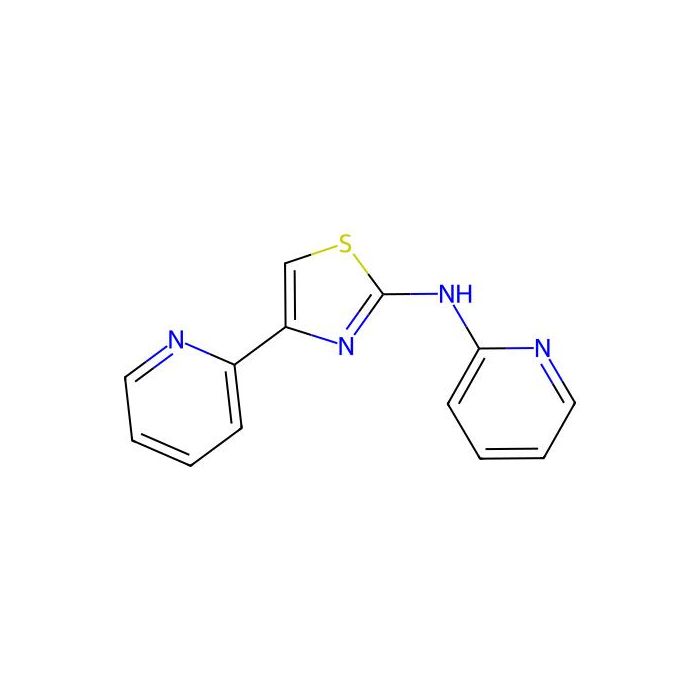
This compound belongs to the class of organic compounds known as aminopyridines and derivatives. These are organic heterocyclic compounds containing an amino group attached to a pyridine ring.
External Descriptors
Not available
1. Djoumbou Feunang Y, Eisner R, Knox C, Chepelev L, Hastings J, Owen G, Fahy E, Steinbeck C, Subramanian S, Bolton E, Greiner R, and Wishart DS. ClassyFire: Automated Chemical Classification With A Comprehensive, Computable Taxonomy. Journal of Cheminformatics, 2016, 8:61.
Determine the necessary mass, volume, or concentration for preparing a solution.
Dilution Calculator
Determine the dilution needed to prepare a stock solution.
Reconstitution Calculator
Reviews
Customer Reviews
Application Protocols
No validated application protocols are supplied for this specific item. As a general guide for small‑molecule screening:
Stock preparation: Dissolve in dry DMSO to 10–50 mM. Vortex/sonicate briefly. Filter (0.22 μm PTFE) if particulate persists.
Working solutions: Dilute into assay buffer to the desired final concentration, keeping DMSO ≤1% v/v. Prepare fresh immediately before use.
Controls: Include vehicle (DMSO only), positive control (assay‑specific), and plate blanks.
Plate handling: Use low‑binding polypropylene plates/tubes; avoid repeated freeze–thaw by aliquoting stocks.
Data quality: Generate concentration–response curves (≥8 points, half‑log spacing) and replicate wells (n≥3) to assess potency and variability.
These are general recommendations; tailor to your assay and consult the SDS/CoA for any item‑specific constraints.
Biological Roles
Item‑specific biological roles or targets are not provided. As a Moligand small‑molecule library member, ICA may be used as a chemical probe candidate in discovery assays; however, no biological function, pathway assignment, or target annotation can be made from the Product Data.
Target engagement, mechanism of action, and ADME properties: Not specified for this item; refer to screening results and any structure information on the CoA.
Use in biology should follow good research practices: concentration–response testing, orthogonal assays to confirm specificity, and appropriate negative/positive controls.
No therapeutic or clinical claims are made. For research use only.
Buffer Applications
This product is a small organic molecule for screening; it is not a buffering agent. Therefore, traditional buffer preparation guidance (pH ranges, buffering capacity) is not applicable.
Practical notes
If dissolving into aqueous buffers for assays, maintain low organic cosolvent (≤1–2% DMSO/EtOH/ACN) to avoid perturbing buffer capacity or biological systems.
Select buffers (e.g., PBS, HEPES, Tris) based on the assay’s biochemical needs rather than properties of this compound.
No item‑specific buffer recipes apply.
Green Alternatives
Because the compound’s structure and solvent preferences are not specified, green‑chemistry guidance focuses on solvent choices and handling practices during solution preparation and screening.
Prefer greener stock solvents when feasible: Ethanol or water (with pH adjustment) can replace DMSO if the compound’s solubility and assay tolerance permit. Assess analyte stability first.
Use acetonitrile over DMF/NMP when LC compatibility and lower toxicity are desired, provided solubility is adequate.
Minimize solvent volumes: Prepare the highest practical stock concentration to reduce organic load in assays and waste streams.
Implement micro‑scale operations: Use low‑dead‑volume reservoirs and automated dispensers to limit waste.
Opt for amber glass vials/plates to avoid photodegradation and microplastic leachables; this also facilitates solvent recycling programs.
Ethanol: renewable, lower toxicity; may affect cells at >1–2% and has narrower solvency.
Acetonitrile: good for LC; volatile and recoverable; flammable; less viscous than DMSO.
Adopt institutional green‑chemistry policies for solvent recovery, energy‑efficient cold storage, and consolidated waste collection.
Pharmaceutical Uses
No pharmacopeial status or excipient use is provided. This product is supplied for research use only as part of a small‑molecule/ligand library.
Formulation/excipient roles: Not specified for this item; refer to CoA/Spec Sheet if relevant to your internal R&D studies.
Manufacturing/GMP: Not intended for human or veterinary use. Not qualified to pharmaceutical compendial monographs.
All work should remain in non‑clinical research settings.
Physical Properties
Item‑specific physico‑chemical properties are not provided in the Product Data.
Appearance: Not specified for this item; refer to CoA/Spec Sheet.
Melting point: Not specified for this item; refer to CoA/Spec Sheet.
Boiling point: Not specified for this item; refer to CoA/Spec Sheet.
Density: Not specified for this item; refer to CoA/Spec Sheet.
Solubility profile (water/organic): Not specified for this item; refer to CoA/Spec Sheet.
Partition coefficient (logP/logD), pKa: Not specified for this item; refer to CoA/Spec Sheet.
Refractive index/optical rotation: Not specified for this item; refer to CoA/Spec Sheet.
General guidance (non‑item‑specific)
For unknown small molecules, begin solubility screening in DMSO (analytical grade), then evaluate miscibility upon dilution into aqueous buffers (0.1–1% final DMSO), ethanol, or acetonitrile as needed.
Determine solution stability by short‑term UPLC monitoring (e.g., 0–24 h at ambient and 37°C) and evaluate freeze–thaw robustness across 3 cycles.
If hygroscopicity or polymorphism is suspected, assess Karl Fischer water and XRPD/DSC on the received batch (best practice; not a product specification).
Quality & Grades
Grade: Moligand™ (as provided). This denotes inclusion in a curated small‑molecule/ligand library intended for discovery screening, chemogenomic probing, and method development. The emphasis is on identity, purity suitable for research screening, and plate/assay compatibility rather than pharmacopeial compliance.
What Moligand grade generally implies (context; not item‑specific specs):
Verified identity against a reference (e.g., NMR/HRMS) and chromatographic purity fit for HTS/fragment/ligand screening workflows.
Packaging suitable for split‑aliquotting and minimizing freeze–thaw (often in glass vials or plate‑compatible formats).
Documentation: CoA with lot‑specific purity and identity methods; SDS for safety.
Item‑specific details
Purity, stabilizers, residual solvents, metals, water, and UV cutoff: Not specified for this item; refer to CoA/Spec Sheet.
Analytical recommendations (general)
Confirm purity by orthogonal detection (UV and MS/ELSD) at multiple wavelengths (e.g., 210, 254, 280 nm) to uncover non‑chromophoric impurities.
For screening campaigns, standardize concentration by quantitative NMR (qNMR) or validated HPLC assay to reduce well‑to‑well variability.
Reaction & Applications
This product is supplied under the Moligand small‑molecule library category for research screening rather than as a dedicated synthetic reagent. Without a confirmed structure, reaction‑specific applications cannot be assigned.
Research applications (general for library ligands)
High‑throughput screening (HTS) and hit identification: Use as part of a diverse set to probe target engagement in biochemical or biophysical assays (e.g., thermal shift/DSF, SPR, MST, enzymatic readouts).
Chemogenomic profiling: Map phenotypic effects or pathway modulation in cell‑based assays with careful DMSO controls and concentration–response curves.
Fragment/ligand discovery workflows: Titrate in biophysical platforms; confirm binding via orthogonal methods.
Method development: Use as a test article for LC/UPLC method optimization (gradient scouting, ionization efficiency, recovery on plastics vs. glass).
Practical tips
Prepare fresh dilute working solutions to minimize adsorption losses and degradation.
Include Vehicle and No‑Compound controls; track plate maps meticulously to avoid well swaps.
Confirm identity and purity prior to biological testing to avoid false positives/negatives.
No item‑specific reaction chemistry guidance is provided due to missing structural information.
Reaction Conditions
Not applicable. This product is provided as a screening library small molecule without disclosed structure; therefore, no canonical reaction conditions or named‑reaction parameters can be responsibly recommended.
If you intend to employ this material in synthesis, first obtain the full structure and characterization package, then consult the primary literature for reaction precedents and condition ranges relevant to the specific functional groups.
Safety & Handling
Hazard classification is not specified in the Product Data. Treat as a laboratory chemical of unknown hazards until the SDS for the specific batch is reviewed.
GHS signal word/pictograms/H‑statements: Not specified for this item; refer to SDS.
Primary PPE: lab coat, safety glasses, disposable nitrile gloves; work in a chemical fume hood when weighing, dissolving, or aliquoting.
General precautions: Avoid inhalation of dust/aerosols and skin/eye contact. Prevent environmental release. Use dedicated tools to avoid cross‑contamination across screening plates.
Incompatibilities: Without a defined structure, avoid strong oxidizers/reductants, strong acids/bases, and reactive metals until compatibility is known.
First aid (overview; defer to SDS): Inhalation—move to fresh air; Skin—wash with soap/water; Eyes—rinse with water for ≥15 min; Ingestion—rinse mouth, seek medical attention. Provide SDS to responders.
Spill response: Contain with inert absorbent, avoid dust, collect in sealable container for disposal per institutional and local regulations.
Waste: Dispose as organic chemical waste; do not mix with incompatible streams. Label as “research chemical—hazards not fully characterized.”
Transport: Shipped on ice with cold packs per Product Data; keep cold during internal transfers as good practice.
Always consult the batch SDS for authoritative hazard and response information.
Solvent Selection
The optimal solvent cannot be prescribed without the structure. For small‑molecule screening compounds, the following decision framework is recommended:
Primary stock solvent: DMSO (anhydrous, ≥99.9%) is typically preferred for 10–50 mM stocks due to broad solvency and assay compatibility at ≤1% v/v.
Secondary options: DMF, acetonitrile, ethanol, isopropanol for compounds with limited DMSO solubility or where DMSO is assay‑incompatible.
Aqueous handling: Prepare concentrated organic stock, then dilute into aqueous buffers (e.g., PBS, HEPES) maintaining final organic cosolvent ≤1–2% to mitigate precipitation.
pH‑assisted solubilization: For acids/bases, adjust buffer pH 1–2 units away from pKa to enhance solubility (if pKa becomes known from CoA or characterization).
Detergent aid: 0.01–0.05% nonionic surfactant (Tween‑20/Pluronic F‑68) can prevent edge precipitation in microplates.
Small comparison (general guidance)
DMSO: broad solvency; can affect some enzymes/receptors above 1–2%.
ACN: volatile, LC‑compatible; lower solvency for very lipophilic solids.
EtOH/IPA: good for hydrophobic compounds; higher assay interference risk in some cell systems.
Always verify solubility/compatibility empirically for the specific batch.
Storage & Reconstitution
Storage conditions: Store at −20°C (as provided). Minimize exposure to ambient temperature. Protect from moisture and, if chromophoric, from light (amber vials) as good practice.
Shipping: Shipped in ice chest with ice pads (as provided). Inspect upon receipt; return to cold storage promptly.
Stability/shelf life: Not specified for this item; refer to CoA/Spec Sheet. Until known, treat as “use promptly after opening.”
Reconstitution guidance (general):
If supplied as a solid: Bring to room temperature in a desiccator before opening to prevent moisture condensation. Dissolve in dry DMSO to prepare a 10–50 mM stock; vortex and, if needed, brief sonication. Record exact concentration by weight or qNMR.
If supplied as a solution: Verify concentration and solvent on the label/CoA. Mix gently and aliquot to single‑use vials to avoid freeze–thaw.
Aliquoting: Dispense into small, inert containers (glass or low‑bind PP). Avoid repeated freeze–thaw; thaw on ice and keep capped when not in use.
Compatibility: Not specified for this item; perform small‑scale solubility and stability checks in intended assay buffers.
Always consult the batch CoA and SDS for definitive, item‑specific instructions.
Structure & Identity
This item is listed as ICA (SKU: I648624) within the Moligand small‑molecule/compound library collection. The precise structural identity is not fully specified in the provided data.
CAS: 3374-88-7 (as provided)
PubChem CID: 772885 (as provided)
InChIKey: 329095 (as provided; note: format appears non‑standard; verify on CoA/SDS)
SMILES: Not specified for this item; refer to CoA/Spec Sheet.
Molecular formula: Not specified for this item; refer to CoA/Spec Sheet.
Molecular weight: Not specified for this item; refer to CoA/Spec Sheet.
Synonyms/chemical name: Not specified for this item; refer to CoA/Spec Sheet.
Structural description
Functional groups, ring systems, stereochemistry: Not specified in Product Data. Do not infer without an authenticated structure record.
Identification guidance
Please cross‑check the CAS and CID against the current batch CoA and SDS for authoritative identifiers (SMILES, InChI, InChIKey) prior to method development, LIMS registration, or regulatory filings.
For spectral confirmation (general guidance): acquire 1H/13C NMR, HRMS, and orthogonal purity (HPLC/UPLC-UV and/or ELSD). Retain batch‑specific spectral data with the CoA.
Synthetic Utility
Due to the absence of a defined structure, no specific synthetic transformations or retrosynthetic roles can be recommended for this item.
General considerations (if used as a synthetic reference compound)
Analytical benchmarking: The material can serve as a reference standard for LC/UPLC method development (retention window, ionization efficiency). Validate identity and purity before use as a standard.
Derivatization feasibility: If the structure becomes available, assess handles (e.g., halides, carbonyls, heteroatoms) for cross‑coupling, amide formation, or protection–deprotection strategies; none can be assumed from current data.
For structure‑driven synthetic planning, consult the batch CoA/SDS or request full structural disclosure.
Target Specificity
Target information is not provided in the Product Data.
Molecular target(s), pathway, or enzyme class: Not specified for this item; determined empirically in your screening assays.
Selectivity profile, off‑targets, species reactivity: Not specified for this item; no claims are made.
Use appropriate positive controls and orthogonal assays to establish target specificity in your research context.
We use cookies to ensure the website functions properly and, where permitted, to improve your experience. You can manage your preferences at any time in Settings. Learn more in our Cookie Policy.
Shall we send you a message when we have discounts available?
Remind me later
Thank you! Please check your email inbox to confirm.
Products are supplied to verified businesses, institutions, and qualified professionals for research and development use only. Not for use in humans, animals, diagnosis, or therapy.

 H2625797