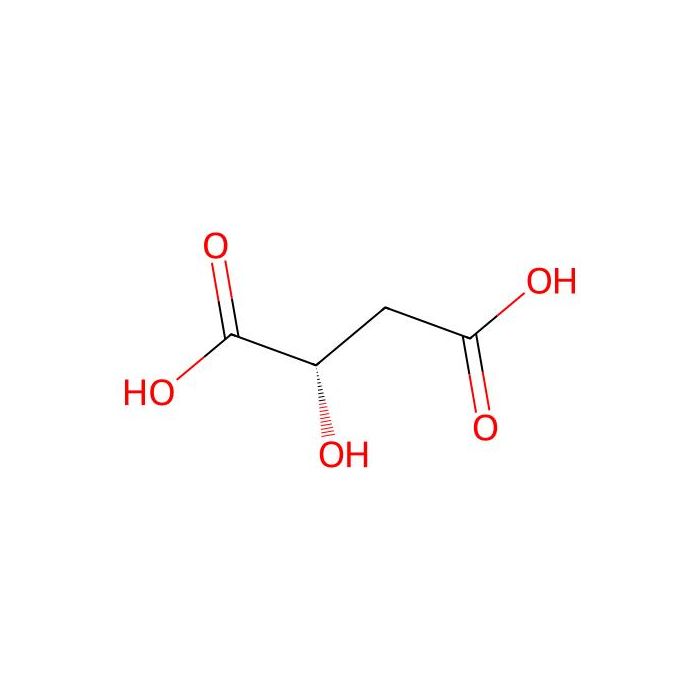
L-(−)-Malic acid - BioReagent, ≥95% , CAS No.97-67-6

CAS: 97-67-6 Cat. No.: L755594 Formula: C4H6O5 Molecular Weight: 134.09 Beilstein Registry Number: 1723540 EC Number: 202-601-5
AVAILABLE TO ORDER
GRADE & PURITY BioReagent ? BioReagent grade — tested suitable for life-science and molecular-biology use. Use for cell culture, assays, and biochemical work needing biological compatibility. ≥95%
Storage
Room temperature
Shipped In
Normal
★
Size
USA
Germany (EU)*
Price
Qty
25g
L755594-25g
Made to order · 8–12 wks
$190.90
100g
L755594-100g
Made to order · 8–12 wks
$381.90
Enter a quantity for the sizes you want to add.

Specifications

Specifications & Purity
BioReagent, ≥95%
Storage
Room temperature
Shipped In
Normal
Grade
BioReagent
Purity
≥95%
Names and Identifiers
SMILES
C(C(C(=O)O)O)C(=O)O
IUPAC Name
(2S)-2-hydroxybutanedioic acid
InChIKey
BJEPYKJPYRNKOW-REOHCLBHSA-N
InChI
1S/C4H6O5/c5-2(4(8)9)1-3(6)7/h2,5H,1H2,(H,6,7)(H,8,9)/t2-/m0/s1
Isomeric SMILES
C([C@@H](C(=O)O)O)C(=O)O
WGK Germany
3
Molecular Weight
134.09
Beilstein
1723540
Reaxy-Rn
1723539
Reaxys-RN_link_address
https://www.reaxys.com/reaxys/secured/hopinto.do?context=S&query=IDE.XRN=1723539&ln=

Advanced Data

Taxonomic Classification

Taxonomy Tree

KingdomOrganic compounds
SuperclassOrganic acids and derivatives
ClassHydroxy acids and derivatives
SubclassBeta hydroxy acids and derivatives
Intermediate Tree Nodes Not available
Direct ParentBeta hydroxy acids and derivatives
Alternative Parents Short-chain hydroxy acids and derivatives  Fatty acids and conjugates  Dicarboxylic acids and derivatives  Alpha hydroxy acids and derivatives  Secondary alcohols  Carboxylic acids  Organic oxides  Hydrocarbon derivatives  Carbonyl compounds  
Molecular FrameworkAliphatic acyclic compounds
Substituents Short-chain hydroxy acid - Beta-hydroxy acid - Fatty acid - Dicarboxylic acid or derivatives - Alpha-hydroxy acid - Secondary alcohol - Carboxylic acid - Carboxylic acid derivative - Organic oxygen compound - Organic oxide - Hydrocarbon derivative - Organooxygen compound - Carbonyl group - Alcohol - Aliphatic acyclic compound
DescriptionThis compound belongs to the class of organic compounds known as beta hydroxy acids and derivatives. These are compounds containing a carboxylic acid substituted with a hydroxyl group on the C3 carbon atom.
External Descriptors malic acid
3D Structure
Interactive Chemical Structure Model


Certificates (CoA,COO,BSE/TSE and Analysis Chart)
C of A & Other Certificates(BSE/TSE, COO):
Analytical Chart:
Chemical and Physical Properties
SolubilityH 2 O: 0.5 M at 20 °C, clear, colorless
Specific Rotation[α]-6.5° (C=10,Acetone)
Flash Point(°C)220°C
Melt Point(°C)101-103°C
Molecular Weight134.090 g/mol
XLogP3-1.300
Hydrogen Bond Donor Count3
Hydrogen Bond Acceptor Count5
Rotatable Bond Count3
Exact Mass134.022 Da
Monoisotopic Mass134.022 Da
Topological Polar Surface Area94.800 Ų
Heavy Atom Count9
Formal Charge0
Complexity129.000
Isotope Atom Count0
Defined Atom Stereocenter Count1
Undefined Atom Stereocenter Count0
Defined Bond Stereocenter Count0
Undefined Bond Stereocenter Count0
The total count of all stereochemical bonds0
Covalently-Bonded Unit Count1
Documents & Articles
Citations of This Product
Solution Calculators
Reviews

Customer Reviews

Application Protocols

Not applicable to this chemical reagent.

  • Item-specific (Product Data): No tested bioassay protocols (e.g., WB, IHC, IF, FC) or specific application dilutions are provided for L-(−)-malic acid.
  • For practical usage, refer to the Buffer Applications, Reaction & Applications, and Reaction Conditions sections for laboratory preparation and handling guidance.
Biological Roles
  • Central metabolism (literature)

    • L-malic acid (malate) is a canonical tricarboxylic acid (TCA) cycle intermediate. Malate dehydrogenase oxidizes L-malate to oxaloacetate with concomitant NAD+ reduction to NADH, linking to oxidative phosphorylation.
    • In the malate–aspartate shuttle, cytosolic malate transports reducing equivalents across the mitochondrial membrane via interconversion with oxaloacetate and aspartate, maintaining redox balance.
  • Enzymology

    • Substrate/product in reactions catalyzed by malate dehydrogenase, fumarase (interconversion via fumarate), and malic enzyme (oxidative decarboxylation of malate to pyruvate with NAD(P)+).
    • Stereospecificity: biological systems utilize the L-(S) enantiomer; D-malate is processed by distinct, less ubiquitous pathways.
  • Transport and homeostasis

    • Malate anions are transported by dicarboxylate carriers (e.g., mitochondrial SLC25 family). Cellular concentration depends on metabolic state, pH, and compartment.
  • Chelation and pH modulation

    • As a dicarboxylate, malate buffers intracellular/extracellular pH and chelates divalent cations (Mg2+, Ca2+), influencing enzyme activity and stability in vitro.
  • Biotechnological notes

    • In cell-free and enzymatic assays, malate is a common substrate/standard for monitoring dehydrogenase activities (e.g., NADH formation at 340 nm). Ensure enantiopurity when stereospecific enzymes are probed.

All biological context above is informational for research planning; this product is for research use only and not for clinical/diagnostic applications.

Buffer Applications
  • Buffering characteristics (literature; not item specifications)

    • Diprotic acid with pKa1 ~3.40 and pKa2 ~5.11 (25 °C), providing effective buffering roughly from pH 2.5 to 6.5.
    • Buffer species: H2Mal ⇌ HMal− ⇌ Mal2−. Ionic strength and temperature subtly shift apparent pKa.
  • Common malate-based buffers

    • Sodium/potassium malate: prepare by partially neutralizing L-malic acid with NaOH or KOH to the target pH.
    • Malate–Tris: blend L-malic acid with Tris base to achieve pH 5–6.5 while leveraging Tris’s buffering near neutral pH.
    • Acetate–malate mixed buffers: broaden buffer capacity across pH 3–6.
  • Example preparations (illustrative; verify with pH meter)

    • 0.1 M malate buffer, pH 5.0 (1 L): dissolve 13.4 g L-malic acid in ~800 mL water; titrate to pH 5.0 with ~40–50 mL of 1 M NaOH (volume is approximate); bring to volume with water; filter-sterilize (0.22 µm) if needed.
    • 50 mM malate–Tris, pH 6.0 (1 L): dissolve 6.7 g L-malic acid; add ~3.0–3.5 g Tris base incrementally while monitoring pH; adjust to 6.0; QS to volume.
  • Practical notes

    • For enzyme assays (e.g., malate dehydrogenase), maintain low ionic strength and chelation control; add Mg2+/Mn2+ only if required by the system.
    • Malate solutions can support microbial growth; prepare fresh or filter-sterilize and store refrigerated; include 0.02% sodium azide for biochemical assays if compatible and permitted.
    • Temperature dependence: recheck pH at working temperature; malate buffers show modest ΔpH/ΔT compared to phosphate.
Green Alternatives

Context: L-(−)-Malic acid itself is a bio-based, readily biodegradable organic acid commonly produced via fermentation, aligning well with green chemistry principles. When selecting acids or buffers, alternatives may be considered based on toxicity, sourcing, and performance.

  • Sustainability considerations (general)

    • Renewable sourcing: malic acid can be produced from renewable feedstocks via microbial routes.
    • Benign by design: low persistence and low bioaccumulation; fully water soluble.
  • Comparison to common alternatives (literature/general)

| Option | Source/Greenness | pKa values (25 °C) | Notes/Tradeoffs | |---|---|---|---| | L-(−)-Malic acid | Often bio-fermented; biodegradable | ~3.40, ~5.11 | Chiral; mild acid; good buffer range 2.5–6.5; can chelate metals | | Citric acid | Bio-based; biodegradable | ~3.13, 4.76, 6.40 | Stronger triprotic buffer; stronger chelation may interfere with metal-catalyzed steps | | Tartaric acid (L) | Bio-based; biodegradable | ~3.04, 4.37 | Chiral diacid; stronger acidity; more pronounced complexation with some metals | | Succinic acid | Bio-based; biodegradable | ~4.21, 5.64 | Achiral diacid; weaker acid; less chelation |

  • Practical green tips
    • Use water or ethanol–water systems where feasible; avoid chlorinated solvents for derivatizations.
    • For esterifications, use solid acid catalysts (e.g., amberlyst resins) and remove water azeotropically to reduce mineral acid usage.
    • Recover alcohol solvents via distillation; neutralize aqueous waste to pH 6–8 prior to disposal according to local regulations.
Pharmaceutical Uses

This section addresses formulation/processing contexts only. No therapeutic/clinical claims are made.

  • Typical roles in formulations (literature/general)

    • Acidulant and pH adjuster: L-malic acid is used to modulate pH in oral liquids, syrups, and solid dosage coatings due to its moderate acidity and pleasant organoleptic profile.
    • Buffer component: forms malate buffers in the mildly acidic range to enhance API stability where phosphate/citrate are unsuitable.
    • Complexing agent: malate can improve solubility of certain metal-containing actives/excipients via chelation.
    • Taste modification: contributes to sourness in oral dosage forms; often combined with sweeteners/flavor systems (excipient role).
  • Regulatory/compendial context

    • Widely recognized as a common excipient; compendial listings may exist (e.g., in major pharmacopeias) but specifics vary by region and grade. For GMP use, compendial-grade material and supporting documentation are required.
  • Manufacturing considerations

    • Hygroscopic caking can occur; maintain low humidity during blending and tableting.
    • Corrosion risk: acidic dusts can be mildly corrosive to carbon steel; prefer stainless contact parts.
    • Compatibility: may interact with amines (salt formation) and catalyze hydrolysis of sensitive APIs at low pH; conduct excipient–API compatibility studies.
  • Note on this product

    • This listing is Research Use Only (BioReagent grade). It is not offered as GMP/compendial grade. For regulated applications, source appropriate pharmaceutical-grade material and full documentation.
Physical Properties
  • Item-specific (Product Data)

    • Appearance: Not specified for this item; refer to CoA/Spec Sheet.
  • Literature/general properties (for reference only; not item specifications)

    • Physical state: crystalline solid; typically colorless to white, odorless.
    • Melting point: ~130–135 °C (often reported with dehydration/decomposition) (literature).
    • Boiling point: not applicable; decomposes before boiling (literature).
    • Density (solid): ~1.6 g/cm³ (literature; method-dependent).
    • Solubility: highly soluble in water; soluble in polar organics such as methanol and ethanol; sparingly soluble in nonpolar solvents (literature trends).
    • Acid dissociation constants (25 °C, water): pKa1 ~3.40; pKa2 ~5.11 (literature), consistent with a moderately strong dicarboxylic acid.
    • LogP (octanol/water): negative (hydrophilic), often reported around −1 to −1.3 (literature, method-dependent).
    • Optical rotation: [α]D typically negative for the L-(−) form; exact value depends on solvent, temperature, and concentration (literature; consult CoA for item-specific rotation if controlled).
    • Hygroscopicity: low-to-moderate; can absorb moisture and cake under high humidity (practical observation).
    • Refractive index: not applicable to solids.

Notes for use

  • In aqueous solution, malic acid partially dissociates to hydrogen malate/malate; ionic strength and temperature influence apparent pKa values.
  • Heating near the melting range can lead to dehydration to maleic/fumaric derivatives; avoid overheating during drying.
Quality & Grades
  • Item-specific (Product Data)

    • Grade/Purity: BioReagent (for research use only)
  • What BioReagent grade generally implies (general guidance; not a specification)

    • Intended for biochemical and molecular biology workflows where consistent composition and low levels of common laboratory contaminants (e.g., heavy metals, bioburden, residual solvents) are desired.
    • Typically supports applications such as buffer/component preparation, enzymology, cell-free systems, and routine lab assays.
  • UV/trace/metals/water/peroxides (item-specific):

    • Not specified for this item; refer to CoA/Spec Sheet.
  • Stabilizers/antioxidants/anti-caking agents:

    • Not specified for this item; refer to CoA/Spec Sheet.
  • Practical considerations

    • For sensitive applications (e.g., enzyme kinetics, spectroscopy), request or review the CoA for lot-specific data such as heavy metals, microbial limits, optical rotation, and assay purity.
    • If optical purity is critical (L-enantiomeric excess), verify by CoA or perform orthogonal testing (e.g., chiral HPLC, specific rotation).
    • If low UV background is needed (e.g., UV detection in HPLC), assess cutoffs by experimental scan; no UV specification is provided here.
  • Compliance and documentation

    • Research Use Only; not intended for food, drug, or household use.
    • If your quality system requires, retain CoA/SDS with recorded lot number and expiration/retest date.
Reaction & Applications
  • General roles in synthesis (literature)

    • Chiral pool building block: L-(−)-malic acid provides an S-configured stereocenter for elaboration into β-hydroxy acids, amino acids, and other chiral synthons.
    • Esterification/transesterification: formation of mono- and di-alkyl malates under Fischer conditions or via carbodiimide/acid chloride methods; useful as ligands, polymer precursors, or intermediates.
    • Selective protection: stepwise esterification (e.g., benzylation) allows differentiation of the two carboxylates; TIPDS/TBDMS protection of the alcohol enables orthogonal manipulations.
    • Dehydration/elimination: acid-catalyzed dehydration can afford maleic or fumaric derivatives; conditions influence E/Z selectivity.
    • Mitsunobu inversion: conversion of the secondary alcohol to inverted derivatives (access to D-series congeners or substituted derivatives) using DEAD/DIAD and PPh3.
    • Oxidation/reduction: TEMPO or Swern oxidation of the secondary alcohol to oxoacids; borohydride or catalytic hydrogenation of activated derivatives for chain editing.
  • Laboratory/analytical uses (literature)

    • Buffering component (malate buffer) across mildly acidic pH.
    • Chelating agent for metal ion solubilization and surface cleaning.
    • Mobile-phase modifier in certain chiral/ion-exclusion chromatographies (rare, but documented).
  • Practical tips

    • Maintain temperature control; overheating may induce dehydration or racemization.
    • For enantiospecific syntheses, minimize strong-base exposure at elevated temperatures to prevent epimerization at C2.
    • When targeting monoesters, use stoichiometric control and protective group strategy; monitor by NMR (distinctive downfield shifts for –CHOH and –CO2R groups).
Reaction Conditions

The following are literature-based, generalized conditions intended for planning. Optimize for your substrates and scale.

  • Esterification (to mono-/diesters)

    • Fischer: alcohol solvent (MeOH/EtOH/iPrOH), catalytic H2SO4 or p-TsOH, 0.1–1.0 equiv water removal (Dean–Stark for higher alcohols), reflux 2–24 h. Typical isolated yields: monoesters 50–80% (selectivity-controlled); diesters 70–95%.
    • Steglich: DCC (1.1–2.2 equiv), DMAP (0.05–0.1 equiv), dry CH2Cl2/DMF, 0–25 °C, 2–16 h. Good for sensitive alcohols; beware dicyclohexylurea removal.
  • Mitsunobu substitution/inversion at C2

    • PPh3 (1.2–1.5 equiv), DIAD/DEAD (1.2–1.5 equiv), nucleophile (1.5–3.0 equiv), dry THF/Et2O/DMF, 0 °C to rt, 2–12 h. Monitor for retention/inversion based on mechanism; expect 60–90% yields depending on nucleophile.
  • Dehydration to fumarate/maleate derivatives

    • Acidic: conc. H2SO4 or POCl3/pyridine, 0–80 °C, 1–6 h; E/Z ratio and over-decarboxylation depend on conditions. Safer variants use p-TsCl/pyridine or SOCl2-mediated activation.
  • Oxidation of secondary alcohol

    • TEMPO/NaOCl (pH ~8.6, biphasic), 0–5 °C to rt, 0.5–4 h; or Swern (oxalyl chloride/DMSO, −78 to −50 °C, then Et3N). Yields typically 60–85%.
  • Amidation/coupling to form malamides

    • EDC·HCl or DIC with HOBt/HOAt or DMAP, DMF/MeCN, 0–25 °C, 2–16 h. Control chemoselectivity to avoid O→N acyl transfer; protect the C2–OH if necessary.

Notes

  • Maintain pH control; strong base at elevated temperature can racemize the stereocenter.
  • Water content critically affects esterification equilibria; use molecular sieves or azeotropes.
  • For enantiosensitive steps, verify ee by chiral HPLC or specific rotation.
Safety & Handling
  • Item-specific (Product Data)

    • Signal word: Not specified for this item; refer to SDS.
    • H-statements: Not specified for this item; refer to SDS.
    • GHS classification: Not specified for this item; refer to SDS.
    • Pictograms: Not specified for this item; refer to SDS.
  • General safety information (literature/practice; consult SDS for authoritative guidance)

    • Expected hazards: Low acute toxicity; may cause eye and skin irritation. Dust may irritate respiratory tract.
    • PPE: lab coat, safety glasses/goggles, appropriate gloves (e.g., nitrile). Use a dust mask or work in a fume hood when handling powders.
    • Handling: Avoid creating dust and inhalation. Do not ingest. Wash hands thoroughly after handling. Keep containers tightly closed.
    • First aid (overview):
      • Inhalation: move to fresh air; seek medical advice if symptoms persist.
      • Skin contact: wash with soap and water; remove contaminated clothing.
      • Eye contact: rinse cautiously with water for several minutes; remove contact lenses if present; seek medical attention if irritation continues.
      • Ingestion: rinse mouth; do not induce vomiting; seek medical advice.
    • Incompatibilities: strong bases (exothermic neutralization), strong oxidizers, reducing sugars at elevated temperature (may promote browning/esterification), reactive metals in acidic conditions.
    • Thermal decomposition: heating may cause dehydration and release of irritating fumes; combustion can produce CO/CO2.
    • Environmental: readily biodegradable; avoid uncontrolled release to the environment.

Always defer to the product SDS and your institutional EHS policies for risk assessment and controls.

Solvent Selection

This product is a solid acid reagent, not a solvent. Solvent selection pertains to dissolving/using L-(−)-malic acid in reactions or preparations.

  • Polarity and miscibility considerations (literature/general)

    • Highly hydrophilic; freely soluble in water. Readily soluble in alcohols (methanol, ethanol), polyols, and other hydrogen-bonding solvents. Poorly soluble in apolar media.
    • Acid strength (pKa1 ~3.40, pKa2 ~5.11) supports preparation of malate buffers across pH ~2.5–6.5.
  • Typical solvent choices by application

    • Buffer/media preparation: ultrapure water; adjust pH with NaOH, KOH, or tris(hydroxymethyl)aminomethane (Tris) to form hydrogen malate/malate.
    • Esterification: use neat alcohols (MeOH, EtOH, iPrOH) with acid catalysis; water removal (Dean–Stark or molecular sieves) favors conversion.
    • Protecting group chemistry/couplings: polar aprotics (DMF, DMSO) or green alternatives (MeCN, propylene carbonate) depending on coupling method; ensure base is controlled to avoid racemization at C2.
    • Metal complexation/cleaning: aqueous solutions; ionic strength control (NaCl) can tune solubility and chelation behavior.
  • Quick comparison (literature values; indicative only)

    • Water (ε ~78): maximum solubility; biocompatible.
    • Ethanol (ε ~25): good solubility; easier solvent removal than water.
    • Methanol (ε ~33): excellent solubility; toxic—use with care.

Choose solvent according to downstream processing (evaporation vs lyophilization), pH targets, and compatibility with catalysts/enzymes used.

Storage & Reconstitution
  • Item-specific (Product Data)

    • Storage conditions: Room temperature
    • Shipped in: Normal
  • General storage guidance (literature/practice)

    • Keep tightly closed in a cool, dry place away from strong bases and oxidizers. Minimize exposure to high humidity to prevent caking.
    • For long-term stability of analytical properties (e.g., specific rotation), store in sealed containers and avoid elevated temperatures.
  • Reconstitution and solution handling (general)

    • Water solubility: high. Prepare stock solutions in ultrapure water; adjust pH with NaOH/KOH or appropriate bases to desired buffer species (HMal−/Mal2−).
    • Typical working concentrations: 1 mM to 0.5 M depending on application (enzyme assays vs buffers). Verify pH at working temperature.
    • Sterilization: filter-sterilize through 0.22 µm if solutions are stored for biochemical work.
    • Storage of solutions: refrigerate (2–8 °C) for short-term (days to weeks). For longer-term storage, prepare aliquots and freeze (−20 °C) if compatible with your application; avoid repeated freeze–thaw.
    • Microbial control: consider adding a suitable biocide (e.g., 0.02% sodium azide) when compatible and permitted to inhibit microbial growth in aqueous buffers.
  • Stability notes

    • Avoid prolonged heating; dehydration and byproduct formation can occur near the melting range.
    • Strongly basic solutions may promote racemization or side reactions over time; limit exposure and store at moderate pH.

Research Use Only: For laboratory use; not for food, drug, or household applications.

Structure & Identity

Brief overview: L-(−)-Malic acid is the naturally occurring L-enantiomer of 2-hydroxybutanedioic acid, a chiral α-hydroxy dicarboxylic acid.

  • Item-specific (Product Data)

    • Product name: L-(−)-Malic acid (SKU: L755594)
    • CAS: 97-67-6
    • Grade/Purity: BioReagent
    • Storage conditions: Room temperature
    • Shipped in: Normal
    • InChIKey: Not specified for this item; refer to CoA/Spec Sheet.
    • SMILES: Not specified for this item; refer to CoA/Spec Sheet.
    • Molecular formula: Not specified for this item; refer to CoA/Spec Sheet.
    • Molecular weight: Not specified for this item; refer to CoA/Spec Sheet.
  • Literature/general identity (for reference only; not item specifications)

    • Preferred IUPAC name: (S)-2-hydroxybutanedioic acid (L-malic acid)
    • Typical molecular formula: C4H6O5; formula units comprise two carboxylic acid groups and one secondary alcohol.
    • Typical molecular weight: ~134.09 g/mol
    • Representative stereochemical SMILES: OC@HC(=O)O
  • Structural features (descriptive)

    • Functional groups: two carboxylic acids (–CO2H), one α-secondary alcohol (–CHOH–).
    • Chirality: single stereocenter at C2; L-(−) corresponds to the S configuration under the CIP rules.
    • 2D description: a four-carbon backbone with terminal carboxyl at C1, a secondary alcohol at C2, a methylene at C3, and a terminal carboxyl at C4. The proximity of –OH and –CO2H at C2 promotes intra/intermolecular hydrogen bonding and chelation to metals.
    • Conjugation/aromaticity: none; fully saturated aliphatic framework.
Synthetic Utility
  • Functional group leverage (literature)

    • Two carboxylic acids: enable selective mono-/diesterification, amidation, anhydride formation (via activation), and salt formation with organic/inorganic bases.
    • Secondary alcohol (α to carboxyl): platform for oxidation (to ketoacids), substitution (e.g., via tosylation/mesylation), and stereochemical inversion (Mitsunobu) while preserving or exploiting chirality.
  • Chiral pool strategies

    • Use the (S)-configured center to transfer stereochemical information in constructing β-hydroxy acids, α-substituted succinate derivatives, or constrained heterocycles.
    • Auxiliary-like behavior: temporary protection of carboxyl groups combined with selective transformations at C2 allows enantiospecific routes to target motifs.
  • Protecting group tactics

    • Orthogonal protection of diacid as mixed esters (e.g., Bn/Me) affords selective downstream couplings.
    • Alcohol protection (TBDMS, TBS, acetonide-like cyclic carbonates) to prevent side reactions during acyl activations.
  • Typical transformations and named methods

    • Fischer esterification to dialkyl malates; Steglich esterification (DCC/DMAP) for mild conditions.
    • Mitsunobu reaction to invert C2–OH and introduce diverse nucleophiles (carboxylates, azides).
    • Oxidative decarboxylations and dehydrogenations (TEMPO, Swern, IBX) to access oxoacids or α-ketoesters.
    • Dehydration to fumarate/maleate derivatives under acid catalysis.
  • Retrosynthetic value

    • Readily accessible, inexpensive chiral starting material with built-in handles for chain extension, ring closure (e.g., lactones), and installation of diester frameworks used in asymmetric catalysis and ligand design.
Target Specificity

Not applicable to this chemical reagent.

  • Item-specific (Product Data): No antibody/biological targeting information is provided or expected for L-(−)-malic acid.
  • Use this section is typically reserved for biologics (e.g., antibodies, enzymes) with defined targets, epitopes, and species reactivity.

Frequently Asked Questions

What is the purity of this product?
This product is supplied at ≥95% purity (chemical assay). Lot-specific values are stated on the Certificate of Analysis.
What does BioReagent mean?
BioReagent indicates that the product has been processed and tested for biological and biochemical applications. Specifications may include endotoxin limits, microbial controls, sterility, low DNase/RNase/protease activity, and verified biological activity where relevant.
How should this product be stored?
Store at room temperature.
How is this product shipped?
This product ships under standard ambient conditions. No temperature-controlled packaging is required.
What are the CAS number, molecular formula and molecular weight?
The CAS Number is 97-67-6, the molecular formula is C4H6O5, and the molecular weight is 134.09 g/mol. InChIKey BJEPYKJPYRNKOW-REOHCLBHSA-N.
What documentation is provided?
Available product documentation, including Certificates of Analysis (COA), Safety Data Sheets (SDS), and specification sheets, is shown in the product document area. Document availability and access follow the current site policy.

Shall we send you a message when we have discounts available?

Remind me later

Thank you! Please check your email inbox to confirm.

Oops! Notifications are disabled.