Background Introduction:
The Lactate Dehydrogenase Cytotoxicity Assay Kit (WST-8 Method) is a kit based on the WST-8 chromogenic reaction, which detects the activity of lactate dehydrogenase (LDH) released during cytotoxicity or LDH activity in other samples through colorimetric analysis.
LDH catalyzes the reaction to generate NADH, which then reacts with WST-8 to produce a water-soluble formazan dye with characteristic absorption at 450 nm. By measuring the absorbance, LDH activity can be quantified, with absorbance values being directly proportional to enzyme activity.
This kit uses LDH release as an indicator of cell membrane integrity, providing a highly sensitive, operationally safe, and non-radioactive method for cytotoxicity detection. Compared with the traditional INT method, the WST-8 method offers higher sensitivity, more pronounced absorbance changes, and more accurate results.
Instruction for use
1. Kit Preparations:
Prepare an appropriate amount of LDH assay working solution based on a volume of 100 µl per detection reaction. For every 100 µl of working solution, uniformly mix 91 µl of Detection Assay Buffer with 9 µl of Chromogen Solution. Prepare a sufficient volume according to the total number of samples to be tested (including controls).
Note: The working solution should be prepared immediately before use. Protect it from light during both preparation and use.
2. Preparation of the LDH Standard Curve (Optional) :
To achieve absolute quantification of LDH enzyme activity, it is necessary to prepare an LDH standard separately. Freshly prepare LDH standards at different concentrations, such as 0, 65, 125, 250, 500, and 1000 mU/ml. If necessary, the concentration range of the standard curve can be appropriately adjusted in subsequent experiments based on the LDH activity of the samples.
3. Determination of Cell Number for Assay (Optional) :
Typically, cells can be seeded according to the routine seeding density. However, since the LDH content varies among different cell types, it is recommended to determine the optimal cell number through preliminary experiments to achieve the best chromogenic results.
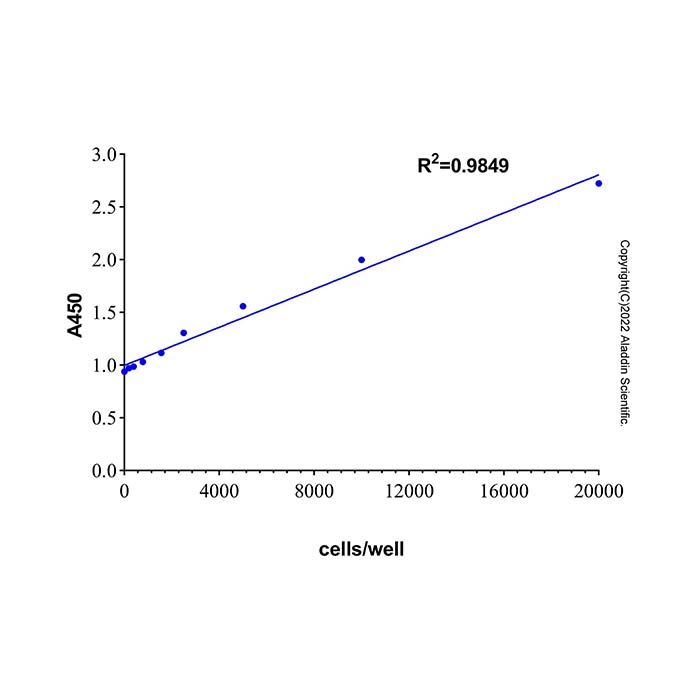
1. Harvest the cells, wash them with culture medium, and prepare a cell suspension at a density of 200,000 cells per milliliter. Aliquot 0, 12.5, 25, 50, and 100 µl of the cell suspension into a 96-well cell culture plate, corresponding to 0, 2,500, 5,000, 10,000, and 20,000 cells per well, respectively. Set up two groups: a Total LDH group and an Untreated Control group, with three replicates for each cell concentration. Incubate the plate overnight.
2. Continue incubation at 37°C for a specified period (consistent with the drug treatment duration in the formal experiment). Add 10 µl of LDH Release Reagent to each well of the Total LDH group, and add 10 µl of culture medium to each well of the Untreated Control group. Mix well and incubate at room temperature (approximately 25°C) protected from light for 15 minutes.
3. Add 100 µl of LDH assay working solution to each well. Mix well and incubate at room temperature (approximately 25°C) protected from light for 0–30 minutes. Due to significant variations among different cell types, it is recommended that during the initial experiment, absorbance readings be taken at 0, 5, 10, 20, and 30 minutes to determine the optimal reaction time. During incubation, the plate may be wrapped in aluminum foil and placed on a horizontal or orbital shaker with gentle agitation. After incubation, measure the absorbance at 450 nm. If a 450 nm filter is not available, a filter within the range of 420–480 nm may be used. A reference wavelength of 600 nm (or above, e.g., 650 nm) can be optionally set. The measured absorbance at 450 nm (A450) is obtained by subtracting the absorbance at the reference wavelength from the reading at 450 nm. The cell density and incubation time that yield a total LDH reading approaching but not exceeding the upper detection limit of the microplate reader are considered the optimal cell number and test time, respectively.
4. Preparation of Cytotoxicity Samples:
1. Set up the experimental groups as described in the table below. Seed an appropriate number of cells into a 96-well plate and culture overnight. Then, replace the culture medium according to the treatments specified for each group in the table.
Note: To ensure experimental validity, it is recommended to set up three replicate wells for each group.
Groups | Method | Note |
Untreated control | Replace with 100 µl of fresh culture medium | Containing cells |
Background control | Replace with 100 µl of fresh culture medium | Cell-free * |
Total LDH | Replace with 100 µl of fresh culture medium | Containing cells |
Background of total LDH | Replace with 100 µl of fresh culture medium | Cell-free * |
Sample ** | Replace with 100 µl of drug-containing culture medium *** | Containing cells |
Background of Sample | Replace with 100 µl of drug-containing culture medium *** | Cell-free * |
Positive Control(Optional) | Replace with 100 µl of appropriately diluted LDH standard *** |
*To avoid interference from serum, drugs, or LDH release reagent present in the culture medium on the readings, it is necessary to include a cell‑free group treated with the same culture medium for background subtraction.
** The sample group may also refer to samples intended solely for lactate dehydrogenase detection.
*** Drug‑containing culture medium: According to experimental requirements, add the drug (e.g., 0–5 µl of a specific drug) to fresh culture medium. Different concentrations and different treatment durations can be set.
2. Upon reaching the predetermined duration of drug treatment, add 10 µl of LDH Release Reagent to the Total LDH group and the Total LDH Background group. For all other groups, add 10 µl of culture medium. Mix well and incubate at room temperature (approximately 25°C) protected from light for 15 minutes.
5. Absorbance Measurement:
1. If the cells in the sample wells are not required for any other purposes, 100 µl of LDH assay working solution can be added directly to each well. If the cells in the sample wells are needed for other uses, either directly collect 100 µl of supernatant from each well, or centrifuge the culture plate at 400 × g for 5 minutes at room temperature using a plate centrifuge, then collect 100 µl of supernatant from each well. Transfer the supernatant to a new 96-well plate, and then add 100 µl of LDH assay working solution to each well.
2. Mix well, and incubate at room temperature (approximately 25°C) protected from light for 10–30 minutes. The optimal incubation time can be determined based on the preliminary experiment described in Step 3. During incubation, the plate may be wrapped in aluminum foil and gently shaken on a horizontal or orbital shaker.
3. Add 50 µl of stop solution to each well, mix well, and then measure the absorbance at 450 nm. If a 450 nm filter is not available, a filter within the range of 420–480 nm may be used. A reference wavelength of 600 nm (or above, e.g., 650 nm) can be optionally set. The measured absorbance value (A450) is obtained by subtracting the absorbance at the reference wavelength from the absorbance reading at 450 nm.
Note: To ensure optimal detection, the stop solution may be omitted initially. The absorbance can be measured at different time points until relatively ideal absorbance data are obtained, after which the stop solution may be added as appropriate.
4. Calculate the average absorbance for each group from the replicate wells.
Sample group absorbance = A450 sample − A450 sample background.
Total LDH group absorbance = A450 Total LDH − A450 Total LDH background.
Untreated control group absorbance = A450 untreated control − A450 blank control background.
Cytotoxicity or mortality = (Sample group absorbance − Untreated control group absorbance) / (Total LDH group absorbance − Untreated control group absorbance) × 100%
5. A cytotoxicity curve can be plotted with the absorbance of the sample group on the y‑axis and the drug concentration on the x‑axis. From this curve, the half‑lethal dose (LD₅₀) of the drug at a specific treatment time can be calculated.
6. To accurately calculate the absolute activity of LDH enzyme, a standard curve can be established using a series of LDH standards and their corresponding measured absorbance values. The enzyme activity of LDH in the sample can then be determined via the formula derived from the standard curve.
After subtracting the background control value from each well, plot the LDH standard curve with the measured absorbance (OD₄₅₀) on the y‑axis and LDH enzyme activity (mU) on the x‑axis. The formula of the resulting trendline should also be calculated, which allows for the determination of LDH enzyme activity in the sample.
A₄₅₀nm = k × LDH enzyme activity (mU) + b
Use software such as Excel to calculate the slope (k) and intercept (b) of the trendline.
Based on the above formula, calculate the LDH activity in the sample:
LDH enzyme activity in the assay system (mU) = (Absorbance of the sample group – b) / k
LDH enzyme activity in the sample (mU/ml) = LDH enzyme activity in the assay system (mU) / volume of sample tested
Matters needing attention
1. Freezing may partially inactivate lactate dehydrogenase in the samples. The samples can be stored at 4°C for 2–3 days. It is recommended to complete the measurement on the same day the samples are prepared whenever possible.
2. When detecting lactate dehydrogenase in cell culture medium, it should be noted that serum contains LDH. Using serum‑containing medium will increase the background reading. Therefore, it is essential to include control wells without cells but containing the same volume of culture medium for background subtraction. The higher the serum concentration, the higher the background value. If it does not significantly affect the experiment, it is recommended to use inactivated serum, which can largely deactivate the LDH present in serum and substantially reduce the background. Alternatively, if experimental conditions allow, serum‑free or low‑serum culture medium can be used during the assay to effectively lower the background activity of LDH from serum.
3. Overgrowth of cells, high cell density, excessive centrifugation speed, and large temperature differences inside and outside the incubator can all lead to increased LDH release from cells. Additionally, the LDH content varies to some extent among different cell types.
4. In the absence of stop solution, the absorbance will gradually increase over time. After adding the stop solution, the color development can remain stable.
5. If absolute quantification of lactate dehydrogenase activity is desired, users need to prepare their own LDH standard separately.

 ZJ26F0433840