

Determine the necessary mass, volume, or concentration for preparing a solution.
Lipo2000 Transfection Reagent
AVAILABLE TO ORDER
Storage
Store at 2-8°C,Protected from light
Shipped In
Wet ice
for sensitive chromatographic and analytical workflows requiring minimal baseline interference.
Store at 2-8°C,Protected from light Ships Wet ice Check lot-specific COA for exact specifications.
SDS, COA, datasheet, and spec sheet available for download. Lot-specific COA accessible via lot number lookup.
Cited in 0 peer-reviewed publications across chromatography, organic synthesis, and cross-coupling reactions.
Product manual
The transfection efficiency of Lipo2000 is between Lip2000 and Lip3000, with lower toxicity and higher transfection efficiency. It is a new type of cationic liposome transfection reagent. Suitable for transfection of nucleic acids (DNA and RNA) into eukaryotic cells, with low cytotoxicity; high transfection efficiency for various types of cells and culture plates; the presence of serum during transfection does not affect the advantages of transfection efficiency .
Scope of application: transfection of adherent cells and suspension cells (mammalian cell lines).
Transfection of plasmid DNA
For most cells, the ratio of DNA (µg) to Lipo2000 (µl) is 1:2~1:3. High cell density during transfection can obtain high transfection efficiency and expression level, and can reduce cytotoxicity.
1. Take 24-well plate as an example
Adherent cells: On the day before transfection, inoculate 0.5~2×10^5 cells with 500 µl of antibiotic-free medium to reach 70-90% confluence the next day.
Suspension cells: Before preparing the DNA-Lip2000 complex, inoculate 4-8×10^5 cells with 500 µl of antibiotic-free medium.
2. Perform the following operations for each transfection sample
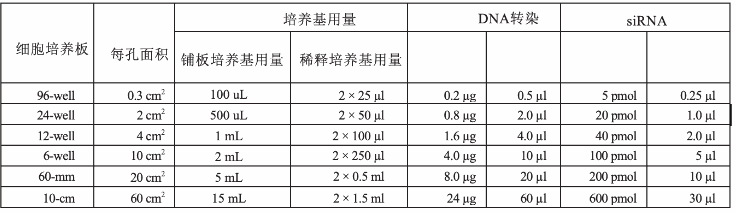
a. Add 50 µl Opti-MEM I ReLipced Serum Medium and 0.8 µg DNA into the eppendorf tube and mix gently to make a DNA dilution.
b. Add 50 µl Opti-MEMI ReLipced Serum Medium and 2.0 µl Lipo2000 to another eppendorf tube (note that you should mix well before use), mix gently to prepare a Lip2000 dilution, and let it stand at room temperature for 5 minutes.
c. Mix the DNA diluent and Lip2000 diluent, mix gently, and let stand at room temperature for 20 minutes to form a DNA-Lip2000 complex. The DNA-Lip2000 complex can exist stably for 6 hours at room temperature.
3. Add the DNA-Lip2000 complex to the inoculated cells, and gently shake the culture plate back and forth to make the complex evenly dispersed.
4. After culturing in a 37°C CO2 incubator for 4-6 hours, change the medium and continue culturing for 18 to 48 hours.
5. If you want to screen for stable cell lines, inoculate the cells in a fresh medium at a ratio of 1:10 or higher 24 hours after transfection, and add selective medium for screening the next day.
Optimization of plasmid DNA transfection In order to achieve the highest transfection efficiency and reduce the impact of cytotoxicity, the ratio of DNA to Lip2000 and cell density can be optimized. Generally, DNA (µg) is optimized in the range of 1:0.5~1:5 And Lip2000 (µl) ratio.
The amount of media, nucleic acid and Lipo2000 for transfection in different cell culture plates
Transfection efficiency of common cells (for reference only, the transfection efficiency will vary with different experimental conditions)

Comprehensive hazard, handling, storage, and regulatory compliance document.
Download SDS →Lot-specific quality data. Enter your lot number to retrieve the exact COA.
Look up COA →Full quality attributes and acceptance criteria for this grade.
View spec sheet →Find and download the COA for your product by matching the lot number on the packaging.
| Lot Number | Certificate Type | Date | Item |
|---|---|---|---|
 C2405442 C2405442 | Certificate of Analysis | Apr 02, 2026 | L266177 |
| H2414023 | Certificate of Analysis | Feb 05, 2026 | L266177 |
| E2507346 | Certificate of Analysis | Feb 05, 2026 | L266177 |
| G23121086 | Certificate of Analysis | Oct 13, 2025 | L266177 |
| C2408445 | Certificate of Analysis | Feb 21, 2024 | L266177 |
| G23121065 | Certificate of Analysis | Jun 27, 2023 | L266177 |
| K2211656 | Certificate of Analysis | Nov 03, 2022 | L266177 |
| K2211762 | Certificate of Analysis | Nov 03, 2022 | L266177 |