
Determine the necessary mass, volume, or concentration for preparing a solution.
| Activity Type | Activity Value -log(M) | Mechanism of Action | Activity Reference | Publications (PubMed IDs) |
|---|
Moligand™, ≥99% Moligand™ for sensitive chromatographic and analytical workflows requiring minimal baseline interference.
Store at -20°C Ships Ice chest + Ice pads Check lot-specific COA for exact specifications.
SDS, COA, datasheet, and spec sheet available for download. Lot-specific COA accessible via lot number lookup.
Cited in 0 peer-reviewed publications across chromatography, organic synthesis, and cross-coupling reactions.
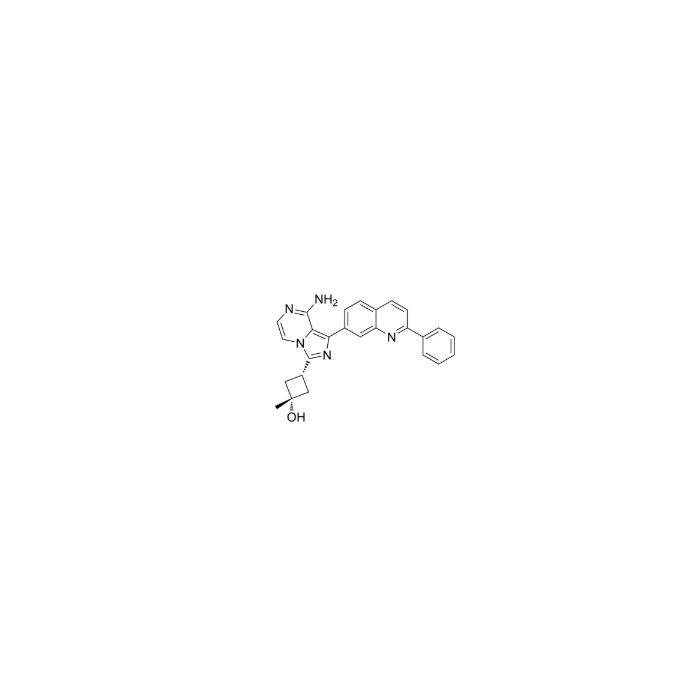
Linsitinib is a potent, selective insulin-like growth factor-1 receptor (IGF-1R, IC50 = 35 nM) and insulin receptor (IR, IC50 = 75 nM) kinase inhibitor which works to block the autophosphorylation of IGF-1R and IR. Additionally, in vitro studies of Linsitinib have demonstrated its ability to inhibit the proliferation of multiple tumor cell lines.Linsitinib is a selective inhibitor of IGF-1R with IC50 of 35 nM, and modestly potent to InsR with IC50 of 75 nM, and has no activity towards Abl, ALK, BTK, EGFR, FGFR1/2, PKA etc.
| Pubchem Sid | 504766617 |
|---|---|
| Pubchem Sid Url | https://pubchem.ncbi.nlm.nih.gov/substance/504766617 |
| Canonical Smiles | CC1(CC(C1)C2=NC(=C3N2C=CN=C3N)C4=CC5=C(C=C4)C=CC(=N5)C6=CC=CC=C6)O |
| IUPAC Name | 3-[8-amino-1-(2-phenylquinolin-7-yl)imidazo[1,5-a]pyrazin-3-yl]-1-methylcyclobutan-1-ol |
| InChIKey | PKCDDUHJAFVJJB-UHFFFAOYSA-N |
| INCHI | 1S/C26H23N5O/c1-26(32)14-19(15-26)25-30-22(23-24(27)28-11-12-31(23)25)18-8-7-17-9-10-20(29-21(17)13-18)16-5-3-2-4-6-16/h2-13,19,32H,14-15H2,1H3,(H2,27,28) |
| Isomeric SMILES | CC1(CC(C1)C2=NC(=C3N2C=CN=C3N)C4=CC5=C(C=C4)C=CC(=N5)C6=CC=CC=C6)O |
| Molecular Weight | 421.51 |
| Reaxy-Rn | 25747541 |
| Reaxys-RN_link_address | https://www.reaxys.com/reaxys/secured/hopinto.do?context=S&query=IDE.XRN=25747541&ln= |
Comprehensive hazard, handling, storage, and regulatory compliance document.
Download SDS →Lot-specific quality data. Enter your lot number to retrieve the exact COA.
Look up COA →Full quality attributes and acceptance criteria for this grade.
View spec sheet →Taxonomy Tree
| Kingdom | Organic compounds |
|---|---|
| Superclass | Organoheterocyclic compounds |
| Class | Quinolines and derivatives |
| Subclass | Phenylquinolines |
| Intermediate Tree Nodes | Not available |
| Direct Parent | Phenylquinolines |
| Alternative Parents | Phenylpyridines Imidazo[1,5-a]pyrazines Aminopyrazines N-substituted imidazoles Imidolactams Benzene and substituted derivatives Tertiary alcohols Heteroaromatic compounds Cyclic alcohols and derivatives Azacyclic compounds Primary amines Organopnictogen compounds Hydrocarbon derivatives |
| Molecular Framework | Aromatic heteropolycyclic compounds |
| Substituents | Phenylquinoline - 2-phenylpyridine - Imidazo[1,5-a]pyrazine - Aminopyrazine - Monocyclic benzene moiety - Imidolactam - Benzenoid - Pyridine - Pyrazine - N-substituted imidazole - Azole - Heteroaromatic compound - Imidazole - Tertiary alcohol - Cyclobutanol - Azacycle - Organonitrogen compound - Primary amine - Alcohol - Hydrocarbon derivative - Organopnictogen compound - Organic oxygen compound - Organic nitrogen compound - Amine - Organooxygen compound - Aromatic heteropolycyclic compound |
| Description | This compound belongs to the class of organic compounds known as phenylquinolines. These are heterocyclic compounds containing a quinoline moiety substituted with a phenyl group. |
| External Descriptors | Not available |
| Activity Type | Activity Value -log(M) | Mechanism of Action | Activity Reference | Publications (PubMed IDs) |
|---|
| Activity Type | Activity Value -log(M) | Mechanism of Action | Activity Reference | Publications (PubMed IDs) |
|---|
| Activity Type | Activity Value -log(M) | Mechanism of Action | Activity Reference | Publications (PubMed IDs) |
|---|
Find and download the COA for your product by matching the lot number on the packaging.
| Lot Number | Certificate Type | Date | Item |
|---|---|---|---|
 K1819045 K1819045 | Certificate of Analysis | Jan 26, 2026 | L126224 |
| K1819044 | Certificate of Analysis | Jan 26, 2026 | L126224 |
| A2628180 | Certificate of Analysis | Sep 11, 2025 | L126224 |
| E2620171 | Certificate of Analysis | Sep 11, 2025 | L126224 |
| I2522478 | Certificate of Analysis | Sep 11, 2025 | L126224 |
| I2522479 | Certificate of Analysis | Sep 11, 2025 | L126224 |
| I2522480 | Certificate of Analysis | Sep 11, 2025 | L126224 |
| B2216162 | Certificate of Analysis | Sep 09, 2025 | L126224 |
| K2415028 | Certificate of Analysis | Nov 19, 2024 | L126224 |
| Solubility | DMSO 84 mg/mL Water <1 mg/mL Ethanol <1 mg/mL |
|---|---|
| Molecular Weight | 421.500 g/mol |
| XLogP3 | 4.200 |
| Hydrogen Bond Donor Count | 2 |
| Hydrogen Bond Acceptor Count | 5 |
| Rotatable Bond Count | 3 |
| Exact Mass | 421.19 Da |
| Monoisotopic Mass | 421.19 Da |
| Topological Polar Surface Area | 89.300 Ų |
| Heavy Atom Count | 32 |
| Formal Charge | 0 |
| Complexity | 663.000 |
| Isotope Atom Count | 0 |
| Defined Atom Stereocenter Count | 0 |
| Undefined Atom Stereocenter Count | 0 |
| Defined Bond Stereocenter Count | 0 |
| Undefined Bond Stereocenter Count | 0 |
| The total count of all stereochemical bonds | 0 |
| Covalently-Bonded Unit Count | 1 |
Our grade selection guide covers purity, stabilizer status, and application suitability for all variants in our catalog.
View Moligand™ grade guide →