•A reactant to synthesize perfluoro-2-methylcyclohex-1-enolate by photochemical reaction with tetrabutylammonium iodide in water.
•A fluorous solvent to synthesize polynorbornene via ring-opening metathesis polymerization (ROMP) of norbornene using fluorous Grubbs′ second-generation catalyst.
It can also be used as a solvent to investigate fluorophilicity of a series of hydrocarbon and fluorocarbon-functionalized nicotinic acid esters.
This compound belongs to the class of organic compounds known as cyclohexyl halides. These are organohalogen compounds containing a monocyclic cyclohexane moiety that is substituted at one or more positions by an halogen atom.
External Descriptors
Not available
1. Djoumbou Feunang Y, Eisner R, Knox C, Chepelev L, Hastings J, Owen G, Fahy E, Steinbeck C, Subramanian S, Bolton E, Greiner R, and Wishart DS. ClassyFire: Automated Chemical Classification With A Comprehensive, Computable Taxonomy. Journal of Cheminformatics, 2016, 8:61.
Determine the necessary mass, volume, or concentration for preparing a solution.
Dilution Calculator
Determine the dilution needed to prepare a stock solution.
Reconstitution Calculator
Reviews
Customer Reviews
Application Protocols
No assay-specific protocols (e.g., WB, IHC, IF, FC) apply to this chemical solvent. For laboratory use, typical protocols involve:
Establishing biphasic systems with an organic or aqueous phase and perfluoro(methylcyclohexane); equilibrate at target temperature and stir vigorously for interfacial mass transfer.
Post-reaction cooling to achieve clean phase separation; recover fluorous-tagged species in the PFC phase.
Distill and reuse the PFC under an inert atmosphere when purity requirements permit.
These are general practices; adapt to your reaction system and consult the primary literature on fluorous biphase catalysis and separations.
Biological Roles
Perfluoro(methylcyclohexane) is a perfluorocarbon (PFC) with no known intrinsic biochemical activity; it is generally considered biologically inert.
General properties relevant to biochemistry (literature/general)
High gas solubility: PFCs dissolve large amounts of O2 and CO2 relative to water or hydrocarbons, which has motivated research use as gas carriers or overlays in cell-free systems and enzymology under strictly non-aqueous exposure.
Immiscibility and low surface energy: Enables formation of stable emulsions with appropriate surfactants for microfluidics and droplet-based assays; the PFC phase can act as an inert carrier fluid.
Non-polar, non-hydrogen bonding: Does not solvate biomacromolecules; direct contact with cells/tissues is generally inert but can extract hydrophobic small molecules depending on surfactants present.
Limitations
No buffering capacity, no ionic strength contribution, and negligible solvation of polar metabolites.
Not a nutrient or excipient for biological systems; used only as an inert phase or carrier in research settings.
Note: No medical or clinical claims are made. Any use with biological materials should be validated for biocompatibility and residual solvent removal per laboratory biosafety protocols.
Buffer Applications
This material is a nonpolar perfluorocarbon and does not function as an aqueous buffer. It has no intrinsic buffering capacity and is immiscible with water. For laboratory workflows, use established buffers (e.g., phosphate, HEPES, Tris) in the aqueous phase and employ perfluoro(methylcyclohexane) only as an inert, immiscible carrier or overlay when needed.
Green Alternatives
Context: Perfluorocarbons are chemically inert and recyclable but have environmental considerations, notably high global warming potentials (GWPs) and atmospheric persistence. Selection should weigh performance benefits against sustainability goals.
Greener or lower-impact alternatives (literature/general comparison)
2-Methyltetrahydrofuran (2-MeTHF): Bio-based cyclic ether, good for many organometallic and biphasic reactions; miscible with many organics but not with water at certain temperatures.
Cyclopentyl methyl ether (CPME): Hydrophobic ether with broad compatibility and low peroxide formation tendency relative to THF.
Hydrofluoroethers (HFEs) or hydrofluorocarbons (HFCs): Lower persistence than fully perfluorinated analogs, though still fluorinated; can emulate some PFC properties with reduced GWP.
Supercritical CO2: For extractions and some reactions; tunable solvating power and low toxicity.
Trade-offs
Solvation orthogonality: No hydrocarbon/ether replicates the strict immiscibility and selectivity of a fluorous phase; fluorous-tag methodologies may require a genuine PFC.
Safety: Ethers can be flammable and may form peroxides; PFCs are typically non-flammable and oxidation-resistant.
Process: Recycling and closed-loop capture are essential when using PFCs to mitigate emissions.
Practical guidance
If a fluorous phase is not essential, prefer greener ethers or esters.
If a PFC is required, minimize losses via cold traps, condensers, and dedicated recovery units; consider PFPEs or HFEs with lower volatility to reduce fugitive emissions.
Note: These are general sustainability considerations; confirm regulatory and EHS guidance for your site.
Pharmaceutical Uses
No pharmacopeial or excipient grade is specified for this item; refer to CoA/Spec Sheet.
General (non-clinical) considerations:
Role in manufacturing: Perfluorocarbons are occasionally used as inert heat-transfer fluids or as immiscible processing media in specialized manufacturing equipment. They can also serve as carrier fluids in microfluidic screening platforms.
Extractables/leachables: If used around drug product contact surfaces, evaluate potential extractables from seals and container–closure systems in the presence of PFCs due to their unique solvency toward low-surface-energy materials.
Residuals: If employed in a process step, validate removal from intermediates/DS via headspace GC or fluorine NMR as appropriate.
No therapeutic uses are implied. For GMP applications, ensure material qualification, vendor audit, and compliance with internal quality standards.
Physical Properties
Provide values below as literature typicals for perfluoro(methylcyclohexane); they are not item-specific specifications.
Appearance: Not specified for this item; refer to CoA/Spec Sheet. (Typically a clear, colorless liquid for PFCs.)
Boiling point (literature): Reported in the ~70–80 °C range at 1 atm for perfluorinated C7 cyclics; verify exact value in primary data before process design.
Melting point (literature): Often below ambient for similar PFCs; consult primary references for precise value.
Density (literature): Perfluorocarbons of this size commonly ~1.75–1.85 g/mL at 25 °C; check specific value prior to volumetric dosing.
Refractive index nD20 (literature): Low, typically ~1.27–1.30 for PFCs.
Vapor pressure (literature): Elevated relative to higher PFCs; expect tens of kPa at 25 °C; confirm experimentally for closed-system work.
Solubility profile (literature/general):
Water: Practically insoluble; water is slightly soluble in PFCs.
Organic solvents: Immiscible with most hydrocarbons, ethers, and polar solvents; miscible with fluorous solvents and other PFCs.
Gas solubility: High solubility for O2/CO2 relative to hydrocarbons, a hallmark of PFCs.
Dielectric constant (literature): Very low (~1.8–2.1 at 20–25 °C for similar PFCs), indicating extreme nonpolarity.
LogP/logS: Conventional logP not meaningful due to the separate “fluorous” phase behavior; partitioning better described by fluorous/hydrocarbon or fluorous/water distribution ratios.
Important: Use these literature ranges for preliminary planning only; for regulated or scale-up work, obtain measured values for the supplied lot.
Quality & Grades
Item-specific grade/purity: Not specified for this item; refer to CoA/Spec Sheet.
What “grade” typically implies for PFC solvents (general)
Research grade: Suitable for general lab use; moisture/volatile impurities and non-volatile residue (NVR) are controlled to typical research thresholds.
High-purity/electronic grade (when specified by suppliers): Tight control of NVR, ionic contaminants, and particulates; often filtered and packaged to minimize trace metals/hydrocarbons for electronics/heat-transfer applications.
HPLC/UV grade: Rarely designated for PFCs; when it is, it implies very low UV absorbance and minimal extractables that could interfere with detection.
Stabilizers/additives
Stabilizer: Not specified for this item; refer to CoA/Spec Sheet. PFCs are commonly supplied neat without stabilizers due to intrinsic oxidation resistance.
Lot-specific testing (what to look for on CoA)
Identity by GC/MS or 19F NMR; purity by GC area %.
Water content (Karl Fischer) if moisture sensitivity is critical to your process.
Residual hydrocarbons or other perfluorocompounds profile (if relevant to application).
Density, refractive index, and boiling range for quick incoming QC.
Packaging considerations
Due to high density and low surface energy, containers should have compatible fluoropolymer or hydrocarbon-resistant liners. Ensure tight seals to limit vapor loss.
Refer to the Aladdin Scientific CoA/Spec Sheet for the definitive specifications of SKU P169858.
Reaction & Applications
Fluorous biphasic catalysis (literature/general)
Perfluoro(methylcyclohexane) serves as a fluorous phase for reactions employing perfluoroalkyl-tagged catalysts/ligands (e.g., fluorous phosphines, sulfonates). After reaction at elevated temperature, cooling restores biphasicity, enabling facile catalyst/product separation.
Common reaction families: hydrogenations, hydroformylations, olefin metathesis, and cross-couplings when catalysts are fluorous-tagged.
Phase-switchable workups
Fluorous-solid phase extraction (F-SPE) and liquid–liquid partitions use this solvent to sequester fluorous-tagged species away from organic/polar products.
Inert processing medium
Provides an oxygen-free, non-participating diluent for highly reactive species, minimizing side reactions of solvent. Particularly useful when strong nucleophiles/bases would attack conventional organic solvents.
Practical tips (general)
Drying: Water has minimal solubility; simple phase separation often suffices. For trace water removal, pass through activated alumina or molecular sieves compatible with PFCs.
Degassing: Sparge with inert gas (N2/Ar). Gas solubility is high, which can be advantageous for gas–liquid reactions.
Stirring/mixing: Due to high density and low viscosity, vigorous stirring may be required to maximize interfacial area in biphasic systems.
Materials compatibility: Most metals and glass are compatible. Avoid exposure to strong reducing metals at elevated temperature.
NMR and analytics
19F NMR: The solvent itself provides intense fluorine signals; use appropriate deuterated co-solvent for lock/shim or external lock tubes.
All points above are general literature practices; tailor conditions to your substrate/catalyst system.
Reaction Conditions
General guidance from literature for fluorous biphasic systems using perfluorinated solvents such as perfluoro(methylcyclohexane):
Temperature
Many fluorous biphasic reactions operate near or above the PFC’s boiling point under reflux or in sealed vessels to achieve temporary monophasic conditions. For perfluoro(methylcyclohexane), literature boiling points for related C7 PFCs are in the ~70–80 °C range; confirm exact BP and adjust accordingly. For higher temperatures, use sealed reactors with appropriate pressure ratings or choose a higher-boiling PFC/PFPE.
Catalysts and tags
Employ perfluoroalkyl-tagged ligands/catalysts (e.g., fluorous phosphines, NHCs) to drive selective partitioning. Typical catalyst loadings mirror homogeneous protocols (0.1–5 mol%) but are system-dependent.
Solvent pairing
Organic co-solvents: toluene, MTBE, acetonitrile, or alcohols for the organic phase; ensure immiscibility at the chosen temperature.
Aqueous phase (if present): buffered as needed for substrate stability; PFC contributes no buffering.
Mass transfer
High-density PFC layers require vigorous stirring (overhead stirrer, baffled reactors, or static mixers) to generate interfacial area. Microreactors can leverage segmented flow with PFC as the carrier.
Workup and recovery
On cooling, phases separate cleanly. Recover the PFC by decantation and distillation. Use cold traps to minimize losses due to volatility.
Expected outcomes
Yields and rates depend strongly on tag design and temperature. Literature reports often show comparable activity to homogeneous analogs with simplified separations.
Always confirm compatibility of substrates and reagents with PFCs under your specific conditions.
Safety & Handling
Item-specific safety data
GHS signal word: Not specified for this item; refer to SDS.
H-statements / hazard classes / pictograms: Not specified for this item; refer to SDS.
Storage conditions: Room temperature (per Product Data).
Shipping: Normal (per Product Data).
Research Use Note: For research use only.
General safety considerations for perfluorocarbons (literature/general)
Inertness: Chemically and biologically inert under ambient laboratory conditions; non-flammable in most cases. Nonetheless, treat as a chemical with appropriate care.
Thermal decomposition: At elevated temperatures or in fires, PFCs may decompose to release toxic/irritant fluorinated gases (e.g., HF, CF2O). Use appropriate firefighting media (water spray, CO2, dry chemical) and SCBA in fires.
Incompatibilities: Strong reducing agents (e.g., alkali metals), extremely reactive nucleophiles at high temperature, or molten alkali can induce defluorination.
Ventilation: Use in well-ventilated areas; vapors are heavier than air and can accumulate in low areas.
PPE: Safety glasses, lab coat, and suitable chemical-resistant gloves. Avoid prolonged skin contact and inhalation of vapors or aerosols.
Spills: Contain with inert absorbent; liquids are dense and can spread. Prevent entry into drains. Dispose according to local regulations.
First aid (overview; consult SDS): Move to fresh air after inhalation; rinse skin/eyes with water for several minutes for contact; seek medical advice if symptoms persist.
Always consult the specific SDS for this product for authoritative hazard classifications and response guidance.
Solvent Selection
Perfluoro(methylcyclohexane) is a prototypical fluorous solvent: extremely nonpolar, low polarizability, lipophobic and hydrophobic, and immiscible with most organic media.
Polarity and dielectric (literature/general)
Polarity class: Fluorous, apolar; dielectric constant typically ~2.
Hydrogen-bonding: Nil donor/acceptor ability; does not solvate ions or polar substrates.
Miscibility profile (general)
Immiscible with water and common organic solvents (ethers, aromatics, alcohols, hydrocarbons).
Miscible with other perfluorocarbons and perfluoropolyethers (PFPEs).
Can form a distinct third phase in ternary systems (water/organic/fluorous) facilitating phase-separable operations.
Typical use scenarios
Fluorous biphasic catalysis and separations using perfluoroalkyl-tagged ligands, catalysts, or reagents.
As an inert heat-transfer or bath fluid near its boiling point (verify exact BP and compatibility before use).
Density-based extractions and liquid–liquid separations, leveraging the high density and immiscibility.
Carrier phase for gas absorption/sparging studies (enhanced O2/CO2 solubility) in research settings.
Choosing vs alternatives
Compared to hydrocarbons (e.g., hexane, toluene): offers far greater chemical inertness and orthogonal phase behavior; poorer solvation of organics.
Compared to PFPEs: lower viscosity and often lower boiling point; PFPEs may offer broader temperature stability.
Compared to other PFCs (perfluorohexane, perfluorodecalin): intermediate volatility; ring structure can affect BP and viscosity—select to match desired boiling range and handling.
Note: Verify boiling range and density from the lot CoA when designing separations or phase cuts.
Storage & Reconstitution
Storage (item-specific)
Store at room temperature (per Product Data) in a tightly closed container.
Shipped under normal conditions (per Product Data).
Handling recommendations (general)
Keep away from heat sources and open flames; while many PFCs are non-flammable, confirm on SDS for this specific item.
Use in well-ventilated areas. Because of volatility relative to higher PFCs, keep containers sealed to limit losses.
Preferred container materials: Glass or compatible fluoropolymer-lined containers. Avoid soft plastics that may cold-flow or deform.
Reconstitution
Not applicable. Supplied as a neat liquid; no reconstitution required.
Stability
Chemically stable under ambient conditions. Avoid extended exposure to very strong reducing agents or high temperatures that could induce decomposition.
Recovery and reuse
Can be purified by simple phase separation followed by fractional distillation. Employ cold traps during distillation to minimize emissions and product loss.
Always consult the product CoA and SDS for lot-specific stability, purity, and safety details. For research use only.
Structure & Identity
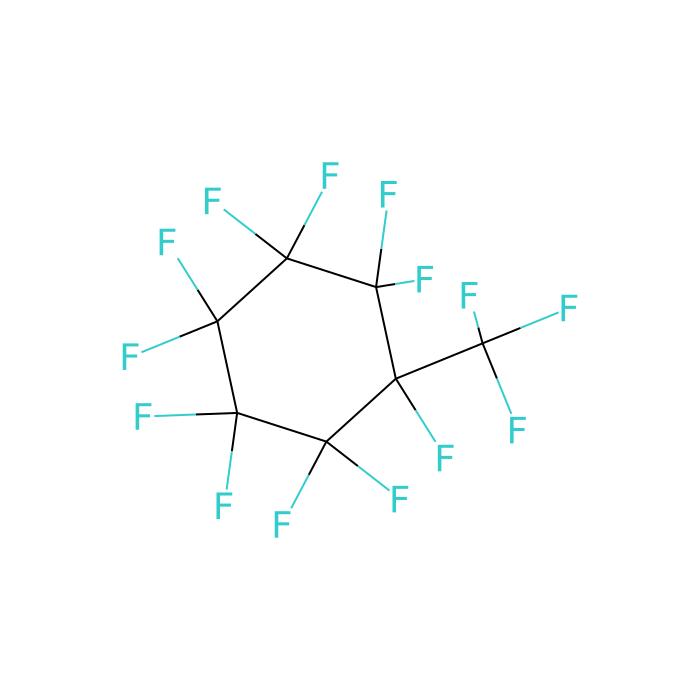
Brief description: Perfluoro(methylcyclohexane) is a fully fluorinated cycloalkane bearing a methyl substituent; a saturated perfluorocarbon (PFC) liquid with exceptional chemical inertness.
Item-specific (from Product Data)
Product Name: Perfluoro(methylcyclohexane)
SKU: P169858
CAS: 355-02-2
CID: 9637
InChIKey: 298000 (as provided)
Storage Conditions: Room temperature
Shipped In: Normal
Literature/computed identifiers and features (general reference; verify on CoA/SDS for procurement-critical use)
InChIKey (literature): Commonly reported for C7F14; consult authoritative databases.
Structural description (general)
Framework: A cyclohexane ring fully substituted by fluorine, bearing one perfluorinated methyl group. All C–H bonds of methylcyclohexane are replaced by C–F.
Functional groups: No conventional functional groups; composed exclusively of C–C and C–F sigma bonds. No heteroatoms other than fluorine.
Stereochemistry: Saturated ring; perfluorination removes conformational reactivity. Chair conformers exist but with minimal polarizability; no stereocenters.
Key physicochemical features: Extremely low polarizability and surface energy; high density versus hydrocarbons; immiscible with water and most organic solvents except fluorous media.
Note: Literature identifiers are provided for context; item-specific certificate should be consulted for final identity specifications.
Synthetic Utility
Fluorous tagging and separations
Attaching perfluoroalkyl tags to reagents, ligands, or catalysts enables selective partitioning into perfluoro(methylcyclohexane) while unlabeled products remain in organic phases. This strategy simplifies catalyst recovery and recycling without solid supports.
Orthogonal phase engineering
The solvent provides a third, immiscible phase distinct from both water and conventional organics. This can enable tandem processes, phase-transfer strategies, and clean workups based on density-driven separations.
Inert reaction medium
Exceptional resistance to oxidation, reduction (under moderate conditions), and strong bases allows handling of species that would otherwise attack ethers or aromatics. It can be used as a diluent to moderate exotherms and suppress side reactions that involve solvent participation.
Gas–liquid chemistry
High oxygen and carbon dioxide solubility can enhance mass transfer in oxidation or carboxylation reactions when compatible with catalysts and substrates. Note that the substrate must access the interface; vigorous agitation is often required.
Analytical and materials roles
As a dense displacement fluid for porosimetry or as a carrier liquid in droplet microfluidics and emulsion polymerization (with suitable fluorinated surfactants).
These are general literature utilities; suitability depends on substrate compatibility and equipment design.
Target Specificity
Not applicable. This product is a small-molecule perfluorocarbon solvent, not a biological targeting reagent (no antigen/epitope/clone/isotype). For application-specific selectivity, see Solvent Selection and Synthetic Utility.
We use cookies to ensure the website functions properly and, where permitted, to improve your experience. You can manage your preferences at any time in Settings. Learn more in our Cookie Policy.
Shall we send you a message when we have discounts available?
Remind me later
Thank you! Please check your email inbox to confirm.
Products are supplied to verified businesses, institutions, and qualified professionals for research and development use only. Not for use in humans, animals, diagnosis, or therapy.

 I2321810