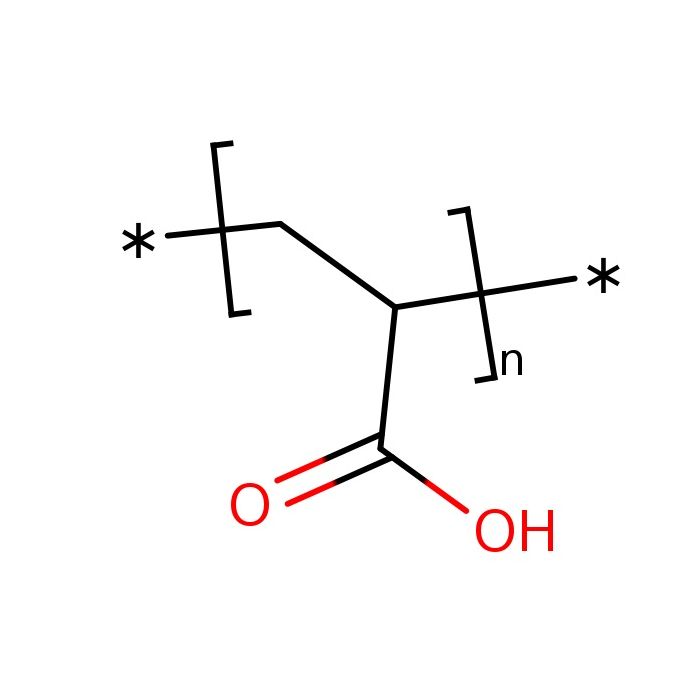
Poly(acrylic acid) solution(PAA) - Average Mw~2000, 50 wt.% in H2O , CAS No.9003-01-4

CAS: 9003-01-4 Cat. No.: P434403 Formula: (C3H4O2)n Beilstein Registry Number: MFCD00084394 EC Number: 920-377-3
AVAILABLE TO ORDER
GRADE & PURITY Average Mw~2000, 50 wt.% in H2O
Synonyms
PAA
Storage
Room temperature
★
Size
USA
Germany (EU)*
Price
Qty
100g
P434403-100g
Made to order · 8–12 wks

$836.90

$977.90
Save $141.00 (14.42%)
Enter a quantity for the sizes you want to add.
🧪
Why this grade

Average Mw~2000, 50 wt.% in H2O for sensitive chromatographic and analytical workflows requiring minimal baseline interference.

🌡

Storage & shipping

Room temperature Ships Check lot-specific COA for exact specifications.

📋

Quality documents

SDS, COA, datasheet, and spec sheet available for download. Lot-specific COA accessible via lot number lookup.

📚

Literature proof

Cited in 718 peer-reviewed publications across chromatography, organic synthesis, and cross-coupling reactions.

Overview

Poly(acrylic acid) solution (PAA) is an anionic polymer that can be synthesized by the free radical polymerization of acrylic acid. It has a swelling nature that tends to absorb and retain the water. It has a high ion exchange capacity that makes it useful in the development of membranes.

Poly(acrylic acid) solution (PAA) is an anionic polymer that can be synthesized by the free radical polymerization of acrylic acid. It has a swelling nature that tends to absorb and retain the water. It has a high ion exchange capacity that makes it useful in the development of membranes.


Application:

Poly(acrylic acid) solution (PAA) can be used for a variety of applications such as:
· a surfactant in the formation of photonic crystals;
· a binder for the development of Silicon anode based lithium ion batteries;
· polyelectrolyte membranes for electronics and optoelectronics based applications.

Specifications

Synonyms
PAA
Specifications & Purity
Average Mw~2000, 50 wt.% in H2O
Storage
Room temperature
Names and Identifiers
Canonical Smiles
C=CC(=O)O
IUPAC Name
prop-2-enoic acid
InChIKey
NIXOWILDQLNWCW-UHFFFAOYSA-N
INCHI
1S/C3H4O2/c1-2-3(4)5/h2H,1H2,(H,4,5)
Isomeric SMILES
C=CC(=O)O
WGK Germany
1
RTECS
AT4680000
Beilstein
MFCD00084394
Reaxy-Rn
635743
Reaxys-RN_link_address
https://www.reaxys.com/reaxys/secured/hopinto.do?context=S&query=IDE.XRN=635743&ln=

Documentation

📋 Safety Data Sheet (SDS)

Comprehensive hazard, handling, storage, and regulatory compliance document.

<<<<<<< HEAD Download SDS → ======= Download SDS → >>>>>>> release248-p3

✅ Certificate of Analysis (COA)

Lot-specific quality data. Enter your lot number to retrieve the exact COA.

Look up COA →

📊 Datasheet

Quick-reference summary of product specifications and applications.

View datasheet →

🔬 Specification Sheet

Full quality attributes and acceptance criteria for this grade.

View spec sheet →

Advanced Data

Taxonomic Classification

Taxonomy Tree

KingdomOrganic compounds
SuperclassOrganic acids and derivatives
ClassCarboxylic acids and derivatives
SubclassAcrylic acids and derivatives
Intermediate Tree Nodes Not available
Direct ParentAcrylic acids
Alternative Parents Monocarboxylic acids and derivatives  Carboxylic acids  Organic oxides  Hydrocarbon derivatives  Carbonyl compounds  
Molecular FrameworkAliphatic acyclic compounds
Substituents Acrylic acid - Monocarboxylic acid or derivatives - Carboxylic acid - Organic oxygen compound - Organic oxide - Hydrocarbon derivative - Organooxygen compound - Carbonyl group - Aliphatic acyclic compound
DescriptionThis compound belongs to the class of organic compounds known as acrylic acids. These are organic compounds containing acrylic acid CH2=CHCO2H.
External Descriptors Unsaturated fatty acids
3D Structure
Interactive Chemical Structure Model


Associated Targets(Human)
CHAT Tchem Choline acetylase (63 Activities)
Activity TypeRelationActivity valueUnitsAction TypeJournalPubMed IddoiAssay Aladdin ID
EHMT2 Tchem Histone-lysine N-methyltransferase, H3 lysine-9 specific 3 (93046 Activities)
Activity TypeRelationActivity valueUnitsAction TypeJournalPubMed IddoiAssay Aladdin ID
LMNA Tbio Prelamin-A/C (36751 Activities)
Activity TypeRelationActivity valueUnitsAction TypeJournalPubMed IddoiAssay Aladdin ID
Associated Targets(non-human)
Hdac6 Histone deacetylase 6 (222 Activities)
Activity TypeRelationActivity valueUnitsAction TypeJournalPubMed IddoiAssay Aladdin ID
Mus musculus (284745 Activities)
Activity TypeRelationActivity valueUnitsAction TypeJournalPubMed IddoiAssay Aladdin ID
Mechanisms of Action
Certificates (CoA,COO,BSE/TSE and Analysis Chart)
C of A & Other Certificates(BSE/TSE, COO):
Analytical Chart:
Chemical and Physical Properties
Boil Point(°C)116℃
Molecular Weight72.060 g/mol
XLogP30.300
Hydrogen Bond Donor Count1
Hydrogen Bond Acceptor Count2
Rotatable Bond Count1
Exact Mass72.0211 Da
Monoisotopic Mass72.0211 Da
Topological Polar Surface Area37.300 Ų
Heavy Atom Count5
Formal Charge0
Complexity55.900
Isotope Atom Count0
Defined Atom Stereocenter Count0
Undefined Atom Stereocenter Count0
Defined Bond Stereocenter Count0
Undefined Bond Stereocenter Count0
The total count of all stereochemical bonds0
Covalently-Bonded Unit Count1
Documents & Articles
Polymer-Clay Nanocomposites: Design and Application of Multi-Functional Materials
Panorama Guide to Lithium-Ion Battery Electrode Materials: Working Principles, Materials Map, and Selection Navigation (incl. Tables 1–4)
Materials Can “Switch”: How Smart Polymers Respond to Temperature, pH, and Light (with Experimental Selection Tips & Product Navigation)
Understanding Hydrophilic Polymers in Aqueous Systems: Hydration Mechanisms, Structural Knobs, and Task-Oriented Selection Guide (Including Tables 1–3)
How Organic Acids “Stabilize a System”: Selection Logic via the pH Window, Salt Forms, and Metal-Ion Management (with a navigation guide to Tables A–E)
Research Value of Polyelectrolyte Multilayers: Layer-by-Layer Design of Interfacial Composition, Mass Transport, and Function
Key Judgments in Medical Hydrogel R&D: From Polymer Source and Crosslinking Strategy to Sterilization Planning, Scale-Up Feasibility, and Quality Control
When Should You Choose Silicone Resin? Selection Comparison with Epoxy, Acrylic, Polyurethane, Fluororesin, and Other Coating Resins
Applications and Selection of Acrylic Resins in Coatings: Analysis of Architectural, Industrial, and Supporting Materials
Waterborne Resin Technology Explained: Waterborne Forms, Performance Balance, and a Technology Map
Resin Polarity in Coating Formulations: From Molecular Structure to Dissolution, Compatibility, Interfacial Interactions, and Formulation Design
The Role, Selection, and Validation of Chelating Agents in Daily Chemical Formulations
From Structure to Rheology: How Carbomer Forms Gel Structures and Enables Thickening, Suspension, and Auxiliary Emulsion Stabilization
What Is the Difference Between Triethanolamine and Diethanolamine: Understanding Their Formulation Functions, Application Differences, and Selection Logic from a Molecular-Structure Perspective
AES (Fatty Alcohol Polyoxyethylene Ether Sulfate) in Personal and Home-Care Cleansing Formulations: An Analysis of Structure, Performance, and Low-Temperature Flowability
From Structure to Rheology: Thickening, Stabilization, and Selection Logic of Cellulose Ethers for Personal Care Applications
How to Select Thickeners for Strongly Acidic Cleaning Systems: Comparison of Thickening Mechanisms and Application Considerations for Fatty Amine Ethoxylates
How Can Sodium Tripolyphosphate (STPP) Be Replaced? From Detergency Mechanisms to Formulation Choices for Low-Phosphorus/Phosphorus-Free Builder Systems
Why Are Daily Chemical Products Prone to Viscosity Thinning in Summer? Core Mechanisms, Troubleshooting Methods, and Solutions
Key Variable in the Long-Term Stability of Waterborne Pigment Concentrates: How Dispersant Molecular Weight Distribution (MWD) Affects Pigment Dispersion, Surface Adsorption-Layer Formation, and Storage Stability
How to Select Binding/Gel Materials for Neutral Wall Putty? A Comparison of Pregelatinized Starch, PVA, and Redispersible Polymer Powder Based on Four Application Trials
Dispersants, Anti-Redeposition Agents, and Scale-Control Materials in Household Cleaning Formulations: Mechanisms of Action, Selection Logic, and Representative Products
Mechanism of Action of Tranexamic Acid in Pigmentation Care: From the Plasmin System to Regulation of Inflammation-Driven Pro-Melanogenic Signaling
Citations of This Product
Solution Calculators
Reviews

Customer Reviews

Shall we send you a message when we have discounts available?

Remind me later

Thank you! Please check your email inbox to confirm.

Oops! Notifications are disabled.