GRADE & PURITYCarrier Free?Carrier-free — supplied without added carrier protein/stabilizer. Use when carriers (e.g. BSA) would interfere with conjugation or sensitive assays.Azide Free?Azide-free — without sodium azide preservative. Use in conjugations, cell work, or assays where azide is toxic or inhibitory.His Tag?His tag grade — recombinant protein bearing a His tag for affinity purification/detection. Use to purify, immobilize, or detect the tagged protein.≥95%(SDS-PAGE)
Carrier Free,Azide Free,His-Tag,≥95%(SDS-PAGE) Azide Free,Carrier Free,His Tag for sensitive chromatographic and analytical workflows requiring minimal baseline interference.
🌡
Storage & shipping
Store at -20°C,Avoid repeated freezing and thawing Ships Ice chest + Ice pads Check lot-specific COA for exact specifications.
📋
Quality documents
SDS, COA, datasheet, and spec sheet available for download. Lot-specific COA accessible via lot number lookup.
📚
Literature proof
Cited in 0 peer-reviewed publications across chromatography, organic synthesis, and cross-coupling reactions.
Overview
Purity: >95%, by SDS-PAGE visualized with Coomassie® Blue Staining. Description: HRas, also known as HRAS, belongs to the small GTPase superfamily, Ras family, and is widely expressed. It functions in signal transduction pathways. HRas can bind GTP and GDP, and they have intrinsic GTPase activity. It undergoes a continuous cycle of de- and re-palmitoylation, which regulates its rapid exchange between the plasma membrane and the Golgi apparatus. Defects in HRAS are the cause of faciocutaneoskeletal syndrome (FCSS). FCSS is a rare condition characterized by prenatally increased growth, postnatal growth deficiency, mental retardation, distinctive facial appearance, cardiovascular abnormalities, tumor predisposition, skin, and musculoskeletal abnormalities. Defects in HRAS also can cause congenital myopathy with excess of muscle spindles. HRAS deficiency may be a cause of susceptibility to Hurthle cell thyroid carcinoma. It has been shown that defects in HRAS can cause susceptibility to bladder cancer which is a malignancy originating in tissues of the urinary bladder. It often presents with multiple tumors appearing at different times and different sites in the bladder. Most bladder cancers are transitional cell carcinomas. They begin in cells that normally make up the inner lining of the bladder. Other types of bladder cancer include squamous cell carcinoma (cancer that begins in thin, flat cells) and adenocarcinoma (cancer that begins in cells that make and release mucus and other fluids). Bladder cancer is a complex disorder with both genetic and environmental influences. Defects in HRAS are the cause of oral squamous cell carcinoma.
Specifications
Product Name
Recombinant Human GTPase HRAS Protein, >95% (SDS-PAGE)
We recommend that this vial be briefly centrifuged prior to opening to bring the contents to the bottom. Reconstitute at 1.0 mg/mL in sterile distilled water. Stock solutions should be apportioned into working aliquots and stored at ≤ -20 °C. Further dilutions should be made in appropriate buffered solutions.
Storage
Store at -20°C,Avoid repeated freezing and thawing
Shipped In
Ice chest + Ice pads
Stability And Storage
Store at -20°C for 1 year. Avoid freeze / thaw cycle.
Images
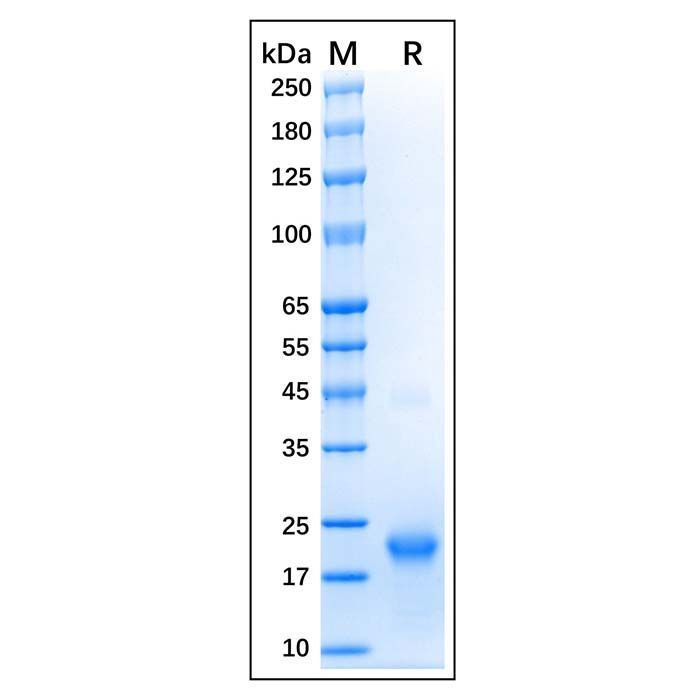
Recombinant Human GTPase HRAS Protein (rp170121) - SDS-PAGE 3 μg/lane of Recombinant Human GTPase HRAS Protein was resolved with SDS-PAGE under reducing (R) and visualized by Coomassie® Blue staining, showing a band at 22.4 kDa under reducing conditions.
Documentation
📋 Safety Data Sheet (SDS)
Comprehensive hazard, handling, storage, and regulatory compliance document.
We use cookies to ensure the website functions properly and, where permitted, to improve your experience. You can manage your preferences at any time in Settings. Learn more in our Cookie Policy.
Shall we send you a message when we have discounts available?
Remind me later
Thank you! Please check your email inbox to confirm.
Products are supplied to verified businesses, institutions, and qualified professionals for research and development use only. Not for use in humans, animals, diagnosis, or therapy.

 ZJ24F0102697