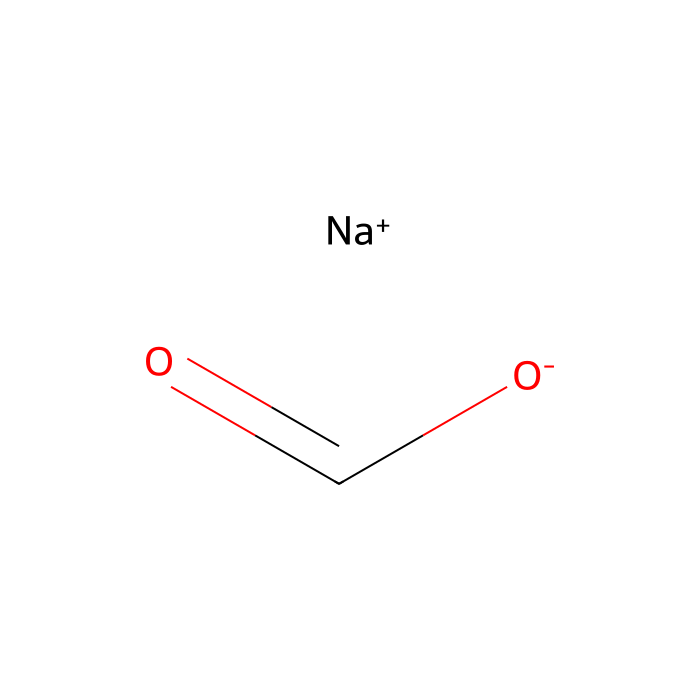
Sodium formate - ≥99.5% , CAS No.141-53-7

CAS: 141-53-7 Cat. No.: S164504 Formula: CHNaO2 Molecular Weight: 68.01 Beilstein Registry Number: 3595134 EC Number: 205-488-0
AVAILABLE TO ORDER
GRADE & PURITY ≥99.5%
Synonyms
SODIUM FORMATE|141-53-7|Formic acid, sodium salt|Formic acid sodium salt|Salachlor|FORMIC ACID, NA SALT|sodium formiate|Formic acid, sodium salt (1:1)|Sodium formate, refined|MFCD00013101|CHEBI:62965|387AD98770|sodium;formate|Mravencan sodny|Mravencan sod
Storage
Argon charged,Room temperature
Shipped In
Normal
★
Size
USA
Germany (EU)*
Price
Qty
100g
S164504-100g
Made to order · 8–12 wks
$9.90
500g
S164504-500g
In stock ≥10
4 In stock
$18.90
12×500g
S164504-12×500g
Made to order · 8–12 wks
$209.90
Enter a quantity for the sizes you want to add.
🧪
Why this grade

≥99.5% for sensitive chromatographic and analytical workflows requiring minimal baseline interference.

🌡

Storage & shipping

Argon charged,Room temperature Ships Normal Check lot-specific COA for exact specifications.

📋

Quality documents

SDS, COA, datasheet, and spec sheet available for download. Lot-specific COA accessible via lot number lookup.

📚

Literature proof

Cited in 162 peer-reviewed publications across chromatography, organic synthesis, and cross-coupling reactions.

Overview

Sodium formate is a versatile chemical used in many laboratory techniques including crystallization, molecule-based material construction, and chemiluminescence. Sodium formate is an intermediate involved in making of formic acid, oxalic acid, and sodium dithionite. Buffering agent for strong mineral acids and noble metals. Sodium formate has been shown to act as a sigmal for Salmonella invasion. Sodium formate also acts as a free radical scavenger.
A versitile formate compound employed in laboratory techniques

Specifications

Synonyms
SODIUM FORMATE | 141-53-7 | Formic acid, sodium salt | Formic acid sodium salt | Salachlor | FORMIC ACID, NA SALT | sodium formiate | Formic acid, sodium salt (1:1) | Sodium formate, refined | MFCD00013101 | CHEBI:62965 | 387AD98770 | sodium;formate | Mravencan sodny | Mravencan sod
Specifications & Purity
≥99.5%
Storage
Argon charged,Room temperature
Shipped In
Normal
Purity
≥99.5%
Names and Identifiers
Pubchem Sid
Pubchem Sid Url
https://pubchem.ncbi.nlm.nih.gov/substance/504760813
Canonical Smiles
C(=O)[O-].[Na+]
IUPAC Name
sodium;formate
InChIKey
HLBBKKJFGFRGMU-UHFFFAOYSA-M
INCHI
1S/CH2O2.Na/c2-1-3;/h1H,(H,2,3);/q;+1/p-1
Isomeric SMILES
C(=O)[O-].[Na+]
WGK Germany
1
RTECS
LR0350000
Molecular Weight
68.01
Beilstein
3595134

Documentation

📋 Safety Data Sheet (SDS)

Comprehensive hazard, handling, storage, and regulatory compliance document.

Download SDS →

✅ Certificate of Analysis (COA)

Lot-specific quality data. Enter your lot number to retrieve the exact COA.

Look up COA →

📊 Datasheet

Quick-reference summary of product specifications and applications.

View datasheet →

🔬 Specification Sheet

Full quality attributes and acceptance criteria for this grade.

View spec sheet →

Advanced Data

Taxonomic Classification

Taxonomy Tree

KingdomOrganic compounds
SuperclassOrganic acids and derivatives
ClassCarboxylic acids and derivatives
SubclassCarboxylic acid derivatives
Intermediate Tree Nodes Not available
Direct ParentCarboxylic acid salts
Alternative Parents Monocarboxylic acids and derivatives  Carboxylic acids  Organic sodium salts  Organic oxides  Hydrocarbon derivatives  Carbonyl compounds  
Molecular FrameworkAliphatic acyclic compounds
Substituents Carboxylic acid salt - Organic alkali metal salt - Monocarboxylic acid or derivatives - Carboxylic acid - Organic oxygen compound - Organic oxide - Hydrocarbon derivative - Organic sodium salt - Organic salt - Organooxygen compound - Carbonyl group - Aliphatic acyclic compound
DescriptionThis compound belongs to the class of organic compounds known as carboxylic acid salts. These are ionic derivatives of carboxylic acid.
External Descriptors organic sodium salt
3D Structure
Interactive Chemical Structure Model


Associated Targets(Human)
CA2 Tclin Carbonic anhydrase II (17698 Activities)
Activity TypeRelationActivity valueUnitsAction TypeJournalPubMed IddoiAssay Aladdin ID
CA1 Tclin Carbonic anhydrase I (13240 Activities)
Activity TypeRelationActivity valueUnitsAction TypeJournalPubMed IddoiAssay Aladdin ID
CA5A Tclin Carbonic anhydrase VA (1168 Activities)
Activity TypeRelationActivity valueUnitsAction TypeJournalPubMed IddoiAssay Aladdin ID
CA9 Tclin Carbonic anhydrase IX (8255 Activities)
Activity TypeRelationActivity valueUnitsAction TypeJournalPubMed IddoiAssay Aladdin ID
SLC16A3 Tchem Monocarboxylate transporter 4 (196 Activities)
Activity TypeRelationActivity valueUnitsAction TypeJournalPubMed IddoiAssay Aladdin ID
Associated Targets(non-human)
CA4 Carbonic anhydrase IV (1713 Activities)
Activity TypeRelationActivity valueUnitsAction TypeJournalPubMed IddoiAssay Aladdin ID
Carbonic anhydrase (69 Activities)
Activity TypeRelationActivity valueUnitsAction TypeJournalPubMed IddoiAssay Aladdin ID
Mechanisms of Action
Certificates(CoA,COO,BSE/TSE and Analysis Chart)
C of A & Other Certificates(BSE/TSE, COO):
Analytical Chart:

Find and download the COA for your product by matching the lot number on the packaging.

34 results found

Lot NumberCertificate TypeDateItem
F2630694Certificate of AnalysisJul 04, 2026 S164504
B2604146Certificate of AnalysisMar 05, 2026 S164504
A2604527Certificate of AnalysisJan 09, 2026 S164504
J2510638Certificate of AnalysisOct 24, 2025 S164504
J2510639Certificate of AnalysisOct 17, 2025 S164504
J2510640Certificate of AnalysisOct 17, 2025 S164504
I2503778Certificate of AnalysisSep 08, 2025 S164504
I2503779Certificate of AnalysisSep 06, 2025 S164504
H2514629Certificate of AnalysisAug 15, 2025 S164504
B2519504Certificate of AnalysisFeb 27, 2025 S164504
B2519503Certificate of AnalysisFeb 27, 2025 S164504
B2519502Certificate of AnalysisFeb 27, 2025 S164504
J2423266Certificate of AnalysisFeb 21, 2024 S164504
A2429089Certificate of AnalysisFeb 21, 2024 S164504
B2418288Certificate of AnalysisFeb 20, 2024 S164504
L2306187Certificate of AnalysisDec 12, 2023 S164504
L2306188Certificate of AnalysisDec 12, 2023 S164504
I2319498Certificate of AnalysisSep 26, 2023 S164504
G2402028Certificate of AnalysisSep 26, 2023 S164504
I2319499Certificate of AnalysisAug 01, 2023 S164504
G2324091Certificate of AnalysisAug 01, 2023 S164504
G2324104Certificate of AnalysisAug 01, 2023 S164504
G2315042Certificate of AnalysisJul 21, 2023 S164504
F2320181Certificate of AnalysisJun 21, 2023 S164504
F2320185Certificate of AnalysisJun 21, 2023 S164504
D2312636Certificate of AnalysisApr 15, 2023 S164504
A2306340Certificate of AnalysisJan 11, 2023 S164504
A2306888Certificate of AnalysisJan 10, 2023 S164504
I2213163Certificate of AnalysisSep 19, 2022 S164504
I2213164Certificate of AnalysisMar 14, 2022 S164504
C2208365Certificate of AnalysisMar 14, 2022 S164504
H2104275Certificate of AnalysisAug 07, 2021 S164504
G2201567Certificate of AnalysisAug 07, 2021 S164504
G2201565Certificate of AnalysisAug 07, 2021 S164504
Chemical and Physical Properties
SolubilitySoluble in water (970 mg/ml at 20 °C), glycerol, and alcohol (slightly). Insoluble in ether.
SensitivityMoisture sensitive
Boil Point(°C)360°C
Melt Point(°C)253°C
Molecular Weight68.007 g/mol
XLogP3
Hydrogen Bond Donor Count0
Hydrogen Bond Acceptor Count2
Rotatable Bond Count0
Exact Mass67.9874 Da
Monoisotopic Mass67.9874 Da
Topological Polar Surface Area40.100 Ų
Heavy Atom Count4
Formal Charge0
Complexity13.500
Isotope Atom Count0
Defined Atom Stereocenter Count0
Undefined Atom Stereocenter Count0
Defined Bond Stereocenter Count0
Undefined Bond Stereocenter Count0
The total count of all stereochemical bonds0
Covalently-Bonded Unit Count2
Documents & Articles
Citations of This Product
Solution Calculators
Reviews

Customer Reviews

Application Protocols

No item-specific tested protocols are provided for this catalog entry. For general laboratory use (literature guidance):

  • Buffer stock (1.0 M): Dissolve 68.0 g sodium formate in water and make up to 1.0 L; adjust pH with concentrated formic acid to the desired value (within 2.8–4.8 range). Filter through 0.22 µm if sterility is needed.
  • Pd/C transfer hydrogenation screening: Charge substrate (1.0 eq), Pd/C (5 wt% of substrate), sodium formate (3.0 eq), solvent (MeOH/H2O 4:1, 0.1–0.5 M), heat 50 °C, monitor by TLC/GC/MS. Optimize catalyst loading and temperature as needed.
  • FDH cofactor recycling: Prepare buffer (e.g., 100 mM sodium formate, pH 7.0 adjusted with formic acid/NaOH as appropriate to enzyme spec), add NAD+ and FDH per supplier recommendations; couple to target reductase.

Always adapt to your system and consult primary literature and the SDS. No warranties for specific applications are implied.

Biological Roles
  • General background (literature)

    • Formate is a central one-carbon (C1) unit in cellular metabolism. It is produced from serine/glycine catabolism and mitochondrial folate-mediated one‑carbon metabolism and can be assimilated into purine and thymidylate biosynthesis via 10‑formyl‑THF.
    • Many microorganisms utilize formate as an electron donor/acceptor; formate dehydrogenases oxidize formate to CO2 while reducing NAD+ or other electron carriers, a reaction exploited for cofactor regeneration in biocatalysis.
    • In mammalian systems, formate levels are tightly regulated; excess formate (notably from methanol metabolism) is toxic primarily through mitochondrial inhibition and acidosis, although sodium formate salts at lab concentrations are routinely handled safely with standard precautions.
  • Laboratory relevance (literature)

    • Sodium formate is used as a substrate for formate dehydrogenase (FDH) to drive NADH-dependent reductive biotransformations and as an osmolyte/ionic strength modifier in biochemical buffers.
    • In electrophoresis and protein work, formate buffers can minimize chloride interference and provide stable low‑pH environments.
  • Notes

    • No clinical or therapeutic claims are implied. All uses are for research/lab applications only.
Buffer Applications

Sodium formate is paired with formic acid to make formate buffers effective near the pKa of formic acid (3.75), suitable for low‑pH applications.

  • Effective pH range (literature)

    • ~2.8–4.8, centered around pH 3.75.
  • Preparation (literature example)

    • To prepare 0.1 M formate buffer, pH 3.5: Dissolve sodium formate to 0.1 M in water, then titrate with ~0.1 M formic acid to pH 3.5. Alternatively, prepare equimolar solutions of sodium formate and formic acid and mix according to Henderson–Hasselbalch.
    • For pH 4.0 at 0.05 M total buffer: Ratio [base]/[acid] ≈ 10^(4.0−3.75) ≈ 1.78. Adjust volumes accordingly.
  • Practical considerations

    • CO2 uptake can slowly convert a portion of formate to bicarbonate/carbonate, slightly shifting pH; use tightly sealed containers and freshly prepare critical buffers.
    • For LC-UV work, formate provides low background absorbance at >210 nm; for LC-MS, ammonium formate (volatile) is often preferred over sodium formate to avoid nonvolatile residues.
    • Filter sterilize (0.22 µm) for cell-free biochemical assays; formate buffers are typically too acidic for most mammalian cell culture.
  • Ionic strength and conductivity

    • Sodium formate contributes high conductivity advantageous in certain electrophoretic systems operating at low pH.
Green Alternatives

Sodium formate often represents a greener alternative itself to pressurized hydrogen or metal hydrides for reductions, offering mild, aqueous-compatible conditions. Selection should weigh atom economy, waste profile, and downstream removal.

  • Comparative assessment (literature)

    • Versus H2 gas: Avoids high-pressure equipment; safer handling; similar redox outcome via transfer hydrogenation, albeit with stoichiometric salt usage.
    • Versus borohydrides/silanes: Lower hazard and easier quench/neutralization; fewer boron/silicon residues; generally narrower substrate scope without catalysts.
    • Versus ammonium formate: Ammonium formate is more volatile and MS-friendly (for LC-MS buffers) but less benign odor-wise and can release ammonia; sodium formate is odorless and often cheaper but nonvolatile, leaving sodium residues.
  • Environmental and safety tradeoffs

    • Aqueous media compatibility reduces reliance on VOCs; effluents contain sodium salts and formate/formic acid, which are biodegradable/oxidizable under typical wastewater treatments.
    • Catalyst compatibility can extend catalyst lifetime compared to chloride-containing reductants.
  • Selection guide (literature)

    • Choose sodium formate when: aqueous systems are acceptable; pressurized hydrogen is impractical; downstream sodium is tolerable.
    • Choose ammonium formate/formic acid when: volatile buffers are needed (e.g., LC-MS) or when sodium contamination must be avoided.
Pharmaceutical Uses
  • Item-specific status

    • Pharmacopeial designation: Not specified for this item; refer to CoA/Spec Sheet.
  • General roles in formulation (literature; no therapeutic claims)

    • Buffering agent: Component of low‑pH buffer systems with formic acid for stability studies and certain analytical methods.
    • Processing aid: Hydrogen donor in catalytic reductions during API intermediate synthesis (process chemistry), offering a safer alternative to pressurized hydrogen in some steps.
    • Excipient considerations: As a nonvolatile inorganic salt, residual sodium formate may persist; typically avoided in final parenteral products unless justified and controlled. For MS‑based analytical methods, ammonium formate is often preferred due to volatility.
  • Quality considerations

    • If used in GMP settings, control bioburden/endotoxin (for aqueous solutions), heavy metals, and residual formic acid. Confirm UV transparency if used in analytical methods.
  • Regulatory note

    • Any pharmacopeial compliance (USP/Ph. Eur.) must be verified per lot on the CoA; none is implied for this catalog item without explicit statement.
Physical Properties
  • Item-specific specifications

    • Appearance: Not specified for this item; refer to CoA/Spec Sheet.
    • Grade/Purity: Not specified for this item; refer to CoA/Spec Sheet.
  • Physical data (literature, typical values for sodium formate)

    • Form: Crystalline solid; mildly hygroscopic
    • Melting point: ~253–255 °C (decomposes) (literature)
    • Density (bulk/true): ~1.92 g/cm³ at 20 °C (literature)
    • Solubility: Highly soluble in water (e.g., >90 g/100 g H2O at 20 °C); sparingly soluble in alcohols; essentially insoluble in nonpolar solvents (literature)
    • pKa of conjugate acid (formic acid): 3.75 at 25 °C (buffering range ~2.8–4.8) (literature)
    • Aqueous solution pH: Basic; e.g., 0.1 M solutions typically near pH 8–8.5 depending on ionic strength/CO2 (literature)
    • LogP: Not applicable (ionic inorganic salt); effective partitioning driven by hydration (literature)
    • Refractive index: Not applicable to solid; aqueous RI depends on concentration (literature)
  • Practical notes

    • Hygroscopic uptake is modest but can cause caking; keep well closed under inert gas as specified for this item.
    • Strongly exothermic dissolution in water is limited; solutions are clear and colorless when pure.
Quality & Grades
  • Item-specific grade/purity

    • Grade/Purity: Not specified for this item; refer to CoA/Spec Sheet.
  • Interpreting common grades for sodium formate (general guidance)

    • Analytical Reagent (AR)/ACS: Assayed purity typically ≥98–99%; controlled levels of chloride, sulfate, heavy metals.
    • Biochemical/Cell culture grade: Additional testing for bioburden/endotoxin; low trace metals; not implied for this item unless stated on the CoA.
    • Buffer grade: Emphasis on low UV absorbance and defined alkalinity/acid equivalence.
  • Stabilizers/impurities (general)

    • Sodium formate typically requires no stabilizers. Impurities may include residual formic acid, sodium carbonate/bicarbonate (from CO2 uptake), chloride, sulfate, and trace metals depending on source.
  • What to check on the CoA for this item

    • Assay (on dry basis), loss on drying, pH of a defined solution, insoluble matter, chloride/sulfate limits, heavy metals, and UV absorbance if relevant to your application.
  • Fit-for-purpose

    • For catalytic transfer hydrogenations or reductions, low chloride and trace metal content improve catalyst lifetimes.
    • For buffering/HPLC applications, confirm low UV background and consistent alkalinity.
Reaction & Applications

Sodium formate is a versatile reagent primarily valued as a benign hydride-equivalent (H−/H2 source) and as a buffering component.

  • Transfer hydrogenation and reductions (literature)

    • Pd/C-mediated reductions: Serves as a convenient hydrogen donor for the reduction of nitro groups to anilines, dehalogenation of aryl halides, and reductive debromination/defluorination under mild conditions. Typical systems utilize 5–10 wt% Pd/C with several equivalents of sodium formate in MeOH/H2O or EtOH/H2O at 25–80 °C.
    • Homogeneous catalysis: With Ru(II)/Rh/Ir catalysts, sodium (or ammonium) formate mediates transfer hydrogenation of ketones, imines, and certain alkenes.
  • Reductive amination (literature)

    • After imine/enamine formation, sodium formate can provide reducing equivalents in the presence of Pd/C or homogeneous catalysts, enabling one-pot reductive amination of carbonyls.
  • Formylation chemistry (literature)

    • As a formyl source to generate formamides from amines under activating conditions (e.g., with coupling agents or dehydrating reagents) or via catalytic oxidative coupling.
  • Carbon/energy source in chemo/biocatalysis (literature)

    • Employed with formate dehydrogenase for NADH regeneration systems.
  • Buffer and analytical uses (literature)

    • Component of formate buffers in electrophoresis and chromatography; modulates ionic strength and pH.
  • Practical tips

    • Limit CO2 exposure to minimize carbonate formation that can shift pH.
    • For heterogeneous reductions, pre-wet and rinse Pd/C thoroughly; add sodium formate portionwise to control gas evolution and foaming.
    • Monitor reactions for formic acid accumulation that can alter catalyst activity and substrate protonation state.
Reaction Conditions

The following are illustrative literature conditions; optimize per substrate and scale. Always consult primary sources.

  • Pd/C-mediated reductions using sodium formate (literature)

    • Substrates: Nitroarenes, haloarenes (dehalogenation), imines.
    • Catalyst: 5–10 wt% Pd/C (0.5–5 mol% Pd typical).
    • Reagent loading: 2–5 equivalents sodium formate.
    • Solvent: MeOH/H2O, EtOH/H2O, or pure alcohols; polar aprotics with water also reported.
    • Temperature/time: 25–80 °C, 1–24 h depending on substrate.
    • Atmosphere: Inert recommended; gradual addition of formate helps control gas evolution.
    • Workup: Filter off catalyst, concentrate, and partition; neutralize residual formate/formic acid as needed.
  • Homogeneous transfer hydrogenation (literature)

    • Catalyst: Ru(II)–arene or Rh/Ir complexes (0.1–2 mol%).
    • Base/additives: Often none required beyond formate; some systems use additional base or TEA.
    • Solvent: Water, MeOH, i‑PrOH, or mixed aqueous media.
    • Conditions: 25–60 °C; 1–12 h; ketone → alcohol yields commonly high (70–95%) under optimized conditions.
  • Reductive amination with sodium formate (literature)

    • Pre-form imine (Lewis acid or dehydration) then add Pd/C and NaOOCH.
    • Typical: 3–4 equiv sodium formate, MeOH or EtOH, 40–70 °C, several hours, furnishing secondary/tertiary amines.
  • Buffer preparation (literature)

    • 0.1–0.5 M stocks in water; adjust with formic acid to target pH; filter sterilize if required.
Safety & Handling
  • GHS classification and hazard statements (item-specific)

    • Signal word: Not specified for this item; refer to SDS.
    • H-statements/Pictograms: Not specified for this item; refer to SDS.
  • General safety (literature/good laboratory practice)

    • Expected hazards: May cause mild eye/skin irritation and GI upset if ingested; dust may irritate respiratory tract.
    • PPE: Wear lab coat, safety glasses, and appropriate gloves (e.g., nitrile). Use a dust mask or work in a fume hood to minimize inhalation of dust.
    • Handling: Avoid generating dust/aerosols. Add to water with stirring when preparing solutions. Follow the item’s Argon-charged storage recommendation to limit moisture/CO2 uptake.
    • Incompatibilities: Strong acids (release formic acid vapors), strong oxidizers. Avoid contact with aluminum or zinc in wet conditions that may evolve hydrogen when acids are present.
    • Decomposition: Heating above the melting/decomp range can generate formic acid, CO, CO2, and water.
    • First aid (overview; consult SDS):
      • Inhalation: Move to fresh air; seek medical attention if symptoms persist.
      • Skin/eye contact: Rinse with water for several minutes; remove contaminated clothing; obtain medical advice if irritation continues.
      • Ingestion: Rinse mouth; do not induce vomiting; seek medical attention.
    • Spill/cleanup: Sweep up to avoid dusting; collect in labeled container. Wash spill area with water.
    • Fire: Not combustible as a salt; use extinguishing media suitable for surrounding fire. Thermal decomposition may release irritating vapors.
Solvent Selection

This product is a water-soluble inorganic salt rather than an organic solvent. Solvent selection therefore concerns dissolution for use, not using it as a reaction medium.

  • Polarity and miscibility (literature)

    • Readily soluble in water across a wide concentration range; limited solubility in methanol/ethanol; negligible in aprotic/nonpolar media (e.g., ethers, hydrocarbons).
  • Practical choices by application

    • Aqueous buffers: Dissolve directly in deionized water, adjust pH with formic acid to prepare formate buffers.
    • Transfer hydrogenation: Water, alcohols (MeOH/EtOH), and mixed aqueous-organic systems are typical; choose based on catalyst system and substrate solubility.
    • Biochemical systems: Use high-purity water; filter-sterilize through 0.22 µm if sterility is required.
  • Comparison (literature)

    • Sodium formate vs ammonium formate: Ammonium formate is more volatile and MS-friendly for LC-MS buffers; sodium formate offers higher buffering capacity at elevated ionic strength but leaves nonvolatile sodium in residues.
    • Sodium formate vs formic acid: Formic acid alone acidifies; the sodium salt is required for buffer capacity near pH ~3–4.
Storage & Reconstitution
  • Item-specific storage

    • Store at room temperature, Argon charged (as provided). Keep container tightly closed to minimize moisture and CO2 uptake that can form sodium carbonate/bicarbonate.
    • Shipped: Normal conditions.
  • General handling

    • Desiccation is beneficial for long-term stability; avoid repeated exposure to humid air.
    • If caking occurs, gently break up and verify assay by weight-on-dry-basis if critical.
  • Solution preparation (literature guidance)

    • Aqueous stocks are stable for weeks at ambient temperature if microbial growth is controlled; for sensitive work, prepare fresh or store refrigerated (2–8 °C) and protect from contamination.
    • Sterile stocks: Prepare with sterile water and 0.22 µm filter; label concentration, pH, and date. Avoid autoclaving acidic formate buffers in metal vessels due to potential corrosion.
  • Freeze–thaw

    • Not generally applicable to the dry solid. Aqueous solutions can be frozen if needed; expect cryoconcentration effects and recheck pH upon thaw.
  • Expiry

    • No item-specific shelf life is provided; consult CoA/Spec Sheet. Inspect periodically for discoloration or insoluble matter, which may indicate contamination or decomposition.
Structure & Identity

Sodium formate is the sodium salt of formic acid, a simple C1 carboxylate, useful as a buffer component and transfer-hydrogen source in catalysis.

  • Item-specific (from Product Data)

    • SKU: S164504
    • CAS: 141-53-7
    • PubChem CID: 2723810
    • InChIKey: 124337 (as provided)
    • Storage conditions: Room temperature, Argon charged
    • Shipped in: Normal
    • Research Use: For research use only
  • Structure (literature)

    • Molecular formula: NaCHO2 (often written as HCOONa)
    • Molecular weight: 68.01 g/mol (literature)
    • SMILES: O=CO[Na] or [Na+].[O-]C=O (literature)
    • InChIKey (literature): VSKZSECVFHJBQZ-UHFFFAOYSA-M
    • Functional groups: Carboxylate anion (formate) coordinated to Na+; no stereocenters.
    • 2D description: A central carbonyl carbon double-bonded to oxygen and single-bonded to an oxyanion (formate), with sodium as the counter-cation; linear, small anionic species.
  • Notes

    • The provided identifier set is minimal; consult the CoA/SDS for definitive, item-specific identifiers and batch-linked metadata.
Synthetic Utility
  • Functional profile (literature)

    • Sodium formate acts as a benign hydride equivalent and formyl source. In the presence of appropriate catalysts, it effects transfer hydrogenation of nitro, imine, and carbonyl functionalities and supports reductive amination.
  • Named/representative transformations

    • Pd/C–formate reductions: Nitro → aniline; aryl halide dehalogenation; azide → amine under mild conditions.
    • Noyori-type transfer hydrogenation: Ru(II) catalysts reduce ketones/imines using formate as hydrogen donor.
    • Formylation: Conversion of amines to formamides using sodium formate under activating or catalytic oxidative conditions; useful for protecting groups or intermediate modification.
    • Biocatalytic NADH regeneration: Formate + FDH to drive reductive enzymes.
  • Retrosynthetic value

    • Allows replacing pressurized H2 or pyrophoric hydrides, enabling milder, aqueous or alcoholic media compatible pathways—useful for sensitive substrates and late-stage functionalization.
  • Practical advice

    • Control base strength: Excess basicity from formate can impact acid-sensitive groups; buffer with formic acid or choose ammonium formate where neutrality/volatility are critical.
    • Salt by-products: Plan for sodium-containing aqueous waste and potential ion-exchange needs if metal-sensitive downstream steps follow.
Target Specificity

This product is a small-molecule inorganic salt, not an antibody, enzyme, or probe. Target specificity concepts (epitope, clone, isotype, species reactivity) are not applicable. For application-relevant information, see the sections on Reaction & Applications, Buffer Applications, and Synthetic Utility.

Frequently Asked Questions

What is the purity of this product?
This product is supplied at ≥99.5% purity (chemical assay). Lot-specific values are stated on the Certificate of Analysis.
How should this product be stored?
Store at room temperature under argon. It is supplied under an argon blanket; reseal under inert gas after each use.
How is this product shipped?
This product ships under standard ambient conditions. No temperature-controlled packaging is required.
What are the CAS number, molecular formula and molecular weight?
The CAS Number is 141-53-7, the molecular formula is CHNaO2, and the molecular weight is 68.01 g/mol. InChIKey HLBBKKJFGFRGMU-UHFFFAOYSA-M.
What documentation is provided?
Available product documentation, including Certificates of Analysis (COA), Safety Data Sheets (SDS), and specification sheets, is shown in the product document area. Document availability and access follow the current site policy.

Shall we send you a message when we have discounts available?

Remind me later

Thank you! Please check your email inbox to confirm.

Oops! Notifications are disabled.