GRADE & PURITYMoligand™?Moligand™ — Aladdin's line of ligands and bioactive small molecules. Use for receptor, pathway, and binding studies needing defined small-molecule tools.10mM in DMSO
Moligand™, 10mM in DMSO Moligand™ for sensitive chromatographic and analytical workflows requiring minimal baseline interference.
🌡
Storage & shipping
Store at -80°C Ships Dry ice packs + Cold packs Check lot-specific COA for exact specifications.
📋
Quality documents
SDS, COA, datasheet, and spec sheet available for download. Lot-specific COA accessible via lot number lookup.
📚
Literature proof
Cited in 0 peer-reviewed publications across chromatography, organic synthesis, and cross-coupling reactions.
Overview
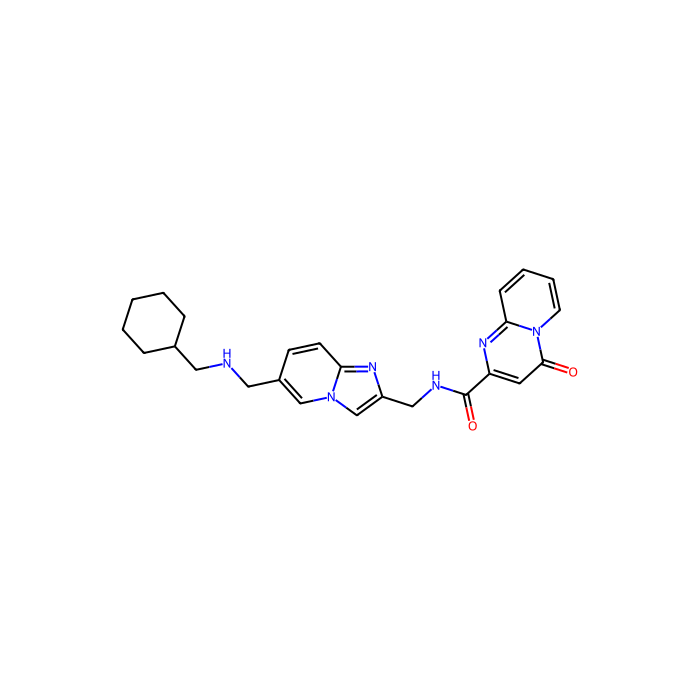
STM2457 is a first-in-class, highly potent, selective METTL3 inhibitor with an IC50 of 16.9 nM. STM2457 can be used for the research of acute myeloid leukaemia (AML).
This compound belongs to the class of organic compounds known as pyridopyrimidines. These are compounds containing a pyridopyrimidine, which consists of a pyridine fused to a pyrimidine. Pyridine is 6-membered ring consisting of five carbon atoms and a nitrogen atom. Pyrimidine is a 6-membered ring consisting of four carbon atoms and two nitrogen centers at the 1- and 3- ring positions.
External Descriptors
Not available
1. Djoumbou Feunang Y, Eisner R, Knox C, Chepelev L, Hastings J, Owen G, Fahy E, Steinbeck C, Subramanian S, Bolton E, Greiner R, and Wishart DS. ClassyFire: Automated Chemical Classification With A Comprehensive, Computable Taxonomy. Journal of Cheminformatics, 2016, 8:61.
Determine the necessary mass, volume, or concentration for preparing a solution.
Dilution Calculator
Determine the dilution needed to prepare a stock solution.
Reconstitution Calculator
Reviews
Customer Reviews
Application Protocols
Tested/validated applications, recommended concentrations, and control protocols are Not specified for this item; refer to CoA/Spec Sheet.
General research-use guidance (non-item-specific):
Prepare a 10 mM DMSO stock, aliquot, and store at −80°C. Thaw once, prepare working dilutions immediately before use, and avoid repeated freeze–thaw.
For biochemical assays: run 10–12 point dose–response curves with triplicates; include SAM/SAH controls and verify enzyme activity linearity.
For cell assays: start with 0.01–10 µM titrations; maintain constant DMSO across all wells; include cytotoxicity counterscreens and orthogonal readouts.
Record pH, temperature, incubation time, and plate map rigorously to ensure reproducibility.
Biological Roles
Context (literature/general):
STM2457 is widely cited as a selective small-molecule inhibitor of the mRNA N6-adenosine methyltransferase METTL3, a catalytic component of the writer complex depositing the m6A modification on RNA. METTL3, often with METTL14 and WTAP, regulates RNA metabolism including splicing, nuclear export, translation efficiency, and decay through m6A reader proteins (e.g., YTH domain proteins).
Chemical inhibition of METTL3 is leveraged to dissect epitranscriptomic control points that influence differentiation, stress responses, and lineage-specific gene expression programs.
Research use (non-clinical):
Tool compounds like STM2457 enable cause–effect mapping between METTL3 activity and transcriptomic changes by correlating biochemical inhibition with shifts in m6A marks (e.g., MeRIP‑seq) and downstream functional assays (translation profiling, RNA stability measurements).
In cell-based systems, researchers typically titrate inhibitors to identify on-target windows that modulate m6A without overt cytotoxicity, validating with rescue experiments (e.g., overexpression of resistant mutants) and orthogonal readouts.
Caution:
Selectivity profiles can be assay- and context-dependent. Always confirm target engagement in your specific biological system and avoid extrapolating findings beyond the intended research scope. No medical or clinical use is implied.
Buffer Applications
This product is not a buffer component; it is a bioactive small molecule used at low micromolar concentrations in biochemical or cell-based assays.
Practical notes (general):
Prepare concentrated DMSO stocks and dilute into assay buffers such as HEPES, Tris, or PBS-based systems immediately before use. Maintain consistent final DMSO content across controls and treated samples.
For enzymology with METTL3, buffers commonly include HEPES or Tris, Mg2+ (if required by the assay design), and SAM/S-adenosylhomocysteine controls. Optimize ionic strength and pH (often pH 7.4–8.0) for enzyme stability and activity. These are general literature considerations, not item-specific specifications.
Buffer-related specifications for this item: Not specified; refer to CoA/Spec Sheet.
Green Alternatives
Applicability: This product is a bioactive screening ligand, not a process solvent or bulk reagent. “Green alternatives” therefore pertain to handling and solution preparation rather than replacing the compound itself.
Greener handling strategies (general):
Minimize DMSO volumes by preparing higher-concentration master stocks and micro-aliquots to reduce waste.
Use aqueous-compatible assay formats where possible, with low final DMSO (≤0.1–0.5% v/v) to reduce solvent burden.
Implement microscale assays (96–1536 well) to decrease per-experiment chemical and solvent consumption.
Prefer LC–MS methods with water/MeOH or water/ACN mobile phases and reduced flow rates to limit solvent use; recycle organic solvents where compliant.
Alternative vehicles (contextual):
If DMSO use is constrained, evaluate ethanol or PEG400/water systems, or cyclodextrin complexation, balancing solubility, stability, and biological compatibility.
Trade-offs:
Lower DMSO can improve green metrics but may compromise solubility and assay linearity; verify dose accuracy and compound stability under modified conditions.
Pharmaceutical Uses
This product is supplied strictly for research use only. It is not an API, excipient, or GMP material, and it is not intended for human or veterinary use.
Formulation/processing context (research only):
In discovery biology, compounds of this class are typically handled as DMSO stock solutions and dosed into in vitro assays. For advanced pre-formulation studies (research-stage only), mixed solvent systems (e.g., DMSO/PEG400/water) or cyclodextrin vehicles are sometimes explored to enhance apparent solubility for in vivo model work; such uses require rigorous internal qualification and are outside the scope of this catalog entry.
Pharmacopeial status, excipient role, impurity limits: Not specified for this item; refer to CoA/Spec Sheet.
No therapeutic claims are made or implied.
Physical Properties
Appearance: Not specified for this item; refer to CoA/Spec Sheet.
Molecular weight: Not specified for this item; refer to CoA/Spec Sheet.
Molecular formula: Not specified for this item; refer to CoA/Spec Sheet.
Melting point: Not specified for this item; refer to CoA/Spec Sheet.
Boiling point: Not applicable/Not typically reported for complex bioactive solids; not specified for this item.
Density: Not specified for this item; refer to CoA/Spec Sheet.
Solubility:
Item-specific aqueous/organic solubility: Not specified for this item; refer to CoA/Spec Sheet.
General guidance (literature/experience): bioactive heteroaromatics of this class are commonly soluble in anhydrous DMSO at 10–50 mM and may require co-solvents (e.g., PEG400, ethanol) for high aqueous concentrations. Verify empirically.
LogP/logD, pKa, refractive index: Not specified for this item; refer to CoA/Spec Sheet.
UV/Vis characteristics: Not specified for this item; refer to CoA/Spec Sheet. For quantitative assays, determine ε/λmax experimentally in your assay buffer or use HPLC-UV at multiple wavelengths (e.g., 210/254/280 nm).
Hygroscopicity/photolability: Not specified for this item. As a precaution, limit exposure to ambient moisture and strong light; handle quickly on the bench and return to cold storage.
Notes:
When preparing stocks, filter-sterilize only if chemically compatible with the compound and solvent. Avoid adsorption losses by using low-binding plastics or glass for low-µM working solutions.
Quality & Grades
Grade/Purity: Moligand™ (as provided). Moligand denotes a research-grade small-molecule ligand suitable for discovery screening and chemical biology workflows.
What this typically implies (general guidance; consult CoA for item-specific specs):
Identity confirmation by LC–MS and/or NMR.
Chromatographic purity suitable for screening assays; exact assay/purity thresholds are Not specified for this item; refer to CoA/Spec Sheet.
Packaging intended to minimize moisture uptake and degradation (e.g., sealed vials, inert backfill when applicable).
How to use grade information:
For biophysical/biochemical assays (e.g., enzyme inhibition, binding), confirm purity by an orthogonal method prior to SAR conclusions.
For cell-based assays, consider additional clean-up or repurification if ultra-low impurity backgrounds are required.
Stabilizers/additives: Not specified for this item; refer to CoA/Spec Sheet. If no stabilizer is listed, store under recommended conditions and avoid repeated freeze–thaw.
Batch-to-batch documentation:
Retain the Certificate of Analysis (CoA) that accompanies your lot for traceability of analytical methods, purity results, water content, and residual solvents where available.
Reaction & Applications
STM2457 is not commonly used as a chemical reagent or solvent for synthetic transformations. Instead, its utility lies in chemical biology and screening applications. Accordingly, the following focuses on assay-related applications rather than organic reactions.
Chemical biology applications (literature/general):
Used as a tool compound to probe the function of the RNA N6-adenosine methyltransferase METTL3, enabling interrogation of m6A-dependent pathways in vitro and in cells.
Employed in enzyme inhibition assays (radiometric, LC–MS methylation readouts), target engagement approaches (e.g., CETSA, NanoBRET), and transcriptional/epitranscriptomic studies (MeRIP‑seq, m6A-Seq) to connect biochemical inhibition with cellular phenotypes.
Supports SAR development when combined with close analogs in orthogonal biochemical and biophysical assays (e.g., ITC, SPR) to characterize binding thermodynamics and kinetics.
Practical tips:
Verify activity window in your assay format using a concentration-response (10–12 points, half-log spacing). Include positive/negative controls and evaluate DMSO tolerance.
Assess chemical stability in assay buffer over the full incubation time (LC–MS time-course). Light- and oxidation-sensitivity should be checked empirically.
For cellular assays, confirm intracellular exposure via LC–MS/MS and monitor potential off-target cytotoxicity with orthogonal viability assays.
Synthetic reaction use: Not typically applicable. For organic synthesis needs, consult reagents/solvents dedicated to transformation chemistry.
Reaction Conditions
Not applicable to this product as a reagent for chemical synthesis.
Assay-condition guidance (general, literature-informed for METTL3 enzymology):
Temperature: Many methyltransferase assays are performed at 25–37°C; choose conditions that preserve enzyme stability while providing measurable turnover.
Time: 15–120 min typical, depending on substrate, enzyme concentration, and detection method (radiometric, LC–MS, fluorescent SAH-coupled readouts).
Cofactors: S-adenosyl-L-methionine (SAM) as methyl donor; include SAH controls where appropriate.
Detection: Quantify methylated RNA nucleosides by LC–MS/MS or use antibody-based MeRIP workflows for enrichment prior to sequencing. Always include DMSO-matched vehicle controls for inhibitor titrations.
Item-specific optimal conditions, solubility limits, stability, and IC50: Not specified for this item; refer to CoA/Spec Sheet and primary literature relevant to your assay design.
Safety & Handling
GHS classification, signal word, H/P statements, pictograms: Not specified for this item; refer to the product SDS for authoritative hazard information.
General laboratory precautions (good practice):
Handle in a chemical fume hood; avoid inhalation, ingestion, and skin/eye contact.
Wear appropriate PPE: lab coat, safety glasses, and nitrile gloves. Upgrade PPE if aerosol generation or larger-scale handling is expected.
Prevent environmental release; collect waste in properly labeled organic waste containers compatible with DMSO/organic solvents.
Incompatibilities (general):
Strong oxidizers and strong acids/bases may degrade heteroaromatic small molecules. Avoid prolonged exposure to moisture and elevated temperatures.
First-aid overview (non-specific; defer to SDS):
Skin/eye contact: Rinse with water for at least 15 minutes; remove contaminated clothing; seek medical advice.
Inhalation: Move to fresh air; monitor breathing; seek medical attention if symptoms persist.
Ingestion: Rinse mouth; do not induce vomiting; seek medical attention.
Special risks/handling notes:
Prepare concentrated stocks in closed containers to minimize volatilization and exposure. Use amber vials if photolability is suspected. Filter solutions only after confirming chemical compatibility with membranes (PTFE/RC often preferred over nylon for polar aprotic solvents).
For research use only: Not intended for human or veterinary use.
Solvent Selection
Intended use: STM2457 is a bioactive small molecule used predominantly in biochemical and cell-based assays rather than as a reaction solvent.
DMSO is the most common vehicle for hydrophobic/heteroaromatic inhibitors. Typical working stocks: 10 mM in anhydrous DMSO, aliquoted and stored at ≤ −20 to −80°C to limit freeze–thaw cycles.
For aqueous dosing, pre-dilute DMSO stocks into media/buffer to a final DMSO concentration generally ≤0.1–0.5% v/v (optimize per assay tolerance). Employ surfactant-free conditions unless otherwise validated.
Miscibility and co-solvents (general):
DMSO mixes with water and most polar solvents; EtOH or PEG400 can assist with higher-concentration formulations for in vitro work. Verify compound stability in each diluent.
Solubility for this item: Not specified for this item; refer to CoA/Spec Sheet.
Comparison notes:
If DMSO is undesirable (e.g., sensitive cellular readouts), consider HP-β-CD inclusion complexes or mixed cosolvent systems (EtOH/water, PEG400/water) following small-scale compatibility tests.
Storage & Reconstitution
Storage conditions (from Product Data): Store at −80°C.
Shipping (from Product Data): Shipped on dry ice packs + cold packs to maintain low temperature during transit.
Stability notes:
Long-term stability is enhanced at deep-cold temperatures. Minimize exposure to ambient conditions; allow vials to equilibrate to room temperature in a desiccated environment before opening to prevent condensation.
Protect from moisture and light as a precaution. Actual shelf life and stability-indicating data are Not specified for this item; refer to CoA/Spec Sheet.
Reconstitution (general guidance for bioactive small molecules):
Dissolve the solid (or thaw the supplied solution, if applicable) in anhydrous DMSO to prepare a concentrated stock (e.g., 10 mM). Item-specific solubility is Not specified for this item; verify empirically.
Vortex gently and, if needed, brief sonication to aid dissolution. Filter only after confirming compatibility with the membrane material.
Aliquot into single-use volumes in amber, low-bind tubes; store aliquots at −80°C. Avoid repeated freeze–thaw cycles.
Working solutions:
Dilute DMSO stocks into pre-warmed assay buffer or culture media immediately prior to use, maintaining consistent final DMSO across controls. Discard unused working solutions at the end of the day unless stability has been established under your conditions.
Molecular formula: Not specified for this item; refer to CoA/Spec Sheet.
Molecular weight: Not specified for this item; refer to CoA/Spec Sheet.
SMILES: Not specified for this item; refer to CoA/Spec Sheet.
InChIKey: 253309 (as provided in Product Data)
Structural features (general, literature context):
STM2457 is widely referenced as a selective, ATP-competitive small-molecule inhibitor targeting the m6A RNA methyltransferase METTL3 (literature). Reported scaffolds for METTL3 inhibitors often include fused heteroaromatic ring systems, H-bond acceptors/donors positioned to engage the SAM/ATP-binding pocket, and polar substituents that tune solubility and selectivity. Exact atom connectivity for this specific lot is not provided here; consult the CoA/SDS for definitive structure.
2D structure description (general):
Literature depictions show a compact heteroaromatic core bearing multiple nitrogen atoms, appended with heteroatom-containing side chains arranged to mimic cofactor interactions in the catalytic site of METTL3. Without a provided SMILES/InChI, no item-specific 2D atom mapping can be given.
Identity controls and best practices:
For screening use, verify identity by orthogonal methods (e.g., LC–MS with exact mass and isotopic pattern, 1H/13C NMR in DMSO‑d6 or CD3OD) and check purity profiles before biological assays. Retain the CoA/In-process control data for traceability.
Synthetic Utility
STM2457 is a finished bioactive small molecule and is not typically employed as a synthetic reagent, building block, or catalyst.
General notes for synthetic chemists (contextual):
If analog synthesis or SAR exploration is of interest, scaffold modifications commonly target heteroaromatic cores and side-chain substituents that interact with the METTL3 catalytic pocket (literature). Purification often relies on reverse-phase preparative HPLC given polarity and potential basic sites.
Structural verification by LC–MS (ESI+), 1H/13C NMR (DMSO‑d6/CD3OD), and, where relevant, 2D NMR (HSQC/HMBC) is recommended. Solid-state form (amorphous vs crystalline salt) can influence handling; characterize if required.
For routine laboratory synthesis needs (e.g., coupling reagents, catalysts, solvents), refer to reagents designed for those transformations. STM2457 itself has no customary role as a reagent in named reactions.
Target Specificity
Item-specific target, selectivity panel results, and potency metrics are Not specified for this item; refer to CoA/Spec Sheet.
No additional target information is provided in the Product Data. Users should consult peer-reviewed literature for general background and perform in-house validation (e.g., CETSA, CETSA MS, NanoBRET, genetic rescue) to confirm on-target activity under their conditions.
Need help choosing the grade?
Our grade selection guide covers purity, stabilizer status, and application suitability for all variants in our catalog.
We use cookies to ensure the website functions properly and, where permitted, to improve your experience. You can manage your preferences at any time in Settings. Learn more in our Cookie Policy.
Shall we send you a message when we have discounts available?
Remind me later
Thank you! Please check your email inbox to confirm.
Products are supplied to verified businesses, institutions, and qualified professionals for research and development use only. Not for use in humans, animals, diagnosis, or therapy.