
Determine the necessary mass, volume, or concentration for preparing a solution.
| Activity Type | Relation | Activity value | Units | Action Type | Journal | PubMed Id | doi | Assay Aladdin ID |
|---|
Taxonomy Tree
| Kingdom | Organic compounds |
|---|---|
| Superclass | Benzenoids |
| Class | Benzene and substituted derivatives |
| Subclass | Styrenes |
| Intermediate Tree Nodes | Not available |
| Direct Parent | Styrenes |
| Alternative Parents | Aromatic hydrocarbons Cyclic olefins |
| Molecular Framework | Aromatic homomonocyclic compounds |
| Substituents | Styrene - Aromatic hydrocarbon - Cyclic olefin - Unsaturated hydrocarbon - Olefin - Hydrocarbon - Aromatic homomonocyclic compound |
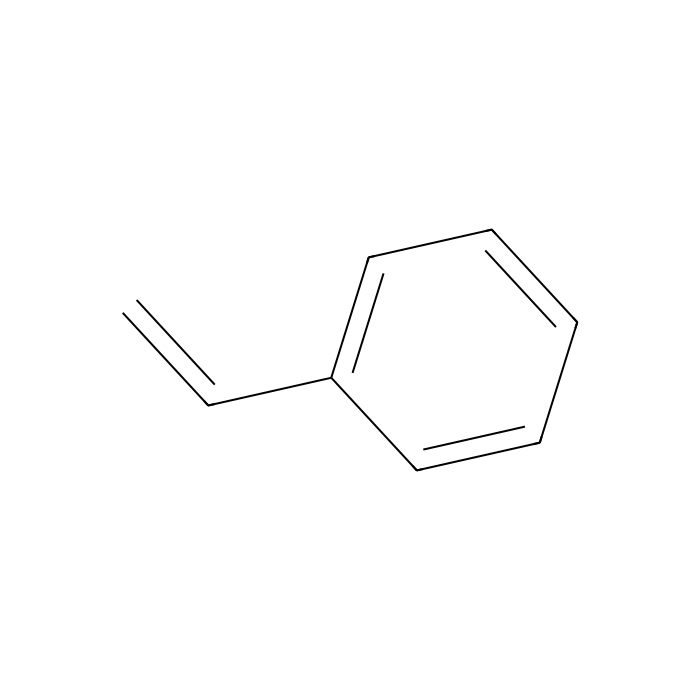
| Description | This compound belongs to the class of organic compounds known as styrenes. These are organic compounds containing an ethenylbenzene moiety. |
| External Descriptors | a small molecule |
| Activity Type | Relation | Activity value | Units | Action Type | Journal | PubMed Id | doi | Assay Aladdin ID |
|---|
| Activity Type | Relation | Activity value | Units | Action Type | Journal | PubMed Id | doi | Assay Aladdin ID |
|---|
| Activity Type | Relation | Activity value | Units | Action Type | Journal | PubMed Id | doi | Assay Aladdin ID |
|---|
| Activity Type | Relation | Activity value | Units | Action Type | Journal | PubMed Id | doi | Assay Aladdin ID |
|---|
| Activity Type | Relation | Activity value | Units | Action Type | Journal | PubMed Id | doi | Assay Aladdin ID |
|---|
| Activity Type | Relation | Activity value | Units | Action Type | Journal | PubMed Id | doi | Assay Aladdin ID |
|---|
| Activity Type | Relation | Activity value | Units | Action Type | Journal | PubMed Id | doi | Assay Aladdin ID |
|---|
| Activity Type | Relation | Activity value | Units | Action Type | Journal | PubMed Id | doi | Assay Aladdin ID |
|---|
| Activity Type | Relation | Activity value | Units | Action Type | Journal | PubMed Id | doi | Assay Aladdin ID |
|---|
Find and download the COA for your product by matching the lot number on the packaging.
| Lot Number | Certificate Type | Date | Item |
|---|---|---|---|
 G2419618 | Certificate of Analysis | Nov 18, 2026 | S110377 |
| J2610905 | Certificate of Analysis | Aug 13, 2026 | S110377 |
| J2610906 | Certificate of Analysis | Aug 13, 2026 | S110377 |
| D2416045 | Certificate of Analysis | Aug 04, 2026 | S110377 |
| D2629006 | Certificate of Analysis | May 19, 2026 | S110377 |
| F2525514 | Certificate of Analysis | Jun 18, 2025 | S110377 |
| D2517583 | Certificate of Analysis | Mar 25, 2025 | S110377 |
| G2419617 | Certificate of Analysis | Jul 15, 2024 | S110377 |
| F2328127 | Certificate of Analysis | Jul 10, 2023 | S110377 |
| G2303584 | Certificate of Analysis | Jul 10, 2023 | S110377 |
| K2218721 | Certificate of Analysis | Nov 08, 2022 | S110377 |
| C2219471 | Certificate of Analysis | Mar 09, 2022 | S110377 |
| Solubility | Insoluble in water, soluble in most organic solvents such as alcohols and ethers. |
|---|---|
| Sensitivity | Light sensitive.;Heat and Air Sensitive |
| Refractive Index | 1.55 |
| Flash Point | 89.6 °F |
| Flash Point | 32°C |
| Boil Point | 145-146°C |
| Melt Point | -31°C(lit.) |
| Molecular Weight | 104.15 |
| XLogP3 | 2.900 |
| Hydrogen Bond Donor Count | 0 |
| Hydrogen Bond Acceptor Count | 0 |
| Rotatable Bond Count | 1 |
| Exact Mass | 104.063 Da |
| Monoisotopic Mass | 104.063 Da |
| Topological Polar Surface Area | 0.000 Ų |
| Heavy Atom Count | 8 |
| Formal Charge | 0 |
| Complexity | 68.100 |
| Isotope Atom Count | 0 |
| Defined Atom Stereocenter Count | 0 |
| Undefined Atom Stereocenter Count | 0 |
| Defined Bond Stereocenter Count | 0 |
| Undefined Bond Stereocenter Count | 0 |
| The total count of all stereochemical bonds | 0 |
| Covalently-Bonded Unit Count | 1 |
H226:Flammable liquid and vapor
H304:May be fatal if swallowed and enters airways
H315:Causes skin irritation
H319:Causes serious eye irritation
H332:Harmful if inhaled
H335:May cause respiratory irritation
H351:Suspected of causing cancer
H361:Suspected of damaging fertility or the unborn child
H372:Causes damage to organs through prolonged or repeated exposure
H401:Toxic to aquatic life
H412:Harmful to aquatic life with long lasting effects
P210:Keep away from heat, hot surface, sparks, open flames and other ignition sources. - No smoking.
P233:Keep container tightly closed.
P240:Ground/bond container and receiving equipment.
P241:Use explosion-proof [electrical/ventilating/lighting/.../] equipment.
P242:Use only non-sparking tools.
P243:Take precautionary measures against static discharge.
P260:Do not breathe dust/fume/gas/mist/vapors/spray.
P261:Avoid breathing dust/fume/gas/mist/vapors/spray.
P264:Wash hands [and …] thoroughly after handling.
P270:Do not eat, drink or smoke when using this product.
P271:Use only outdoors or in a well-ventilated area.
P280:Wear protective gloves/protective clothing/eye protection/face protection.
P321:Specific treatment (see ... on this label).
P302+P352:IF ON SKIN: wash with plenty of water.
P303+P361+P353:IF ON SKIN (or hair): Take off Immediately all contaminated clothing. Rinse SKIN with water [or shower].
P304+P340:IF INHALED: Remove person to fresh air and keep comfortable for breathing.
P305+P351+P338:IF IN EYES: Rinse cautiously with water for several minutes. Remove contact lenses if present and easy to do - continue rinsing.
P362+P364:Take off contaminated clothing and wash it before reuse.
P370+P378:In case of fire: Use ... to extinguish.
P405:Store locked up.
P403+P235:Store in a well-ventilated place. Keep cool.
P501:Dispose of contents/container to an approved waste disposal plant.
P203:Obtain, read and follow all safety instructions before use.
P264+P265:Wash hands [and …] thoroughly after handling. Do not touch eyes.
P318:if exposed or concerned, get medical advice.
P317:Get emergency medical help.
P337+P317:If eye irritation persists: Get medical help.
P332+P317:If skin irritation occurs: Get medical help.
P319:Get medical help if you feel unwell.
Our grade selection guide covers purity, stabilizer status, and application suitability for all variants in our catalog.
View Analytical standard grade guide →