
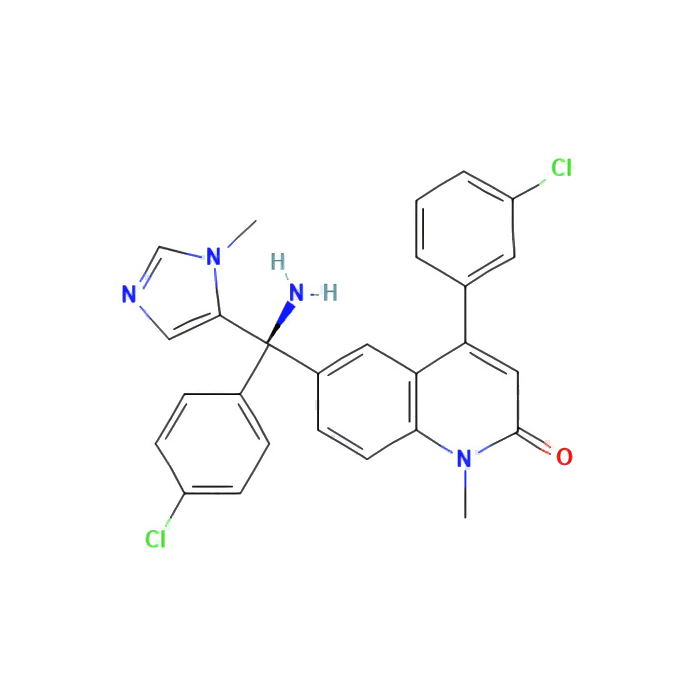
Determine the necessary mass, volume, or concentration for preparing a solution.
| Activity Type | Activity Value -log(M) | Mechanism of Action | Activity Reference | Publications (PubMed IDs) |
|---|
Pre-clinical studies show that tipifarnib has antiproliferative effects on pancreatic cancer cell lines at clinically relevant concentrations (concentration that inhibits 50% growth [IC50] from 9.5 to 500 nmol/L). It also exhibits marked growth retardation and antiangiogenic effects in a pancreatic cancer xenograft model.
Taxonomy Tree
| Kingdom | Organic compounds |
|---|---|
| Superclass | Phenylpropanoids and polyketides |
| Class | Diarylheptanoids |
| Subclass | Linear diarylheptanoids |
| Intermediate Tree Nodes | Not available |
| Direct Parent | Linear diarylheptanoids |
| Alternative Parents | Phenylquinolines Phenylpyridines Hydroquinolones Hydroquinolines Pyridinones Aralkylamines Chlorobenzenes Aryl chlorides N-substituted imidazoles Heteroaromatic compounds Lactams Azacyclic compounds Hydrocarbon derivatives Monoalkylamines Organic oxides Organochlorides Organooxygen compounds Organopnictogen compounds |
| Molecular Framework | Aromatic heteropolycyclic compounds |
| Substituents | Linear 1,7-diphenylheptane skeleton - Phenylquinoline - 4-phenylpyridine - Dihydroquinolone - Dihydroquinoline - Quinoline - Chlorobenzene - Halobenzene - Aralkylamine - Pyridinone - Aryl chloride - Aryl halide - Monocyclic benzene moiety - N-substituted imidazole - Pyridine - Benzenoid - Azole - Heteroaromatic compound - Imidazole - Lactam - Organoheterocyclic compound - Azacycle - Amine - Hydrocarbon derivative - Primary aliphatic amine - Organic oxide - Organopnictogen compound - Organic oxygen compound - Organic nitrogen compound - Organohalogen compound - Organochloride - Primary amine - Organonitrogen compound - Organooxygen compound - Aromatic heteropolycyclic compound |
| Description | This compound belongs to the class of organic compounds known as linear diarylheptanoids. These are diarylheptanoids with an open heptane chain. The two aromatic rings are linked only by the heptane chain. |
| External Descriptors | Not available |
| Activity Type | Activity Value -log(M) | Mechanism of Action | Activity Reference | Publications (PubMed IDs) |
|---|
Find and download the COA for your product by matching the lot number on the packaging.
| Lot Number | Certificate Type | Date | Item |
|---|---|---|---|
 I2404220 | Certificate of Analysis | Jun 15, 2026 | T125396 |
| A2219621 | Certificate of Analysis | Aug 11, 2025 | T125396 |
| A2219623 | Certificate of Analysis | Aug 11, 2025 | T125396 |
| A2219692 | Certificate of Analysis | Aug 11, 2025 | T125396 |
| A2219693 | Certificate of Analysis | Aug 11, 2025 | T125396 |
| A2219741 | Certificate of Analysis | Aug 11, 2025 | T125396 |
| I2404221 | Certificate of Analysis | Aug 22, 2024 | T125396 |
| I2404433 | Certificate of Analysis | Aug 22, 2024 | T125396 |
| A2219694 | Certificate of Analysis | Nov 10, 2023 | T125396 |
| Solubility | Solvent:DMSO, Max Conc. mg/mL: 48.94, Max Conc. mM: 100; Solvent:ethanol, Max Conc. mg/mL: 9.79, Max Conc. mM: 20 |
|---|---|
| Molecular Weight | 489.4 |
| XLogP3 | 4.100 |
| Hydrogen Bond Donor Count | 1 |
| Hydrogen Bond Acceptor Count | 3 |
| Rotatable Bond Count | 4 |
| Exact Mass | 488.117 Da |
| Monoisotopic Mass | 488.117 Da |
| Topological Polar Surface Area | 64.200 Ų |
| Heavy Atom Count | 34 |
| Formal Charge | 0 |
| Complexity | 785.000 |
| Isotope Atom Count | 0 |
| Defined Atom Stereocenter Count | 1 |
| Undefined Atom Stereocenter Count | 0 |
| Defined Bond Stereocenter Count | 0 |
| Undefined Bond Stereocenter Count | 0 |
| The total count of all stereochemical bonds | 0 |
| Covalently-Bonded Unit Count | 1 |
H302:Harmful if swallowed
H315:Causes skin irritation
H319:Causes serious eye irritation
H335:May cause respiratory irritation
P261:Avoid breathing dust/fume/gas/mist/vapors/spray.
P264:Wash hands [and …] thoroughly after handling.
P270:Do not eat, drink or smoke when using this product.
P271:Use only outdoors or in a well-ventilated area.
P280:Wear protective gloves/protective clothing/eye protection/face protection.
P321:Specific treatment (see ... on this label).
P330:Rinse mouth.
P302+P352:IF ON SKIN: wash with plenty of water.
P304+P340:IF INHALED: Remove person to fresh air and keep comfortable for breathing.
P305+P351+P338:IF IN EYES: Rinse cautiously with water for several minutes. Remove contact lenses if present and easy to do - continue rinsing.
P362+P364:Take off contaminated clothing and wash it before reuse.
P405:Store locked up.
P403+P233:Store in a well-ventilated place. Keep container tightly closed.
P501:Dispose of contents/container to an approved waste disposal plant.
P264+P265:Wash hands [and …] thoroughly after handling. Do not touch eyes.
P301+P317:IF SWALLOWED: Get medical help.
P337+P317:If eye irritation persists: Get medical help.
P332+P317:If skin irritation occurs: Get medical help.
P319:Get medical help if you feel unwell.
Our grade selection guide covers purity, stabilizer status, and application suitability for all variants in our catalog.
View Moligand™ grade guide →