GRADE & PURITYMoligand™?Moligand™ — Aladdin's line of ligands and bioactive small molecules. Use for receptor, pathway, and binding studies needing defined small-molecule tools.≥98%(HPLC)
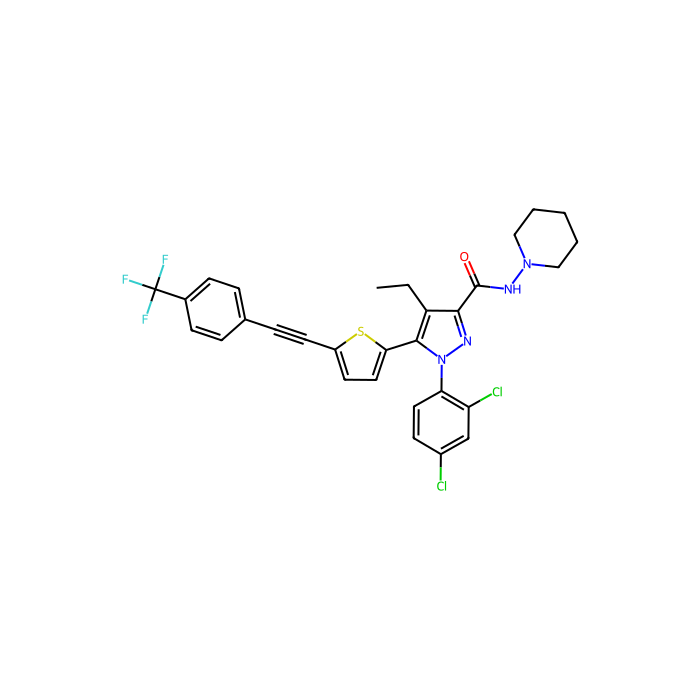
Highly potent cannabinoid 1 receptor (CB1) inverse agonist (IC50values are 8.5 nM and 605 nM for inhibition of [3H]-CP 55940 binding at CB1and CB2receptors, respectively). Displays 71-fold selectivity for CB1receptors over CB2receptors. Inhibits GTP bindi
Storage
Store at -20°C
Shipped In
Ice chest + Ice pads
This product requires cold chain shipping. Ground and other economy services are not available.
Grade
Moligand™
Action Type
ANTAGONIST
Mechanism of action
Antagonist of CB 1 receptor;Antagonist of CB 2 receptor
This compound belongs to the class of organic compounds known as phenylpyrazoles. These are compounds containing a phenylpyrazole skeleton, which consists of a pyrazole bound to a phenyl group.
External Descriptors
Not available
1. Djoumbou Feunang Y, Eisner R, Knox C, Chepelev L, Hastings J, Owen G, Fahy E, Steinbeck C, Subramanian S, Bolton E, Greiner R, and Wishart DS. ClassyFire: Automated Chemical Classification With A Comprehensive, Computable Taxonomy. Journal of Cheminformatics, 2016, 8:61.
Solvent:DMSO, Max Conc. mg/mL: 12.35, Max Conc. mM: 20; Solvent:ethanol, Max Conc. mg/mL: 12.35, Max Conc. mM: 20
Molecular Weight
617.500 g/mol
XLogP3
9.000
Hydrogen Bond Donor Count
1
Hydrogen Bond Acceptor Count
7
Rotatable Bond Count
7
Exact Mass
616.108 Da
Monoisotopic Mass
616.108 Da
Topological Polar Surface Area
78.400 Ų
Heavy Atom Count
41
Formal Charge
0
Complexity
962.000
Isotope Atom Count
0
Defined Atom Stereocenter Count
0
Undefined Atom Stereocenter Count
0
Defined Bond Stereocenter Count
0
Undefined Bond Stereocenter Count
0
The total count of all stereochemical bonds
0
Covalently-Bonded Unit Count
1
Solution Calculators
Molarity Calculator
Determine the necessary mass, volume, or concentration for preparing a solution.
Dilution Calculator
Determine the dilution needed to prepare a stock solution.
Reconstitution Calculator
Reviews
Customer Reviews
Application Protocols
No tested applications or recommended dilutions are provided for this item.
General protocols for small-molecule screening stocks
Stock solution: Dissolve to 10–50 mM in anhydrous DMSO. Sonication or gentle heating (≤40°C) may aid dissolution. Filter through 0.22 µm PTFE if needed.
Plate handling: Dispense using acoustic or pin-tool transfer to minimize DMSO load. Seal plates to limit evaporation; equilibrate to assay temperature before readout.
Concentration–response: Prepare 8–12 point serial dilutions (e.g., 1:3) to map full sigmoidal response; include vehicle controls matching the highest DMSO concentration.
Counter-screens: Include aggregation controls (0.01–0.05% non-ionic detergent), redox cycling checks, and autofluorescence/inner-filter controls for optical assays.
Analytics
Verify concentration by UV or quantitative NMR where feasible. Confirm integrity after incubation by LC–MS to exclude degradation artifacts.
All parameters should be optimized for your specific assay; no item-specific, validated protocols are supplied.
Biological Roles
Specific biological targets or pathways for this item are not provided in the product data. Consequently, no definitive roles can be assigned here.
General considerations for small-molecule library members
Potential uses include exploration of ligand–protein interactions across enzyme panels, GPCRs, ion channels, transporters, or nuclear receptors in biochemical or cell-based systems.
In phenotypic screening, compounds like this may reveal pathway modulation signatures without prior target knowledge; follow-up target deconvolution can include thermal shift assays, CETSA, DARTS, chemoproteomics, and genetic perturbation.
ADME profiling (stability in buffer/microsomes, permeability in PAMPA/MDCK, and protein binding) is recommended early to contextualize potency and exposure in vitro.
Cautions
Do not infer therapeutic relevance from screening activity alone; orthogonal assays, counter-screens, and selectivity profiling are required.
Avoid over-interpretation of cytotoxicity or pan-assay interference; implement controls for redox cycling, aggregation (detergent tests), autofluorescence, and assay signal quenching.
For target-specific information, consult the literature associated with CAS 1253641-65-4 or the CoA if a reference is provided.
Buffer Applications
This material is a small-molecule screening ligand, not a buffering reagent. It does not constitute a defined buffer system and is not typically used to control solution pH.
Practical notes
When preparing assay solutions, dissolve in DMSO and dilute into an appropriate biological buffer (e.g., PBS, HEPES, Tris) validated for your assay. Maintain DMSO at minimal percentages to avoid perturbing buffer capacity or assay components.
Filter assay buffers (0.22 µm) and equilibrate to assay temperature to reduce baseline drift and precipitation risk.
Green Alternatives
Without item-specific solvent constraints, greener choices can be considered for stock preparation and processing while maintaining assay integrity.
Comparison (general guidance)
DMSO (benchmark): exceptional solvency; low volatility; widely accepted in bioassays. Tradeoff: high viscosity; not bio-based.
Ethanol (greener): renewable routes available; good miscibility with water. Tradeoff: narrower solvency window; assay interference at higher v/v.
2-MeTHF or CPME (green ethers): improved safety versus classical ethers; good for extractions. Tradeoff: limited aqueous miscibility; less common in biochemical assays.
Propylene carbonate or PEG-400: low volatility, greener profiles. Tradeoff: viscosity and potential assay interference.
Tips for greener implementation
Start with aqueous systems and minimal organic cosolvent (≤0.5–1% v/v) compatible with the assay signal-to-noise.
Use micro-scale operations, sealed microplates, and low-headspace vials to minimize solvent use and emissions.
Prefer LC–MS mobile phases based on water/ethanol or water/ACN with volatile buffers over halogenated solvents for analytics when feasible.
Note: Selection must be validated empirically for the specific compound’s solubility and stability; no item-specific solubility data are provided here.
Pharmaceutical Uses
No pharmacopeial status or excipient role is provided for this item. It is supplied strictly for research use only and is not intended for human or veterinary use.
Context for formulation scientists (general)
If used as a reference compound in preformulation studies, evaluate solubility across pH-adjusted media, cosolvent systems, and surfactant-enabled vehicles to map kinetic vs thermodynamic solubility.
Stability-indicating methods (LC–UV/MS) under ICH-like conditions (light, heat, humidity, oxidative stress) can assist in understanding degradation liabilities; however, no item-specific degradation pathways are provided here.
For in vitro release or permeability models, ensure vehicle components (e.g., DMSO, ethanol, Cremophor, Tween) are compatible with the test system and concentration limits.
Important: No therapeutic, diagnostic, or clinical claims are made or implied. This product is intended only for laboratory research workflows.
Physical Properties
Item-specific physicochemical parameters have not been provided for this catalog entry.
Appearance: Not specified for this item; refer to CoA/Spec Sheet.
Melting/boiling point: Not specified for this item; refer to CoA/Spec Sheet.
Density/refractive index: Not specified for this item; refer to CoA/Spec Sheet.
Solubility: Not specified for this item; refer to CoA/Spec Sheet.
logP / pKa: Not specified for this item; refer to CoA/Spec Sheet.
Practical guidance (general)
For diverse screening ligands, initial dissolution is typically attempted in anhydrous DMSO (analytical grade) at 10–50 mM, then diluted into assay buffers. If precipitation is observed upon aqueous dilution, increase DMSO cosolvent fraction (commonly 0.1–1% v/v in assays) or employ co-solvents (ethanol, PEG-400) compatible with the assay.
If crystalline, gentle warming (≤40°C) and vortex/sonication aid dissolution; avoid prolonged heating or light exposure unless stability is documented.
If hydrophobic, consider solubilization aids (cyclodextrins, non-ionic surfactants such as 0.01–0.05% Tween-20) as assay-appropriate.
Always defer to the item’s CoA/SDS for definitive specifications and stability windows.
Quality & Grades
Grade: Moligand™ (Aladdin). This designation indicates a small-molecule ligand suitable for discovery, screening, and chemical biology workflows. It is intended for research use only and is not a GMP/pharmacopeial grade.
What Moligand™ typically implies
Emphasis on identity confirmation and suitability for high-throughput or targeted screening campaigns.
Purity profile, residual solvent levels, water content, or stabilizers are not specified in the provided data. For precise acceptance criteria and batch-specific results, consult the CoA/Spec Sheet.
How to use this grade effectively
For biochemical assays, prepare fresh DMSO stocks and filter-sterilize if assay demands are stringent (0.22 µm PTFE recommended for organic solutions).
For analytical uses (LC–MS/HRMS), verify background and UV profile of the specific lot; if low-UV background or LC compatibility is critical, request UV-cutoff/LC baseline information on the CoA.
Stabilizers/antioxidants
Not specified for this item; refer to CoA/Spec Sheet.
Documentation
If your workflow requires exact purity (%), assay, water, peroxide, or metal content limits, please request the CoA and specifications prior to use.
Reaction & Applications
Manufacturer-provided applications are not specified for this item. In practice, Moligand™ small molecules are commonly used in:
Primary and secondary screening: target-based or phenotypic assays to identify activity profiles. Establish concentration–response curves from validated DMSO stocks.
Assay development and controls: serve as reference ligands or probe candidates once activity is characterized in your system.
Analytical benchmarking: LC–MS method development/validation as a positive control for retention, ionization, and stability behavior.
SAR campaigns: as a seed structure for analog selection and as a comparator within a chemotype series.
Practical tips
Verify identity/purity by LC–MS before biological testing; impurities can confound assay readouts.
Confirm solubility and stability under assay conditions (time-course LC–MS in buffer with intended cosolvent; check for hydrolysis/oxidation or adsorption to plastics).
For light- or air-sensitive compounds (unknown here), work under inert atmosphere and amber vials.
Since no specific reactivity or functional groups are provided, named synthetic reaction roles are not assigned to this item. If using TM 38837 as a reference standard in analytical methods, document calibration ranges and response factors for your detector.
Reaction Conditions
No item-specific reaction conditions are applicable because the product is supplied as a finished small molecule for screening rather than as a reagent or catalyst.
General guidance for handling in solution
Stock preparation: 10–50 mM in anhydrous DMSO; store aliquots at ≤−20°C to limit freeze–thaw cycles.
Aqueous dilution: Introduce stock slowly into vortexing buffer to minimize local supersaturation; typical final DMSO 0.1–1% v/v depending on assay tolerance.
Analytical method setup: LC–MS with water/acetonitrile or water/methanol (0.1% FA) gradients is broadly suitable; optimize source parameters for the observed ionization mode.
If using TM 38837 as an analytical reference, validate calibration ranges, linearity, and stability in your exact matrix; item-specific stability constants or kinetics are not provided.
Safety & Handling
Safety data specific to this item are not listed in the provided product data.
GHS/CLP classification: Not specified for this item; refer to SDS.
Signal word / H-statements / pictograms: Not specified for this item; refer to SDS.
General laboratory precautions for small-molecule research reagents
Use in a certified chemical fume hood; avoid inhalation and skin/eye contact.
Personal protective equipment: lab coat, safety glasses, and suitable chemical-resistant gloves (e.g., nitrile). Change gloves regularly when handling organic solids/solutions.
Storage incompatibilities: Keep segregated from strong oxidizers and acids/bases unless compatibility is known. Avoid moisture and light until stability is confirmed.
First aid (overview; defer to SDS): in case of contact, rinse affected area with water for ≥15 minutes; remove contaminated clothing. If inhaled, move to fresh air. Seek medical attention if symptoms persist.
Spill response: For small spills, absorb with inert material (vermiculite) and collect as hazardous waste. Prevent release to drains.
Waste disposal: Dispose according to institutional and local regulations for organic chemical waste.
Research Use Only: This product is intended solely for laboratory research. No food, drug, household, or cosmetic use.
Solvent Selection
Because item-specific solubility and polarity are not provided, selection should follow general best practices for screening ligands.
Primary stock solvent
DMSO (anhydrous, ≥99.9%): default solvent for small-molecule libraries due to broad solvating power and assay compatibility at low percentages.
Secondary solvents/co-solvents
Acetonitrile or methanol: miscible with water; frequently compatible with LC–MS and enzyme assays at low fractions.
Ethanol or isopropanol: acceptable in many biochemical and cell-based assays; monitor final v/v to avoid cytotoxic effects.
PEG-400 or 20–40% hydroalcoholic mixtures: for difficult-to-dissolve hydrophobes in non-cell assays.
Assay dilution tips
Prepare 10–50 mM DMSO stocks and dilute into assay buffer to a final DMSO concentration typically 0.1–1% v/v (assay-dependent). Verify absence of precipitation.
For LC–MS sample prep, ACN/water (0.1% formic acid) or MeOH/water systems are typical; filter through 0.22 µm PTFE or PVDF.
Decision guide (general)
If hydrophobic behavior is suspected (precipitation upon aqueous dilution), increase organic cosolvent or use cyclodextrin inclusion strategies.
If volatility or odor suggests a low-boiling solvent-like compound, cap immediately and minimize headspace. Otherwise, treat as a typical non-volatile solid.
Storage & Reconstitution
Storage conditions (from product data)
Store at −20°C.
Shipped in ice chest with ice pads to maintain a cold chain.
Reconstitution and handling (general guidance)
Allow the sealed container to equilibrate to room temperature before opening to avoid condensation. Work quickly to minimize moisture uptake.
Prepare concentrated stocks in anhydrous DMSO (typical 10–50 mM). If aqueous stocks are needed, verify stability; absent item-specific data, prefer organic DMSO stocks with on-demand dilution.
Aliquot stocks into inert, amber vials or microtubes to avoid repeated freeze–thaw; purge headspace with nitrogen or argon if air sensitivity is suspected.
Freeze–thaw guidance: Avoid multiple cycles. Thaw on ice or at room temperature, mix gently, and promptly return unused portions to −20°C.
Stability
Shelf-life and solution stability are not specified for this item; refer to CoA/Spec Sheet and SDS. If critical, conduct a short stability study (e.g., LC–MS over 1–7 days at intended storage and assay conditions).
Structure & Identity
Compact small-molecule screening ligand supplied under the Moligand line. Item identity is tied to the CAS/CID and catalog SKU below.
SKU: T287414 (TM 38837)
CAS: 1253641-65-4
PubChem CID: 49779607
Chemical name: Not specified for this item; refer to CoA/Spec Sheet.
Molecular formula: Not specified for this item; refer to CoA/Spec Sheet.
Molecular weight: Not specified for this item; refer to CoA/Spec Sheet.
SMILES: Not specified for this item; refer to CoA/Spec Sheet.
InChIKey: Not specified for this item; refer to CoA/Spec Sheet.
Structural description
Functional groups, ring systems, stereochemistry: Not specified for this item; refer to CoA/Spec Sheet.
Notes
This product is part of a small-molecule/compound library category (小分子和化合物库), suitable for screening and discovery workflows.
For unambiguous structure confirmation, consult the Certificate of Analysis and any provided spectral package (1H/13C NMR, LC–MS, HRMS).
Synthetic Utility
Because the structural features and functional groups of TM 38837 are not specified in the product data, detailed reaction planning, named transformations, or reactivity discussions cannot be assigned.
General roles for catalog small molecules in synthesis and analysis
Reference standard: may serve as a comparator for chromatographic retention time, MS fragmentation patterns, and stability studies.
Derivatization feasibility: If structure is available from the CoA/literature, common late-stage diversification strategies (amide coupling, Suzuki/Miyaura, Buchwald–Hartwig, or SNAr) can be planned contingent on the actual functional group map.
Impurity profiling: Can assist in method development for related substances in a synthetic campaign targeting the same chemotype.
Recommendations
Obtain structural documentation (SMILES, InChIKey, NMR, MS) from the CoA before attempting any transformations.
If derivatization is intended, perform small-scale feasibility assays (0.5–5 mg) to verify chemoselectivity and stability, and confirm products by LC–MS/NMR.
Target Specificity
No target, epitope, or binding specificity data are provided in the product data for TM 38837.
Target class: Not specified for this item; refer to CoA/Spec Sheet or primary literature associated with CAS 1253641-65-4.
Species reactivity or selectivity panels: Not specified for this item; refer to CoA/Spec Sheet.
Use-case guidance
If used in target-based programs, document assay format, binding mode (if known), and selectivity against off-targets using orthogonal assays.
For phenotypic campaigns, plan target deconvolution (affinity capture, thermal shift, chemoproteomics) after activity is confirmed.
Frequently Asked Questions
What is the purity of this product, and how is it determined?
This product is supplied at ≥98% purity, determined by HPLC. Lot-specific values are stated on the Certificate of Analysis.
What is Moligand??
Moligand? is one of Aladdin Scientific's premium product lines, formulated for high-purity applications across multiple workflows. Compared to standard grades in the same workflow, Moligand? products typically offer tighter specifications, more rigorous QC, and stronger lot-to-lot consistency.
How should this product be stored?
Store at ?20 °C. Freezer storage is required to maintain the specified shelf life.
What documentation is provided?
Available product documentation, including Certificates of Analysis (COA), Safety Data Sheets (SDS), and specification sheets, is shown in the product document area. Document availability and access follow the current site policy.
Need help choosing the grade?
Our grade selection guide covers purity, stabilizer status, and application suitability for all variants in our catalog.
We use cookies to ensure the website functions properly and, where permitted, to improve your experience. You can manage your preferences at any time in Settings. Learn more in our Cookie Policy.
Shall we send you a message when we have discounts available?
Remind me later
Thank you! Please check your email inbox to confirm.
Products are supplied to verified businesses, institutions, and qualified professionals for research and development use only. Not for use in humans, animals, diagnosis, or therapy.