
Determine the necessary mass, volume, or concentration for preparing a solution.
| Activity Type | Activity Value -log(M) | Mechanism of Action | Activity Reference | Publications (PubMed IDs) |
|---|
10mM in DMSO for sensitive chromatographic and analytical workflows requiring minimal baseline interference.
Store at -80°C Ships Dry ice packs + Cold packs Check lot-specific COA for exact specifications.
SDS, COA, datasheet, and spec sheet available for download. Lot-specific COA accessible via lot number lookup.
Cited in 0 peer-reviewed publications across chromatography, organic synthesis, and cross-coupling reactions.
Information
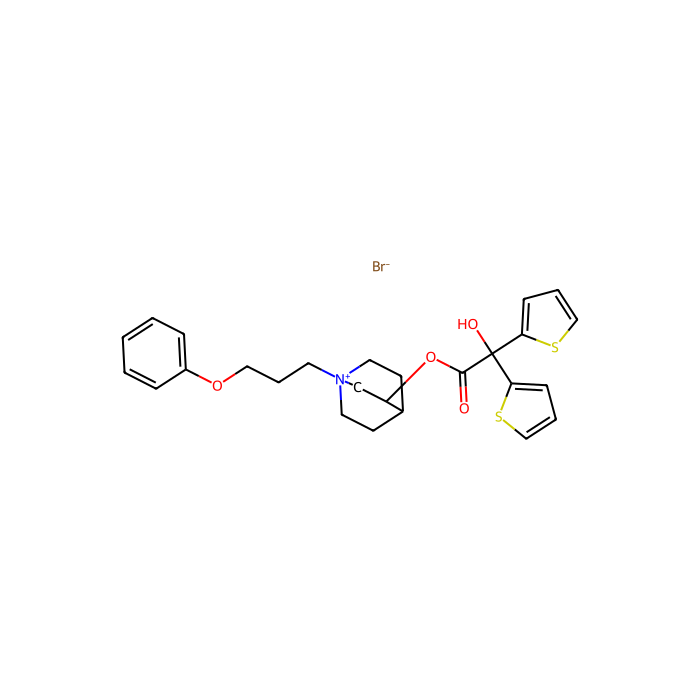
Aclidinium Bromide (LAS 34273, LAS-W 330) inhibits human muscarinicAChRM1, M2, M3, M4 and M5 withKiof 0.1 nM, 0.14 nM, 0.14 nM, 0.21 nM and 0.16 nM, respectively.
In vitro
[3H]Aclidinium binds to a homogeneous receptor of M2 with Kd of 0.34 nM and Bmax of 3.13 pmol/mg, and binds to M3 with Kd of 0.34 nM and Bmax of 3.13 pmol/mg. Aclidinium (< 100 nM) dose-dependently inhibits carbachol-induced contractions in isolated guinea pig trachea. Aclidinium shows an onset of action with t1/2 of 6.8 min, tmax of 35.9 min in isolated guinea pig trachea. Aclidinium is hydrolysed in plasma samples from all species studied, with apparent half-lives at 37℃ of 11.7 min, 38.3 min, 1.8 min and 2.4 min in rat, guinea pig, dog and human plasma, respectively. Aclidinium (0.1 μM) inhibits carbachol and TGF-β1 induced upregulation of collagen type I and α-SMA mRNA and protein expression in human bronchial fibroblasts. Aclidinium (0.1 μM) inhibits TGF-β1 induced upregulation of ChAT expression in human bronchial fibroblasts. Aclidinium (0.1 μM) inhibits carbachol- and TGF-β1-induced increases in ERK1/2 phosphorylation and RhoA-GTP formation in human bronchial fibroblasts. Aclidinium pretreatment prevents the upregulation of M1 and M3, but not M2 downregulation induced by carbachol or TGF-β1 in human lung fibroblasts. Aclidinium (0.1 μM) dose-dependently inhibits the TGF-β1 and carbachol-induced cell proliferation of human lung fibroblasts.
In vivo
Aclidinium shows an onset of action with IC50 (95% CI) of 140 μg/mL and tmax of 30 min in the acetylcholine-induced bronchoconstriction model in anesthetized guinea pigs. Aclidinium (500 μg/kg) induces a maximal increase in heart rate of 55% after 1 hour in conscious beagle dogs. Aclidinium (1 mg/ml) produces a potent and sustained bronchoprotection (72%–88.4%) over the 120-min study period in anaesthetised guinea pigs.
Cell Data
cell lines:
Concentrations:100 nM
Incubation Time:48 hours
Powder Purity:≥99%
| Isomeric SMILES | C1C[N+]2(CCC1[C@H](C2)OC(=O)C(C3=CC=CS3)(C4=CC=CS4)O)CCCOC5=CC=CC=C5.[Br-] |
|---|---|
| Molecular Weight | 564.57 |
| Reaxy-Rn | 14488516 |
| Reaxys-RN_link_address | https://www.reaxys.com/reaxys/secured/hopinto.do?context=S&query=IDE.XRN=14488516&ln= |
Comprehensive hazard, handling, storage, and regulatory compliance document.
Download SDS →Lot-specific quality data. Enter your lot number to retrieve the exact COA.
Look up COA →Full quality attributes and acceptance criteria for this grade.
View spec sheet →| Activity Type | Activity Value -log(M) | Mechanism of Action | Activity Reference | Publications (PubMed IDs) |
|---|
| Activity Type | Activity Value -log(M) | Mechanism of Action | Activity Reference | Publications (PubMed IDs) |
|---|
| Activity Type | Activity Value -log(M) | Mechanism of Action | Activity Reference | Publications (PubMed IDs) |
|---|
| Activity Type | Activity Value -log(M) | Mechanism of Action | Activity Reference | Publications (PubMed IDs) |
|---|
| Activity Type | Activity Value -log(M) | Mechanism of Action | Activity Reference | Publications (PubMed IDs) |
|---|
| Solubility | Solubility (25°C) In vitro Water: 59 mg/mL (198.76 mM); DMSO: 30 mg/mL (101.06 mM); Ethanol: Insoluble; |
|---|