
Centella asiatica Skincare Raw Materials: Ingredient Types, Total Glycosides, Representative Triterpenes, Mechanisms of Action, and Evidence of Efficacy
Centella asiatica Skincare Raw Materials: Ingredient Types, Total Glycosides, Representative Triterpenes, Mechanisms of Action, and Evidence of Efficacy
1 Basic Types of Centella asiatica Skincare Raw Materials
1.1 Centella asiatica Water
“Centella asiatica water” is generally a commercial raw-material name, and the specific manufacturing process cannot be determined from the name alone. It may refer to:
① a Centella asiatica distillate;
② an aqueous Centella asiatica extract;
③ a low-concentration solution of Centella asiatica extract;
④ a blended raw material diluted with water, glycerol, or other polyols.
If the raw material is produced by steam distillation, the components entering the distillate are primarily volatile constituents. Asiaticoside, madecassoside, asiatic acid, and madecassic acid are triterpenes with relatively high molecular weights and very low volatility, and they generally do not distill over in large quantities with steam. Therefore, a high use level of distilled Centella asiatica water cannot be directly converted into a high triterpene content.
If the raw material is an aqueous extract, it may contain certain triterpene glycosides, polysaccharides, polyphenols, and other hydrophilic constituents. However, the actual levels depend on the plant part used, solid-to-liquid ratio, extraction temperature, extraction time, degree of concentration, and subsequent dilution factor. Without quantitative analytical data, a claim such as “80% Centella asiatica water” cannot be used to determine how much total Centella glycosides the product contains.
1.2 Conventional Centella asiatica Extract
Conventional Centella asiatica extracts are generally prepared using water, ethanol, or a mixed solvent of water and an organic alcohol. In addition to triterpenes, they may also contain:
① polysaccharides and oligosaccharides;
② flavonoids and other polyphenols;
③ amino acids;
④ organic acids;
⑤ phytosterols;
⑥ trace volatile constituents.
These raw materials exhibit the multicomponent characteristics of botanical extracts. Their moisturizing, antioxidant, and soothing effects may involve the combined contributions of multiple constituent classes.
1.3 Standardized Centella asiatica Extract
A standardized extract is a raw material in which selected marker compounds are quantitatively controlled after conventional extraction and purification. Its main value includes:
① defining the active constituents to be measured;
② controlling batch-to-batch variation in constituent levels;
③ calculating the actual amount of active material introduced into the finished product;
④ establishing relationships between raw-material dose and efficacy in human use.
Standardization does not necessarily mean that a raw material has stronger efficacy, but it can substantially improve the reproducibility of quality control and efficacy research.
1.4 High-Purity Single Compounds and Triterpene Blends
High-purity asiaticoside, madecassoside, asiatic acid, and madecassic acid have relatively well-defined chemical identities and purities. Compared with conventional extracts, they are easier to use for dose calculations and mechanistic studies, but they also present more specific challenges related to solubility, stability, and dermal delivery.
2 Definition of Total Centella Glycosides
According to the recommended pharmaceutical industry standard YY/T 10003—2026, Cosmetic Raw Materials—Centella asiatica Extract (issued on April 3, 2026 and effective from May 1, 2027), the principal characteristic constituents of Centella asiatica extract include:
1. Asiaticoside;
2. Asiaticoside B;
3. Madecassoside.
Under this standard, total Centella glycosides are defined as the sum of the contents of these three glycosides. Asiatic acid and madecassic acid are triterpenoid acids, or triterpene aglycones, and are not included in this total-glycoside index.
YY/T 10003—2026 specifies the following requirements:
Raw-Material Form | Total Centella Glycoside Specification |
Liquid Centella asiatica extract | ≥0.25% |
Solid Centella asiatica extract | ≥20% |
These values are quality-control specifications for Centella asiatica raw materials. They are not statutory use levels for finished skincare products and do not represent a universal concentration threshold for efficacy. The standard does not cover high-purity raw materials in which a single constituent exceeds 90%. In addition, the standard does not apply to materials obtained by co-extracting Centella asiatica with other plants, or to blends of Centella asiatica extract with other active ingredients.
The terms “total Centella glycosides,” “total Centella triterpenes,” and “four major triterpenes” should be distinguished as follows:
① Total Centella glycosides: the total amount of specified glycosides measured using the prescribed method;
② Total Centella triterpenes: may include both glycosides and aglycones, with the exact scope depending on the raw-material specification;
③ Four representative Centella triterpenes: also commonly referred to in the industry as the “four major triterpenes,” generally meaning asiaticoside, madecassoside, asiatic acid, and madecassic acid;
④ High-purity single compound: a raw material consisting of one compound obtained through isolation and purification.
3 Structural Relationships Among the Four Representative Triterpenes
The four representative Centella triterpenes can be divided into two groups: triterpene glycosides and triterpene aglycones.
Component | English Name | Molecular Formula | Chemical Class | Structural Relationship |
Asiaticoside | Asiaticoside | C₄₈H₇₈O₁₉ | Triterpene glycoside; triterpene saponin | Glycosylated form of asiatic acid |
Madecassoside | Madecassoside | C₄₈H₇₈O₂₀ | Triterpene glycoside; triterpene saponin | Glycosylated form of madecassic acid |
Asiatic acid | Asiatic acid | C₃₀H₄₈O₅ | Pentacyclic triterpenoid acid; aglycone | Aglycone corresponding to asiaticoside |
Madecassic acid | Madecassic acid | C₃₀H₄₈O₆ | Pentacyclic triterpenoid acid; aglycone | Aglycone corresponding to madecassoside |
3.1 Structural Conversion Between Glycosides and Aglycones
Both asiaticoside and madecassoside carry a sugar chain composed of two glucose units and one rhamnose unit. Their idealized complete hydrolysis reactions can be represented as follows:
Asiaticoside + 3 H₂O → Asiatic acid + 2 glucose + 1 rhamnose
C₄₈H₇₈O₁₉ + 3 H₂O → C₃₀H₄₈O₅ + 2 C₆H₁₂O₆ + C₆H₁₂O₅
Madecassoside + 3 H₂O → Madecassic acid + 2 glucose + 1 rhamnose
C₄₈H₇₈O₂₀ + 3 H₂O → C₃₀H₄₈O₆ + 2 C₆H₁₂O₆ + C₆H₁₂O₅
These equations are intended to illustrate the structural relationship between the glycosides and their aglycones. They do not indicate that rapid and complete hydrolysis will occur in a skincare formulation or on the skin surface.
3.2 Effects of Structural Differences on Formulation
The sugar chains give asiaticoside and madecassoside more hydroxyl groups and greater polarity. However, their molecular weights are approximately 959 and 975, respectively, and their molecular dimensions are relatively large. Passive diffusion of these large glycosides across an intact stratum corneum is limited.
After removal of the sugar chain, the molecular weights of asiatic acid and madecassic acid decrease to approximately 489 and 505, respectively, and their relative lipophilicity increases, while their water solubility decreases. In aqueous products, they may therefore exhibit inadequate dissolution or crystallization.
Glycosides and aglycones have different formulation limitations:
Glycosides: higher polarity, but larger molecular size and limited membrane permeability.
Aglycones: smaller molecular size and higher lipophilicity, but potentially limited by water solubility and release from the formulation.
This is also why liposomes, cyclodextrins, nanocarriers, and microneedle delivery systems are frequently investigated for Centella triterpenes. Studies of madecassoside-loaded liposomes and asiatic-acid microneedles indicate that improved delivery can increase cutaneous distribution or enhance effects in wound models. However, these studies use specialized delivery systems, such as liposomes and microneedles, and specific wound or animal models. Their findings cannot be directly extrapolated to suggest that conventional creams, gels, or serums achieve the same penetration depth or human efficacy.
4 Mechanisms of Action of Centella Triterpenes in the Skin
Findings from experimental studies of Centella triterpenes can be understood within an interconnected framework of oxidative stress, inflammation, epidermal injury, and extracellular-matrix remodeling.
Ultraviolet radiation, irritants, over-cleansing, or mechanical injury | |
↓ | |
Increased reactive oxygen species and oxidation of cell-membrane lipids | |
↓ | |
Enhanced stress and inflammatory signaling through MAPK, AP-1, NF-κB, and related pathways | |
Increased inflammatory mediators ↓ Keratinocyte injury ↓ Slower barrier recovery and increased TEWL | Increased MMP expression ↓ Degradation of collagen and extracellular matrix ↓ Reduced elasticity and dermal structural support |
This diagram presents a general biological framework of skin injury. It does not indicate that every Centella triterpene has been demonstrated, within a single study, to act at every node shown.
In this framework:
① Excess reactive oxygen species (ROS) can oxidize lipids, proteins, and nucleic acids;
② Mitogen-activated protein kinase (MAPK) pathways can further influence inflammation and cellular stress responses;
③ Activator protein-1 (AP-1) participates in the regulation of matrix metalloproteinase expression;
④ Nuclear factor kappa B (NF-κB) regulates the transcription of multiple inflammatory mediators;
⑤ Matrix metalloproteinases (MMPs) participate in the degradation of collagen and other extracellular-matrix components.
Available cell and animal studies suggest that Centella triterpenes may influence oxidative stress, inflammatory responses, cell migration, and matrix remodeling within this injury process. However, the compounds, doses, and experimental models differ among studies, and pathway-level findings should not be directly converted into estimates of the magnitude of efficacy produced by a finished skincare product in humans.
4.1 Epidermal Cell Protection and Re-Epithelialization
Keratinocytes are the principal cells of the epidermis. When irritation or ultraviolet exposure causes keratinocyte apoptosis, impaired migration, or abnormal differentiation, the rate of skin-barrier recovery may be affected.
In vitro studies indicate that madecassoside can promote wound closure and cell migration in keratinocyte models and reduce the loss of cell viability and apoptosis induced by ultraviolet B (UVB) radiation.
Its potential relevance to skincare mainly includes:
① reducing cellular injury under stressful conditions;
② supporting the migration of epidermal cells toward damaged areas;
③ helping provide conditions that support epidermal continuity and barrier recovery.
Centella triterpenes are not ceramides, cholesterol, or free fatty acids and therefore cannot directly replace stratum-corneum lipids. Their influence on the barrier is better understood as helping reduce persistent inflammation and cellular injury, thereby allowing the skin’s own renewal processes to proceed normally.
4.2 Modulation of Oxidative Stress and Inflammation
After irritation occurs, ROS and inflammatory mediators can reinforce one another. ROS can directly cause membrane-lipid peroxidation and amplify inflammatory signaling; inflammatory cells and damaged cells can, in turn, generate additional ROS, creating a self-amplifying cycle.
The antioxidant effects observed for Centella triterpenes in experimental models include:
① reducing excessive ROS and lipid peroxidation;
② reducing oxidative damage to cell membranes and mitochondria;
③ decreasing selected inflammatory signals and mediators;
④ reducing secondary injury to epidermal cells and the dermal matrix caused by inflammation.
Flavonoids, polyphenols, and carbohydrates present in whole Centella asiatica extracts may also contribute to antioxidant, water-retaining, and soothing effects.
4.3 Fibroblasts and Extracellular-Matrix Regulation
Dermal fibroblasts synthesize type I collagen, type III collagen, and other extracellular-matrix components. Transforming growth factor beta (TGF-β) and Smad signaling are among the important pathways regulating collagen transcription.
A representative signaling sequence can be summarized as follows:
Extracellular stimulus → phosphorylation of Smad2 and Smad3 → formation of the Smad3–Smad4 complex → nuclear translocation → regulation of collagen-related genes such as COL1A1 and COL1A2
Studies using human dermal fibroblasts have shown that asiaticoside can induce the phosphorylation of Smad2 and Smad3, promote the association of Smad3 with Smad4, and increase type I collagen synthesis. The study also suggested that this process is not entirely dependent on activation of the classical TGF-β type I receptor kinase.
Different in vitro fibroblast models have produced results in opposite directions. In normal human dermal fibroblasts, some studies observed increased type I collagen synthesis. In fibroblasts derived from keloids, asiaticoside inhibited cell proliferation and the expression of type I and type III collagen, while also modulating TGF-β/Smad-related signaling. These differences may be related to cell origin, baseline signaling status, dose, and culture conditions.
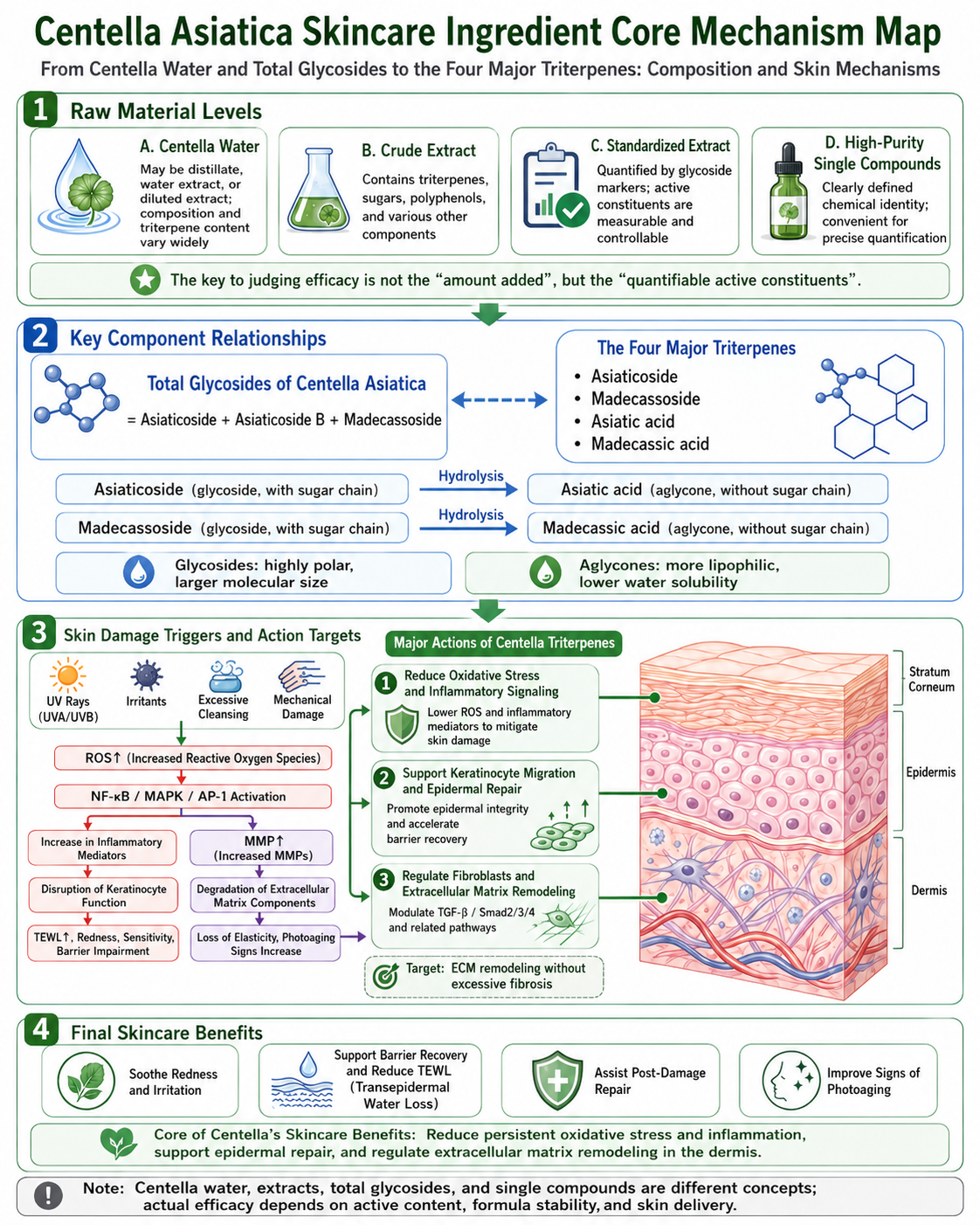
5 Research Focus and Application Differences Among the Four Triterpenes
Component | Main Research Focus | Primary Formulation Challenges | Status of Human Evidence |
Asiaticoside | Fibroblasts, collagen transcription, repair processes, and matrix remodeling | Large molecular size; limited passive permeation across an intact stratum corneum | Evidence is derived mainly from cell, animal, and multicomponent-extract studies |
Madecassoside | Keratinocyte protection, antioxidant activity, post-irritation recovery, and combination use in photoaging studies | Large molecular size and limited membrane permeability | Small combination-product human studies are available, but the independent contribution of the single compound remains to be verified |
Asiatic acid | Inflammatory modulation, oxidative stress, and extracellular-matrix research | Low water solubility and possible crystallization; access to the dermis is limited by the stratum corneum | Few independent human studies in routine skincare use |
Madecassic acid | Experimental studies of antioxidant, inflammatory, and matrix-regulating effects | Low water solubility; demanding quantitative-control and delivery requirements | Limited independent human skincare evidence |
In actual products, outcomes are also influenced by raw-material purity and composition ratios; the actual amount of active material introduced; the dissolution state within the formulation; release of active constituents from the formulation matrix; the intended site of action in the skin; product-use frequency and amount; and synergistic or interfering effects from other ingredients.
6 Active-Constituent Concentration and Actual Skincare Efficacy
6.1 Calculating the Actual Amount of Active Constituent Introduced
The use level of a Centella raw material and the concentration of Centella active constituents are two different values.
The calculation is:
Nominal active concentration in the finished product = raw-material use level × active-constituent content of the raw material
Examples:
Formulation Scenario | Calculation Result |
1% liquid extract containing 0.25% total glycosides | Approximately 0.0025% total glycosides in the finished product, equivalent to 25 ppm |
1% solid extract containing 20% total glycosides | Approximately 0.2% total glycosides in the finished product |
0.1% madecassoside with a purity of 95% | Approximately 0.095% madecassoside in the finished product |
Even when two products are both described as containing “1% Centella raw material,” the final concentration of active constituents may differ by dozens of times because the raw-material specifications are different.
6.2 A Concentration of 0.5% Is Not a Universal Efficacy Threshold
A four-week human study involving 25 participants used a dried Centella asiatica extract specified to contain 10% active constituents, including asiatic acid, madecassic acid, and asiaticoside. The abstract and main text of the paper reported formulations containing 2.5% and 5% extract. Based on the 5% extract level stated in the main text and a combined active-constituent content of 10% in the raw material, the theoretical nominal concentration of the three active constituents in the finished product would be approximately 0.5%. The study observed increased stratum-corneum hydration, reduced transepidermal water loss, and reduced erythema in a methyl nicotinate irritation model.
This study provides preliminary human data for this specific extract and the specific cream and gel systems tested, but the sample size was small and the study period was short. Accordingly, the findings cannot be used to establish 0.5% as a universal efficacy threshold for all Centella raw materials or triterpene constituents.
Another randomized, double-blind study involving 20 women evaluated a combination of 0.1% madecassoside and 5% vitamin C. Improvements in photoaging-related parameters were observed after six months of use. Because the product also contained 5% vitamin C, the entire effect cannot be attributed to the 0.1% madecassoside.
Current evidence is insufficient to establish a single minimum effective concentration applicable to all Centella single compounds and extracts. Product development should instead confirm all of the following:
① the quantitative specifications of the raw material;
② the actual concentration of active constituents in the finished product;
③ whether the active constituents remain dissolved and stable;
④ whether the formulation can deliver them to the relevant site of action;
⑤ whether the finished product has supporting human efficacy data.
7 Effects of Centella Water and Standardized Extracts on Skincare Performance
The principal difference between these two raw-material categories is whether their chemical composition can be measured and controlled.
Assessment Item | Centella Water | Standardized Extract |
Manufacturing process | Cannot be determined from the commercial name alone; may be a distillate, aqueous extract, or diluted blended raw material | Extraction, purification, and specifications are generally well defined |
Triterpene content | May be very low or not quantitatively specified | Has a defined total-glycoside or single-compound content |
Batch consistency | Strongly influenced by plant source and process | Generally controlled within a specified range |
Calculation of active dose | Cannot be calculated without analytical data | Can be calculated from the use level and material specification |
Reproducibility of efficacy studies | It may be difficult to confirm whether the research material matches the product raw material | More readily supports relationships between dose and efficacy |
Formulation value | A distillate can serve as a botanical aqueous base; an aqueous extract may additionally provide carbohydrates, polyphenols, and other hydrophilic constituents | More suitable when the formulation is intended to deliver a defined triterpene activity |
Centella water is not necessarily without skincare value. Carbohydrates, polyphenols, and other hydrophilic constituents in aqueous extracts may contribute to moisturization and antioxidant effects, but efficacy should be determined from the actual composition and analytical results. A standardized extract also does not automatically guarantee efficacy in the finished product. Even when raw-material content is clearly defined, the active constituents must still dissolve, be released from the formulation, partition into the skin, and diffuse to the relevant site.
8 How to Evaluate Centella Skincare Products
When evaluating a Centella skincare product, the following information can be reviewed in sequence:
Product Information | What It Can Demonstrate | What It Cannot Demonstrate on Its Own |
“Contains 80% Centella water” | The proportion of the Centella-water raw material in the formulation | The actual concentration of total glycosides or the four representative triterpenes |
“Contains 1% Centella extract” | The use level of the extract raw material | The specific active-constituent content of the extract |
“Total glycosides ≥20%” | The content of the specified glycosides in the raw material | The total-glycoside concentration in the finished product or its human efficacy |
“Contains 0.1% madecassoside” | A relatively well-defined dose of the single compound in the finished product | Its dissolution, penetration, or independent contribution to efficacy |
“The raw material has cell-study data” | The constituent may possess the corresponding biological activity | That the finished product can reproduce the same effect |
“The finished product completed a human efficacy test” | The actual results under the tested formulation and conditions of use | That the same results will be obtained after changing the concentration or formulation |
9 Classification and Applications of Research Products for Total Glycosides and Representative Triterpenes of Centella asiatica
The following products are reagents intended for analytical testing, in vitro experiments, or other scientific research purposes. They are not equivalent to cosmetic-grade raw materials and do not constitute recommendations for incorporation into cosmetic formulations or for human use.
Category | CAS No. | Aladdin Cat. No. | Name | Specification or Purity | Product Features and Applications |
Total Glycoside Marker · Asiaticoside Analytical Standard | 16830-15-2 | Asiaticoside | Analytical standard, Moligand™, ≥98% | Suitable for the qualitative identification and quantitative determination of asiaticoside in Centella asiatica extracts, the development of high-performance liquid chromatography methods, method validation, and quality assessment of total glycosides. Asiaticoside is a quantitative marker of the total glycosides of Centella asiatica and is the triterpene glycoside corresponding to asiatic acid. | |
Total Glycoside Active · Asiaticoside Preformulated Solution | 16830-15-2 | Asiaticoside | 10 mM in DMSO | A preformulated stock solution with a defined concentration, suitable for dose-gradient studies, cell migration assays, collagen-related transcription studies, inflammatory signaling investigations, and extracellular matrix regulation research in fibroblast, keratinocyte, and injury-repair models. | |
Total Glycoside Marker · High-Purity Asiaticoside B | 125265-68-1 | Asiaticoside B | ≥98% | Suitable for studies of the total glycoside composition of Centella asiatica, triterpene glycoside profiling, the structural relationship between asiaticoside B and its aglycone, and differences in biological activity among triterpene glycosides. It is also one of the components included in analytical systems covering the six representative triterpenes of Centella asiatica. | |
Total Glycoside Marker · Madecassoside Analytical Standard | 34540-22-2 | Madecassoside | Analytical standard, Moligand™, ≥98% | Suitable for the qualitative and quantitative analysis of madecassoside in Centella asiatica extracts, chromatographic peak confirmation, calibration-curve establishment, analytical method validation, and total glycoside quality assessment of standardized raw materials. | |
Total Glycoside Active · High-Purity Madecassoside | 34540-22-2 | Madecassoside | Moligand™, ≥98% | Suitable for studies of madecassoside dose-response relationships, keratinocyte protection, oxidative stress, inflammatory signaling, cell migration, and re-epithelialization mechanisms. It may also be used in solubility, stability, and carrier-encapsulation experiments. | |
Total Glycoside Active · Madecassoside Preformulated Solution | 34540-22-2 | Madecassoside | 10 mM in DMSO | A preformulated stock solution with a defined concentration, suitable for in vitro studies involving cellular treatment, concentration-gradient screening, ultraviolet-induced damage, inflammatory mediators, cell viability, and migration-based repair. It helps reduce concentration errors caused by weighing and stock-solution preparation. | |
Aglycone of the Four Representative Triterpenes · High-Purity Asiatic Acid | 464-92-6 | Asiatic Acid | Moligand™, ≥98% | Suitable for studies of oxidative stress, inflammatory signaling, transforming growth factor-related pathways, fibroblast activity, and extracellular matrix remodeling associated with asiatic acid. It may also be used to evaluate dissolution, solubilization, and dermal delivery systems. | |
Aglycone of the Four Representative Triterpenes · Asiatic Acid Preformulated Solution | 464-92-6 | Asiatic Acid | Moligand™, 10 mM in DMSO | A preformulated stock solution with a defined concentration, suitable for cellular treatment, dose-response studies, matrix metalloproteinase analysis, collagen metabolism research, and signaling-pathway validation in inflammatory and oxidative-injury models. | |
Aglycone of the Four Representative Triterpenes · Madecassic Acid Analytical Standard | 18449-41-7 | Madecassic Acid | Analytical standard, ≥98% | Suitable for the qualitative identification and quantitative determination of madecassic acid in Centella asiatica extracts, triterpenic acid profiling, detection of glycoside hydrolysis products, and chromatographic method validation. | |
Aglycone of the Four Representative Triterpenes · High-Purity Madecassic Acid | 18449-41-7 | Madecassic Acid | Moligand™, ≥98% | Suitable for studies of inflammatory signaling, oxidative stress, cellular injury, and extracellular matrix-related mechanisms involving madecassic acid. It may also be used for comparative activity studies of madecassoside and its aglycone, as well as for the development of delivery systems. | |
Aglycone of the Four Representative Triterpenes · Madecassic Acid Preformulated Solution | 18449-41-7 | Madecassic Acid | 10 mM in DMSO | A preformulated stock solution with a defined concentration, suitable for in vitro studies of inflammatory signaling, reactive oxygen species-induced injury, cell viability, apoptosis, and matrix remodeling. It may also be used for activity comparisons between glycosides and aglycones at equivalent concentrations. | |
Asiaticoside B-Related Aglycone · High-Purity Triterpenic Acid | 564-13-6 | Terminolic Acid | ≥99% | The triterpene aglycone corresponding to asiaticoside B. Suitable for studies of the hydrolysis and glycosylation relationship of asiaticoside B, profiling of the six representative triterpenes of Centella asiatica, structural identification of triterpenic acids, and comparative activity studies of different glycoside-aglycone pairs. |
References
[1] National Medical Products Administration. YY/T 10003—2026 Cosmetic Raw Materials—Centella asiatica Extract[S]. 2026.
[2] National Center for Biotechnology Information. PubChem Compound Summary for CID 11954171, Asiaticoside; CID 24825675, Madecassoside; CID 119034, Asiatic Acid; CID 73412, Madecassic Acid[DB/OL]. Bethesda (MD): National Library of Medicine.
[3] Lee J, Jung E, Kim Y, et al. Asiaticoside induces human collagen I synthesis through TGFβ receptor I kinase-independent Smad signaling[J]. Planta Medica, 2006, 72(4): 324-328. DOI: 10.1055/s-2005-916227.
[4] Tang B, Zhu B, Liang Y, et al. Asiaticoside suppresses collagen expression and TGF-β/Smad signaling through inducing Smad7 and inhibiting TGF-βRI and TGF-βRII in keloid fibroblasts[J]. Archives of Dermatological Research, 2011, 303(8): 563-572. DOI: 10.1007/s00403-010-1114-8.
[5] Sucharitakul T, Chatkul P, Satianrapapong W, et al. Centella asiatica phytochemical Madecassoside enhances skin wound healing and protects against UVB-induced keratinocyte damage[J]. Tissue Barriers, 2025: 2532229. DOI: 10.1080/21688370.2025.2532229.
[6] Ratz-Łyko A, Arct J, Pytkowska K. Moisturizing and antiinflammatory properties of cosmetic formulations containing Centella asiatica extract[J]. Indian Journal of Pharmaceutical Sciences, 2016, 78(1): 27-33. DOI: 10.4103/0250-474X.180247.
[7] Haftek M, Mac-Mary S, Le Bitoux M A, et al. Clinical, biometric and structural evaluation of the long-term effects of a topical treatment with ascorbic acid and madecassoside in photoaged human skin[J]. Experimental Dermatology, 2008, 17(11): 946-952. DOI: 10.1111/j.1600-0625.2008.00732.x.
[8] Li Z, Liu M, Wang H, Du S. Increased cutaneous wound healing effect of biodegradable liposomes containing madecassoside: preparation optimization, in vitro dermal permeation, and in vivo bioevaluation[J]. International Journal of Nanomedicine, 2016, 11: 2995-3007. DOI: 10.2147/IJN.S105035.
[9] Ryall C, Chen S, Duarah S, Wen J. Chitosan-based microneedle arrays for dermal delivery of Centella asiatica[J]. International Journal of Pharmaceutics, 2022, 627: 122221. DOI: 10.1016/j.ijpharm.2022.122221.
[10] National Medical Products Administration. Announcement on Matters Concerning the Administration of the Inventory of Existing Cosmetic Ingredients (Announcement No. 61 of 2025)[Z]. 2025-06-23.
[11] National Medical Products Administration. Announcement on the Issuance of the Standard for the Evaluation of Cosmetic Efficacy Claims (Announcement No. 50 of 2021)[Z]. 2021-04-08.
More Related Articles
See below for more related articles.
Applicability Comparison of Vitronectin, Laminin and Fibronectin in Cell Culture Coating Systems
Antibody simulation experiments based on the framework of fibronectin type III structural domains
Ferulic Acid: Structural Features, Preparation Routes, and Key Points for Research Applications
Role of Sphingolipid Metabolic Remodeling in Apoptotic and Inflammatory Signaling
How to decipher the whitening code?
Niacin (Vitamin B3): Structural Features, Metabolic Roles, and Application Landscape
The "Six Key Checkpoints" of Skin Lightening
Tyrosinase: a key regulatory enzyme in melanin synthesis and its biological and applied significance
Enzymatic Hydroxylation Mechanism of Salicylate Conversion to Catechol