
I.A practical R&D problem: Why does “swapping one small ring” often make results more stable?
In drug discovery, agrochemical R&D, and functional materials design, the common challenge is not “activity from 0 to 1,” but rather “how to make a 1 more usable and reproducible.” Typical bottlenecks include:
1. Solubility and polarity: The active core looks promising, but aqueous behavior is hard to control, making formulation and bioavailability difficult to stabilize.
2. Metabolic/chemical stability: Certain fragments are prone to oxidation, ring opening, or side reactions, causing data drift and inconsistency.
3. Electronic effects and synthetic routing: You want to functionalize a specific position, yet substitution keeps occurring elsewhere—forcing frequent route redesign and rework.
These issues are often well addressed by fragment replacement: introducing a heteroaromatic fragment with more predictable properties without substantially changing molecular size and overall shape. Oxazole is one of those highly reusable “small rings” that is used both to tune properties and to connect/assemble structures.
II.Basic concepts: What is oxazole? What does “oxazole class” refer to?
2.1 Definition
1. Oxazole typically refers to 1,3-oxazole (1,3-oxazole): a five-membered monocyclic aromatic heterocycle with O at position 1 and N at position 3.
2. In the literature, terms such as “oxazole ring / oxazolyl / oxazole-based” usually refer to a family of derivatives containing a 1,3-oxazole scaffold or built around it as a core.
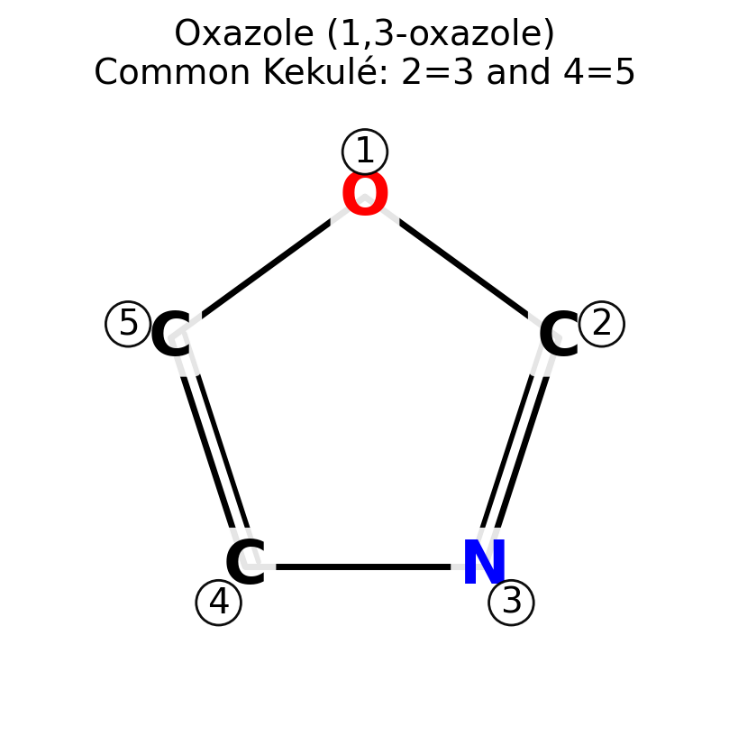
2.2 Three commonly confused names
Name | Key structural difference | Notes |
Oxazole (oxazole, 1,3-) | O and N are separated by one carbon | The focus of this article; commonly used for fine property tuning and as a ring-forming/assembly module |
Isoxazole (isoxazole, 1,2-) | O and N are adjacent | Not the same scaffold; electron distribution and reactivity can differ substantially |
Oxazoline / Oxazolidine (oxazoline/oxazolidine) | Not equivalent to aromatic oxazole (more saturated or partially saturated) | Acid–base behavior, conformation, stability, and “use logic” shift to a different set (often seen in ligands/protecting groups/reactive units in materials) |
2.3 Numbering and positions
A one-sentence rule for oxazole numbering: start at O as 1, and walking around the ring you reach N at 3.
Position | 1 | 2 | 3 | 4 | 5 |
Atom | O | C | N | C | C |
Common notation | 1,3-oxazole; hetero atom position | 2-substituted | N-3 (hetero atom position) | 4-substituted | 5-substituted |
III.Structural features: three “predictable effects” oxazole tends to bring
3.1 Weak basicity: it is usually not the “primary salt-forming site”
Authoritative reviews point out that oxazole is weakly basic: its pKa (conjugate-acid pKaH) is about 0.8, and it can form salts with mineral acids. This implies that oxazole becomes appreciably protonated only under fairly strong acidic conditions; under neutral to mildly acidic conditions, it typically does not serve as the main salt-forming center. Therefore, tasks such as “boosting solubility via salt formation” are often expected to be carried by other basic centers in the molecule.
How to use this information:
1. If you need a strong basic center that markedly increases water solubility upon protonation, oxazole usually does not play that role.
2. But if you want to avoid the high charge and higher nonspecific binding risk that often accompany strong bases, oxazole is often a milder choice.
3.2 Electronic effects: overall more electron-deficient (a π-deficient tendency)
Because an oxazole ring contains both O and a pyridine-type N, it often reduces the π-electron density of the ring system, making the fragment more electron-poor / π-deficient overall. When oxazole is introduced as an aryl/heteroaryl fragment, a common outcome is: stronger electron-acceptor character (energy levels pulled “down”), along with increased dipole and polarity.
In some systems, this π-deficiency together with lower basicity may reduce the probability of certain undesired side reactions (e.g., side chemistry under photo/oxidative stress). However, whether “stability truly improves” still depends on the substitution pattern, conjugation length, and specific conditions—and should be validated by measured data (chemical stability / metabolic stability / photostability).
3.3 Interaction pattern: clear acceptor sites; donor sites are usually absent
In oxazole, both N and O can typically serve as hydrogen-bond acceptors (HBA = 2). Meanwhile, the oxazole core contains no N–H, so it usually does not introduce hydrogen-bond donors (HBD = 0). Importantly, although both N and O may participate in acceptor interactions, the relative strength and mode of participation can shift with substitution and microenvironment (for example, under competition between hydrogen bonding and halogen bonding, or changes in solvation and local electric fields, the contributions of N vs O can be redistributed).
Therefore, when a system needs to add acceptor-type recognition/positioning capacity but you prefer not to increase the number of H-bond donors—and want to avoid forming overly strong, nonspecific H-bond networks—oxazole is often a relatively controllable fragment choice (the actual effect still needs to be evaluated together with overall polarity and total acceptor count).
IV.Quick Reference: Classification Dimensions for Oxazole-Related Heterocycles
Classification dimension | Literature/catalog keywords | What to pay attention to |
Heteroatom arrangement | oxazole (1,3-) vs isoxazole (1,2-) | First confirm the relative positions of N and O (1,3-oxazole vs 1,2-isoxazole). They are positional isomers: changing the heteroatom arrangement can markedly alter dipole/electron distribution, acceptor patterns, and functionalizable positions. If used as a “control,” clearly state that the goal is to compare heteroatom-arrangement effects, and avoid extrapolating conclusions as if this were merely a “minor tweak of the same scaffold.” |
Fused vs non-fused (annulated) | benzoxazole, benzo-fused (annulated) oxazole (and benzisoxazole) | Fusion typically extends conjugation and increases planarity, making energy levels, optical properties, and molecular packing more sensitive. Therefore, in materials and emission studies, discussions often use fused systems as representative examples. |
Aromaticity / degree of saturation | oxazole vs oxazoline (dihydrooxazole) vs oxazolidine | Whether the ring is aromatic determines whether the underlying “logic” of electronic effects, acceptor strength, and reactivity remains consistent. For property comparisons or bioisosteric swaps, you must distinguish these first. |
Substitution pattern | 2-/4-/5-substituted, 2,4,5-trisubstituted | The electronic environments at C2/C4/C5 differ and directly shape strategy: is it more efficient to introduce substituents during ring construction, or to functionalize after cyclization (site selectivity)? |
V.Three typical application pathways: What problems is oxazole most often used to solve?
A. Medicinal chemistry / chemical biology: fragment replacement and physicochemical “property-window” tuning
Oxazole is a highly reusable heteroaryl fragment. Without significantly increasing molecular size, it is often used to systematically tune polarity/dipole, electronic effects, and hydrogen-bond acceptor patterns (and typically without introducing HBDs). This supports SAR optimization and “property-window” parameter tuning; multiple reviews have summarized oxazole scaffolds in drug molecules and related SAR trends.
Suggested search keywords: oxazole scaffold; oxazole medicinal chemistry; oxazolyl substituent.
B. Organic synthesis: mature ring-forming methods enable “rapid access to the desired substitution pattern”
Two high-reuse classic routes are:
1. Robinson–Gabriel oxazole synthesis: cyclodehydration of 2-acylamino ketones to form oxazoles; a long-established and systematically compiled ring-forming method.
2. van Leusen (TosMIC) oxazole synthesis: a one-step “ring-construction reaction” that rapidly delivers series of substituted oxazoles.
In the van Leusen reaction, TosMIC is the key building block. A single ring-forming step can efficiently construct the oxazole core, which is especially suitable for parallel synthesis / rapid library generation. With common substrate combinations, it is often easier to obtain 5-substituted oxazole series. But this does not mean it can “only make 5-substituted products”: by switching to substituted TosMIC, adopting one-pot multicomponent strategies, or performing post-cyclization functionalization/coupling, the substitution map can be expanded to more complex patterns such as 4,5-disubstituted oxazoles. Since its introduction in the 1970s, this methodology has matured and has been covered in systematic reviews for further reading.
How to use this: If your goal is to quickly generate a set of substituted oxazoles for trend scouting, prioritize introducing major substitution differences during ring construction. After identifying the direction, follow with couplings or fine functionalization as needed. (Optional search keyword: Hantzsch oxazole synthesis.)
C. Materials and photophysics: a structural unit for emission/scintillation and energy transfer
Oxazole derivatives are very common in organic scintillators and luminescent materials. A typical example is PPO (2,5-diphenyl-1,3-oxazole), which is often used as a primary fluor / wavelength shifter, converting shorter-wavelength excitation energy into emission that is easier to detect.
VI.When is oxazole worth prioritizing?
Task / pain point | What oxazole may offer | Priority “decision check” | Related product tables below |
You want higher polarity / a different electronic effect, but do not want to introduce a strong basic center | A weakly basic, relatively electron-deficient heteroaryl acceptor pattern | Do you must have a strong salt-forming / strong-base anchor? If yes, oxazole usually should not be the primary salt-forming site | Table 2 (core/simple fragment controls) + Table 3 (building blocks with connection handles) |
You need to rapidly build a set of substituted heteroaryl controls (library/SAR) | Substitution positions can be compared systematically; easy to form positional isomer series | Do you need C2 vs C4 vs C5 positional controls, or “handle-bearing” acids/aldehydes/halides? | Table 3 (halides/acids/aldehydes/amines/esters) |
You are working on scintillation / emission / energy-transfer systems | Mature, “validated” representative compounds/systems for feasibility checks and formulation benchmarking | Run a proven system first (primary fluor + secondary wavelength shifter/optical brightener), then discuss structural innovation | Table 1 (DPO/PPO, POPOP, optical brighteners, ESIPT) |
You encounter terms like TOMMs / oxazole-containing peptide in papers and are unsure of meaning and entry points | Oxazole is a common post-translational heterocycle motif in natural products/modified peptides—useful as an entry point for structural origin and mechanistic controls | Start with reviews to clarify terminology, representative structural types, and biosynthetic routes (which tailoring enzymes form them), then decide whether structural controls/synthetic validation are needed | If you need synthesis/assembly building blocks → Table 3; if you need ring-formation entry points → Table 4 |
VII.Oxazole (Oxazole) Product Navigation Table: Quickly locate Tables 1–4 by “research task / experimental scenario”
Research task / experimental need | Start with which table | Why start here | Common follow-up linkages (what you usually check next) |
Radiation detection: liquid scintillation counting (LSC) and plastic scintillator formulation development/optimization (primary fluor + secondary wavelength shifter) | Table 1 Optical / luminescent materials | Table 1 concentrates the most-used scintillator components: the primary fluor DPO and the secondary fluor / wavelength shifter POPOP (different grades for different uses), plus common optical brighteners/chromophores—directly answering “what to choose, how to formulate, and what controls to use.” | If you need derivatizable structures or connection handles → Table 3 (halides/acids/aldehydes); for generic fragment controls → Table 2 |
Fluorescence/spectroscopy methods: fluorescence intensity/quantum yield/film emission benchmarks, UV–Vis/PL standards or mechanistic controls (including ESIPT) | Table 1 Optical / luminescent materials | Table 1 includes typical high-efficiency emissive cores and “environment-sensitive” scaffolds (e.g., 2-(2-hydroxyphenyl)benzoxazole for ESIPT), suitable for solvent effects, H-bond effects, polymer doping, and photostability mechanism controls. | To attach chromophores to target molecules/polymers → Table 3 (aldehydes/acids/halides); for minimal fragment controls → Table 2 |
Materials-side work: fluorescent whitening/optical brightening, conjugated small molecules/organic semiconductor chromophore screening (structure–emission relationships) | Table 1 Optical / luminescent materials | The brighteners and conjugated benzoxazole systems in Table 1 are closer to real materials scenarios (formulation/doping/film performance) and can be used directly as additives or control molecules to assess migration, phase separation, and photoaging. | Need reactive sites for structural expansion → Table 3; need core/simple substitution controls → Table 2 |
Medicinal chemistry / fragment screening: introduce a small, stable heteroaryl fragment and quickly build oxazole/benzoxazole control sets (not aiming for immediate coupling) | Table 2 Core scaffolds / simple substitutions | Table 2 provides the most-used “core and simple substituted” set (Oxazole, methyl-oxazoles, aryl-oxazoles, benzoxazole), enabling quick property-window comparisons (polarity, pKa/salt-forming tendency, metabolic stability) and the fastest “should we use oxazole?” decision. | To add substituents or introduce linkers → Table 3 (halides/acids/aldehydes/esters/amines) |
SAR or positional-isomer controls: keep the “oxazole ring” fixed while systematically comparing substitution position effects (C2 vs C4 vs C5) | Table 3 Functional building blocks | Table 3 covers 2-halo and 4-halo oxazoles, plus 2/4/5 carboxylic acids and aldehydes—an efficient entry for positional-isomer series, enabling rapid access to a set of “same core, different substitution positions.” | For optical/emission evaluation → Table 1; for “minimal starting point” and baseline controls → Table 2 |
Rapid library / parallel synthesis: batch-generate substituted oxazole/benzoxazole derivatives mainly via coupling/condensation (method development + scalable routes) | Table 3 Functional building blocks | Table 3 provides the most universal “plug-in handles”: halides (cross-coupling), carboxylic acids/esters (coupling/hydrolysis), aldehydes (reductive amination/condensation), amines (acylation/sulfonylation)—well-suited for parallel reactions and late-stage diversification. | If your goal is “direct ring construction” for rapid oxazole access → Table 4 (TosMIC); if the endpoint is luminescent materials → Table 1 |
Oxazole ring-forming routes: one-pot rapid oxazole construction from aldehydes/other substrates (method feasibility and route prototyping) | Table 4 Key reagents and reference compounds | Table 4 includes TosMIC (the key reagent for the van Leusen reaction), a typical methodology entry point for “fastest access to the oxazole core,” useful for feasibility checks and rapid small-library generation. | After ring closure, install substituents/expand → Table 3; for core/simple controls → Table 2 |
Metal coordination/inhibition/capture: evaluate sulfur-containing benzoxazoles for coordination/inhibition (e.g., metal binding, corrosion inhibition) | Table 3 Functional building blocks | 2-Mercaptobenzoxazole in Table 3 is the most direct “functional-site” molecule for this direction—useful for assessing binding/inhibition mechanisms and condition windows (pH, competing ligands, ionic strength). | If you need fluorescence readouts or environment-sensitive probe linkage → Table 1 (ESIPT/emissive cores) |
Analytical methods / drug controls: HPLC/LC–MS quantification, impurity/metabolite studies—need an “oxazole-containing drug-grade reference” as a systematic control | Table 4 Key reagents and reference compounds | Oxaprozin (a classic oxazole-containing drug reference) in Table 4 is suitable for method development, QC, and structure–property examples in a drug context; Table 4 also includes benzoxazolone scaffolds for activity/analytical controls. | To expand into derivative series → Table 3; for heteroaryl fragment-only controls → Table 2 |
Usage tips:
For emission/scintillation/brighteners → start with Table 1.
For synthesis libraries/coupling/condensation → start with Table 3.
For core scaffolds/simple fragment controls → start with Table 2.
For rapid ring construction or drug/analytical references → see Table 4.
Table 1 | Optical / Luminescent Materials (Scintillators, Optical Brighteners, Conjugated Chromophores, ESIPT Probes)
Category | CAS No. | Aladdin Cat. No. | Name | Spec / Purity | Key features & applications |
Luminescent / optical materials | Primary fluor for scintillators (Primary fluor) | 92-71-7 | 2,5-Diphenyloxazole (DPO) | Scintillation grade, ≥99% | A classic primary scintillator / primary fluor: used in liquid scintillation counting, plastic scintillators, and radiation-detection material formulations as an energy acceptor with efficient emission; also widely used as a benchmark/control for fluorescence quantum yield and luminescence performance. | |
Luminescent / optical materials | Scintillator / wavelength shifter (secondary fluor) | 1806-34-4 | 1,4-Bis(5-phenyl-2-oxazolyl)benzene (POPOP) | ≥98% | A classic secondary fluor / wavelength shifter in scintillators: commonly paired with a primary fluor in LSC or plastic scintillator formulations to shift the emission band after energy transfer to a more easily detected region; also usable as a fluorescence standard / spectroscopic control. | |
Luminescent / optical materials | Scintillator / wavelength shifter (secondary fluor) | 1806-34-4 | 1,4-Bis(5-phenyl-2-oxazolyl)benzene (POPOP) | BioReagent, suitable for scintillation | A common specification tailored for scintillation counting: suitable as a secondary fluor (wavelength shifter) in liquid scintillation systems for radioactive tracer / environmental sample counting method development and QC; also frequently used in polymer scintillator doping systems. | |
Luminescent / optical materials | Laser dye / fluorescent chromophore | 1806-34-4 | 1,4-Bis(5-phenyl-2-oxazolyl)benzene (POPOP) | For laser dyes | A conjugated oxazole chromophore: beyond scintillator applications, also commonly used as a laser dye/fluorophore or as a reference molecule in luminescent-material studies to evaluate energy transfer, photoluminescence (PL), and solid-state/doped emission behavior. | |
Luminescent / optical materials | Fluorescent whitening agent / optical standard | 1533-45-5 | 4,4′-Bis(2-benzoxazolyl)stilbene | ≥97% | A representative fluorescent whitening / optical brightening chromophore (commonly used in plastics, fibers, and resins): used to evaluate whitening performance, UV absorption–re-emission behavior, and migration/blooming; also often used as a solid-state fluorescence and thin-film spectroscopy control. | |
Luminescent / optical materials | Conjugated benzoxazole chromophore (materials/probe) | 7128-64-5 | 2,5-Bis(5-tert-butyl-benzoxazol-2-yl)thiophene | ≥99% | A benzoxazole–thiophene conjugated system: common in contexts such as organic emitters, optical brighteners, and organic semiconductors; used to build rigid, strongly conjugated chromophore backbones. High purity benefits thin-film emission and device/spectroscopy reproducibility assessments. | |
Luminescent / optical materials | ESIPT fluorescent core (environment-sensitive probe) | 835-64-3 | 2-(2-Hydroxyphenyl)benzoxazole | ≥98% | A classic ESIPT (excited-state intramolecular proton transfer) fluorescent scaffold: sensitive to solvent polarity, hydrogen bonding, and microenvironment; widely used in fluorescent probes, polymer luminescent additives, and studies on UV absorption and photostability; also serves as a photophysics mechanistic reference compound. |
Table 2 | Core Scaffolds / Simply Substituted Oxazoles (Property Controls, Fragment Introduction)
Category | CAS No. | Aladdin Cat. No. | Name | Spec / Purity | Key features & applications |
Core scaffold | Oxazole (minimal core / control) | 288-42-6 | Oxazole | ≥98% | The minimal oxazole core: used as a reactivity and spectral reference and as a starting point for substituted oxazole derivatives. In medicinal chemistry, it is often used as a “stable aromatic heterocycle fragment” to tune polarity and electronic effects while largely maintaining scaffold size. | |
Basic heterocycle | Simple substituted oxazole (general fragment) | 23012-10-4 | 2-Methyloxazole | ≥97% | A basic 2-methyl oxazole fragment: commonly used to introduce a small, stable heteroaryl ring to tune polarity/metabolic stability; remaining ring positions can still be functionalized, enabling substitution scans and route expansion. | |
Basic heterocycle | Simple substituted oxazole (general fragment) | 693-93-6 | 4-Methyloxazole | ≥97% | A basic 4-methyl oxazole fragment: often used to introduce a small-volume heteroaryl unit and enable further functionalization (e.g., substitution/coupling at remaining positions), serving as a starting unit for medicinal “fragment stitching” or conjugated-material motifs. | |
Basic heterocycle | Oxazole with further functionalization possible at C2 | 20662-83-3 | 4,5-Dimethyloxazole | ≥95% | With 4,5-dimethyl substitution, C2–H remains: commonly used to start from C2 for metalation and subsequent functionalization to rapidly access 2-substituted oxazole series; suitable for “site-controllable” oxazole derivatization and methodology studies. | |
Basic heterocycle | Simple substituted oxazole (property/spectral control) | 20662-84-4 | 2,4,5-Trimethyloxazole | ≥97% | A highly methylated small oxazole ring: often used as a hydrophobic heteroaryl fragment and as an electronic-effect control (spectra, volatility/polarity, solvation behavior). With fewer remaining positions for further functionalization, it is better suited for property controls or fragment-introduction assessment. | |
Basic heterocycle | Aryl oxazole (conjugation/control) | 20662-88-8 | 2-Phenyloxazole | ≥95% | A conjugated aryl-oxazole fragment: commonly used as a spectroscopic/electronic-effect control or intermediate for extension into larger conjugated chromophores (emissive materials, fluorescent probes) or as an aryl/heteroaryl fragment in drug molecules. | |
Core scaffold | Benzoxazole (fused-scaffold control) | 273-53-0 | Benzoxazole | ≥98% (GC) | A rigid fused aromatic heterocycle: widely used in medicinal chemistry and functional materials as a more planar, more rigid heteroaryl fragment; also used for coordination/emissive scaffold construction and as a spectral/reactivity control. A starting point for benzoxazole derivatization. |
Table 3 | Functional Building Blocks (Halides / Amines / Sulfur / Acid–Ester / Aldehydes: Coupling, Condensation, Library Construction)
Category | CAS No. | Aladdin Cat. No. | Name | Spec / Purity | Key features & applications |
Functional building block | Halo-oxazoles (high-frequency sites for cross-coupling) | 125533-82-6 | 2-Bromooxazole | ≥98% | A standard 2-halo oxazole coupling building block: used in Suzuki, Stille, Negishi and other cross-couplings to precisely install substituents at the oxazole C2 position; widely used for late-stage diversification in medicinal chemistry and for assembling conjugated backbones in materials. | |
Functional building block | 4-halo oxazoles (regioselective coupling) | 1240598-57-5 | 4-Bromo-1,3-oxazole | ≥95% | 4-halo substitution provides regioselectivity complementary to 2-halo analogs: used to install substituents specifically at oxazole C4 (Pd coupling/substitution). Particularly useful for building “positional isomer” oxazole libraries for SAR optimization. | |
Functional building block | Iodo-oxazoles (high-activity coupling sites) | 877614-97-6 | 2-Iodo-1,3-oxazole | ≥97% | A highly reactive 2-iodo oxazole: advantageous for Pd-catalyzed coupling and late-stage diversification under milder conditions, especially for sensitive substrates (many functional groups, prone to decomposition); commonly used for rapid construction of substituted oxazole fragment libraries. | |
Functional building block | Halo benzo[d]oxazoles (cross-coupling / conjugation stitching) | 68005-30-1 | 2-Bromobenzo[d]oxazole | ≥98% | A fused benzo[d]oxazole halide building block: used to build larger conjugated systems or heteroaryl ligand frameworks (coupling can increase rigidity and conjugation length); common in emissive materials, coordination ligands, and medicinal heteroaryl-fragment assembly routes. | |
Functional building block | Halo benzoxazoles (coupling/substitution site) | 615-18-9 | 2-Chlorobenzoxazole | ≥98% (GC) | An activated C2-halogenated benzoxazole: commonly used in Pd-catalyzed couplings (Suzuki/Stille/Negishi, etc.) or nucleophilic substitution to introduce C2 substituents and build benzoxazole series; a high-frequency starting point for rapidly expanding benzoxazole libraries. | |
Functional building block | Amino-oxazoles (nucleophilic derivatization) | 4570-45-0 | 2-Aminooxazole | ≥97% | A commonly used amino-oxazole building block: enables acylation/sulfonylation/urea formation and other derivatizations; also used to introduce N-containing heteroaryl motifs in medicinal chemistry and ligand design. Often used for interaction scans involving combined H-bond donor + acceptor features and for fragment annulation reactions. | |
Functional building block | Aminobenzoxazoles (nucleophilic derivatization) | 4570-41-6 | 2-Aminobenzoxazole | ≥97% | A bifunctional benzoxazole–amino building block: the rigid, planar heteroaromatic core provides a stronger π system and hydrophobic surface, while the amino group provides an additional connection handle; often used to quickly establish derivatizable benzoxazole cores in drug leads and functional materials. | |
Functional coordination / additive | Sulfur-containing benzoxazoles (coordination / inhibition / capture) | 2382-96-9 | 2-Mercaptobenzoxazole | ≥98% | A sulfur-containing benzoxazole ligand: thiol/thione tautomerism gives strong affinity for metals; commonly used for metal-ion capture/chelation and studies on corrosion inhibition (e.g., copper and related systems). Also used as a functional additive scaffold in materials and rubber systems (coordination, oxidation inhibition, etc.). | |
Functional building block | Oxazole-2-carboxylic acid (coupling handle) | 672948-03-7 | 2-Oxazolecarboxylic acid | ≥95% | A C2 heteroaryl carboxylic acid: directly used for amide/ester coupling to install an oxazole fragment into target molecules. Together with 4-/5-carboxylic acids, forms a “positional isomer control set” for systematic comparison of electronic effects, salt/solubility behavior, and binding-mode differences. | |
Functional building block | Oxazole carboxylic acid (coupling handle) | 23012-13-7 | 4-Oxazolecarboxylic Acid | ≥98% | A general oxazole carboxylic-acid coupling building block: used under EDC/HATU and related conditions to couple with amines/alcohols and rapidly introduce oxazole into target scaffolds. The carboxylic acid is also a common “knob” for tuning solubility/polarity, making it suitable for property-window optimization controls. | |
Functional building block | Oxazole carboxylic acid (coupling handle) | 118994-90-4 | 5-Oxazolecarboxylic acid | ≥97% | A 5-carboxy oxazole: used to build amides/esters and to systematically compare electronic and polarity differences arising from changing the carboxyl position. Common in heteroaryl-acid fragment libraries and in ligand/drug fragment optimization. | |
Functional building block | Substituted oxazole carboxylic acid (property tuning + coupling) | 103879-58-9 | 5-Methyloxazole-4-carboxylic acid | ≥98% | A methyl + carboxylic acid disubstituted oxazole: provides both hydrophobic volume and a coupling handle, useful as an SAR control for fine-tuning the hydrophobic/polar balance; commonly followed by amide coupling to form stable linkages. | |
Functional building block | Oxazole-2-carboxylate ester (hydrolyzable → coupling) | 31698-88-1 | Methyl oxazole-2-carboxylate | ≥95% | A C2 ester oxazole building block: often used as a “convertible handle” (ester → acid → amide/ester) to stably incorporate oxazole into a core scaffold; also supports a property-gradient control set across acid/ester/amide forms. | |
Functional building block | Oxazole carboxylate ester (hydrolyzable → coupling) | 85806-67-3 | Methyl 2-methyloxazole-4-carboxylate | ≥97% | An oxazole building block bearing an ester “connection handle”: often handled and purified as the ester first, then hydrolyzed to the acid for amide/ester coupling. Used to introduce oxazole into larger scaffolds while enabling fine tuning of polarity and electronic effects. | |
Functional building block | Oxazole-2-aldehyde (condensation / stitching) | 65373-52-6 | Oxazole-2-carbaldehyde | ≥97% | A general heteroaryl aldehyde stitching unit: used in reductive amination (with amines to build side chains) and in condensations such as Knoevenagel/Wittig (extend conjugation / introduce alkene linkers), enabling rapid grafting of oxazole fragments onto more complex scaffolds. | |
Functional building block | Benzoxazole-2-carboxylic acid (coupling / coordination) | 21598-08-3 | Benzoxazole-2-carboxylic acid | ≥95% | Benzoxazole-2-carboxylic acid: combines fused heteroaryl rigidity with a carboxylic-acid coupling handle; commonly used to build drug/ligand fragments via amidation and also used in coordination chemistry and materials end-group installation (improving polarity and derivatizability). | |
Functional building block | Benzoxazole-2-aldehyde (condensation / stitching) | 62667-25-8 | Benzooxazole-2-carbaldehyde | ≥95% | A fused heteroaryl aldehyde building block: used for Schiff-base/imine formation, reductive amination, and condensations such as Knoevenagel, enabling rapid attachment of benzoxazole fragments to amines or active-methylene substrates; especially common in fluorescent probe and conjugated-material synthetic routes. |
Table 4 | Key Synthetic Reagents and Drug / Bioactive Reference Compounds (Methodology and Quantitative Controls)
Category | CAS No. | Aladdin Cat. No. | Name | Spec / Purity | Key features & applications |
Synthetic reagent | Key reagent for oxazole ring construction (van Leusen) | 36635-61-7 | p-Toluenesulfonylmethyl isocyanide | ≥98% | A high-frequency reagent for oxazole ring formation: TosMIC is commonly used in the van Leusen reaction to rapidly construct oxazole rings from aldehydes and related substrates in a one-pot manner while introducing substituents—an “step-saving” choice for oxazole fragment libraries and rapid route validation. Isocyanide reagents are often more sensitive in odor and storage; ensure ventilation and dryness in practice. | |
Drug standard | Oxazole-containing NSAID reference compound | 21256-18-8 | Oxaprozin | Moligand™, ≥98% | A classic oxazole-containing nonsteroidal anti-inflammatory drug (NSAID) reference: used in pharmacology controls, impurity/metabolite studies, HPLC/LC–MS method development, and quantitative analysis; also serves as a “drug-grade oxazole fragment” example in structure–property discussions. | |
Drug / bioactive reference | Benzoxazolinone scaffold | 59-49-4 | 2-Benzoxazolinone | ≥98% | A benzoxazolinone (lactam) scaffold: frequently encountered in bioactive/agrochemical and natural-product-related contexts; can serve as an analytical control or synthetic intermediate to build substituted benzoxazolinone series and evaluate activity and metabolic stability. |
For more related articles, please see below: