
Determine the necessary mass, volume, or concentration for preparing a solution.
| Activity Type | Relation | Activity value | Units | Action Type | Journal | PubMed Id | doi | Assay Aladdin ID |
|---|
≥95% for sensitive chromatographic and analytical workflows requiring minimal baseline interference.
Protected from light,Store at -20°C,Argon charged,Desiccated Ships Ice chest + Ice pads Check lot-specific COA for exact specifications.
SDS, COA, datasheet, and spec sheet available for download. Lot-specific COA accessible via lot number lookup.
Cited in 15 peer-reviewed publications across chromatography, organic synthesis, and cross-coupling reactions.
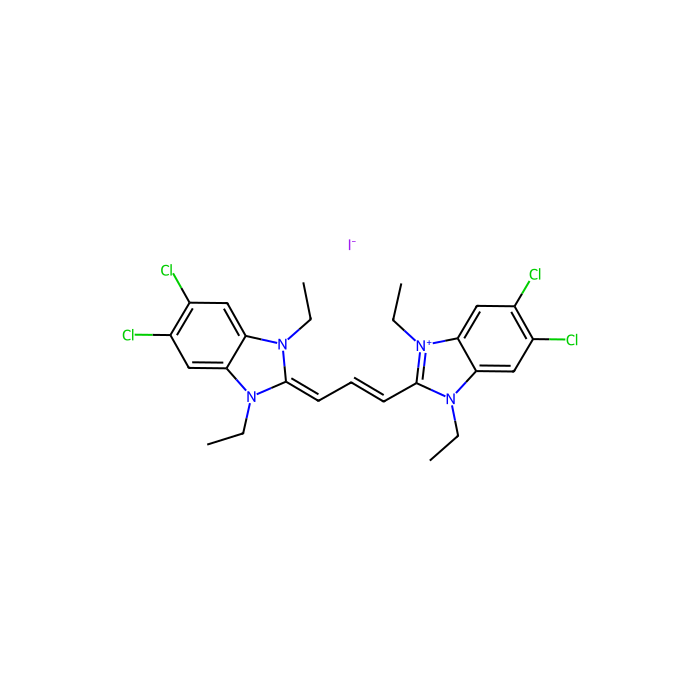
JC-1 is a fluorescent lipophilic carbocyanine dye, which can be used to measure mitochondrial membrane potential.
A dual-emission potential-sensitive probe that can be used to measure mitochondrial membrane potential. JC-1 is a green-fluorescent (λex 520 nm) monomer at low membrane potential. At higher potentials, JC-1 forms red-fluorescent (λem 596 nm ) "J-aggregates," which exhibit broad excitation and very narrow emission spectra. The ratio of red to green fluorescence of JC-1 is dependent only on membrane potential, and not influenced by mitochondrial size, shape, or density.
The decrease of mitochondrial membrane potential is a landmark event in the early stage of apoptosis. The decrease of cell membrane potential can be easily detected by the transition of JC-1 from red fluorescence to green fluorescence, and the transition from red fluorescence to green fluorescence of JC-1 can also be used as an early detection indicator of apoptosis.
The maximum excitation wavelength of JC-1 monomer is 514nm and the maximum emission wavelength is 529nm; the maximum excitation wavelength of JC-1 polymer is 585nm and the maximum emission wavelength is 590nm. For actual observation, use the conventional settings for observing red fluorescence and green fluorescence.
The commonly used concentration range of JC-1 for detecting the mitochondrial membrane potential of cells is 1-20μg/mL, and the suitable concentration of JC-1 for many cells is 10μg/mL.
Precautions
If the amount of JC-1 used at a time is small, each tube needs to be appropriately divided to avoid repeated freeze-thaw.
For your safety and health, please wear lab coats and disposable gloves.
| Pubchem Sid | 504763893 |
|---|---|
| Pubchem Sid Url | https://pubchem.ncbi.nlm.nih.gov/substance/504763893 |
| Canonical Smiles | CCN1C2=CC(=C(C=C2[N+](=C1C=CC=C3N(C4=CC(=C(C=C4N3CC)Cl)Cl)CC)CC)Cl)Cl.[I-] |
| IUPAC Name | 5,6-dichloro-2-[(E)-3-(5,6-dichloro-1,3-diethylbenzimidazol-3-ium-2-yl)prop-2-enylidene]-1,3-diethylbenzimidazole;iodide |
| InChIKey | FYNNIUVBDKICAX-UHFFFAOYSA-M |
| INCHI | 1S/C25H27Cl4N4.HI/c1-5-30-20-12-16(26)17(27)13-21(20)31(6-2)24(30)10-9-11-25-32(7-3)22-14-18(28)19(29)15-23(22)33(25)8-4;/h9-15H,5-8H2,1-4H3;1H/q+1;/p-1 |
| Isomeric SMILES | CCN1C2=CC(=C(C=C2[N+](=C1/C=C/C=C3N(C4=CC(=C(C=C4N3CC)Cl)Cl)CC)CC)Cl)Cl.[I-] |
| PubChem CID | 5492929 |
| Molecular Weight | 652.23 |
Comprehensive hazard, handling, storage, and regulatory compliance document.
Download SDS →Lot-specific quality data. Enter your lot number to retrieve the exact COA.
Look up COA →Full quality attributes and acceptance criteria for this grade.
View spec sheet →Taxonomy Tree
| Kingdom | Organic compounds |
|---|---|
| Superclass | Organoheterocyclic compounds |
| Class | Benzimidazoles |
| Subclass | Not available |
| Intermediate Tree Nodes | Not available |
| Direct Parent | Benzimidazoles |
| Alternative Parents | N-substituted imidazoles Benzenoids Aryl chlorides Heteroaromatic compounds Ketene acetals Azacyclic compounds Organopnictogen compounds Organonitrogen compounds Organochlorides Organic iodide salts Hydrocarbon derivatives |
| Molecular Framework | Aromatic heteropolycyclic compounds |
| Substituents | Benzimidazole - Aryl chloride - Aryl halide - Benzenoid - N-substituted imidazole - Azole - Heteroaromatic compound - Imidazole - Ketene acetal or derivatives - Azacycle - Organic nitrogen compound - Organohalogen compound - Organochloride - Organonitrogen compound - Organic salt - Organic iodide salt - Hydrocarbon derivative - Organopnictogen compound - Aromatic heteropolycyclic compound |
| Description | This compound belongs to the class of organic compounds known as benzimidazoles. These are organic compounds containing a benzene ring fused to an imidazole ring (five member ring containing a nitrogen atom, 4 carbon atoms, and two double bonds). |
| External Descriptors | cyanine dye - organic iodide salt |
| Activity Type | Relation | Activity value | Units | Action Type | Journal | PubMed Id | doi | Assay Aladdin ID |
|---|
Find and download the COA for your product by matching the lot number on the packaging.
| Lot Number | Certificate Type | Date | Item |
|---|---|---|---|
 K2224596 K2224596 | Certificate of Analysis | Jun 09, 2026 | J125134 |
| K2224597 | Certificate of Analysis | Jun 09, 2026 | J125134 |
| K2224598 | Certificate of Analysis | Jun 09, 2026 | J125134 |
| D2617443 | Certificate of Analysis | Apr 08, 2026 | J125134 |
| D2617444 | Certificate of Analysis | Apr 08, 2026 | J125134 |
| D2617448 | Certificate of Analysis | Apr 08, 2026 | J125134 |
| G2509024 | Certificate of Analysis | Jul 22, 2025 | J125134 |
| D2507073 | Certificate of Analysis | Apr 19, 2025 | J125134 |
| K2405029 | Certificate of Analysis | Nov 12, 2024 | J125134 |
| L2312076 | Certificate of Analysis | Dec 20, 2023 | J125134 |
| L2103714 | Certificate of Analysis | Sep 19, 2023 | J125134 |
| L2103724 | Certificate of Analysis | Sep 19, 2023 | J125134 |
| G1917104 | Certificate of Analysis | Mar 14, 2023 | J125134 |
| Solubility | DMSO |
|---|---|
| Sensitivity | light sensitive;Moisture sensitive;air sensitive |
| Molecular Weight | 652.200 g/mol |
| XLogP3 | |
| Hydrogen Bond Donor Count | 0 |
| Hydrogen Bond Acceptor Count | 3 |
| Rotatable Bond Count | 6 |
| Exact Mass | 652.001 Da |
| Monoisotopic Mass | 650.003 Da |
| Topological Polar Surface Area | 15.300 Ų |
| Heavy Atom Count | 34 |
| Formal Charge | 0 |
| Complexity | 625.000 |
| Isotope Atom Count | 0 |
| Defined Atom Stereocenter Count | 0 |
| Undefined Atom Stereocenter Count | 0 |
| Defined Bond Stereocenter Count | 1 |
| Undefined Bond Stereocenter Count | 0 |
| The total count of all stereochemical bonds | 1 |
| Covalently-Bonded Unit Count | 2 |
| 1. Lei Qian, Hu Xu, Ruqiang Yuan, Weijing Yun, Yufang Ma. (2023) Formononetin ameliorates isoproterenol induced cardiac fibrosis through improving mitochondrial dysfunction. BIOMEDICINE & PHARMACOTHERAPY, [PMID:38070245] [10.1016/j.biopha.2023.116000] |
| 2. Mingqiao Li, Hedan Xu, Nan Zhao, Liangjun Zhang, Haihan Xia, Xiaoxun Zhang, Qiao Li, Min Liao, Qiong Pan, Zeng Yi, Jin Chai. (2023) Hepatocyte-targeted hyaluronic acid-polyethyleneimine conjugates for acute liver injury therapy by ROS elimination and inflammation modulation. MATERIALS & DESIGN, [PMID:] [10.1016/j.matdes.2023.112212] |
| 3. Fang Zhu, Jianhua Zhang, Jian Zhong, Tianyou Wang, Yiwen Li, Zhipeng Gu. (2023) Natural polyphenol-based nanoparticles for the treatment of iron-overload disease. JOURNAL OF CONTROLLED RELEASE, [PMID:36813037] [10.1016/j.jconrel.2023.02.027] |
| 4. Qiying Lv, Kai Chi, Xiaolei Shi, Miaodeng Liu, Xiaoye Li, Cheng Zhou, Lin Shi, Huiling Fan, Huan Liu, Jia Liu, Yan Zhang, Shuai Wang, Lin Wang, Zheng Wang. (2023) Nanozyme-like single-atom catalyst combined with artesunate achieves photothermal-enhanced nanocatalytic therapy in the near-infrared biowindow. Acta Biomaterialia, [PMID:36623782] [10.1016/j.actbio.2022.12.071] |
| 5. Wei Guo, Fei Wang, Dandan Ding, Chuanqi Song, Chongshen Guo, Shaoqin Liu. (2017) TiO2–x Based Nanoplatform for Bimodal Cancer Imaging and NIR-Triggered Chem/Photodynamic/Photothermal Combination Therapy. CHEMISTRY OF MATERIALS, [PMID:] [10.1021/acs.chemmater.7b03241] |
| 6. Tang Yizhang, Yu Xujiang, He Liangrui, Tang Meng, Yue Wenji, Chen Ruitong, Zhao Jie, Pan Qi, Li Wanwan. (2025) A high-valence bismuth(V) nanoplatform triggers cancer cell death and anti-tumor immune responses with exogenous excitation-free endogenous H2O2- and O2-independent ROS generation. Nature Communications, 16 (1): (1-19). [PMID:39833161] [10.1038/s41467-025-56110-7] |
| 7. Pingjun Zhu, Xi Wang, Qingfeng Wu, Jianbo Zhu, Yifan Que, Yan Wang, Yongkai Ding, Yang Yang, Jie Jin, Xin Zhang, Qian Xu, Qinge Yong, Christopher Chang, Guogang Xu, Yingzhen Du. (2024) BCAP31 Alleviates Lipopolysaccharide-Mediated Acute Lung Injury via Induction of PINK1/Parkin in Alveolar Epithelial Type II Cell. Research, [PMID:39381793] [10.34133/research.0498] |
| 8. Jie Zhou, Xin Zheng, Chen Xi, Xinyi Tang, Yinjie Jiang, Minjuan Xie, Xiaoyi Fu. (2024) Cr(VI) induced hepatocyte apoptosis through the CTH/H2S/Drp1 signaling pathway. SCIENCE OF THE TOTAL ENVIRONMENT, [PMID:39117219] [10.1016/j.scitotenv.2024.175332] |
| 9. Xin Zheng, Xinyi Tang, Yinan Xu, Haiyan Zhu, Lianwei Zhong, Chen Chen, Jiajun Cui, Jie Zhou. (2025) Sodium aescinate induces hepatotoxicity through apoptosis and ferroptosis by inhibiting the Nrf2/CTH pathway. JOURNAL OF ETHNOPHARMACOLOGY, [PMID:40064321] [10.1016/j.jep.2025.119608] |
| 10. Zihuan Wu, Haiqin Chen, Bo Yang, Jianxin Zhao, Wei Chen. (2024) Structural identification and antioxidant activity of trans-9, trans-11, cis-15-conjugated linolenic acid converted by probiotics. FOOD RESEARCH INTERNATIONAL, [PMID:38609236] [10.1016/j.foodres.2024.114258] |
| 11. Zhen Jin, Yunkai Wang, Miaomiao Han, Li Wang, Fei Lin, Qianfang Jia, Wu Ren, Jiawei Xu, Wenhao Yang, Guo-an Zhao, Xuming Sun, Changqin Jing. (2024) Tumor microenvironment-responsive size-changeable and biodegradable HA-CuS/MnO2 nanosheets for MR imaging and synergistic chemodynamic therapy/phototherapy. COLLOIDS AND SURFACES B-BIOINTERFACES, [PMID:38631280] [10.1016/j.colsurfb.2024.113921] |
| 12. Yi Chen, Wen-Xiong Wang. (2025) Immune Resilience and Subcellular Adaptation of Oyster Hemocytes under Hypoxic Stress. ENVIRONMENTAL SCIENCE & TECHNOLOGY, [PMID:40754948] [10.1021/acs.est.5c05254] |
| 13. Xing-Jie Zhang, Peng-Yun Yang, Ling Ding, Jun Wang, Xiao-Li Li, Wei-Lie Xiao. (2025) Isolicoflavonol alleviates UVB-induced photodamage via protecting mitochondria and blocking the activation of NLRP3 inflammasome. TOXICOLOGY AND APPLIED PHARMACOLOGY, [PMID:39929282] [10.1016/j.taap.2025.117262] |
| 14. Jie Zhou, Yurou Li, Chen Xi, Wupei Pan, Qin Yu, Zhengping Wu. (2025) Apigenin Alleviates Fumonisin B1-Induced Hepatotoxicity by Suppressing Ferroptosis through the Nrf2/FSP1 Pathway. JOURNAL OF AGRICULTURAL AND FOOD CHEMISTRY, [PMID:41073359] [10.1021/acs.jafc.5c08870] |
| 15. Zhen Peng, Yimin Cheng. (2026) Hexavalent Chromium Inhibits Human Sperm Motility by Targeting Lysine Glutarylation and Mitochondrial Function. JOURNAL OF APPLIED TOXICOLOGY, [PMID:41500245] [10.1002/jat.70043] |