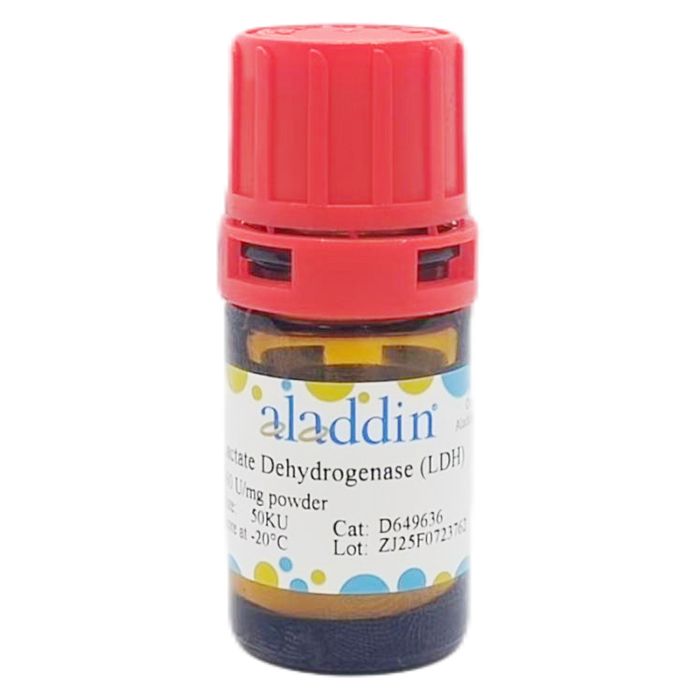
Lactate Dehydrogenase (LDH) is an oxidoreductase that uses NAD⁺ or NADP⁺ as an acceptor and acts on the donor CH-OH group, and can catalyze the oxidation of D-lactate to pyruvate. D-Lactate dehydrogenase widely exists in bacteria and fungi, and is often used in biochemical research.
Application:
Used in the research and development and large-scale formulation of reagents such as glutamate transaminase.
Enzymatic Properties
Source: Microorganism
Classification: EC 1.1.1.28
Molecular Weight: 45 kDa (SDS-PAGE)
Isoelectric Point: 4.5
Km Value: 2.2×10⁻⁶ M (Pyruvate)
Inhibitors: Ag⁺, Hg²⁺
Optimal pH: 6.5-7.0 (Fig.1)
Optimal Temperature: 45℃ (Fig.2)
pH Stability: 5.5-10.0 (25℃, 16 h) (Fig.3)
Thermal Stability: Stable below 50℃ (pH 7.0, 30 min) (Fig.4)
Stability: Store at -25~-15℃ in the dark, maintain over 90% activity for 12 months (Fig.5)
Protectant: BSA


Assay Method
Principle

The NADH consumed in the reaction can be detected at 340 nm using a spectrophotometer.
Enzyme Activity Definition
One unit of enzyme activity is defined as the amount of enzyme required to oxidize 1 μmol of NADH per minute under the following conditions.
Reagent Preparation
Reagent I: Weigh 0.04 g of sodium pyruvate, dissolve it in 0.1 M Tris-HCl buffer (pH 7.7), and dilute to 100 mL.
Reagent II: Weigh 21.1 g of CAPS, dissolve it in 80 mL of water, adjust the pH to 9.7 with NaOH, add 120 mg of NADH, and dilute to 100 mL with double-distilled water.
Enzyme Dilution Buffer: 10 mM potassium phosphate buffer (pH 7.0) with BSA added to a final concentration of 0.1%.
Sample: Dilute the enzyme with pre-cooled enzyme dilution buffer to 1-2 U/mL.
Operating Procedures
1. Operating Procedures4.1 Add 1 mL of Reagent I and 20 μL of the sample to be tested into a 1 mL cuvette, and mix well.
2. Preheat the reaction mixture at 37℃ for 5 min.
3. Add 0.2 mL of Reagent II to the reaction mixture, mix well, react at 37℃, and record the absorbance change (ΔAs) within 1 min at 340 nm using a spectrophotometer.
* Replace the enzyme with enzyme dilution buffer, and follow the same steps. The absorbance of the resulting solution is the blank absorbance (ΔAb).
∆A=∆As-∆Ab
Calculation
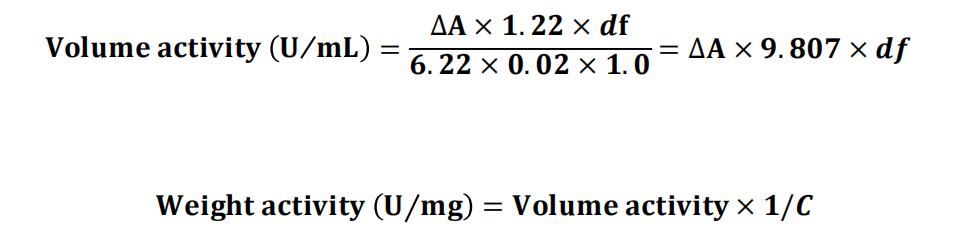
1.22: Total volume of the reaction solution (mL);
0.02: Volume of the enzyme solution (mL);
1.0: Path length (cm);
df: Dilution factor;
C: Enzyme concentration (mg/mL);