GRADE & PURITYCarrier Free?Carrier-free — supplied without added carrier protein/stabilizer. Use when carriers (e.g. BSA) would interfere with conjugation or sensitive assays.Azide Free?Azide-free — without sodium azide preservative. Use in conjugations, cell work, or assays where azide is toxic or inhibitory.His Tag?His tag grade — recombinant protein bearing a His tag for affinity purification/detection. Use to purify, immobilize, or detect the tagged protein.≥90%(SDS-PAGE)
Carrier Free,Azide Free,His-Tag,≥90%(SDS-PAGE) Azide Free,Carrier Free,His Tag for sensitive chromatographic and analytical workflows requiring minimal baseline interference.
🌡
Storage & shipping
Store at -20°C,Avoid repeated freezing and thawing Ships Ice chest + Ice pads Check lot-specific COA for exact specifications.
📋
Quality documents
SDS, COA, datasheet, and spec sheet available for download. Lot-specific COA accessible via lot number lookup.
📚
Literature proof
Cited in 0 peer-reviewed publications across chromatography, organic synthesis, and cross-coupling reactions.
Overview
Purity:>90%, by SDS-PAGE visualized with Coomassie® Blue Staining. Description: p53 is well known for its key role as a tumor suppressor protein. It is 393 amino acids (aa) in length with a predicted molecular weight of 44 kDa. It belongs to the p53 family that also includes p63 and p73. Structurally, p53 is characterized by an N-terminal transactivation domain, central DNA-binding and oligomerization domains, and a C-terminal regulatory domain. It is thought to exist as a homotetramer, and it exhibits approximately 72% and 76% aa identity with its mouse and rat orthologs, respectively. Mutations in the p53 gene are one of the most frequent genomic events accompanying oncogenic transformation. p53 responds to signals such as DNA damage or cell stress primarily through its actions as a transcription factor. Among its gene targets are a range factors that promote DNA repair mechanisms or apoptosis, including cell cycle regulatory proteins and members the Bcl-2 family. Because of its critical role in genomic homeostasis, p53 activities are tightly regulated by a network of protein-protein interactions, microRNAs, and a range of post-translational modifications, including phosphorylation, acetylation, methylation, and ubiquitination. A widely studied regulator is Murine Double Minute 2 (MDM2). MDM2 is known to suppress p53 activity through direct binding or through its actions as a Ubiquitin ligase (E3) that catalyzes p53 ubiquitination and proteasome-mediated degradation.
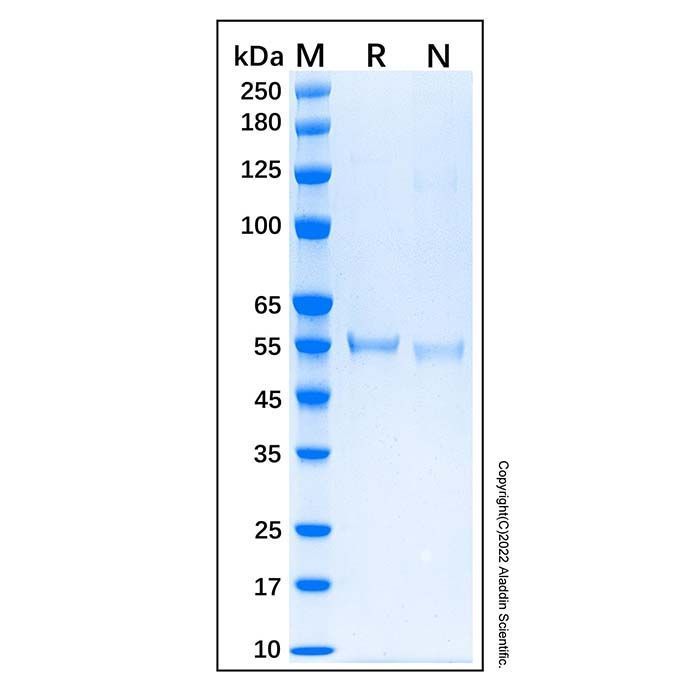
55.4 kDa, under reducing conditions; 52.5 and 122.4 kDa, under non-reducing conditions
Molecule Type
Protein
Storage and Shipping
Shape
Lyophilized
Reconstitution
We recommend that this vial be briefly centrifuged prior to opening to bring the contents to the bottom. Reconstitute at 0.5 mg/mL in sterile distilled water. Stock solutions should be apportioned into working aliquots and stored at ≤ -20 °C. Further dilutions should be made in appropriate buffered solutions.
Storage
Store at -20°C,Avoid repeated freezing and thawing
Shipped In
Ice chest + Ice pads
Stability And Storage
Store at -20°C for 1 year. Avoid freeze / thaw cycle.
Images
Recombinant Human p53 Protein (rp170134) - SDS-PAGE 2 μg/lane of Recombinant Human p53 Protein was resolved with SDS-PAGE under reducing (R) and non-reducing (N) conditions and visualized by Coomassie® Blue staining, showing a band at 55.4 kDa under reducing conditions and 52.5 & 122.4 kDa under non-reducing conditions.
Documentation
📋 Safety Data Sheet (SDS)
Comprehensive hazard, handling, storage, and regulatory compliance document.
We use cookies to ensure the website functions properly and, where permitted, to improve your experience. You can manage your preferences at any time in Settings. Learn more in our Cookie Policy.
Shall we send you a message when we have discounts available?
Remind me later
Thank you! Please check your email inbox to confirm.
Products are supplied to verified businesses, institutions, and qualified professionals for research and development use only. Not for use in humans, animals, diagnosis, or therapy.

 ZJ24F0303510