
Why Copper Develops Local Pinholes in Water Systems: The Film-Forming Protection Mechanism of Benzotriazole (BTA), Key Variables, and a Selection Guide (Tables 1–3)
Why Copper Develops Local Pinholes in Water Systems: The Film-Forming Protection Mechanism of Benzotriazole (BTA), Key Variables, and a Selection Guide (Tables 1–3)
1.Real-world pain point: Why copper pipes can “suddenly start leaking” — local perforation driven by pitting/crevice corrosion
1. In building potable-water plumbing, recirculating cooling-water loops, heat exchangers, fire-sprinkler systems, and related applications, copper and copper alloys are widely used for their high thermal conductivity and good processability. However, once pitting or crevice corrosion occurs, it often manifests as rapid, highly localized wall penetration, leading to leaks, shutdowns, and costly replacement.
2. Pitting does not necessarily wait until “overall water quality is bad.” Even when bulk water-quality indicators look acceptable, a combination of oxidizing conditions (dissolved oxygen; residual disinfectants such as free chlorine or chlorine dioxide), an ionic environment containing Cl⁻, plus factors such as stagnation vs. flow, deposits/crevices, or residual films from manufacturing/installation (e.g., carbonaceous/organic films) can create local micro-environment differences and micro-galvanic cells. Corrosion can then shift from “uniform thinning” to “runaway at a single spot,” ultimately producing pinhole perforation.
3. Benzotriazole (benzotriazole, BTA) is a commonly used copper corrosion inhibitor. It can form a Cu–BTA complex/adsorbed protective layer on copper surfaces, suppressing interfacial reactions associated with localized corrosion. However, when oxidant residuals are high or under high-shear flow, the formation and stability of the protective film may be affected; in practice, BTA should be treated as a variable and verified via small-scale comparative testing.
2.What is benzotriazole?
2.1 Basic definition and key structural points
Benzotriazole (benzotriazole, BTA) is an aromatic nitrogen-containing heterocycle formed by the fusion of a benzene ring with a 1,2,3-triazole ring, with the molecular formula C₆H₅N₃. In real systems it often exists as 1H/2H tautomeric forms. In industrial water systems, it is commonly used as a corrosion inhibitor for copper and copper alloys.
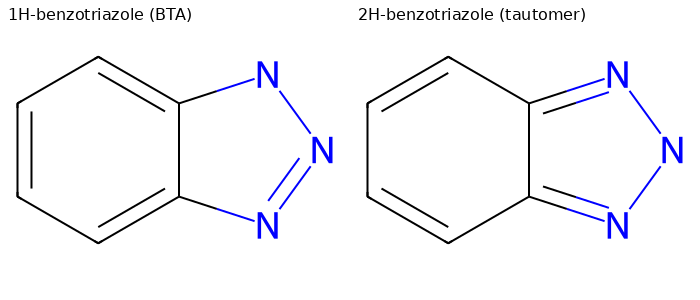
A key advantage of BTA lies in the multiple nitrogen sites on the triazole ring: these sites can coordinate/adsorb to copper surface sites and to dissolved Cu species, forming a relatively compact Cu–BTA protective layer on the copper surface. This lowers the interfacial reaction rates required for pitting/crevice corrosion (i.e., it “suppresses the localized interfacial reactions”).
2.2 Glossary / terminology cross-reference table
How it is written in literature/formulations | Chemical form / concept | What it implies for “film formation to suppress copper corrosion” (key caveats) |
BTA / BTAH (or BtH) | BTA is often used as a generic name for “benzotriazole-type substances.” BTAH/BtH is often used to emphasize the neutral, N–H (acid) form (not the same as the cation [HBTA]⁺). | Speciation shifts with pH. Neutral BTAH tends to adsorb first and then deprotonate; as the system becomes more alkaline, a larger fraction of BTA⁻ participates in subsequent complexation/film growth. |
BTA⁻ | The conjugate base (deprotonated anion) of benzotriazole; BTA acidity is roughly pKₐ ≈ 8.3–8.4, so the fraction of BTA⁻ increases under mildly alkaline conditions. | More prone to forming “benzotriazolate salts/complexes” with copper sites/Cu ions and integrating into the film structure; many surface studies also observe stronger surface interactions for deprotonated species. |
1H / 2H tautomers | Tautomerism in which the H “moves among different N positions”; writing 1H/2H indicates which N bears H. | Tautomerism changes the distribution of N sites available for coordination/adsorption, so adsorption orientation and complexation mode can vary with environment. Treat it as a chemical reason behind condition dependence, rather than as an independent “control knob.” |
Cu–BTA surface film (may show Cu(I)–BTA / Cu(II)–BTA valence features) | Copper–benzotriazole complexes / surface complex films; depending on the study conditions, structures involving Cu(I) and/or Cu(II) may be present. | The inhibition effect of BTA is widely linked to forming a Cu–BTA protective layer on copper; Cu(I)–BTA-related film components are repeatedly discussed as key constituents. |
TTA (tolyltriazole) | A methyl-substituted derivative of BTA (often a mixture of isomers), belonging to the same family of “azole-type copper inhibitors.” | Commonly appears as an alternative and/or co-inhibitor in industrial water systems such as cooling water. |
3.Why copper “locally perforates” in water: the two-step logic of pitting (initiation → propagation)
Copper in water typically develops a surface product film/deposit layer dominated by species such as Cu₂O. When this “protective layer” can persist and continuously self-repair, corrosion tends to remain relatively mild. By contrast, if a site experiences local film breakdown and cannot reliably re-passivate due to ion accumulation, mass-transfer limitation, or oxygen concentration gradients, corrosion may switch from “overall slow” to a pitting/crevice mode that “drills inward aggressively” at a single location.
In engineering practice, high-frequency triggers can be grouped into three categories:
1. More oxidizing water: Residual disinfectants such as free chlorine/hypochlorous acid (as well as dissolved oxygen and other oxidants) raise the oxidation driving force, making it harder for a stable film to suppress reaction rates locally.
2. A surface “starting point”: Residual inner-wall films/flux residues, deposits, or fouling films can create local shielding and micro-galvanic/oxygen-differential conditions, serving as pitting initiation sites. Such “surface factors” are repeatedly discussed in pitting case analyses.
3. Piping geometry + operating conditions amplify local differences: The same water can experience very different flow velocities, oxygen supply, and deposition behavior at different locations. In dead legs, crevices, or under deposits, water can stagnate, oxygen replenishment can be limited, and ions/corrosion products can accumulate, forming a “micro-environment” distinct from the bulk water—amplifying small differences into sustained deepening of localized pits.
4.Why BTA protects copper: “growing” a Cu–BTA protective film on the surface
4.1 Core mechanism
BTA (benzotriazole) protects copper primarily not by changing the bulk water, but because it interacts readily with copper surfaces and Cu species to form a Cu–BTA-related protective layer (often discussed as a composite film involving Cu–N interactions), markedly slowing copper dissolution. More strictly, BTA tends to form a strongly bonded chemisorbed barrier film on copper (usually very thin yet relatively compact). By forming sparingly soluble complex structures with copper surface sites and dissolved Cu ions, it covers active sites and helps “patch” defects in the oxide film—reducing copper dissolution and the propagation rate of localized corrosion from the interfacial layer upward.
4.2 Three things the protective film does: cover active sites, slow dissolution, reduce pitting propagation
From common experimental and interfacial-science descriptions, the Cu–BTA protective layer helps pitting/localized corrosion mainly in three ways:
1. Covers active sites and slows reactions: It masks/passivates locally highly active regions, reducing interfacial electron transfer and electrochemical reaction rates.
2. Makes aggressive ions less able to “join in”: In chloride-containing environments, the film can be viewed as an interfacial “barrier,” reducing the chance for Cl⁻ and similar ions to approach and act on the metal surface, thereby lowering the probability and rate of continued pit growth.
3. Film composition and “valence features” may shift with ORP/oxidant residuals: Under more strongly oxidizing conditions, Cu–BTA films often coexist with oxidized/hydrated components and undergo structural adjustment (which may appear as changes in the Cu(I)/Cu(II) feature ratio in surface characterization). As a result, compactness, adhesion, and durability become more dependent on operating conditions—an important source of real-world “condition dependence.”
4.3 Where field variability comes from: whether the film can form quickly and remain stable long-term
A common engineering reality is: Cu–BTA film can form ≠ the film will definitely be stable. Film formation rate, compactness, shear resistance, and oxidation resistance can diverge significantly due to water chemistry and operating conditions—one of the main reasons field performance varies.
Common variable | How it affects “film formation / film retention” | What to check first (signals) |
Residual free chlorine / oxidizing disinfectant residuals | Stronger oxidizing conditions both increase the driving force for oxidative dissolution of copper and promote coexistence/structural shifts between the Cu–BTA film and oxidized/hydrated components (often observable as changes in valence-feature ratios). This more easily leads to “slow onset / hard to maintain / rapid consumption” performance drop-off. | Whether changes in free chlorine track copper-ion release/corrosion rate/leak growth; whether film/surface state drops off more readily under high-oxidant operation. |
Cl⁻ / salinity | Cl⁻ more readily pushes corrosion toward a “localized mode.” One key value of BTA is weakening Cl⁻ participation in pitting propagation at the interface, but at high Cl⁻ it more often requires a film that is sufficiently compact and maintainable. | Pitting morphology (pit density/depth), evidence consistent with Cl⁻ enrichment on the surface; differences for the same material under different chloride-level water sources. |
Dissolved oxygen (DO) and aeration status | DO alters cathodic reactions and oxygen-differential conditions, thereby changing how easily pitting is “ignited.” It primarily changes corrosion driving force and local amplification, not merely “whether a film exists.” | Whether pits concentrate in low-flow/deposit zones (where oxygen differentials readily form); whether corrosion-monitoring trends are consistent when DO changes. |
Residual surface films / deposits (carbonaceous film, fouling film, under-deposit scale) | Residual films/deposits often provide a pitting “starting point” (shielding, micro-cells, under-deposit differentials). BTA may still work on real surfaces (including carbonaceous films), but effectiveness depends strongly on the true surface condition. | Evidence of residual film/under-deposit corrosion; whether leak points cluster in specific fabrication segments/deposit zones; whether cleaning/replacing segments changes the issue pattern. |
Flow–stagnation cycling, dead legs/crevices, shear intensity | Flow affects mass transfer and shear: it may aid oxygen supply/ion exchange, but can also hinder film adhesion/stability; stagnation and crevices more readily form local micro-environments distinct from the bulk, amplifying differences. | Whether leaks strongly correlate with dead legs/crevices/deposit zones; whether corrosion indicators fluctuate significantly after pump start–stop or nighttime shutdown patterns. |
5.Typical copper-inhibition applications of benzotriazole (BTA): common systems and effectiveness signals
Application scenario | Why BTA is used (what pain point it addresses) | What to check first (to judge effectiveness) |
Industrial recirculating cooling water / heat-exchange equipment | Helps copper/copper-alloy surfaces form and maintain a protective layer more readily, reducing efficiency loss and leak risk caused by corrosion (in practice, BTA/TTA are often grouped as “azole-type copper inhibitors”). | Trend in copper-ion release / corrosion rate; frequency of leak points / maintenance; (if monitored) whether inhibitor consumption is abnormally fast. |
Closed-loop recirculating water (HVAC / chilled-water systems, etc.) | Because the loop is more controllable, BTA’s “film formation → film retention” is more likely to perform steadily, helping reduce long-term corrosion and copper release. | Whether copper release and corrosion products decrease in the loop; whether surface condition at critical locations becomes more stable. |
Building potable-water systems / complex piping networks with pitting risk | End branches/dead legs/stagnant segments/deposit zones in complex networks more readily develop “local micro-environments,” making pitting easier to initiate and persist; the BTA approach is used to reduce localized-corrosion risk via “film-forming suppression” (applicability must be assessed against system characteristics and compliance requirements). | Whether leaks cluster at endpoints/dead legs/deposit zones; whether stagnation time correlates with copper release; whether pitting morphology shows typical pinhole features. |
Electroplating / copper electrodeposition and surface engineering | Used as an additive to influence copper interfacial processes and deposit quality (suppression/leveling related), and linked to coating surface quality and corrosion resistance. | Coating roughness/planarity; deposition defects; trend changes in corrosion-resistance indicators. |
6.Product navigation table|Azole systems for copper inhibition: choose the right table by research task (Tables 1–3)
Research / experimental need | Which table to check first | Table-selection logic | Representative products in the table |
Screening copper/brass inhibitors in aqueous environments: compare “inhibition efficiency, onset speed, stability” | Table 1 (core copper protection: BTA/TTA and salts) | Table 1 contains the most commonly used, most mechanism-direct products in practice: BTA/TTA and their salt forms best represent the main pathway of “Cu–azole film formation/passivation,” making them ideal baselines and primary variables. | 95-14-7 (BTA); 29385-43-1 (TTA); 136-85-6 (5-methyl BTA); 15217-42-2 (sodium BTA) |
Still BTA/TTA, but want to verify whether “single compound vs mixture” causes batch-to-batch / performance variation (same formulation, fluctuating results) | Table 1 | Table 1 includes BTA, TTA mixtures, a 5-methyl single-isomer component, and water-soluble salts. You can run head-to-head controls at the same concentration and water-chemistry conditions to determine whether differences come from “component form” or “system conditions.” | 29385-43-1 (TTA mixture) vs 136-85-6 (5-methyl BTA); 95-14-7 (BTA) vs 15217-42-2 (sodium BTA) |
Focus is on dosing/preparation window: powders dissolve poorly, feeding is unstable, want online replenishment or a concentrated stock solution | Table 1 | Salt forms are easier for solution make-up and dosing. For problems most sensitive to “operational dosing practicality,” start with the salt/primary-agent forms in Table 1. | 15217-42-2 (sodium BTA); 95-14-7 (BTA); 29385-43-1 (TTA) |
Need to use a copper inhibitor in an organic/oil phase (e.g., metalworking fluids, lubrication/rust-prevention systems), concerned that aqueous BTA will be lost or poorly compatible | Table 2 (benzotriazole derivatization and modification building blocks) | Table 2 focuses on benzotriazole derivatives that adjust solubility and interfacial anchoring via substitution/functionalization—closer to the engineering need of “making the inhibitor fit the medium.” | 3663-24-9 (5-butyl BTA) |
Want a “more durable / immobilizable” protective copper layer: graft benzotriazole onto resins, coatings, polymers, or surface linkers | Table 2 | Table 2 includes functional handles such as amino/halo/carboxy/hydroxymethyl groups, serving as controlled starting points for grafting, coupling, and surface anchoring—often more controllable than modifying BTA directly. | 3325-11-9 (5-amino BTA); 94-97-3 (5-chloro BTA); 23814-12-2 (benzotriazole-5-carboxylic acid); 28539-02-8 (BTA-1-methanol); 4144-64-3 (benzotriazole-acetic acid) |
Study structure–property relationships: how substituents affect “adsorption/film formation/hydrophobicity/stability,” while staying on the benzotriazole mainline | Table 2 (with Table 1 as the baseline) | Use Table 1 as the “copper-protection baseline point” (BTA/TTA), then use Table 2 as the substitution/functionalization variable set—keeping the discussion anchored to “benzotriazole film formation.” | 4184-79-6 (5,6-dimethyl BTA); 3663-24-9 (5-butyl BTA) benchmarked against 95-14-7 (BTA) / 29385-43-1 (TTA) |
Need non-benzotriazole controls: determine whether “only BTA/TTA works,” or compare different film-forming mechanisms (N-azoles vs sulfur-containing azoles) | Table 3 (control inhibitors: N-azoles / sulfur-containing azoles) | Table 3 provides two high-value control sets: (1) non-fused N-azoles (imidazole/triazoles) and (2) sulfur-based film-formers (MBT/mercaptobenzimidazole), useful for probing “mechanistic differences/synergy potential/condition dependence.” | 288-32-4 (imidazole); 288-88-0 (1,2,4-triazole); 288-36-8 (1,2,3-triazole); 149-30-4 (MBT); 583-39-1 (2-mercaptobenzimidazole) |
Explore synergy / blends: e.g., whether “BTA/TTA + sulfur inhibitor” is more robust, more oxidation-resistant, or more pitting-resistant | Table 1 + Table 3 | Blend exploration should be built around the “mainline baseline (Table 1)” and then introduce a mechanistically different control group (Table 3) to see true synergy rather than simple additivity—this best matches real formulation development paths. | Table 1: 95-14-7 (BTA) / 29385-43-1 (TTA) + Table 3: 149-30-4 (MBT) / 583-39-1 (2-mercaptobenzimidazole) |
Table 1|Core copper protection: BTA / TTA and water-soluble salts (common for engineering dosing and benchmarking)
Category | CAS No. | Aladdin Cat. No. | Name | Spec / purity | Product features & applications |
Copper inhibitor|Benzotriazole core (BTA) | 95-14-7 | Benzotriazole | ≥99% | The primary copper-protection agent: a classic “azole-type copper inhibitor.” By forming a stable Cu–BTA composite film/passivation layer on copper surfaces, it significantly suppresses copper dissolution and pitting propagation; suitable for aqueous corrosion inhibition and anti-tarnish protection for copper/brass systems. | |
Copper inhibitor|Methylbenzotriazole mixture (TTA) | 29385-43-1 | Methyl-1H-benzotriazole (mixture) (TTA) | ≥98% (GC) | One of the most common BTA-family copper inhibitors in industrial water treatment (typically a mixture of 4-/5-methyl isomers): similar to BTA, it suppresses corrosion via surface film formation; the mixture form aligns well with common engineering dosing and commercial formulation practices. | |
Copper inhibitor|Methylbenzotriazole single isomer (TTA component) | 136-85-6 | 5-Methyl-1H-benzotriazole | ≥99% | A representative single-isomer component within the TTA family; like BTA, it can form a Cu–azole protective film on copper surfaces. Used as an active component in copper-protection formulations for cooling water/recirculating water/antifreeze systems, and as a “single compound vs mixture” performance control. | |
Copper inhibitor|Water-soluble salt (easy dosing / metering) | 15217-42-2 | Sodium benzotriazolate | ≥40% | Higher water solubility, easier solution make-up and online replenishment; supplies benzotriazolate anions for copper surface film formation in water systems; suitable for engineering dosing scenarios and for “BTA vs salt form” benchmarking. |
Table 2|Benzotriazole derivatization and modification building blocks: solubility/anchoring/structure–property benchmarking
Category | CAS No. | Aladdin Cat. No. | Name | Spec / purity | Product features & applications |
BTA derivative|Methyl substitution (TTA family extension / structure–property control) | 4184-79-6 | 5,6-Dimethylbenzotriazole | ≥99% | Part of the “methyl-substituted benzotriazole” series: used to study how substitution affects adsorption/film formation and hydrophobicity; also commonly used as an intermediate/control in benzotriazole derivatization or functional additive research. | |
BTA derivative|Hydrophobic alkyl substitution (organic-phase compatibility) | 3663-24-9 | 5-Butylbenzotriazole | ≥98% | Increased hydrophobicity via alkylation: better suited to formulations needing higher solubility in organic phases and reduced loss to the water phase (e.g., metalworking fluids, lubrication/rust-prevention systems for copper protection/anti-tarnish additives); mechanism remains centered on “Cu–azole film formation.” | |
BTA derivative|Functional intermediate (amino handle) | 3325-11-9 | 5-Aminobenzotriazole | ≥98% | Provides an amino reaction handle for further derivatization (introducing stronger adsorption groups, polymerizable groups, or linkers), supporting the design of “immobilizable/more durable” copper-protection molecules and structure–property comparisons. | |
BTA derivative|Functional intermediate (halo handle) | 94-97-3 | 5-Chlorobenzotriazole | ≥98% | Halogen-activated handle commonly used for subsequent substitution/coupling to build more complex benzotriazole inhibitors or functional additives; also suitable for evaluating substitution effects on adsorption/film formation and stability. | |
BTA derivative|Functional intermediate (carboxylic acid handle) | 23814-12-2 | Benzotriazole-5-carboxylic acid | ≥96% (HPLC) | Carboxyl functionalization: can be converted to salts to improve water solubility, or used to couple with resins/polymers/surfaces for “immobilized inhibition layers”; suitable as a platform for “graftable/formulatable” copper-protection derivatives. | |
BTA derivative|Functional intermediate (hydroxymethyl handle) | 28539-02-8 | 1H-Benzotriazol-1-ylmethanol | ≥96% | Hydroxymethyl provides a versatile modification entry: enables attachment of more hydrophilic or more hydrophobic side chains, or crosslinking/grafting groups, for developing benzotriazole derivatives better matched to specific media and operating conditions. | |
BTA derivative|Functional intermediate (carboxyl side-chain linker) | 4144-64-3 | 2-(1-Benzotriazolyl)acetic acid | ≥95% | A linker-type benzotriazole with a carboxyl side chain: can be converted to salts, coupled, or grafted—useful for building more stable interfacial anchoring and improving formulation compatibility; also serves as a structure–property comparison molecule. |
Table 3|Control inhibitors: non-benzotriazole systems (N-azoles / sulfur-containing azoles) for mechanistic and formulation benchmarking
Category | CAS No. | Aladdin Cat. No. | Name | Spec / purity | Product features & applications |
Control azoles|Small N-heterocycles (inhibition/coordination control) | 288-32-4 | Imidazole | Anhydrous, ACS, ≥99% | A representative N-azole ligand and adsorption/film-forming molecule, commonly used as a mechanistic and formulation control item in “azole-based copper protection.” Can be used to evaluate the inhibition strength and condition dependence of “non-fused small azoles” on copper surfaces (often weaker than BTA/TTA, thus better suited as a control variable). | |
Control azoles|Fused N-azole (framework control) | 51-17-2 | Benzimidazole (BZI) | AR, ≥98% (HPLC) | A fused N-azole framework that readily adsorbs on metal surfaces and coordinates to metal ions; commonly used as a control versus benzotriazole systems for comparing “fused heterocycles vs film-forming performance,” and also as a precursor for inhibitor/additive or coordination-framework research. | |
Control azoles|Triazole (alternative/control route) | 288-88-0 | 1,2,4-Triazole | ≥99% | Not a benzotriazole, but within the N-azole inhibition route: can form an inhibitory layer on copper surfaces via adsorption/coordination; often used to benchmark “azole-type copper protection effectiveness and stability” against BTA/TTA, or as an alternative candidate. | |
Control azoles|Triazole (control route) | 288-36-8 | 1H-1,2,3-Triazole | ≥98% | A typical N-rich triazole small molecule: suitable as a “non-benzotriazole” adsorption/coordination film-forming control, helping distinguish the film-forming advantage and system dependence contributed by the fused benzotriazole framework. | |
Sulfur-containing control azoles|S-coordination film formation (control/synergy common) | 149-30-4 | 2-Mercaptobenzothiazole (MBT) | ≥98%, white powder | A representative sulfur-based inhibitor: the S site has strong affinity for copper and can form Cu–thiolate/complex films to suppress copper dissolution; used both as a control against BTA (differences in film structure/condition dependence) and in combination with azoles to evaluate synergy and durability. | |
Sulfur-containing control azoles|S/N dual-site film formation (control) | 583-39-1 | 2-Mercaptobenzimidazole | ≥98% | Contains both N and S sites: can form sulfur-containing organic films/complex layers on copper surfaces; commonly used for comparative evaluation of “sulfur-based vs azole-based” inhibition efficiency, oxidation tolerance, and film stability versus MBT and BTA/TTA. |
Note: The above are representative Aladdin products. For additional specifications, please refer to the product list at the end of the document, or search the Aladdin website using the “product name / CAS / catalog number.”
For more related articles, please see below:
1,2,4-Triazole Derivatives for Synthesis of Biologically Active Compounds