L-Lactate Dehydrogenase Assay Kit (WST-8) is a kit designed for the rapid and highly sensitive colorimetric detection of L-lactate dehydrogenase activity in samples such as serum, plasma, tissues, cells, and tissue or cell culture supernatants, based on the chromogenic reaction of WST-8.
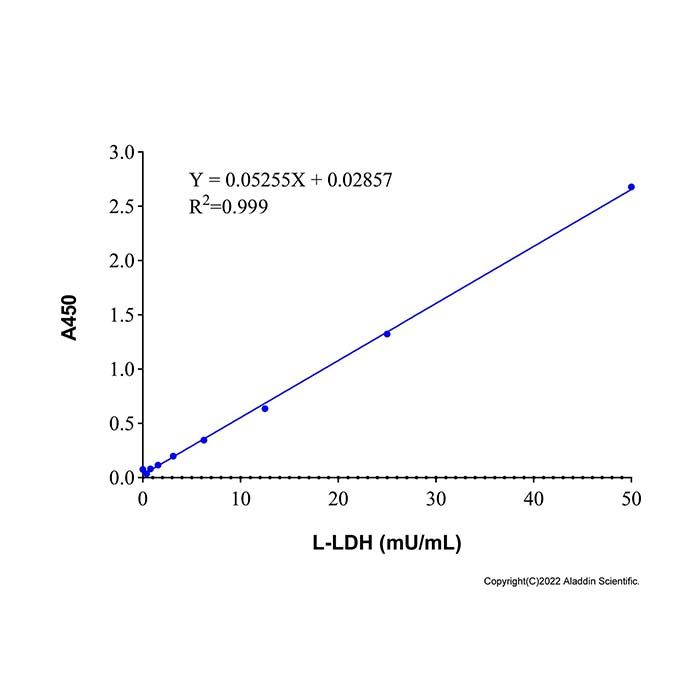
The assay principle is as follows: L-lactate dehydrogenase catalyzes the oxidation of L-lactate to pyruvate, during which NAD⁺ is reduced to NADH. The generated NADH then reduces WST-8 to an orange-yellow formazan in the presence of the electron coupling reagent 1-mPMS (1-Methoxy-5-methylphenazinium methyl sulfate). The formazan product exhibits a maximum absorption peak at approximately 450 nm. The amount of formazan generated is proportional to the activity of L-lactate dehydrogenase, allowing for highly sensitive detection of LDH activity by measuring the absorbance at 450 nm. With a sample volume of 50 μL, this kit can detect L-lactate dehydrogenase activity as low as 0.39 mU/mL and demonstrates a strong linear relationship within the activity range of 0.39–50 mU/mL.
D1373349 | Component | 50 T | 100 T | 500T | Storage conditions |
D1373349A | L-LDH Lysis Buffer | 10 mL | 20 mL | 100 mL | -20℃. |
D1373349B | L-LDH Assay Buffer | 10 mL | 20 mL | 100 mL | -20℃. |
D1373349C | Coenzyme | 200 μL | 400 μL | 2000 μL | -20℃.Store in the dark. |
D1373349D | L-Lactate Solution | 25 μL | 50 μL | 250 μL | -20℃.Store in the dark. |
D1373349E | WST-8 | 100 μL | 200 μL | 1000 μL | -20℃.Store in the dark. |
D1373349F | PMS | 100 μL | 200 μL | 1000 μL | -20℃.Store in the dark. |
D1373349G | L-Lactate Dehydrogenase (5 U/mL) | 100 μL | 200 μL | 1000 μL | -20℃.Store in the dark. |
Usage Protocol
1. Sample Preparation
1) Preparation of Blood Samples:
For serum samples: Allow whole blood to clot at room temperature for 30 minutes to 2 hours. Centrifuge at approximately 1000-2000 × g for 10 minutes at 4°C and collect the supernatant.
For plasma samples: Collect whole blood using heparin or EDTA as an anticoagulant. Centrifuge at approximately 1000-2000 × g for 10 minutes at 4°C and collect the supernatant.
2) Preparation of Cell Samples:
For cultured adherent cells: Wash the cells once with PBS; For cultured suspension cells: Centrifuge to collect the cells and wash them once with PBS. Add Lysis Buffer at a ratio of 100-200 µL per 1 million cells. Pipette appropriately to mix and incubate on ice for 5-10 minutes for complete lysis. Centrifuge at 12,000 × g for 5 minutes at 4°C. Collect the supernatant for subsequent assays.
3) Preparation of Tissue Samples:
Add Lysis Buffer at a ratio of 100 µL per 10 mg of tissue. Homogenize the tissue using a homogenizer on ice. Centrifuge at approximately 12,000 × g for 5 minutes at 4°C. Collect the supernatant for subsequent assays.
4) Preparation of Cell Culture Supernatant Samples:
For adherent cells: Directly collect the culture medium; For suspension cells: Centrifuge the culture and collect the supernatant.
All the above procedures must be performed at 4°C or on ice. Prepared cell or tissue samples can be stored at -20°C or -80°C if not assayed immediately.
2. Establishment of L-Lactate Dehydrogenase Standard Curve
Take 9 microcentrifuge tubes. Add 297 μL of Assay Buffer to the first tube and 150 μL of Assay Buffer to each of the remaining tubes. Pipette 3 μL from the L-Lactate Dehydrogenase (5 U/mL) standard into the first tube and mix thoroughly to prepare a 50 mU/mL standard solution. Transfer 150 μL from the first tube to the second tube. After mixing, transfer 150 μL from the second tube to the third tube. Continue this serial dilution stepwise. The last tube contains 150 μL of Assay Buffer. The resulting standard concentrations are 50, 25, 12.5, 6.25, 3.13, 1.56, 0.78, 0.39, and 0 mU/mL, respectively.
3. Preparation of WST-8 Working Solution
Prepare the WST-8 Working Solution according to the table below. Note: This procedure must be performed on ice.
Samples | 1 | 10 | 20 | 50 |
L-LDH Assay Buffer | 41.5 μL | 415 μL | 830 μL | 2075 μL |
Coenzyme | 4 μL | 40 μL | 80 μL | 200 μL |
L-Lactate Solution | 0.5 μL | 5 μL | 10 μL | 25 μL |
WST-8 | 2 μL | 20 μL | 40 μL | 100 μL |
PMS | 2 μL | 20 μL | 40 μL | 100 μL |
Total volume | 50 μL | 500 μL | 1000 μL | 2500 μL |
4. Sample Assay
1) Add 1-50 µL of the sample or diluted sample to the sample wells of a 96-well plate. Bring the volume in each well to 50 µL with Assay Buffer. Simultaneously, set up wells containing only L-LDH Assay Buffer as the blank control.
2) Add 50 µL of the WST-8 Chromogenic Working Solution to each well and mix thoroughly.
3) Immediately measure the absorbance at 450 nm using a microplate reader. Record this initial reading (0-minute time point) as A1.
4) Incubate the reaction at 37°C for 20-30 minutes, then measure the absorbance at 450 nm again, recorded as A2. The increase in absorbance (ΔA = A2 - A1) is proportional to the L-Lactate Dehydrogenase activity.
5. Calculation of Results
Generate a standard curve for L-Lactate Dehydrogenase. Substitute the ΔA value obtained for the sample into the standard curve to calculate the L-Lactate Dehydrogenase activity in the sample during the reaction time.
The L-LDH activity is calculated as follows: L-LDH Activity (mU/mL) = B × n
Note: B is the L-LDH activity (mU/mL) determined from the standard curve; n is the total dilution factor of the sample.
Definition of L-Lactate Dehydrogenase Activity Unit: One unit (U) of enzyme activity is defined as the amount of enzyme that catalyzes the generation of 1 µmol of pyruvate per minute at 25°C or 37°C and pH 7.5.
Precautions
1. Both the Lysis Buffer and L-LDH Assay Buffer must be completely thawed and equilibrated to room temperature prior to use, as failure to do so may affect the assay results.
2. The presence of NADH, NADPH, or other substances that can influence NADH/NADPH levels may interfere with the detection. If the sample contains such interfering substances, a background control well for the sample must be set up concurrently. This is prepared by replacing the L-Lactate Solution in the WST-8 Chromogenic Working Solution with L-LDH Assay Buffer. During calculation, the absorbance reading from the sample well must be subtracted by the reading from its background control well.
3. To ensure that sample values fall within the range of the standard curve, it is recommended to perform a preliminary experiment testing multiple dilution factors for the sample to estimate the approximate L-LDH activity. Adjust the sample dilution factor accordingly if the values lie outside the standard curve range.
4. For optimal results, the reaction time can be adjusted based on the estimated L-LDH activity in the sample, provided that the measured absorbance remains within the linear range of the standard curve.
5. Aliquot the components according to experimental needs to avoid repeated freeze-thaw cycles.

 ZJ26F0332686