Triton™ X-114 - Reagent Grade , CAS No.9036-19-5

CAS: 9036-19-5 Cat. No.: T101474 Formula: R-C6H4-(OCH2CH2)xOH Beilstein Registry Number: 2315025 EC Number: 618-541-1
AVAILABLE TO ORDER
GRADE & PURITY Reagent Grade ? General reagent-grade purity suitable for most laboratory work. Use as a dependable default when no specific higher grade is required.
Storage
Room temperature,Argon charged
Shipped In
Normal
★
Size
USA
Germany (EU)*
Price
Qty
250ml
T101474-250ml
3 In stock
3 In stock

$17.90

$26.90
Save $9.00 (33.46%)
500ml
T101474-500ml
1 In stock
2 In stock

$30.90

$46.90
Save $16.00 (34.12%)
Enter a quantity for the sizes you want to add.
🧪
Why this grade

Reagent Grade Reagent Grade for sensitive chromatographic and analytical workflows requiring minimal baseline interference.

🌡

Storage & shipping

Room temperature,Argon charged Ships Normal Check lot-specific COA for exact specifications.

📋

Quality documents

SDS, COA, datasheet, and spec sheet available for download. Lot-specific COA accessible via lot number lookup.

📚

Literature proof

Cited in 30 peer-reviewed publications across chromatography, organic synthesis, and cross-coupling reactions.

Overview

Triton™ X-114 is a nonionic detergent. It is a good detergent for solubilizing membranes having reversible phase-separation property useful for the separation of intrinsic membrane proteins. Solution of Triton™ X-114 is homogeneous at 0°C but phase separation into aqueous phase and a detergent phase occurs above 20°C. Phase separation of proteins in solutions of Triton™ X-114 has been investigated.This octylphenol ethoxylate is compatible with anionic, cationic, and other nonionic surfactants and chemically stable in most acidic & alkaline solutions.

Triton™ X-114 has been used:
To remove endotoxin from solutions of protein using phase separation technique
In the extraction and purification of DNA from endotoxin
In the biphasic extraction of lipoproteins from bacterial cell wall
As a non-ionic detergent with a low cloud point (23 °C) enabling protein solubilization with phase-partitioning of hydrophilic from amphiphilic proteins

Specifications

Specifications & Purity
Reagent Grade
Biochemical and Physiological Mechanisms
Widely used nonionic surfactant for recovery of membrane fractions under mild, non-denaturing conditions
Legal Information
Triton is a trademark of The Dow Chemical Company or an affiliated company of Dow
Storage
Room temperature,Argon charged
Shipped In
Normal
Grade
Reagent Grade
Names and Identifiers
Pubchem Sid
Pubchem Sid Url
https://pubchem.ncbi.nlm.nih.gov/substance/488203110
PH
5.0-8.0(20℃)
UN Number
3082
Packing Group
III
Beilstein
2315025

Documentation

📋 Safety Data Sheet (SDS)

Comprehensive hazard, handling, storage, and regulatory compliance document.

Download SDS →

✅ Certificate of Analysis (COA)

Lot-specific quality data. Enter your lot number to retrieve the exact COA.

Look up COA →

📊 Datasheet

Quick-reference summary of product specifications and applications.

View datasheet →

🔬 Specification Sheet

Full quality attributes and acceptance criteria for this grade.

View spec sheet →

Advanced Data

Certificates(CoA,COO,BSE/TSE and Analysis Chart)
C of A & Other Certificates(BSE/TSE, COO):
Analytical Chart:

Find and download the COA for your product by matching the lot number on the packaging.

69 results found

Lot NumberCertificate TypeDateItem
H2617278Certificate of AnalysisAug 08, 2026 T101474
H2617273Certificate of AnalysisAug 08, 2026 T101474
H2617270Certificate of AnalysisAug 08, 2026 T101474
H2617261Certificate of AnalysisAug 08, 2026 T101474
F2617596Certificate of AnalysisJun 12, 2026 T101474
F2617595Certificate of AnalysisJun 12, 2026 T101474
F2617594Certificate of AnalysisJun 12, 2026 T101474
F2617593Certificate of AnalysisJun 12, 2026 T101474
F2617592Certificate of AnalysisJun 12, 2026 T101474
G2504629Certificate of AnalysisJun 26, 2025 T101474
G2504227Certificate of AnalysisJun 26, 2025 T101474
G2504179Certificate of AnalysisJun 26, 2025 T101474
G2504177Certificate of AnalysisJun 26, 2025 T101474
D2601176Certificate of AnalysisJun 26, 2025 T101474
K2421199Certificate of AnalysisNov 18, 2024 T101474
F2517191Certificate of AnalysisNov 18, 2024 T101474
K2421198Certificate of AnalysisNov 18, 2024 T101474
K2421197Certificate of AnalysisNov 18, 2024 T101474
A2613168Certificate of AnalysisSep 19, 2024 T101474
I2425119Certificate of AnalysisSep 19, 2024 T101474
I2425189Certificate of AnalysisSep 19, 2024 T101474
I2425190Certificate of AnalysisSep 19, 2024 T101474
I2425191Certificate of AnalysisSep 19, 2024 T101474
K2322300Certificate of AnalysisOct 07, 2023 T101474
C2429027Certificate of AnalysisOct 07, 2023 T101474
K2322301Certificate of AnalysisOct 07, 2023 T101474
K2322318Certificate of AnalysisOct 07, 2023 T101474
J2311634Certificate of AnalysisOct 07, 2023 T101474
J2311563Certificate of AnalysisOct 07, 2023 T101474
J2311594Certificate of AnalysisOct 07, 2023 T101474
J2311564Certificate of AnalysisOct 07, 2023 T101474
I2307058Certificate of AnalysisJul 12, 2023 T101474
G2319804Certificate of AnalysisJul 12, 2023 T101474
G2319802Certificate of AnalysisJul 12, 2023 T101474
G2319797Certificate of AnalysisJul 12, 2023 T101474
G2319790Certificate of AnalysisJul 12, 2023 T101474
G2319785Certificate of AnalysisJul 12, 2023 T101474
E2316286Certificate of AnalysisMay 10, 2023 T101474
E2316273Certificate of AnalysisMay 10, 2023 T101474
E2316272Certificate of AnalysisMay 10, 2023 T101474
E2316271Certificate of AnalysisMay 10, 2023 T101474
D23261034Certificate of AnalysisApr 14, 2023 T101474
D23261022Certificate of AnalysisApr 14, 2023 T101474
D23261025Certificate of AnalysisApr 14, 2023 T101474
D23261027Certificate of AnalysisApr 14, 2023 T101474
A2312248Certificate of AnalysisDec 28, 2022 T101474
A2312247Certificate of AnalysisDec 28, 2022 T101474
A2312249Certificate of AnalysisDec 28, 2022 T101474
A2312250Certificate of AnalysisDec 28, 2022 T101474
L2215938Certificate of AnalysisNov 25, 2022 T101474
L2215877Certificate of AnalysisNov 25, 2022 T101474
L2215875Certificate of AnalysisNov 25, 2022 T101474
K2208597Certificate of AnalysisOct 28, 2022 T101474
K2208619Certificate of AnalysisOct 28, 2022 T101474
K2208598Certificate of AnalysisOct 28, 2022 T101474
K2208573Certificate of AnalysisOct 28, 2022 T101474
H2222164Certificate of AnalysisAug 13, 2022 T101474
H2222165Certificate of AnalysisAug 13, 2022 T101474
H2222166Certificate of AnalysisAug 13, 2022 T101474
H2222167Certificate of AnalysisAug 13, 2022 T101474
C2203286Certificate of AnalysisFeb 23, 2022 T101474
C2203291Certificate of AnalysisFeb 23, 2022 T101474
C2203321Certificate of AnalysisFeb 23, 2022 T101474
C2203285Certificate of AnalysisFeb 23, 2022 T101474
C2203284Certificate of AnalysisFeb 23, 2022 T101474
H2210058Certificate of AnalysisFeb 23, 2022 T101474
J2220045Certificate of AnalysisFeb 23, 2022 T101474
B2209088Certificate of AnalysisFeb 10, 2022 T101474
I2202144Certificate of AnalysisSep 15, 2021 T101474
Chemical and Physical Properties
SolubilitySoluble in water
Refractive Index1.488
Flash Point(°F)>230 °F
Boil Point(°C)>200℃
Documents & Articles
Endotoxin (LPS) Removal from Protein Samples Using Triton X-114 Phase Separation
Buffer exchange of a sample using a dialysis bag
Common Questions and Answers for SDS-PAGE Experiments
Differences Among Antibodies for WB/FC/IP/ChIP/IF/IHC
How to Choose Reagent Grades in Scientific Research? A Practical Guide to Reagent Grade
NPE (NP-n) Selection Guide: How EO Number Affects Solubility, HLB, Cloud Point, and CMC | With an Aladdin Product Reference Table
A Panoramic Guide to Surfactants: Definitions & Mechanisms, Key Metrics, Application Scenarios, and Selection Navigation (Tables 1–3)
Endotoxin Removal in Protein Purification: Physicochemical Basis, Methodological Strategies, and Process Considerations
Structural Logic of Nonionic Surfactants: Mechanisms of Action, Classification Features, and Selection Principles
Citations of This Product
Solution Calculators
Reviews

Customer Reviews

Application Protocols

No item-specific, validated protocols are supplied with this listing. The following is a literature-based example for cloud-point extraction (CPE) of membrane proteins using Triton X‑114; adapt to your system.

Example: Enrichment of membrane proteins by TX‑114 CPE

  • Reagents: 1× PBS or 50 mM Tris–HCl pH 7.5, 150 mM NaCl; protease inhibitor cocktail; Triton X‑114 (prepare 10% w/v stock).
  • Steps:
    1. Chill all solutions and samples to 0–4 °C.
    2. Add TX‑114 to 1–2% (w/v); incubate 15–30 min with gentle mixing to solubilize membranes.
    3. Clarify by centrifugation (e.g., 10,000 × g, 10 min, 4 °C).
    4. Transfer supernatant; warm to 30–37 °C for 10 min to induce phase separation.
    5. Centrifuge briefly (e.g., 2,000–5,000 × g, 5–10 min) to separate phases.
    6. Collect surfactant-rich (lower) phase for hydrophobic proteins; collect upper aqueous phase for soluble proteins.
    7. Optional: repeat partitioning to increase purity.
    8. Remove detergent prior to MS/enzymology via adsorption (Bio-Beads), dialysis, or precipitation.
  • Notes: Maintain pH 7–8; control ionic strength to tune cloud point. Validate detergent compatibility with downstream assays.

For small-molecule preconcentration or LPS handling, analogous CPE steps can be applied, with calibration to the analyte’s hydrophobicity and temperature sensitivity.

Biological Roles

Triton X‑114 has no native biological role; it is a synthetic nonionic surfactant. In research, it serves as a tool to interrogate biological membranes and hydrophobic biomolecules.

  • Membrane mimicry (literature): Forms micelles that encapsulate hydrophobic segments of integral membrane proteins, enabling extraction from cells or membranes while preserving partial native conformation for downstream analysis (e.g., activity assays, reconstitution trials). The lower cloud point facilitates controlled partitioning of proteins by hydrophobicity.
  • Protein fractionation: In cloud-point systems, proteins partition based on surface hydrophobicity and glycosylation state. GPI-anchored and palmitoylated proteins preferentially enter the surfactant-rich phase; soluble cytosolic proteins remain in the aqueous phase.
  • Lipid interactions: Binds cholesterol-rich microdomains (rafts) and bacterial endotoxins (LPS). This can be exploited to deplete or enrich these components during sample preparation; conditions must be tuned to minimize co-extraction of targets.
  • Enzyme and assay considerations: Nonionic detergents can stabilize or inhibit enzymes depending on micelle composition and concentration relative to the CMC. TX‑114 often interferes with protein quantification assays (Lowry/BCA) and can suppress ESI-MS signals unless removed.

Note: All uses are for research purposes only (as stated in the product data). Triton X‑114 is not intended for clinical or diagnostic procedures.

Buffer Applications

Triton X‑114 is commonly formulated into aqueous buffers as a nonionic detergent for lysis, extraction, and cloud-point partitioning. Values below are literature-based guidance; optimize for your system.

  • Typical working concentrations: 0.05–2% (w/v).
    • Gentle solubilization: 0.05–0.2% for peripheral proteins and to reduce nonspecific binding.
    • Membrane protein extraction: 0.5–2%. Higher levels increase solubilization but may complicate downstream removal.
  • Common buffer systems:
    • PBS or TBS, pH 7.2–8.0; 10–50 mM Tris, pH 7.5–8.5; inclusion of 100–150 mM NaCl to stabilize proteins and modulate cloud point.
    • Additives: protease/phosphatase inhibitors; 10–20% glycerol for protein stability; Mg2+/Ca2+ as required by enzymes.
  • Cloud-point extraction workflow (schematic):
    1. Prepare homogenate/lysate with 1–2% TX‑114 at 0–4 °C; clarify by cold centrifugation.
    2. Warm supernatant to 25–37 °C for 5–15 min to induce phase separation.
    3. Centrifuge to separate phases; collect surfactant-rich phase (hydrophobic fraction) and aqueous phase (hydrophilic fraction).
    4. Repeat partitioning if higher purity is needed; remove detergent before enzymology or MS.
  • Compatibility: Nonionic; stable from pH ~5–9. Salts and kosmotropes lower cloud point; chaotropes (urea) can raise it. Reduce agents (DTT/TCEP) are generally compatible.

Note: Prepare and equilibrate all reagents below the cloud point to maintain a single phase until intentional separation.

Green Alternatives

From a green chemistry perspective, octylphenol ethoxylates face scrutiny for environmental persistence and aquatic toxicity. Selection should balance performance needs (e.g., low cloud point for CPE) against environmental impact.

Representative comparison (literature-based, general):

  • Triton X‑114:

    • Strengths: low cloud point (~20–25 °C) enabling easy phase separation; strong membrane solubilization.
    • Tradeoffs: octylphenol core raises ecotoxicity concerns; not readily biodegradable compared with sugar-based surfactants.
  • Alkyl polyglucosides (APGs, e.g., decyl/LAE-glucoside):

    • Strengths: renewable feedstocks, good biodegradability, lower aquatic toxicity.
    • Tradeoffs: higher cloud points; different micellar properties; may be less effective for temperature-triggered CPE.
  • Polysorbates (Tween series) and sorbitan esters (Span):

    • Strengths: established bioprocess use; biodegradable tendencies; broad compatibility.
    • Tradeoffs: hydrolytic/oxidative instability; can cause particles in long storage; cloud points generally higher than TX‑114.
  • Designer micelles (e.g., TPGS‑750‑M) for aqueous synthesis:

    • Strengths: enable micellar catalysis under “benign” aqueous conditions, high turnover numbers, minimized organic solvent.
    • Tradeoffs: different HLB and cloud-point behaviors; not direct substitutes for CPE-focused workflows.

Guidance: If your objective is cloud-point extraction at near‑ambient temperatures, TX‑114 is uniquely convenient. If general solubilization is sufficient, evaluate APGs or polysorbates to improve sustainability while validating performance.

Pharmaceutical Uses

This product is offered for research use only. It is not supplied as a pharmacopeial excipient and is not intended for clinical, diagnostic, or therapeutic applications.

General, literature-based context for nonionic surfactants in pharmaceutical development (for background only):

  • Roles in formulation science: Nonionic surfactants can serve as wetting agents, emulsifiers, solubilizers for poorly soluble actives, and stabilizers to reduce interfacial stress. Selection is typically limited to compendial, well-characterized excipients (e.g., polysorbates, poloxamers), not octylphenol ethoxylates.
  • Processing aids in bioprocess R&D: Detergents may be used during upstream/downstream research to lyse cells, solubilize membranes, or inactivate enveloped entities under tightly controlled, non-clinical conditions. For any regulated use, dedicated GMP-grade materials with established safety dossiers are required.

If your objective is to identify a pharmaceutically acceptable surfactant, consider compendial alternatives (e.g., Polysorbate 20/80, Poloxamer 188/407), validate interactions with the active, and consult relevant pharmacopeias. Triton X‑114 should be restricted to lab-scale research workflows.

Physical Properties

Item-specific numeric specifications are not provided for this catalog entry. Where helpful, representative literature values for Triton X-114 (octylphenol ethoxylate, low-EO) are summarized for general guidance only; actual values vary by lot and must be verified on the CoA/SDS.

  • Appearance: Not specified for this item; refer to CoA/Spec Sheet.
    • General: viscous liquid/paste; can appear cloudy near room temperature due to low cloud point (literature).
  • Molecular weight: Not specified for this item.
    • Literature: average ~520–580 g/mol (polydisperse).
  • Cloud point (aqueous, 1–10% w/w): literature ~20–25 °C; often ~23 °C, strongly composition- and concentration-dependent.
  • Critical micelle concentration (CMC, water, 25 °C): literature ~0.2–0.7 mM (0.01–0.04% w/v), depends on ionic strength.
  • HLB (hydrophile–lipophile balance): literature ~12–13 (lower than Triton X‑100).
  • Solubility: miscible with water below its cloud point; forms a surfactant-rich coacervate phase above the cloud point (literature). Soluble in common organic solvents (alcohols, acetone, toluene) (literature).
  • Density, viscosity, refractive index, pKa, logP: Not specified for this item; refer to CoA/Spec Sheet.
    • General: nonionic polyether; no discrete pKa; apparent hydrophobicity reflects micellar partitioning.

Note: Exact thermophysical constants depend on the ethoxylate distribution and concentration; treat all literature values as approximate.

Quality & Grades
  • Grade: Reagent Grade (as listed for this item).

    • Meaning (general): suitable for routine laboratory and analytical applications where high chemical cleanliness is required but not necessarily validated for chromatographic baselines or biopharma GMP use. Reagent Grade Triton X‑114 is appropriate for research-scale biochemical workflows such as membrane protein extraction and cloud-point partitioning.
  • Purity: Not specified for this item; refer to CoA/Spec Sheet. For nonionic surfactants, “purity” reflects the distribution of ethoxylate homologs and low levels of residual alcohols/phenols/EO oligomers.

  • Stabilizers/inhibitors: Not specified for this item; refer to CoA/Spec Sheet. Polyethers are generally supplied without added stabilizers; inert gas headspace can minimize oxidative aging (see Storage Conditions below).

  • Item-specific handling advantages:

    • Supplied for research use only (as stated).
    • Storage guidance: Room temperature, Argon charged (per product data). This minimizes oxidative discoloration and preserves consistent cloud-point behavior.
  • When to consider higher/different grades (general):

    • Proteomics-grade detergents for MS-sensitive workflows (minimized polymer “tails”).
    • Ultra-pure, low-UV-absorbing surfactants for spectroscopic assays.
    • GMP/compendial excipient grades are distinct products and not implied by this listing.
Reaction & Applications

Primary laboratory applications are in biochemistry and analytical separations rather than stoichiometric/synthetic reactions.

Key research uses (literature-based):

  • Cloud-point extraction (CPE): Triton X‑114’s low cloud point enables temperature-controlled phase partitioning of hydrophobic proteins, peptides, lipidated species, and small molecules. Useful for enriching membrane proteins and GPI-anchored proteins from cell lysates.
  • Membrane solubilization: Efficiently disrupts lipid bilayers at 0.1–2% (w/v) to extract integral membrane complexes while maintaining partial native interactions in micelles.
  • Endotoxin and lipopolysaccharide handling: Its hydrophobic core binds LPS; can aid removal or fractionation in research workflows (optimize to avoid co-extraction of targets).
  • Sample clean-up/preconcentration: Surfactant-rich phase can preconcentrate hydrophobic analytes before spectroscopic/LC analysis (remove detergent prior to MS).

Practical notes:

  • Pre-equilibrate all solutions below cloud point to avoid premature phase split; induce separation by warming to ~25–37 °C with gentle mixing, then centrifuge to accelerate demixing. Salt and polymer additives can shift cloud point—titrate accordingly.
  • Detergent removal: Use adsorption resins (e.g., polystyrene Bio-Beads), diafiltration, protein precipitation, or phase-switching. Validate removal to protect downstream enzymes/columns.
  • Assay compatibility: Interferes with Lowry/BCA; Bradford is more tolerant at low % but still affected. Consider detergent-compatible assay kits.
  • Materials: Use glass or compatible plastics (HDPE/PP). Avoid latex and low-grade rubbers that may swell.
Reaction Conditions

There are no item-specific, validated conditions supplied for this product. The following literature-based guidance pertains to common research uses of Triton X‑114:

  • Cloud-point extraction (proteins/small molecules):

    • Detergent: 0.5–2% (w/v) in Tris or phosphate buffer with 100–150 mM NaCl.
    • Temperature: 0–4 °C to prepare a single phase; 25–37 °C for 5–15 min to induce phase separation; brief centrifugation (e.g., 5–10 min, 2,000–10,000 × g) to sharpen the interface.
    • Repetition: 1–3 extraction cycles can enhance selectivity/purity.
    • Notes: Salt and kosmotropes depress cloud point; chaotropes and some co-solvents elevate it—titrate to target separation temperature.
  • Membrane protein extraction:

    • Detergent: 0.1–2% (w/v) with protease inhibitors.
    • Temperature: maintain below cloud point during solubilization to avoid coacervation; optional warming post-extraction for fractionation.
    • Additives: 10–20% glycerol may stabilize complexes; Mg2+/ATP as needed for ABC transporters.
  • Detergent removal (post-reaction/assay cleanup):

    • Adsorption with polystyrene beads (batch, 1–2 h, room temperature).
    • Dialysis/ultrafiltration against detergent-free buffer (consider micelle size ~6–10 nm).
    • Protein precipitation (e.g., acetone/TCA) followed by resolubilization.

All values above are general guidance; optimize empirically for each substrate/protein.

Safety & Handling

Item-specific GHS details are not provided here; consult the product SDS for authoritative hazard classifications. The following are general, literature-based precautions for nonionic octylphenol ethoxylate surfactants such as Triton X‑114.

  • GHS classification, signal word, H-statements, pictograms: Not specified for this item; refer to SDS.
  • Likely hazards (general): eye/skin irritation; harmful to aquatic life with long-lasting effects; combustible liquid at elevated temperatures. Avoid aerosol generation and prolonged skin contact.
  • PPE: lab coat, safety glasses/goggles, and suitable chemical-resistant gloves (e.g., nitrile). Use in a fume hood or well-ventilated area when handling concentrates or preparing warm solutions for phase separation.
  • Handling notes:
    • Cloud-point behavior: Above ~20–25 °C, aqueous solutions separate into surfactant-rich and surfactant-poor phases; mix and equilibrate temperatures carefully to avoid unexpected phase splits.
    • Avoid strong oxidizers; polyether chains can undergo oxidative degradation over time.
    • Detergents can increase permeability of some plastics; store in compatible containers (glass or HDPE).
    • Detergents may interfere with protein assays (e.g., Lowry, BCA) and some enzyme activities.
  • First aid (general): rinse exposed skin/eyes with water for at least 15 minutes; remove contaminated clothing; if inhaled, move to fresh air; if ingested, rinse mouth—seek medical attention per SDS.
  • Spills: absorb with inert material; avoid release to the environment; clean residue with warm water and detergent; dispose of waste in accordance with local regulations.
  • Fire: use water spray, foam, dry chemical, or CO2; thermal decomposition can release irritating vapors (general).
Solvent Selection

This product is a nonionic surfactant, not a solvent. Traditional “solvent selection” criteria do not directly apply. Instead, consider “detergent selection” and medium compatibility for your system.

  • Polarity/medium compatibility (general, literature):

    • Water: readily soluble below its cloud point; forms micelles and, above the cloud point (~20–25 °C), separates into a surfactant-rich phase.
    • Organic solvents: soluble in alcohols (MeOH, EtOH, i-PrOH), acetone, and many nonpolar solvents (e.g., toluene); miscibility depends on composition.
    • Salts/chaotropes: ionic strength and additives (NaCl, urea) shift the cloud point; screen conditions accordingly.
  • Choosing Triton X‑114 vs alternatives (general):

    • Use Triton X‑114 when temperature-triggered phase partitioning (cloud-point extraction) is desired, particularly for enriching membrane proteins/lipid rafts or separating hydrophobic analytes.
    • Prefer Triton X‑100, NP-40 substitutes, or alkyl maltosides when higher cloud points, gentler protein handling, or easier detergent removal are needed.
    • For green, biodegradable options in aqueous catalysis, consider polysorbates, alkyl polyglucosides, or designer micelles (see Green Alternatives).
  • Practical tips:

    • Work below ~15–18 °C to maintain single-phase solutions during extraction or lysis; warm to 25–37 °C to induce phase separation.
    • Verify compatibility with downstream assays; Triton can suppress/shift signals in colorimetric protein and enzyme assays.
Storage & Reconstitution
  • Storage conditions (item-specific): Room temperature, Argon charged (per product data). Store tightly closed under an inert atmosphere to limit oxidative aging of the polyether/phenoxy components. Protect from moisture ingress and prolonged light/heat exposure.

  • Shipping: Normal (per product data). Ambient shipment is acceptable.

  • Stability considerations (general):

    • Cloud-point proximity: Because TX‑114’s cloud point is near ambient temperature, solutions may appear cloudy or phase-separated at room temperature. Warm gently (e.g., 25–30 °C) and mix to homogenize before use.
    • Over time, polyethers can yellow slightly due to oxidation; an argon headspace helps mitigate this. Check clarity and performance (cloud point, CMC) if material has been stored long-term.
  • Reconstitution: Typically supplied ready-to-use as a liquid. If viscosity impedes handling or if partial solidification occurs at low temperature, warm the container in a 25–30 °C water bath and mix to uniformity. Prepare aqueous stocks (e.g., 10% w/v) using cold buffer below the cloud point; store stocks refrigerated if single-phase clarity is required.

  • Freeze–thaw: Not generally necessary; avoid freezing concentrated solutions as phase behavior may change after thawing. If freezing is unavoidable, validate performance post-thaw.

  • Container compatibility: Use glass or compatible plastics (HDPE/PP). Wipe closures to prevent residue-induced sticking.

Structure & Identity

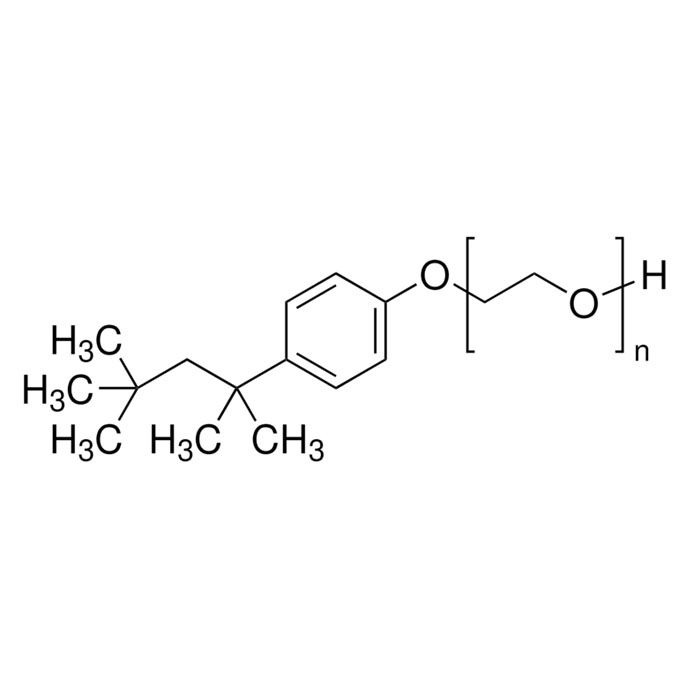
Triton X-114 is a nonionic surfactant in the octylphenol ethoxylate family. It is a technical mixture (polydisperse) of p-(1,1,3,3-tetramethylbutyl)phenyl poly(ethylene glycol) chains with a relatively low average ethoxylation number.

  • SKU: T101474; Product name: Triton™ X-114; CAS: 9036-19-5; CID: 162103267
  • Molecular formula: Not specified for this item; refer to CoA/Spec Sheet.
  • Molecular weight: Not specified for this item; refer to CoA/Spec Sheet.
    • Typical average MW (literature, varies by lot): approximately 520–580 g/mol due to distribution of ethoxylate chain lengths.
  • SMILES: Not applicable for this technical mixture (polydisperse); structure is a distribution of oligomers.
  • InChIKey: Not applicable for the mixture.

Structural features (general description):

  • Core aromatic ring (p-substituted phenyl) bearing a bulky tert-octyl (1,1,3,3-tetramethylbutyl) group that provides a hydrophobic anchor.
  • A single phenoxy oxygen connects to a poly(ethylene oxide) chain [–O–(CH2CH2O)n–H] that confers hydrophilicity.
  • No ionic groups; nonionic across broad pH. No defined stereocenters. Amphiphilic architecture drives micelle formation and cloud-point phase separation.

2D structure in words (general): A tert-octyl-substituted phenyl ring linked through an ether oxygen to a flexible ethoxy repeat chain terminating in a hydroxyl group. The hydrophobic aryl–alkyl moiety forms micelle cores; the ethoxylate tail solvates in water until the cloud point is reached.

Synthetic Utility

Although Triton X‑114 is primarily a biochemical reagent, nonionic surfactants have roles in synthesis and catalysis via micellar media and phase-transfer effects (literature-based guidance):

  • Micellar catalysis: Surfactant micelles create hydrophobic nanoreactors in water that can accelerate organometallic (e.g., Pd-catalyzed cross-couplings), radical, and nucleophilic substitutions. TX‑114’s low cloud point can be useful for temperature-triggered product isolation (phase separation) but may complicate room-temperature reactions by premature phase split.
  • Phase-transfer enhancement: At sub-CMC to modest concentrations, nonionic surfactants improve interfacial contact in biphasic reactions (e.g., oxidations, substitutions), sometimes replacing quaternary ammonium PTCs for greener profiles.
  • Extraction and workup: Cloud-point extraction with TX‑114 can preconcentrate hydrophobic products or metal complexes from dilute aqueous streams ahead of chromatographic purification.

Practical considerations:

  • Choose concentration relative to CMC; keep below cloud point during reaction if homogeneous conditions are desired.
  • Verify catalyst compatibility; polyethers can coordinate metals (beneficial or inhibitory).
  • Removal: Adsorption on polymeric resins, liquid–liquid partitioning after cloud-point phase switch, or ultrafiltration.

For state-of-the-art aqueous micellar synthesis at ambient temperature, designer surfactants (e.g., TPGS‑750‑M) often outperform TX‑114; however, TX‑114 remains valuable where thermal phase switching is part of the process design.

Target Specificity

Not applicable. This product is a nonionic surfactant, not a biological affinity reagent or antibody. No antigen/epitope, species reactivity, clone, or isotype information applies to Triton X‑114. For application-related selectivity, see Reaction & Applications and Buffer Applications.

Shall we send you a message when we have discounts available?

Remind me later

Thank you! Please check your email inbox to confirm.

Oops! Notifications are disabled.