
Cold denaturation co-amplification PCR
Cold denaturation co-amplification PCR
Cold denaturing co-amplification PCR is a method for selectively amplifying a small number of alleles from a mixture of wild-type and mutant-containing sequences, regardless of the location of the mutation. Currently, there is one main method used for cryo-degenerative co-amplification PCR: cryo-degenerative co-amplification PCR.
Principle
The basic principle of low-temperature denaturation co-amplification PCR is that the melting point temperature of a double-stranded DNA sequence can change in small but predictable ways due to mismatches of individual nucleotides during the synthesis of the sequence. Depending on the upstream and downstream base backgrounds and mismatch locations of the sequence, the melting point temperature of a sequence of up to 200 bp can typically vary by 0.2 to 1.5 °C or even more.
Each DNA sequence has a critical denaturation temperature (Tc) below its melting point, below which the efficiency of PCR decreases dramatically. For example, for a 167 bp p53 sequence, PCR amplification is very efficient at 87 °C; at 86.5 °C, PCR amplification is modest; and at 86 °C or lower, no PCR product is detected. Therefore, the Tc of this sequence is ≈ 86.5 °C. The threshold for denaturation is very high.
The threshold denaturation temperature depends very much on the sequence of the DNA. When the PCR denaturation temperature is set at the critical point, repeated cycles of amplification result in different DNA being amplified with different efficiencies due to differences in individual bases. This phenomenon can be observed when selectively amplifying a few alleles in the presence of one or more dissimilar bases at any position of a given sequence. In COLD-PCR, in order for molecular hybridization to occur between mutant and wild-type alleles, an annealing temperature needs to be set in the middle of the PCR cycle, and the annealing temperature for heteroduplex hybridization has to be lower than that of homoduplexes, so that the heteroduplexes are already denatured at Tc during amplification, while the homoduplexes are still in double-stranded state and will not be able to be amplified efficiently.COLD-PCR can be used to amplify mutants at the same time as the wild-type allele by setting the denaturation temperature at Tc. By setting the denaturation temperature at Tc in COLD-PCR, the mutant can be amplified in large quantities at any position.
According to the needs of experiments, COLD-PCR can be divided into two application modes, i.e., complete COLD-PCR and rapid COLD-PCR, the former focuses on identifying all possible mutants, and the latter focuses on obtaining a large number of mutants with low denaturation temperature.
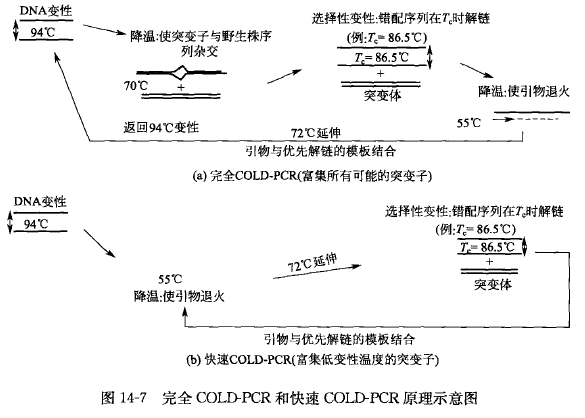
(1) Full COLD-PCR: Figure 14-7(a)] The full COLD-PCR program is activated after several cycles of conventional PCR, which results in the accumulation of the original target amplicons. After denaturation at 94 ℃, the PCR amplicons are hybridized at an intermediate annealing temperature (70 ℃ for 2~8 min). Due to the small number of mutants containing the mutant gene, the vast majority of mutant alleles terminate in a heteroduplex state due to incomplete complementary pairing of the bases of the two strands, and the melting point temperature of the heteroduplex is lower than that of the fully paired structure (homoduplex). The temperature of the PCR system is then raised to Tc to denature the heteroduplex while the homoduplex fails to denature, and finally the system temperature is lowered to 55 °C to allow the primers to bind to the preferentially denatured template in preparation for the next round of replication. Because each round of PCR performs the critical denaturation temperature, the amount of amplification of mutant-containing alleles increases exponentially, and at the end of the cycle, the amplification efficiencies of each mutant gene and the wild-type allele are very different.
(2) Rapid COLD-PCR [Fig. 147(b)] Amplification of mutant genes at low denaturation temperatures by COLD-PCR is performed as described below. Most point mutant genes can be amplified even without the intermediate 70 ℃ hybridization session, so rapid PCR amplification is performed at Tc, which is specifically designed for the low melting-point allele, instead of 94 ℃. For example, now that the two alleles differ by only one base pair, with A:T replacing G:C, the allele A:T mutant is amplified during cycling because it contains an A:T replicon with a lower melting point than the allele G:C. For amplification of the mutant, full COLD-PCR requires the accumulation of a large number of PCR products in order to achieve efficient molecular hybridization, which limits the amplification in the later stages of PCR. For amplification of mutants, full COLD-PCR requires a large accumulation of PCR products for efficient molecular hybridization, which limits amplification in the later stages of PCR. In contrast, rapid COLD-PCR does not require the accumulation of PCR products, so mutants are amplified in early cycles. Rapid COLD-PCR amplifies the mutant faster and in larger quantities than full COLD-PCR. However, the full COLD-PCR program is still necessary to amplify all possible mutants, including deletion and insertion mutations. In full COLD-PCR, mismatches between mutant and wild-type sequences often occur, and amplification products are produced regardless of whether the melting point temperature of the mutant nucleic acids is increased or decreased.
Operation method
Cold denaturation co-amplification PCR
Principle
The basic principle of low-temperature denaturation co-amplification PCR is that the melting point temperature of a double-stranded DNA sequence will change slightly and predictably due to mismatches of individual nucleotides during the synthesis of the sequence. Depending on the upstream and downstream base backgrounds and mismatch locations of the sequence, the melting point temperature of a sequence of up to 200 bp can typically vary by 0.2 to 1.5 °C or even more. Each DNA sequence has a critical denaturation temperature (Tc) below its melting point, below which the efficiency of PCR decreases dramatically. For example, for a 167 bp p53 sequence, PCR amplification is very efficient at 87 °C; at 86.5 °C, PCR amplification is modest; and at 86 °C or lower, no PCR product is detected. Therefore, the Tc of this sequence is ≈ 86.5 °C. The threshold for denaturation is very high. The threshold denaturation temperature depends very much on the sequence of the DNA. When the PCR denaturation temperature is set at the critical point, repeated cycles of amplification result in different DNA being amplified with different efficiencies due to differences in individual bases. This phenomenon can be observed when selectively amplifying a few alleles in the presence of one or more dissimilar bases at any position of a given sequence. 在 COLD-PCR 中,为了使突变型基因和野生型的等位基因发生分子杂交,PCR 循环时中间需要设定一个退火温度,异型双链杂交时的退火温度要低于同型双链,因此扩增时异型双链在 Tc时已经变性,而同型双链仍是双链的状态将无法高效扩增。COLD-PCR 时通过将变性温度设定 By setting the denaturation temperature at Tc in COLD-PCR, the mutant can be amplified in large quantities at any position.
Materials and Instruments
Equipment: PCR thermocycler, nucleic acid electrophoresis, gel imaging equipment, centrifuge, etc. Move The basic process of low temperature denaturation co-amplification PCR can be divided into the following steps: In conventional PCR, the denaturation temperature of the template is lowered in a temperature gradient (e.g., 0.5 °C). When the temperature is lowered to a certain temperature, a moderate amount of product is produced, and when the temperature is lowered again, no PCR product is produced, which is then defined as the Tc of the template DNA strand. 3.
Reagents:
① Genomic DNA.
② Heat-stabilized DNA polymerase (5 U/M)
③ 10 × buffer: Tris-HCl (pH 8.0), 100 mmol/L; KC1, 500 mmol/L; MgCl
2
KC1, 500 mmol/L; MgCl2, 15 mmol/L
④ dNTP mixture (2.5 mmol/L each)
⑤ Primers (upstream and downstream, 20 μmol/L each)
⑥ Sterilized distilled water.
(1) Complete COLD-PCR: 94 ℃ for 5 min; 94 ℃ for 30 s, 70 ℃ for 2-8 min, Tc for 3 s, 55 ℃ for 30 s, 72 ℃ for 3 min, 30 cycles.
(2) Rapid COLD-PCR: 94 ℃ for 5 min; 94 ℃ for 30 s, 55 ℃ for 30 s, 72 ℃ for 3 min, 10~30 cycles; 94 ℃ for 30 s, Tc for 3 s, 55 ℃ for 30 s, 72 ℃ for 3 min, 30 cycles.
4. Analysis of resultsCOLD-PCR can be used as a starting step for the detection of mutated genes, and its products can be analyzed in combination with MALDI-TOF genotyping, Sanger sequencing, real-time PCR, mutant screening, mutant genotyping, and methylation analysis, so as to identify the mutations in genes, including cancer, prenatal diagnosis, and infectious diseases, etc. In particular, COLD-PCR is often combined with fluorescent real-time quantitative PCR. It should be noted that COLD-PCR is often used in combination with fluorescence real-time quantitative PCR to enhance the ability of detecting mutant genes and improve the detection efficiency. When used in combination, the PCR system is established in accordance with fluorescence real-time quantitative PCR, and fluorescence reading is added to the annealing temperature step of the PCR reaction conditions.
For more product details, please visit Aladdin Scientific website.