
Emulsion PCR experiment
Emulsion PCR experiment
In 2005, Margulies et al. published an article in Nature describing a fast and simple sequencing method based on an emulsion system for DNA amplification and a picoliter-sized pyrophosphate. Pyrosequencing is a simple sequencing method based on an emulsion system for DNA amplification and pyrophosphate - pyrosequencing. This method is 100 times faster than conventional Sanger sequencing, and if the human genome were to be sequenced using this method, it could be completed in more than 100 days.
At the end of 2005, researchers at 454 Corporation commercialized the Genome Sequencer 20 System, a new sequencing technology that is exclusively sold and serviced worldwide by Roche Applied Science.
Once launched, Genome Sequencer 20 system has received extensive attention from international genomics experts and has been successfully installed in major sequencing laboratories around the world. It can be said that with the continuous promotion and upgrading of the Genome Sequencer 20 system, the era of rapid genome sequencing has already come, and will have a great impetus to the whole genomics research.
Principle
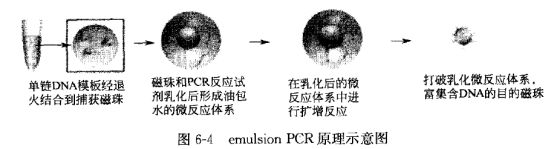
The basic principle of the emulsion PCR experiment is to anneal a single-stranded DNA template onto capture magnetic beads, which are then combined with PCR reagents to form a tiny emulsion in an oil-water mixture. The amplification reaction is carried out in this tiny emulsion, and the amplified products are enriched on the beads, which are then centrifuged and the beads collected. After elution, the PCR products from the beads are sequenced to obtain the base sequences (Figure 6-4).
Appliance
The main applications of emulsion PCR include: (i) sequencing of amplification products; (ii) searching for rare mutations in the genome that cannot be detected by the Sanger method; (iii) identification of open reading frames (ORFs), homology analysis among different organisms, and genome structure profiling; (iv) high-throughput screening of target sites of transcription factors; (v) identification of conserved regions and mutation hotspots and gene insertions or deletions of different strains, and understanding the genetic basis of drug resistance; (vi) sequencing of cDNA libraries and BAC libraries; and (vii) sequencing of cDNA and BAC libraries. (v) Identification of conserved regions, mutation hotspots and gene insertions or deletions in different strains to understand the genetic basis of drug resistance; (vi) Sequencing of cDNA libraries and BAC libraries.
For more product details, please visit Aladdin Scientific website.