Determine the necessary mass, volume, or concentration for preparing a solution.
| Activity Type | Relation | Activity value | Units | Action Type | Journal | PubMed Id | doi | Assay Aladdin ID |
|---|

for electrophoresis Für die Elektrophorese geeignet for sensitive chromatographic and analytical workflows requiring minimal baseline interference.
Room temperature Ships Normal Check lot-specific COA for exact specifications.
SDS, COA, datasheet, and spec sheet available for download. Lot-specific COA accessible via lot number lookup.
Cited in 820 peer-reviewed publications across chromatography, organic synthesis, and cross-coupling reactions.
General description
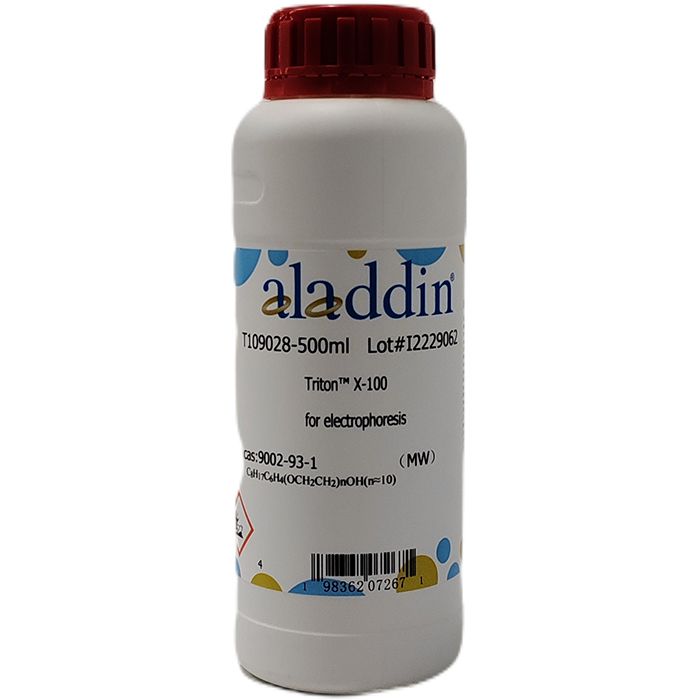
Triton™ X-100 is a common non-ionic surfactant and emulsifier which is often used in biochemical applications to solubilize proteins. It is considered a comparatively mild detergent, non-denaturing, and is reported in numerous references as a routinely added reagent. It is utilized for lysing cells to extract protein and cellular organelles. It can also permeabilize the living cell membrane for transfection
Application
Triton™ X-100 has been used:
• In immunohistochemistry for staining the Flat-mount retinas
• Along with ice-cold PBS (phosphate buffered saline) in suspension of cells for cell DNA analysis and Annexin V assay
• To permeabilise cells during Immunofluorescent microscopic studies
• As a positive control in LDH assay to determine the cell membrane integrity
• For estimating the lipase activity in postheparin plasma by using modified Belfrage and Vaughan radioenzymatic procedure
• For the preparation of outer membrane protein exctract
• As a component of extraction buffer along with tris-HCl, NaCl, CaCl2, ZnCl2, Brij 35 for homogenization of mice lung cells
• In the treatment of tissue sections for Immunofluorescence labeling
Comprehensive hazard, handling, storage, and regulatory compliance document.
Download SDS →Lot-specific quality data. Enter your lot number to retrieve the exact COA.
Look up COA →Full quality attributes and acceptance criteria for this grade.
View spec sheet →Taxonomy Tree
| Kingdom | Organic compounds |
|---|---|
| Superclass | Benzenoids |
| Klasse | Benzene and substituted derivatives |
| Subclass | Phenylpropanes |
| Intermediate Tree Nodes | Not available |
| Direct Parent | Phenylpropanes |
| Alternative Parents | Phenoxy compounds Phenol ethers Alkyl aryl ethers Primary alcohols Hydrocarbon derivatives |
| Molecular Framework | Aromatic homomonocyclic compounds |
| Substituents | Phenylpropane - Phenoxy compound - Phenol ether - Alkyl aryl ether - Ether - Organic oxygen compound - Hydrocarbon derivative - Primary alcohol - Organooxygen compound - Alcohol - Aromatic homomonocyclic compound |
| Beschreibung | This compound belongs to the class of organic compounds known as phenylpropanes. These are organic compounds containing a phenylpropane moiety. |
| External Descriptors | a small molecule |
| Activity Type | Relation | Activity value | Units | Action Type | Journal | PubMed Id | doi | Assay Aladdin ID |
|---|
| Activity Type | Relation | Activity value | Units | Action Type | Journal | PubMed Id | doi | Assay Aladdin ID |
|---|
| Activity Type | Relation | Activity value | Units | Action Type | Journal | PubMed Id | doi | Assay Aladdin ID |
|---|
| Activity Type | Relation | Activity value | Units | Action Type | Journal | PubMed Id | doi | Assay Aladdin ID |
|---|
| Activity Type | Relation | Activity value | Units | Action Type | Journal | PubMed Id | doi | Assay Aladdin ID |
|---|
| Activity Type | Relation | Activity value | Units | Action Type | Journal | PubMed Id | doi | Assay Aladdin ID |
|---|
| Activity Type | Relation | Activity value | Units | Action Type | Journal | PubMed Id | doi | Assay Aladdin ID |
|---|
| Activity Type | Relation | Activity value | Units | Action Type | Journal | PubMed Id | doi | Assay Aladdin ID |
|---|
| Activity Type | Relation | Activity value | Units | Action Type | Journal | PubMed Id | doi | Assay Aladdin ID |
|---|
| Activity Type | Relation | Activity value | Units | Action Type | Journal | PubMed Id | doi | Assay Aladdin ID |
|---|
| Activity Type | Relation | Activity value | Units | Action Type | Journal | PubMed Id | doi | Assay Aladdin ID |
|---|
| Activity Type | Relation | Activity value | Units | Action Type | Journal | PubMed Id | doi | Assay Aladdin ID |
|---|
Find and download the COA for your product by matching the lot number on the packaging.
| Lot Number | Certificate Type | Datum | Artikel |
|---|---|---|---|
 I2229062 | Certificate of Analysis | Jul 03, 2026 | T109028 |
| D2601126 | Certificate of Analysis | Apr 08, 2026 | T109028 |
| A2620716 | Certificate of Analysis | Jan 23, 2026 | T109028 |
| K2528133 | Certificate of Analysis | Dec 03, 2025 | T109028 |
| J2521384 | Certificate of Analysis | Oct 29, 2025 | T109028 |
| J2515136 | Certificate of Analysis | Oct 22, 2025 | T109028 |
| J2513188 | Certificate of Analysis | Oct 18, 2025 | T109028 |
| F2518192 | Certificate of Analysis | Jun 24, 2025 | T109028 |
| F2505554 | Certificate of Analysis | Jun 13, 2025 | T109028 |
| C2526707 | Certificate of Analysis | Apr 02, 2025 | T109028 |
| H2415008 | Certificate of Analysis | Feb 25, 2025 | T109028 |
| L2418564 | Certificate of Analysis | Dec 30, 2024 | T109028 |
| K2411357 | Certificate of Analysis | Nov 16, 2024 | T109028 |
| I2405114 | Certificate of Analysis | Sep 12, 2024 | T109028 |
| H2405048 | Certificate of Analysis | Aug 07, 2024 | T109028 |
| G2417864 | Certificate of Analysis | Jul 20, 2024 | T109028 |
| F2404180 | Certificate of Analysis | Jun 15, 2024 | T109028 |
| A2424335 | Certificate of Analysis | Jan 27, 2024 | T109028 |
| B2314631 | Certificate of Analysis | Feb 16, 2023 | T109028 |
| I2223524 | Certificate of Analysis | Sep 29, 2022 | T109028 |
| I2220711 | Certificate of Analysis | Sep 22, 2022 | T109028 |
| I2205389 | Certificate of Analysis | Apr 14, 2022 | T109028 |
| G2212159 | Certificate of Analysis | Apr 14, 2022 | T109028 |
| C2226528 | Certificate of Analysis | Apr 14, 2022 | T109028 |
| Brechungsindex | 1.491 |
|---|---|
| Flammpunkt (°C) | 251°C |
| Siedepunkt (°C) | 270°C |
| Schmelzpunkt (°C) | 6°C |
| Molekulargewicht | 250.380 g/mol |
| XLogP3 | 4.600 |
| Hydrogen Bond Donor Count | 1 |
| Hydrogen Bond Acceptor Count | 2 |
| Rotatable Bond Count | 6 |
| Exact Mass | 250.193 Da |
| Monoisotopic Mass | 250.193 Da |
| Topological Polar Surface Area | 29.500 Ų |
| Heavy Atom Count | 18 |
| Formal Charge | 0 |
| Complexity | 232.000 |
| Isotope Atom Count | 0 |
| Defined Atom Stereocenter Count | 0 |
| Undefined Atom Stereocenter Count | 0 |
| Defined Bond Stereocenter Count | 0 |
| Undefined Bond Stereocenter Count | 0 |
| The total count of all stereochemical bonds | 0 |
| Covalently-Bonded Unit Count | 1 |
Our grade selection guide covers purity, stabilizer status, and application suitability for all variants in our catalog.
View Suitable for electrophoresis grade guide →