Ethylene (ETHYLENE) is one of the endogenous plant hormones, which exists in the form of a gas and has a variety of physiological functions for the plant body. The amount of ethylene released varies according to different species of plants, different tissues, different developmental stages and different environmental conditions. Accurate determination of ethylene release is important for understanding the role of ethylene in plant stress resistance, developmental physiology and flowering physiology. This experiment is to master the principle and method of gas chromatography for the determination of ethylene content.
Principle
Gas chromatography has the advantages of high sensitivity and good stability. The separation system in a chromatograph includes a stationary phase and a mobile phase. Since the stationary phase and the mobile phase have different adsorption or solubilization capacities of various substances, the partition coefficients (or adsorption capacities) of various substances are not the same.
When a sample containing a mixture to be measured (e.g., a mixture containing ethylene) enters the stationary phase, it is continuously redistributed with the mobile phase (usually M or the substance to be measured), and finally, in accordance with the size of the partition coefficient, it is separated and flows out of the column and into the detection system to be detected.
The magnitude of the detected signal reflects the amount of the substance, and the chromatogram is presented on the recorder (Figure 27-1). A suitable stationary phase is required for adequate separation of the substance to be measured. Ethylene is often difficult to separate from ethylene and ethane, but a good separation can be achieved by using GDX502 as the stationary phase.

Operation method
Determination of ethylene content by gas chromatography
Principle
Gas chromatography has the advantages of high sensitivity and good stability. The separation system in a chromatograph includes a stationary phase and a mobile phase. Since the stationary phase and the mobile phase have different adsorption or solubilization capacities of various substances, the partition coefficients (or adsorption capacities) of various substances are not the same. When a sample containing a mixture to be measured (e.g., a mixture containing ethylene) enters the stationary phase, it is continuously redistributed with the mobile phase (usually M or the substance to be measured), and finally, in accordance with the size of the partition coefficient, it is separated and flows out of the column and into the detection system to be detected. The magnitude of the detected signal reflects the amount of the substance, and the chromatogram is presented on the recorder (Figure 27-1). A suitable stationary phase is required for adequate separation of the substance to be measured. Ethylene is often difficult to separate from ethylene and ethane, but a good separation can be achieved by using GDX502 as the stationary phase.
Materials and Instruments
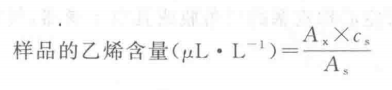
Materials: fruits such as apples, bananas, or other plant materials. Move The basic procedure for the determination of ethylene content by gas chromatography can be divided into the following steps: 1. the test material is subjected to different treatments (e.g., isolation, injury, germination, darkness, radiation, refrigeration, ripening, etc.) and then placed in a sealed unit for a period of time. 2. Start the chromatograph. Start-up procedure is as follows: (1) Check to see if all parts of the instrument are reset, if not, reset them. (2) Open the mobile phase (Ang), set the pressure to (5 kg - cm-2 ), then open the N2 valve on the instrument and set the flow rate to 25 mL - min-1 (pipeline 1,2 - sample). (3) Plug in the power supply and turn on the power switch on the instrument. (4) Adjust the column temperature to 60 °C and the inlet temperature to 100 °C (ethylene is a gas, the inlet temperature does not need to be too high). (5) open the ignition device power supply and air compressor switch, adjust the appropriate range and attenuation (off, the range should be adjusted to L attenuation of 8). (6) Open the cylinder hydrogen valve, adjust the pressure to 1.0 kg・cm-2 (the same as the two pipelines), and at the same time, adjust the air pressure to 0.5 kg - cm-2. Turn on the recorder power supply, and select the output voltage of 10 mV and the appropriate speed of paper walking (10 mm - min-1 ). (7) After the air and hydrogen have been adjusted, turn the selector key to the ON position and press the ignition key for about 10 s. Hydrogen can be burned in the combustion chamber, and the recorder can be seen moving upwards when the ignition is lit. (8) Set the selection key to 2, and adjust the air pressure to 1.0 kg - cm-2 and hydrogen to 0.5 - 0.7 kg - cm-2 (the same as the two pipelines), and the measurement can be made formally after the baseline is stabilized. 3. Measurement: (1) Take a certain concentration (in μL - L-1, with N2 as diluent), a certain amount (100 ~ 1 000 μL) of standard ethylene into the sample, and pay attention to the peak time. When the ethylene peak to the top of the retention time of ethylene, repeat 3 to 4 times, to get the average value, the average value is used as one of the basis for the characterization of ethylene in the sample. (2) Take the same amount of sample to be tested, injected into the column (injection), until the sample peaks all out, you can do the next sample. (3) Characterization: Qualitative external standard method: the peak in the sample with the same retention time as the standard ethylene, that is, the sample ethylene peak. Internal standard method: After getting the chromatogram of a sample, add a certain amount of standard ethylene into the sample, if a peak increases, the peak is the ethylene peak in the sample. 4. 4. After getting the chromatograms of all the samples, you can shut down the machine, the shutdown steps are as follows: (1) Turn off the hydrogen valve or nitrogen valve. (2) Turn off the air compressor. (3) Reset the range or attenuation, and turn the selection key to OFF. (4) Turn off the recorder. (5) Reset all valves after all H2 and N2 are discharged. (6) Turn off power to the main unit and unplug it. 5. Result calculation: Where: Ax-Sample peak height; As-standard ethylene peak height; cs-standard ethylene concentration, μL - L -1; V a volumetric volume L; t-a sealing time, h; W-sample mass, g . Common Problems 1. New columns contain solvents and high boiling point substances, so the baseline is unstable, ghost peaks and noise appear; old columns have not been used for a long time, and the same problem exists. Generally, it depends on the basic condition of the instrument to determine whether aging is needed and the aging time. The common use of temperature aging is to increase the temperature of the column from room temperature to the highest temperature and to keep it at the high temperature for several hours. It is best not to connect the detector when aging a new column. 2. 2. It is important that the FID detector temperature is above 120 °C during ignition. If ignition is difficult, increase the hydrogen flow rate and decrease the air flow rate, then return to the original ratio after ignition. The detector should be 20~50 °C above the column temperature to prevent water condensation. 3. Regularly clean the nozzle, note that the linear range is related to the following conditions: generally use N2 as a carrier gas, the carrier gas should be purified, in addition to organic matter; gas flow rate. 4. FID detector against hydrogen leakage, do not allow hydrogen leakage into the column thermostat to prevent explosion. Pay attention to the following points: do not pass hydrogen before connecting the column and column leakage test; before unloading the column, check whether the hydrogen gas is turned off; if it is a dual-column dual-detector chromatograph, only one FID detector work, make sure to plug the other unused FID with the screws; anti-scald, because the FID shell is very hot. For more product details, please visit Aladdin Scientific website.
Reagent: standard ethylene.
Equipment: Triangular flask with hollow rubber stopper for sealing device or vacuum desiccator
Gas chromatograph (Agilent 7890A, or Hitachi model 163).