
Hill reaction (Hill reaction) is a reaction in which the isolated chloroplasts of green plants decompose water in the light, release oxygen, and at the same time reduce the electron acceptor, which is an important phenomenon in the photosynthesis reaction. The purpose of this experiment is to understand the photoreduction of photosynthesis in chloroplasts through the observation and measurement of the Hill reaction.
Principle
The Hill reaction is the process by which an isolated chloroplast suspension, exposed to light, releases oxygen while reducing the added oxidant or electron acceptor (high iron salt).

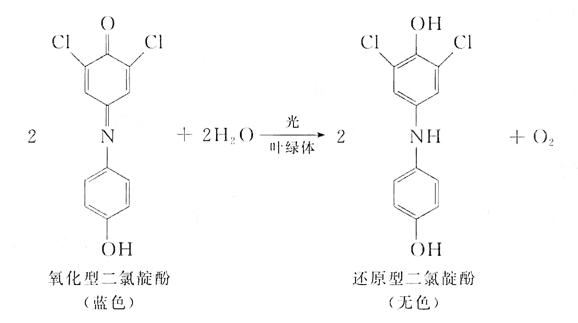
The oxidant, 2,6-dichlorophenol indophenol, is a blue dye that is reduced to colorless after accepting electrons and H+ from the Hill reaction. The color change can be observed directly, or the amount of reduction can be measured accurately by a spectrophotometer, which measures the change in dye absorbance A before and after the reaction, and the change in the reaction shows a linear relationship within 4-5 min.
Operation method
Observation and Determination of Hill's Reaction
Principle
The Hill reaction is a process in which a suspension of isolated chloroplasts, exposed to light, releases oxygen while reducing the added oxidant or electron acceptor (high iron salt). The oxidant, 2,6-dichlorophenol indophenol, is a blue dye that is reduced to colorless after accepting electrons and H+ from the Hill reaction, and the color change can be observed directly, or the amount of reduction can be measured accurately with a spectrophotometer, which determines the change in dye absorbance A before and after the reaction, and the change in the reaction shows a linear relationship within 4~5 min.
Materials and Instruments
Material: chloroplast suspension. Move The basic procedure for the observation and determination of Hill's reaction can be divided into the following steps: 1. Sample addition: Take 6 clean test tubes, divide them into two groups and number them 1, 2 and 3, then add reagents according to Table 12-1. Table 12-1 Hill's Reaction Assay Preparation Table Tube No. 0, 1 mol・L-1 Phosphoric acid Chloroplast suspension Boiling 0.3 mmol・L-1 Buffer/mL (pH 7.3) /mL /min Dichlorophenol indophenol sodium /mL Intact chloroplasts 1 9.4 0.1 - - - - - - - - - - - - - - - - - - - - - - - 0.5 2 9.4 0.1 5 0.5 3 9.9 0.1 - - - - - - - - - - - - - - - - - - - - - - - - Broken chloroplasts 1 9.4 0.1 - 0.5 2 9.4 0.1 5 0.5 3 9.9 0.1 - - - - - - - - - - - - - - - - - - - - - - - - Note: (1) Chloroplast suspension was prepared for the previous experiment.
Reagents:
① 0.3 mmol・L
-1
2,6-Dichlorophenolindophenol sodium (weigh 8.7 mg of dichlorophenolindophenol sodium, add distilled water to 100 mL);
② 0.1 mol・L
-① 0.1 mol・L
phosphate buffer (pH 7.3);
③ Quartz sand.
Equipment:
① test tube
② test tube rack
③ Water bath
④ Pipette.
(2) No. 2 tube was boiled in boiling water for 5 min after adding chloroplast suspension, and then the evaporated water was replenished with distilled water.
(3) Tube No. 3 is the control for zeroing.
(4) Each tube was spiked with sodium diazophenol huperzol at the end and the colorimetry was shaken immediately after addition to represent an action time of 0. The tubes were kept in an ice bath prior to the addition of the dye.
2. Colorimetric: When the dye is added, it is immediately shaken well and poured into the corresponding colorimetric cup, and the absorbance is quickly measured at 620 nm, which represents the absorbance at 0 min. Then place the colorimetric cup about 60 cm away from the 150 W light and take a quick reading of the change in absorbance every 1 min, five or six consecutive readings, strictly controlling the time of illumination. 3.
3. The results are plotted in terms of the change in ∆620 per minute ( ∆A620・min-1 ) as the vertical coordinate and time (min) as the horizontal coordinate.
Caveat
1. When adding chloroplast suspensions to cook on a boiling water bath, the evaporated water is to be made up with evaporated water.
2. Shake immediately after adding the dye and measure the absorbance quickly.
3. Preparation of 0.3 mmol・L-1When preparing 0.3 mmol・L -1 of 2,6-dichlorophenol called sodium noisophenol, the concentration can be increased appropriately if the purity of the drug is low.
For more product details, please visit Aladdin Scientific website.