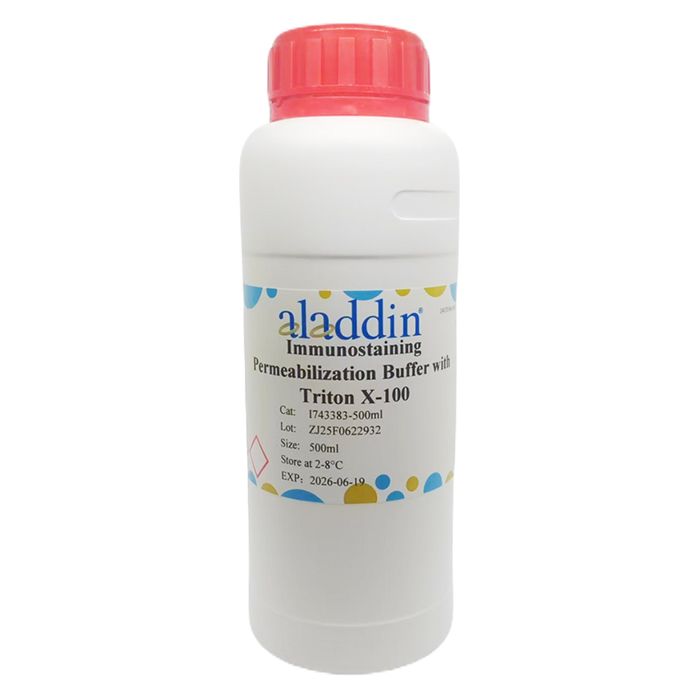
Immunostaining Permeation Buffer with Triton X-100 (also known as Triton X-100) Immunostaining Permeabilization Solution with Triton X-100), It can be used for permeabilization treatment of cell samples, frozen or paraffin sections during various in situ detections such as immunostaining, which helps to expose targets such as antigens and nucleic acids, making it easier for antibodies, probes or markers to enter the cell, thereby ensuring the detection effect of staining. This product is a ready to use working fluid that can be used directly without dilution.
This product has strong permeability and is recommended for various conventional cell permeabilization methods such as immunofluorescence, immunohistochemistry, immunohistochemistry, and flow cytometry. For situations where high transparency is not required, immunostaining wash solution can also be used. For situations where cell membrane proteins need to be detected, it is recommended to use immunostaining wash solution (Saponin). For situations with high transparency requirements, immunostaining strong permeability solution can be used. For the detection of lectin, it is recommended to use this product or immunostaining strong penetration solution.
Permeation of cell membranes can usually be achieved by using organic solvents such as methanol, acetone, etc., or by using detergents such as Triton X-100, Saponin, etc. Organic solvents such as methanol or acetone can dissolve the cell membrane and nuclear membrane, fully exposing the target proteins in the cytoplasm and nucleus. On the other hand, they can also denature and fix the proteins inside the cell. Organic reagents such as methanol or acetone are relatively simple to operate, and can achieve both fixation and permeability in one step. However, the disadvantage is that membrane proteins can also be dissolved and some proteins may denature, which is not conducive to subsequent detection. Therefore, organic solvents are used relatively less and are only used for rough detection requirements. Triton X-100 is a commonly used permeabilizing reagent that can penetrate cell membranes and nuclear membranes. Its principle of action is also non-specific dissolution of cell membranes, so its disadvantage is that it is not conducive to the detection of membrane proteins. However, when using polyformaldehyde for cross-linking and fixation, a considerable portion of membrane proteins will be cross-linked and fixed, and will not be dissolved by Triton X-100, so they can still be detected in the future. Saponin can specifically dissolve cholesterol in the cell membrane, thereby selectively punching holes on the cell membrane. Its advantage is that it is suitable for detecting cell membrane proteins, especially for detecting marker proteins on the cell membrane through flow cytometry. The disadvantage is that it has poor permeability for some cells with low cholesterol content, weaker than Triton X-100 and organic solvents, and cannot penetrate nuclear and mitochondrial membranes with low cholesterol content. For the detection of lectin, the effect of permeate containing non-specific detergents such as Triton X-100 is significantly better than that of permeate mainly containing Saponin.
This immunostaining permeabilization solution (Triton X-100) contains detergents such as Triton X-100, prepared in PBS. The immunostaining results of the target protein in the cytoplasm or nucleus of the sample treated with Triton X-100 showed that the staining effect was basically consistent or slightly enhanced compared to conventional permeabilization solution.
According to the requirement of 0.1 or 1 milliliter of immunostaining permeabilization solution (Triton X-100) for each sample, a 100ml package of this product can permeabilize 1000 or 100 samples, and a 500ml package of this product can permeabilize 5000 or 500 samples.
Usage
1. For slicing, after fixation and washing, drop 50-100 μ l of immunostaining permeabilization solution (Triton X-100) per sample, or completely immerse it in a staining tank for permeabilization. For cell samples, after fixation and washing, 1 milliliter of immunostaining permeabilization solution (Triton X-100) was added to each well of a six well plate, while other well plates were added according to this ratio. For other samples, the amount of immunostaining permeabilization solution (Triton X-100) added should be sufficient to cover the sample.
2. Usually, the permeabilization can be completed by incubating at room temperature in immunostaining permeabilization medium (Triton X-100) for 5-10 minutes. For samples that are difficult to permeabilize or require particularly sufficient permeabilization, they can be incubated at room temperature in immunostaining permeabilization solution (Triton X-100) for 10-30 minutes.
precautions
1. Try to minimize the number of repeated freeze-thaw cycles to avoid failure.
2. For your safety and health, please wear lab clothes and disposable gloves and masks during operation.
3. This product is only for scientific research by professionals and should not be used for clinical diagnosis or treatment, food or medicine, or stored in ordinary residential areas.

 ZJ25F1129527