
Determine the necessary mass, volume, or concentration for preparing a solution.
| Activity Type | Activity Value -log(M) | Mechanism of Action | Activity Reference | Publications (PubMed IDs) |
|---|
Moligand™, 10mM in DMSO Moligand™ for sensitive chromatographic and analytical workflows requiring minimal baseline interference.
Store at -80°C Ships Dry ice packs + Cold packs Check lot-specific COA for exact specifications.
SDS, COA, datasheet, and spec sheet available for download. Lot-specific COA accessible via lot number lookup.
Cited in 0 peer-reviewed publications across chromatography, organic synthesis, and cross-coupling reactions.
Information
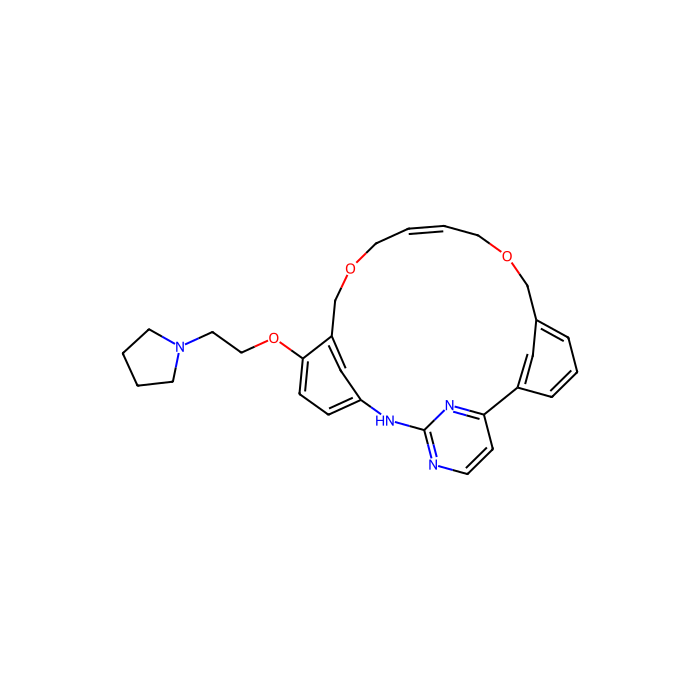
Pacritinib (SB1518) is a potent and selective inhibitor ofJanus Kinase 2 (JAK2)andFms-Like Tyrosine Kinase-3 (FLT3)withIC50sof 23 and 22 nM in cell-free assays, respectively. Phase 3.
In vitro
Pacritinib is a potent inhibitor of both wild-type JAK2 and JAK2V617F mutant (IC50= 19 nM) that is present in high frequencies among patients with MPD. Relative to JAK2, Pacritinib is two-fold less potent against TYK2 (IC50= 50 nM), 23-fold less potent against JAK3 (IC50= 520 nM) and 56-fold less potent against JAK1 (IC50= 1280 nM). Pacritinib effectively permeates cells to modulate signaling pathways downstream of JAK2, whether agonist activated or mutationally activated. Pacritinib induces apoptosis, cell cycle arrest and antiproliferative effects in JAK2WT- and JAK2V617F-dependent cells. Pacritinib inhibits cell proliferation of Karpas 1106P and Ba/F3-JAK2V617F with IC50 of 348 and 160 nM, respectively. Pacritinib inhibits endogenous colony growth derived from erythroid and myeloid progenitors with IC50 of 63 and 53 nM , respectively. SB1518 also inhibits FLT3 and its mutant FLT3-D835Y(IC50= 6 nM ). Pacritinib inhibits FLT3 phosphorylation and downstream STAT, MAPK and PI3K signaling in FLT3-internal-tandem duplication (ITD), FLT3-wt cells and primary AML blast cells. Pacritinib treatment leads to a dose-dependent decrease of pFLT3, pSTAT5, pERK1/2 and pAkt in FLT3-ITD harboring MV4-11 cells with IC50 of 80, 40, 33 and 29 nM , respectively. Treatment of the primary AML blast cells with Pacritinib for 3 h leads to a dose-dependent decrease of pFLT3, pSTAT3 and pSTAT5 with an IC50 below 0.5 μM. Pacritinib induces apoptosis, cell cycle arrest and anti-proliferative effects in FLT3-mutant and FLT3-wt cells. Pacritinib inhibits cell proliferation of FLT3-ITD-harboring cells MV4-11 and primary AML blast cells with IC50s of 47 nM and 0.19-1.3 μM, respectively.
In vivo
Pacritinib administrated at 150 mg/kg p.o. q.d. to JAK2V617F-dependent xenograft model, significantly ameliorates splenomegaly and hepatomegaly symptoms, with 60% normalization of spleen weight and 92% normalization of liver weight and is well tolerated without significant weight loss or any hematological toxicities, including thrombocytopenia and anemia. Pacritinib induces dose-dependent inhibition of tumor growth of JAK2V617F-dependent SET-2 xenograft model (40% for 75 mg/kg and 61% for 150 mg/kg). Pacritinib is efficacious in FLT3-ITD-bearing MV4-11 xenograft models. Pacritinib treated once daily for 21 consecutive days, induces dose-dependent inhibition of tumor growth (38% for 25 mg/kg, 92% for 50 mg/kg and 121% for 100 mg/kg). Complete regression is observed in 3/10 and 8/8 mice for the 50 and 100 mg/kg/day groups, respectively.
Cell Data
cell lines:Ba/F3, Ba/F3-JAK2V617F and Ba/F3-MPLW515L cells
Concentrations:~10 μM
Incubation Time:2 days
Powder Purity:≥95%
| ALogP | 4.547 |
|---|---|
| HBD Count | 1 |
| Rotatable Bond | 4 |
| Isomeric SMILES | C1CCN(C1)CCOC2=C3COC/C=C/COCC4=CC(=CC=C4)C5=NC(=NC=C5)NC(=C3)C=C2 |
|---|---|
| PubChem CID | 46216796 |
| Molecular Weight | 472.58 |
Comprehensive hazard, handling, storage, and regulatory compliance document.
Download SDS →Lot-specific quality data. Enter your lot number to retrieve the exact COA.
Look up COA →Full quality attributes and acceptance criteria for this grade.
View spec sheet →| Activity Type | Activity Value -log(M) | Mechanism of Action | Activity Reference | Publications (PubMed IDs) |
|---|
| Activity Type | Activity Value -log(M) | Mechanism of Action | Activity Reference | Publications (PubMed IDs) |
|---|
| Activity Type | Activity Value -log(M) | Mechanism of Action | Activity Reference | Publications (PubMed IDs) |
|---|
| Activity Type | Activity Value -log(M) | Mechanism of Action | Activity Reference | Publications (PubMed IDs) |
|---|
| Activity Type | Activity Value -log(M) | Mechanism of Action | Activity Reference | Publications (PubMed IDs) |
|---|
| Activity Type | Activity Value -log(M) | Mechanism of Action | Activity Reference | Publications (PubMed IDs) |
|---|
| Activity Type | Activity Value -log(M) | Mechanism of Action | Activity Reference | Publications (PubMed IDs) |
|---|
| Activity Type | Activity Value -log(M) | Mechanism of Action | Activity Reference | Publications (PubMed IDs) |
|---|
| Solubility | Solubility (25°C) In vitro DMSO: 44.5 mg/mL (200.21 mM); Ethanol: 44.5 mg/mL (200.21 mM); Water: Insoluble; |
|---|---|
| DMSO(mg / mL) Max Solubility | 11 |
| DMSO(mM) Max Solubility | 23.27648229 |
| Water(mg / mL) Max Solubility | <1 |
Our grade selection guide covers purity, stabilizer status, and application suitability for all variants in our catalog.
View Moligand™ grade guide →