
Pyrophosphate sequencing
Pyrophosphate sequencing
Pyrosequencing is a luminescence-based sequencing technology for the determination of pyrophosphate (PPi). The three key points of pyrosequencing are: (1) dATPaS, an analog of dATP, is used in the reaction because dATP, which has a structure similar to that of ATP, reacts with luciferin and emits fluorescence, whereas dATPαS produces little or no background fluorescence. Adenosine triphosphate bisphosphatase (ATPBP) allows sequencing to proceed in a cyclic fashion, because each addition of dNTP must remove the last unreacted dNTP, otherwise sequential sequencing would be impaired. This bisphosphatase is able to degrade the remaining dNTP after the polymerization reaction is complete, so there is no need for an isolation or washing step to remove the remaining dNTP. iii) Enables peak formation in the sequencing signal. Since the ATP signal generated by the sequencing reaction can accumulate and overflow the background, thus preventing sequencing, however, the adenosine triphosphate bisphosphatase used to degrade dNTP also degrades ATP, so that a peak signal can be obtained.
Principle
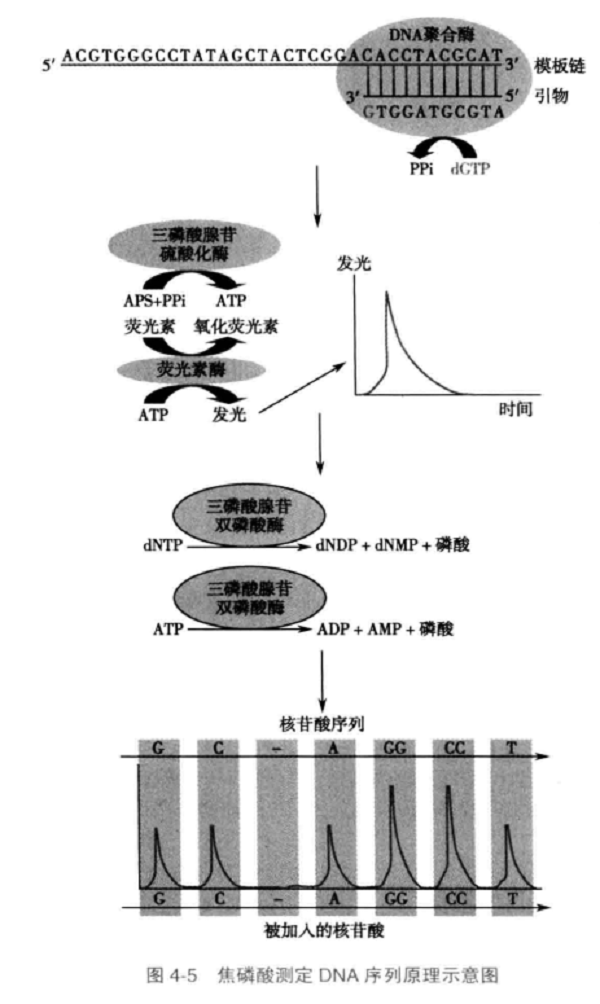
The basic principle of pyrosequencing is that:
A specific sequencing primer is annealed to a single-stranded template DNA and added to an enzyme mixture consisting of DNA polymerase, ATP sulfurylase, luciferase and apyrase, and a substrate mixture consisting of adenosine 5'-sulphatophosphate (APS) and luciferase, and a substrate mixture consisting of adenosine 5'-sulphatophosphate (APS) and luciferin. ' -sul-phatophosphate (APS) and fluorescein in the substrate mixture.
(ii) One dNTP is added to the reaction system, and if it pairs with the next base of the DNA template, it will be added to the 3'-end of the sequencing primer by the action of DNA polymerase, and a molecule of PPi will be released at the same time.
③ Under the action of adenosine triphosphate sulfatase, the generated PPi binds to APS to form ATP. under the catalysis of luciferase, ATP binds to luciferin to form oxidized luciferin and emits light at the same time, with a maximum wavelength of about 560 nm, and the intensity of fluorescent signals (i.e., the height of the detection peak) is proportional to the number of polymerized dNTPs.
The intensity of the fluorescence signal (i.e. the detection peak) is proportional to the number of polymerized dNTPs. ④ The remaining dNTP and residual ATP in the reaction system are degraded by adenosine triphosphate diphosphatase.
⑤ Add another dNTP and repeat steps ② to ④. Through this cycle, the exact nucleotide sequence of the template DNA can be read out in real time according to the type of dNTP added and the intensity of the fluorescence signal (the level of the peak).
The principle is shown in the figure:
Appliance
Pyrophosphate sequencing technology is easy to operate and provides accurate results, and can be used for single nucleotide polymorphism site analysis, allele frequency determination, typing identification of microorganisms such as bacteria and viruses, CpG methylation analysis, and scanning for point mutations in the sequences of disease-related genes.
Operation method
Pyrophosphate sequencing
Materials and Instruments
Reagents: Move The basic process of pyrophosphate sequencing technology has the following steps: 2. 1 dNTP is added to the reaction system, and if it pairs with the next base of the DNA template, it is added to the 3'-end of the sequencing primer by DNA polymerase, and a molecule of PPi is released. 3. Under the action of adenosine triphosphate sulfatase, the generated PPi binds to APS to form ATP, and under the catalytic action of luciferase, ATP binds to luciferin to form oxidized luciferin, which emits light at the same time, with a maximum wavelength of about 560 nm, and the intensity of the fluorescence signal (i.e., the peak level of the detection) is proportional to the number of dNTP polymerized. 4. The remaining dNTP and residual ATP in the reaction system are degraded by the action of adenosine triphosphate bisphosphatase (ATPBP). 5. Add another dNTP and repeat steps 2-4. Through this cycle, the exact nucleotide sequence of the template DNA can be read in real time according to the type of dNTP added and the intensity of the fluorescence signal (the level of the peak). For more product details, please visit Aladdin Scientific website.
DNA template, dNTP, primers
Instrument:
Sequencer