
Ras-Raf-MEK-ERK Signaling
Ras-Raf-MEK-ERK Signaling
The Ras-Raf-MEK-MAPK-ERK signaling pathway plays a crucial role in cell differentiation, proliferation, and survival. This pathway transmits extracellular signals through ligands of receptor tyrosine kinases on the membrane, activating nuclear transcription factors that regulate gene expression and product synthesis. Protein mutations in this pathway are prevalent in various cancers, leading to hyperactivation of signaling and inducing uncontrolled cell proliferation. Therefore, proteins and receptors in the Ras-Raf-MEK-MAPK-ERK pathway are important targets for anticancer therapies. Additionally, the Ras signaling pathway is closely associated with aging and metabolism, and research on small molecule targeting of this pathway has garnered attention in neurodegenerative diseases. For example, the Ras/ERK pathway, through activation of amyloid precursor protein (APP), promotes the development of neurodegenerative lesions and formation of dendritic plaques. Future research targeting this key pathway may provide novel therapeutic strategies for various diseases.
MEK
MEK (mitogen-activated protein kinase kinase, MAP2K) is a class of tyrosine/threonine kinases activated by Raf, responsible for phosphorylating ERK and other MAPK proteins. There are two isoforms of MEK, MEK1 and MEK2. These kinases may undergo mutations in certain cancer types, leading to sustained and uncontrolled activation.

Figure 1 Chemical structure of ARRY-162

Figure 2 Chemical structure of AZD8330
Name | ID |
ARRY-162 | |
AS-703026 | |
AZD8330 | |
GDC-0623 | |
GSK1120212 | |
PD184352 | |
PD325901 | |
RDEA119 | |
Selumetinib |
Ras
Ras family proteins are small GTPases, similar to Rho, Ran, and Arf, involved in regulating intracellular processes like nuclear transport, vesicle trafficking, and signal transduction. Ras proteins are activated by receptor tyrosine kinases, such as growth factor and ephrin receptors. Specific Ras proteins, including K-Ras, H-Ras, and N-Ras, transmit growth factor signals by activating downstream targets like Raf and PI3K. Mutant K-Ras subtypes are overactive and linked to colorectal and pancreatic cancers. Activating mutations in H-Ras are associated with bladder cancer. Similarly, mutations in N-Ras are common in melanoma and thyroid cancer. Ras proteins are targets for drugs like Zoledronic acid and Nilotinib.

Figure 3 Chemical structure of Zoledronic Acid Monohydrate
Name | ID |
Deltarasin Hydrochloride | |
(E,Z)-4-Hydroxytamoxifen | |
Kobe0065 | |
Kobe2602 | |
Manumycin A | |
Nobiletin | |
Zoledronic Acid Hydrate |
RAF
Raf proteins are serine/threonine kinases responsible for transmitting signals from Ras proteins and amplifying them through the MAPK signaling cascade. The main Raf proteins are A-Raf, B-Raf, and C-Raf. While mutations in A-Raf and C-Raf occur occasionally, mutant B-Raf forms play a significant role in many cancers. In B-Raf, V599 and V600 are part of the activation loop, maintaining the inactive conformation until phosphorylation. Mutations like V599K or V600E disrupt these interactions, induce activation, and lead to uncontrolled signaling and growth. Raf proteins are explored as targets for chemotherapy drugs, like Dabrafenib and Vemurafenib.

Figure 4 Chemical structure of B-Raf IN1

Figure 5 Chemical structure of PLX4720

Figure 6 Chemical structure of SB-590885
Name | ID |
AZ628 | |
B-Raf IN1 | |
CEP-32496 | |
Dabrafenib | |
Dabrafenib Mesylate | |
GDC-0879 | |
GW5074 | |
MLN2480 | |
Pazopanib | |
PD184352 (CI-1040) | |
PD325901 | |
PLX4720 | |
RAF265 | |
D10137 | |
SB-590885 | |
Sorafenib | |
TAK-632 | |
Vemurafenib(PLX4032) | |
ZM-336372 |
ERK
ERK (extracellular signal-regulated kinase) is a classic MAP kinase that receives signals from MEK and other proteins involved in the MAPK signaling cascade, thereby activating downstream transcription factors such as c-Fos, c-Myc, and ELK1. These transcription factors regulate the synthesis of gene products associated with meiosis, mitosis, and cell differentiation. ERK1 or ERK2 signaling plays a crucial role in the initiation and progression of cancer, and it is also closely associated with migraines and mood disorders, such as schizophrenia and bipolar disorder.

Figure 7 Chemical structure of SU-1498
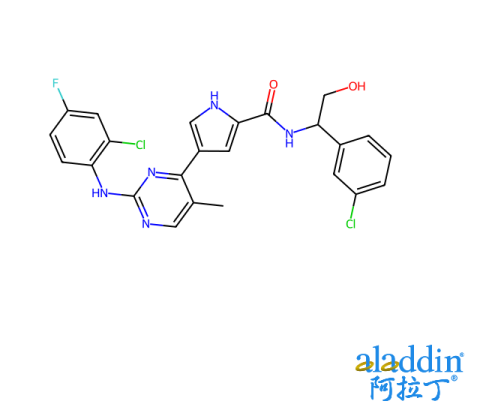
Figure 7 Chemical structure of SU-1498
Name | ID |
Apigenin | |
Bisdemethoxycurcumin | |
Canertinib 2HCl | |
CV-65 | |
Demethoxycurcumin | |
Enniatin B1 | |
4-O-Methylhonokiol | |
Nitidine Chloride | |
Nobiletin | |
Olomoucine II | |
Pelitinib | |
SU-1498 | |
Tangeretin | |
Ulixertinib(BVD-523) | |
VX-11e |
p38 MAPK
The p38 MAPKs are a class of protein kinases involved in cell differentiation, apoptosis, and autophagy. p38 MAPKs participate in regulating the signaling cascades that mediate cellular responses to environmental stress and inflammatory cytokines. There are four known p38 MAPK isoforms: p38-α, β, γ, and δ. Activation of the p38 pathway can trigger the generation of pro-apoptotic transcription factors. As regulators of cell survival, dysregulation of the p38 pathway is a key factor in certain cancers, making compounds that modulate p38 MAPK a potential target for cancer therapy. And they have also shown promise in the treatment of autoimmune diseases and inflammation.

Figure 9 Chemical structure of VX-702
Name | ID |
Doramapimod | |
Enniatin B | |
Hypothemycin | |
SB-202190 | |
SB-203580 | |
Theaflavin | |
VX-702 |
Aladdin:https://www.aladdinsci.com/