Vitamin C, also known as L-ascorbic acid, is an essential nutrient for higher primates and a few other organisms. In living organisms, vitamin C acts as an antioxidant, an acidic hexose derivative, and an enediol hexonic acid lactone, protecting the body from free radical damage. It also functions as a coenzyme and is widely found in various fresh fruits and vegetables. Vitamin C exists in two isomeric forms: L-form and D-form. Only the L-form has physiological functions, and both the reduced form and oxidized form exhibit biological activity.
The detection principle of the Vitamin C Assay Kit (Phenanthroline Colorimetric Method) is as follows: Under acidic conditions, vitamin C reduces ferric ions (Fe³⁺) to ferrous ions (Fe²⁺), which then form a stable red chelate complex with phenanthroline. The absorbance is measured at 534 nm using a microplate reader . Within a certain concentration range, the absorbance shows a linear relationship with the vitamin C content, allowing the determination of vitamin C concentration.
Product Components
V1515893 | Component | 48 T | 96 T | Storage conditions | V1515893A | Extraction buffer(5×) | 10 mL | 20 mL | 2-8℃. Store in the dark | V1515893B | Acidic Buffer | 1.5 mL | 3 mL | 2-8℃ | V1515893C | Assay Reagent A | 15 mg | 25 mg | 2-8℃. Store in the dark | V1515893D | Assay Reagent B | 1 mL | 2 mL | 2-8℃. Store in the dark | V1515893E | Standard | 2×5 mg | 4×5 mg | 2-8℃. Store in the dark |
|
Usage
1.Reagent Preparation
(1) Equilibrate all reagents in the kit to room temperature.
(2) Prepare 1× Extraction Solution by mixing Extraction Solution (5×) and double-distilled water in a volume ratio of 1:4. Store at 2-8°C protected from light.
(3) Add 5 mL (for 96 tests) or 3 mL (for 48 tests) of absolute ethanol to Detection Reagent A and mix well. Store at 2-8°C protected from light.
(4) Take one vial of Vitamin C standard, add 1 mL of 1× Extraction Solution to obtain a 5 mg/mL Vitamin C standard solution. Then dilute it with 1× Extraction Solution to a 250 μg/mL Vitamin C standard solution. Dilute according to the table below. Prepare fresh before use:
Volume of 250 μg/mL Vitamin C Standard (μL) | 1.6 | 8 | 16 | 24 | 32 | 40 | Volume of 1× Extraction Solution (μL) | 38.4 | 32 | 24 | 16 | 8 | 0 | Final Vitamin C Concentration (μg/mL) | 10 | 50 | 100 | 150 | 200 | 250 |
|
2. Sample Preparation (1) Samples must not contain reducing agents such as DTT or 2-mercaptoethanol, nor chelating agents such as HEDP or EDTA. (2) Accurately weigh the tissue sample, add 9 volumes of 1× Extraction Solution according to the weight (g): volume (mL) ratio of 1:9, grind and homogenize. Collect the supernatant after centrifugation at 4000 g for 10 minutes. The supernatant is the test solution. 3. Assay Procedure (1) Perform a preliminary assay on 2-3 samples with expected large differences before formal measurement. (2) Preheat the microplate reader for 30 minutes and set the wavelength to 534 nm. (3) Add reagents sequentially according to the table below: |
Reagent (μL) | Blank Well | Standard Well | Sample Well | 1× Extraction Buffer | 40 | - | - | Vitamin C Standard | - | 40 | - | Test Sample | - | - | 40 | Deionized Water | 80 | 80 | 80 | Acidic Buffer | 20 | 20 | 20 | Reagent A | 40 | 40 | 40 | Reagent B | 20 | 20 | 20 |
|
Mix well and incubate at 30°C for 30 minutes. Measure the absorbance at 534 nm in a 96-well microplate.
4. Result Calculation
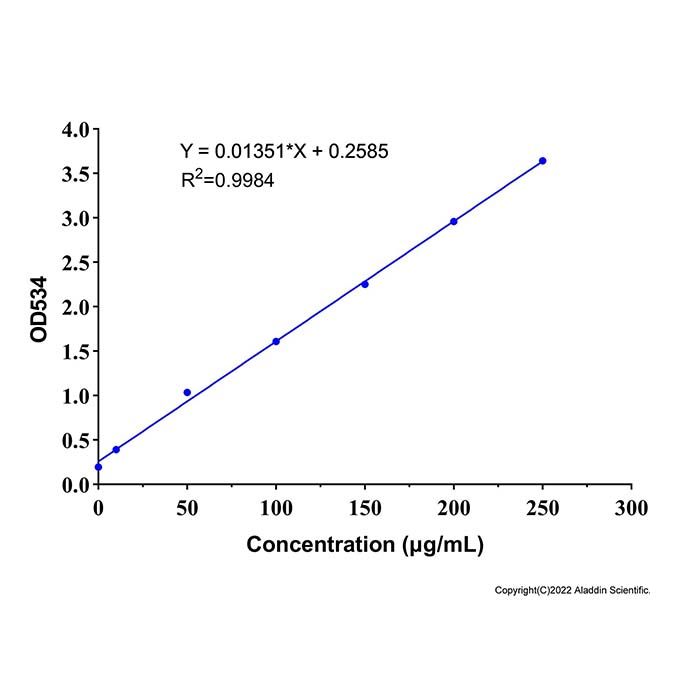
Plot a standard curve with the series of standard vitamin C concentrations (0, 10, 50, 100, 150, 200, 250 μg/mL) as the x-axis and the corresponding absorbance values as the y-axis to obtain the regression equation. Substitute the absorbance of the sample well into the regression equation to calculate the vitamin C concentration.
Vitamin C Content (μg/g) = Cₛₐₘₚₗₑ × Vₛₐₘₚₗₑ × N / W
Cₛₐₘₚₗₑ: Vitamin C concentration obtained from the standard curve (μg/mL)
Vₛₐₘₚₗₑ: Total volume of sample extraction solution (μL)
N: Sample dilution factor
W: Sample mass (g)
5. Precautions
(1) If the sample concentration is too high, dilute it with distilled water and re-measure. Multiply the result by the dilution factor.
(2) Vitamin C standard is easily oxidized. Therefore, it is recommended to prepare the standard solution after the sample supernatant is prepared, and perform the assay within 10 minutes.
6. Result Presentation
Typical Standard Curve: