Fusion PCR experiment
Fusion PCR experiment
Fusion PCR is the process of joining two DNA sequences together in an adjacent position by PCR. Generally speaking, the primer sequence designed for fusion PCR contains a piece of template sequence to be fused at the 5' end and 3' end of the primer sequence, which is equivalent to the header, joining the two DNA sequences together. Fusion PCR is most commonly used for splicing full-length sequences, but now with the development of technology, it is gradually applied to gene disruption, gene labeling, sequence deletion, fusion of two genes and other fields.
Principle
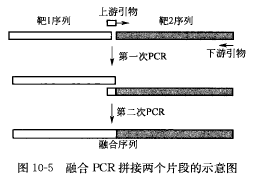
The basic principle of the fusion PCR experiment is to add a cap sequence at the 5' end of the upstream primer, which is homologous to the target 1 sequence, and a sequence at the 3' end of this primer, which is homologous to the target 2 sequence. In this way, in the first PCR reaction, the target 2 sequence is used as a template to amplify the target 2 sequence, and the amplified products all carry sequences that are homologous or complementary to the target 1 sequence. The amplification products all carry sequences homologous or complementary to the target 1 sequence. The amplification products are then used as primers to amplify the target 1 sequence using the target 1 sequence as a template in the second PCR reaction. The resulting product contains both target 1 and target 2 sequences, making it a long fragment of fusion sequence (see Figure 10-5).
Operation method
Fusion PCR
Principle
The basic principle of the fusion PCR experiment is to add a cap sequence at the 5' end of the upstream primer, which is homologous to the target 1 sequence, and the 3' end of this primer, which is homologous to the target 2 sequence. Thus, in the first PCR reaction, the target 2 sequence is used as a template to amplify the target 2 sequence, and the amplified products all carry sequences homologous or complementary to the target 1 sequence. The amplification products all carry sequences homologous or complementary to the target 1 sequence. Then, using such amplification products as primers, the target 1 sequence is amplified in the second PCR reaction, using the target 1 sequence as a template. The resulting product contains both target 1 and target 2 sequences, making it a long fragment of fusion sequence (see Figure 10-5).
Materials and Instruments
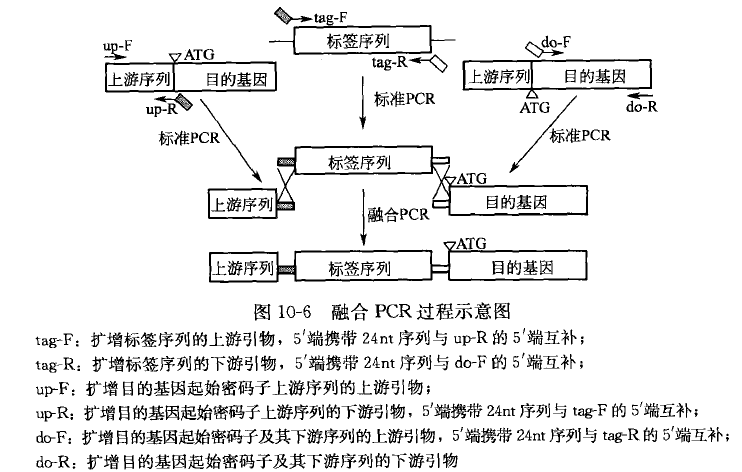
Equipment: PCR instrument, electrophoresis apparatus, etc. Move The basic process of a fusion PCR experiment can be divided into the following steps, which are applied to the specific procedure of fusion PCR for gene insertion, and the fusion PCR process is shown in Figure 10-6: (A) Using standard PCR methods, perform three independent PCR reactions: PCR reaction 1: Obtain a tag sequence: use primers tag-F and Wg-R. PCR Reaction 2: Obtain the upstream sequence of the start codon ATG of the target gene, about 500 bp, using primers up-F and up-R, of which up-R contains 24 bp of sequence complementary to the 5' of the tag sequence. PCR reaction 3: obtain the start codon ATG of the target gene and its downstream sequence, about 500 bp, using primers do-F and do-R, where do_F contains 24 bp of sequence complementary to the 3' of the tag sequence. (B) Fusion PCR reaction system: The three PCR products were mixed at approximately the same molar ratio (preferably with separate purification of the PCR products) to a total of about 100 ng, and then the reaction system was made up to 50 μL, consisting of 5 μL of Pwo polymerase buffer with MgSO4, 0.2 mmol/L of each of the PCR products, and 49 μL of deionized water, and then heated to 94 ℃. The reaction system was heated to 94 ℃, and then 1 μL of Pwo polymerase (Roche) was added. The reaction conditions were 94 ℃ for 30 s-55 ℃ for 1 min-72 ℃ for 3.5 min in five cycles. The objective was to extend the three PCR products in complementary fashion to form a full-length fusion PCR product. (C) Fusion PCR products. (C) Further amplification of the fusion PCR product After the above five cycles, the reaction system was heated to 94 °C and 50 μL of reaction solution (5 μL of Fwo polymerase buffer with MgSO4, 0.2 mmol/L each of dNTP, 1 μL of Pwo polymerase, and primers up-F and dbR for the 5' and 3' ends) was added to make up the nominal volume. The PCR reaction was performed for 25 cycles at 94 ℃ for 30 s-55 ℃ for 1 min-72 ℃ for 3.5 min. The resulting fusion PCR product consisted of 500 bp of sequence upstream of the start codon ATG, a tag sequence, and 500 bp of sequence at and downstream of the start codon ATG. Caveat 1, the length of the homologous complementary regionSince fusion PCR mainly utilizes the complementary sequences at the 3' ends of two fragments for fusion, the longer the fragments to be fused, the less the amount of complete fusion product. Sometimes the amplification product is difficult to detect in gel electrophoresis. However, extending the homologous complementary region between the two fragments to be fused is a good way to increase the yield of the fusion product. As shown in Figure 10-12, the procedure (b) is easy to obtain a high yield, while the procedure (a) yields a low amount of product Ang seven Fan Baochang et al. In order to obtain the full-length cDNA molecule of the dengue 2 virus, they increased the length of the complementary sequences of the 5' hemi-molecule and the 3' hemi-molecule to 1.6 kb, which ensures the correct matching of the hemi-molecules after annealing and the stability of the intermediates. 2. Performance of DNA polymeraseFusion PCR results are sometimes unsatisfactory and are also related to the performance of the DNA polymerase used. In most cases, high-fidelity DNA polymerases are recommended to minimize the generation of mutations. However, with good fidelity, there are some limitations on the amplification ability, for example, in order to ensure that the 11 kb fusion product is obtained, Fan Baochang et al. used a high-fidelity PCR system (B.M. Company) with better amplification ability but slightly lower fidelity than that of Pfu. Wang et al.'s experimental results proved that, if the fusion amplification of high-fidelity DNA polymerase is not good, we can try to utilize ordinary Taq enzyme and high-fidelity DNA polymerase. Wang et al. proved that if the fusion amplification effect of high-fidelity DNA polymerase is not good, we can try to use a mixture of normal Taq enzyme and high-fidelity DNA polymerase. Because some high-fidelity DNA polymerase is sensitive to the templates from agarose gel and electrophoresis buffer, it is not easy to get good amplification effect. 3. PCR Primer Design and PCR Reaction ConditionsIn the fusion PCR as shown in Fig. 10-13, Oakley Laboratory found that the optimal distance of primers P2 and P5 from their respective fusion ends was about 1,000 bp, and the overlapping regions of P2, P5 and the fragments to be fused were only 18~21 bp in length. In addition, in order to ensure that the same PCR results were obtained on different PCR instruments, they stipulated the following conditions Precise PCR conditions:① 94 ℃ for 2 min;② 10 cycles: 94 ℃ for 20 s, 70 ℃ for 1 s, reduce to 55 ℃ at 0.1 ℃/s, 55 ℃ for 30 s, warm up to 68 ℃ at 0.2 ℃/s, 68 ℃ for 5 min;③ 5 cycles: 94 ℃ 20 s, 70 ℃ Is, 0.1 ℃/s speed down to 55 ℃, 55 ℃ 30 s, 0.2 ℃/s warming up to 68 ℃, 68 ℃ 5 min (after each cycle plus 5 s, the last cycle extension time for 5 min 20 s);④ 10 cycles: 94 ℃ for 20 s, 70 ℃ for 1 s, reduce to 55 ℃ at the speed of 0.1 ℃/s, 55 ℃ for 30 s, warm up to 68 ℃ at the speed of 0.2 ℃/s, and 68 ℃ for 5 min 20 s (each cycle after that, add 20 s, and the extension time of the last cycle is 9 min 20 s);In steps ③ and ④, the extension time was prolonged in consideration of the gradual decrease of Taq enzyme activity. After their strict and delicate PCR program, they obtained a single and high concentration of specific products. 4. Primer ratioIt was also found that different primer ratios also affect the fusion PCR results. In a one-step fusion PCR reaction (same principle as shown in Figure 10-7), Karremann added all three primers and the desired template in the same reaction tube and utilized one PCR reaction to obtain the fusion product. He found that the amount of primer 1 was highly dependent on the outcome of the fusion PCR. When the ratio of primer 2:primer 3 was 1:100:100, 1:1,000:1,000, 1:10,000:10,000, the accumulation of intermediate products was obvious and the amount of fusion products was small; when the ratio of primers was 1:100:100, 1:1,000:1,000. 1:10,000:10,000, the fusion PCR results became very poor, and the fusion products were almost undetectable. The fusion products were hardly detectable. Therefore, the ratio of primer 1:primer 2:primer 3 should be kept at an appropriate level. For more product details, please visit Aladdin Scientific website.