
Homologous one-step fluorescent allele-specific PCR
Homologous one-step fluorescent allele-specific PCR
Homologous one-step fluorescent allele-specific PCR utilizes water-soluble conjugated polyelectrolytes (CPs) containing a large number of absorbing units, and the excitation energy is transferred along the backbone of the CPs to a chromophore reporter, resulting in the amplification of fluorescent signals. Combining allele-specific PCR with detection using CP. Currently, there is one main method for homologous one-step fluorescent allele-specific PCR: homologous one-step fluorescent allele-specific PCR.
Principle
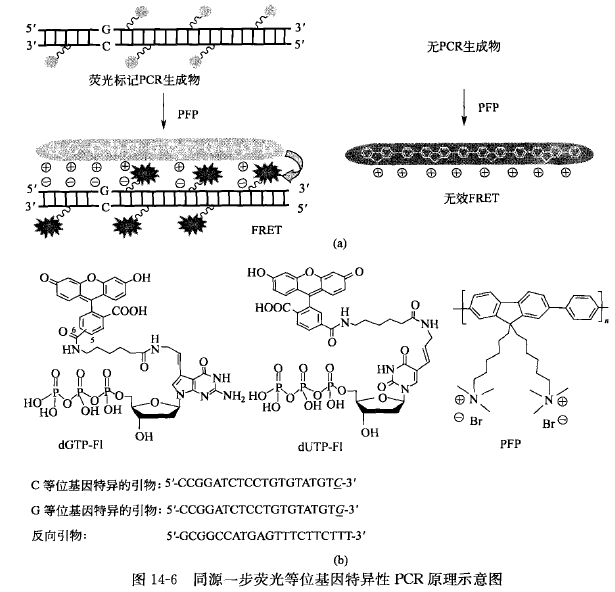
The basic principle of homologous one-step fluorescent allele-specific PCR is the same as that of allele-specific PCR, which also requires three primers, two upstream primers targeting different alleles and one common downstream primer, but the difference lies in the detection method. In Figure 14-6, the cationic multimer PFP [9,9-bis(6-N,N,N,N-trimethylammoni-um)hexyl fluorenylene-phenylene dibromide] was detected in the fluorescence resonance energy transfer (FRET) assay. energy transfer (FRET) experiments as a co-running polyelectrolyte, with fluorescein-labeled dGTP and dUTP as acceptors and PFP as a fluorescein donor to meet the requirements for FRET. The target DNA sequence containing the G allele was used as a template, and in case A of Figure 14-6, the upstream primer 3' contained a C paired with a G. The primer paired well with the template, and the PCR reaction proceeded normally.
In the presence of Taq DNA polymerase, dGTP-F1 and dUTP-Fl were doped into the DNA strand during chain extension. After exponential amplification, a large number of fluorescein-labeled amplification products were obtained. Once the cationic PFP is added, the strong electrostatic interactions between the DNA and PFP bring the fluorescein close to the PFP, and an efficient FRET with the fluorescein occurs. in case B, the 3' end of the upstream primer is paired with allele C and is not complementary to allele G. During thermal cycling, only the linear amplification caused by the reverse primer extension produces a weakly fluorescein-labeled PCR product, and after the addition of PFP to the PCR product, the 3' end of the upstream primer is paired with allele C. The PCR product is then amplified by the reverse primer extension. During thermal cycling, only the linear amplification caused by reverse primer extension produces a weakly fluorescein-labeled PCR product that undergoes an ineffective FRET upon addition of PFP, and it is possible to analyze the genotype of the SNP by triggering a change in the emission density of PFP and fluorescein.
Operation method
Homologous one-step fluorescent allele-specific PCR
Principle
The basic principle of homologous one-step fluorescent allele-specific PCR is the same as that of allele-specific PCR, which also requires three primers, two upstream primers targeting different alleles and one common downstream primer, but the difference lies in the detection method. In Figure 14-6, the cationic multimer PFP [9,9-bis(6-N,N,N,N-trimethylammoni-um)hexyl fluorenylene-phenylene dibromide] was detected in the fluorescence resonance energy transfer (FRET) assay. energy transfer (FRET) experiments as a co-running polyelectrolyte, with fluorescein-labeled dGTP and dUTP as acceptors and PFP as a fluorescein donor to meet the requirements for FRET. The target DNA sequence containing the G allele was used as a template, and in case A of Figure 14-6, the upstream primer 3' contained a C paired with a G. The primer paired well with the template, and the PCR reaction proceeded normally. In the presence of Taq DNA polymerase, dGTP-F1 and dUTP-Fl were doped into the DNA strand during chain extension. After exponential amplification, a large number of fluorescein-labeled amplification products were obtained. Once the cationic PFP is added, the strong electrostatic interactions between the DNA and PFP bring the fluorescein close to the PFP, and an efficient FRET with the fluorescein occurs. in case B, the 3' end of the upstream primer is paired with allele C and is not complementary to allele G. During thermal cycling, only the linear amplification caused by the reverse primer extension produces a weakly fluorescein-labeled PCR product, and after the addition of PFP to the PCR product, the 3' end of the upstream primer is paired with allele C. The PCR product is then amplified by the reverse primer extension. During thermal cycling, only the linear amplification caused by reverse primer extension produces a weakly fluorescein-labeled PCR product that undergoes an ineffective FRET upon addition of PFP, and it is possible to analyze the genotype of the SNP by triggering a change in the emission density of PFP and fluorescein.
Materials and Instruments
Equipment: PCR amplifier, fluorescence spectrophotometer (Hitachi F-4500). Move The basic process of homologous one-step fluorescent allele-specific PCR can be divided into the following steps: Genomic DNA extracted using the kit.
Reagents:
① Template: genomic DNA;
① Template: genomic DNA; ② dNTP mixture: 2.5 mmol/L for each deoxyribonucleic acid;
③ Three specific primers: the concentration is 10 μmol/L. ④ Tag DNA polymerase and 10 μmol/L. ⑤ The DNA polymerizer and the DNA polymerizer are used in the preparation;
④ Tag DNA polymerase and 10 × PCR buffer: 15 mmol/L MgCl
2, 500 mmol/L KCI
④ Tag DNA polymerase and 10 × PCR buffer: 15 mmol/L MgCl2, 500 mmol/L KCI, 100 mmol/L Tris-Cl, 0.1% (v/v) Triton X-100;
⑤ Shrimp alkaline phosphatase (Takara);
⑥ dGTP-Fl (Perkin Eime), dUTP~Fl (Fermentas), PFP, SYBR gold (Invitrogen);
⑦ Autoclaved deionized water;
⑧ Electrophoresis apparatus for polyacrylamide gel electrophoresis (DYCZ-24D, Beijing Liuyi) and related reagents.
The primer design method is described in Allele-Specific PCR.
3. Operation method(1) Set up 20 μl of PCR reaction system and prepare at least two tubes of reaction solution in 0.25 ml PCR tubes, adding the following components respectively.

(2) Set up the PCR reaction conditions.

(3) Detection of PCR products: PCR amplification products were detected by electrophoresis on a 15% nondenaturing polyacrylamide gel with 1 × TBE buffer. After electrophoresis, the products were stained with 1 × SYBR Gold dissolved in 1 × TBE buffer for 30 min and then visualized.
For fluorescence detection, 4 μl of shrimp alkaline phosphatase (0.5 U/μl) was added to the PCR product, and the mixture was incubated at 37 ℃ for 20 min to degrade unreacted dNTP-Fl. After incubation, the mixture was incubated at 4 ℃, diluted with HEPES buffer (25 mmol/L, pH 8.0), and then added to PFP, and emission was detected at 380 nm with a 3-ml quartz beaker. The emission spectra were detected at an excitation wavelength of 380 nm using a 3 ml quartz beaker with a slit width and PMT voltage of 5 nm and 700 V, respectively.
Caveat
① The precautions for PCR reaction can be found in allele-specific PCR, both of them have the same operation principle, so the precautions are also the same.② In the fluorescence detection part, choosing the right PFP is crucial. Different PFPs have different fluorescence intensities, so it is necessary to conduct pre-tests to find out the conditions.
For more product details, please visit Aladdin Scientific website.