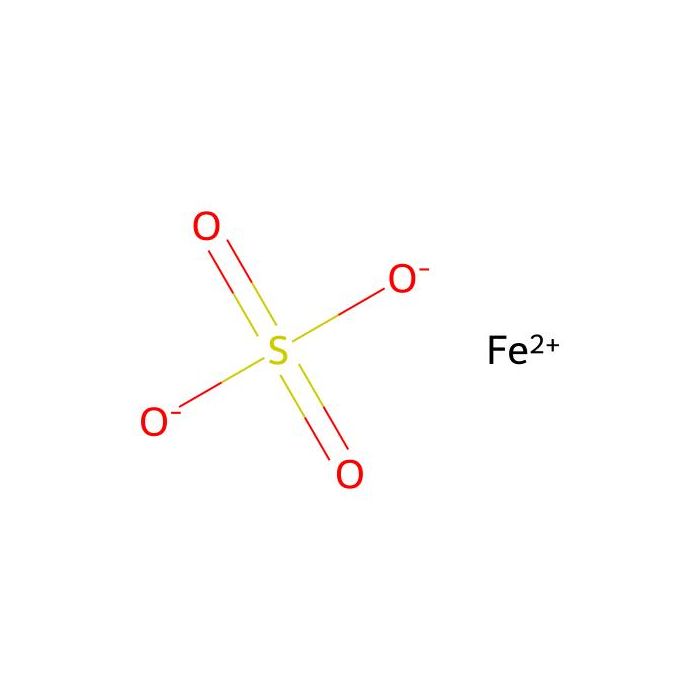
FERROUS SULFATE standard solution - 0.25mol/L in H2O , CAS No.7720-78-7

CAS: 7720-78-7 Cat. No.: F709863 Formula: FeSO4 Molecular Weight: 151.91 EC Number: 231-753-5
AVAILABLE TO ORDER
GRADE & PURITY 0.25mol/L in H2O
Storage
Room temperature
★
Size
USA
Germany (EU)*
Price
Qty
500ml
F709863-500ml
Made to order · 8–12 wks

$115.90

$135.90
Save $20.00 (14.72%)
Enter a quantity for the sizes you want to add.
🧪
Why this grade

0.25mol/L in H2O for sensitive chromatographic and analytical workflows requiring minimal baseline interference.

🌡

Storage & shipping

Room temperature Ships Check lot-specific COA for exact specifications.

📋

Quality documents

SDS, COA, datasheet, and spec sheet available for download. Lot-specific COA accessible via lot number lookup.

📚

Literature proof

Cited in 291 peer-reviewed publications across chromatography, organic synthesis, and cross-coupling reactions.

Specifications

Specifications & Purity
0.25mol/L in H2O
Storage
Room temperature
Names and Identifiers
Canonical Smiles
[O-]S(=O)(=O)[O-].[Fe+2]
IUPAC Name
iron(2+);sulfate
InChIKey
BAUYGSIQEAFULO-UHFFFAOYSA-L
INCHI
1S/Fe.H2O4S/c;1-5(2,3)4/h;(H2,1,2,3,4)/q+2;/p-2
Isomeric SMILES
[O-]S(=O)(=O)[O-].[Fe+2]
Alternate CAS
7720-78-7; 7782-63-0(heptahydrate),15438-31-0 (Parent)
MeSH Entry Terms
Aktiferrin;Apo-Ferrous Sulfate;biofer;Ceferro;Conferon;Eisendragees-ratiopharm;Eisensulfat Stada;Feospan;Fer-Gen-Sol;Fer-in-Sol;Feratab;Fero-Gradumet;Ferodan;Ferogradumet;Ferro-Gradumet;Ferrogamma;Ferrograd;FERROinfant;ferrous sulfate;ferrous sulfate, hep
Molecular Weight
151.91

Documentation

📋 Safety Data Sheet (SDS)

Comprehensive hazard, handling, storage, and regulatory compliance document.

<<<<<<< HEAD Download SDS → ======= Download SDS → >>>>>>> release248-p3

✅ Certificate of Analysis (COA)

Lot-specific quality data. Enter your lot number to retrieve the exact COA.

Look up COA →

📊 Datasheet

Quick-reference summary of product specifications and applications.

View datasheet →

🔬 Specification Sheet

Full quality attributes and acceptance criteria for this grade.

View spec sheet →

Advanced Data

Taxonomic Classification

Taxonomy Tree

KingdomInorganic compounds
SuperclassMixed metal/non-metal compounds
ClassTransition metal oxoanionic compounds
SubclassTransition metal sulfates
Intermediate Tree Nodes Not available
Direct ParentTransition metal sulfates
Alternative Parents Inorganic salts  Inorganic oxides  
Molecular FrameworkNot available
Substituents Transition metal sulfate - Inorganic oxide - Inorganic salt
DescriptionThis compound belongs to the class of inorganic compounds known as transition metal sulfates. These are inorganic compounds in which the largest oxoanion is sulfate, and in which the heaviest atom not in an oxoanion is a transition metal.
External Descriptors metal sulfate - iron molecular entity
3D Structure
Interactive Chemical Structure Model


Certificates (CoA,COO,BSE/TSE and Analysis Chart)
C of A & Other Certificates(BSE/TSE, COO):
Analytical Chart:
Chemical and Physical Properties
Molecular Weight151.910 g/mol
XLogP3
Hydrogen Bond Donor Count0
Hydrogen Bond Acceptor Count4
Rotatable Bond Count0
Exact Mass151.887 Da
Monoisotopic Mass151.887 Da
Topological Polar Surface Area88.600 Ų
Heavy Atom Count6
Formal Charge0
Complexity62.200
Isotope Atom Count0
Defined Atom Stereocenter Count0
Undefined Atom Stereocenter Count0
Defined Bond Stereocenter Count0
Undefined Bond Stereocenter Count0
The total count of all stereochemical bonds0
Covalently-Bonded Unit Count2
Documents & Articles
Transition-Metal Salts/Precursor Selection Guide: How “Different Salts of the Same Metal” Start from Different Chemical Realities—and How to Reproduce Results (including a Selection Navigator and Product Tables 1–5)
Procyanidins: Structural Features and Key Points for Research and Application
Phytase: Enzymological Properties, Mechanism of Action, and Applications in Feed and Food
Chlorophyll: Structural Features, Physicochemical Properties, and Key Points for Research and Industrial Applications
Coelenterazine (CTZ) Differences and an Application Overview
Physicochemical Properties of Diphenylamine, Analytical Applications, and a Review of Its DNA Colorimetric Reaction
Types of Inorganic Salts That Can Undergo Reduction Reactions: Nitrates, Sulfur-Containing Salts, Halogen Oxyanion Salts, and Metal Salts
Comparison of Iron Content Detection Methods: TPTZ, 1,10-Phenanthroline, Ferrozine, 2,2'-Bipyridine, and Instrumental Analysis
How Do Collagen Peptides Act on the Skin? From Surface Hydration and Percutaneous Delivery to Fibroblasts and Collagen Homeostasis
What Is “Plant Collagen”? Distinguishing Ingredient Types, Structural Differences, Production Methods, and Skincare Effects
Citations of This Product
Solution Calculators
Reviews

Customer Reviews

Shall we send you a message when we have discounts available?

Remind me later

Thank you! Please check your email inbox to confirm.

Oops! Notifications are disabled.