
Determine the necessary mass, volume, or concentration for preparing a solution.
| Activity Type | Relation | Activity value | Units | Action Type | Journal | PubMed Id | doi | Assay Aladdin ID |
|---|
UltraBio™, Suitable for molecular biology, Ultra pure, ≥99%(HPLC) Suitable for molecular biology,Ultra pure,UltraBio™ for sensitive chromatographic and analytical workflows requiring minimal baseline interference.
Room temperature Ships Normal Check lot-specific COA for exact specifications.
SDS, COA, datasheet, and spec sheet available for download. Lot-specific COA accessible via lot number lookup.
Cited in 8 peer-reviewed publications across chromatography, organic synthesis, and cross-coupling reactions.
The N-lauroylsarcosine sodium salt is applicable for processes that require tight control of elemental content. This product aids in the solubilization and separation of membrane proteins, glycoproteins, and the isolation of RNA and plasmids. N-lauroylsarcosine sodium salt serves as an antifoaming supplement or as a component of a lysing buffer of bacteria or other cells. It indicates the paramagnetic anisotropy sign change in the micelle mesophase. N-lauroylsarcosine sodium salt inhibits hexokinase and the bacterial flora of human saliva/gut at 0.25%. It also exhibits fungistatic activity in aqueous dispersion (1%). N-lauroylsarcosine (LS) is an anionic surfactant with protein denaturant potency that is structurally similar to sodium lauryl sulfate (SLS). It can inactivate herpes simplex virus (HSV) infectivity in vitro. It is used as a microbicide in topical vaginal formulations to block the transmission of HSV, human immunodeficiency virus type 1 (HIV-1), and possibly other pathogens causing sexually transmitted diseases (STDs)
Application
N-Lauroylsarcosine sodium salt has been used as a component:of nuclease stop mix, embryo extract buffer to dissociate nonspecifically bound proteins from chromatin;of proteinase K solution for the heat denaturation of genomic DNA;of 10% (w/v) sarcosyl/0.5 M ethylenediaminetetraacetic acid (EDTA) solution to prepare EDTA-sarcosyl-proteinase (ESP) buffer;in the hybridization buffer for in situ hybridization histochemistry;in the embryo extract buffer to dissociate nonspecifically bound proteins from chromatin;in proteinase K solution to inactivate the enzymes;
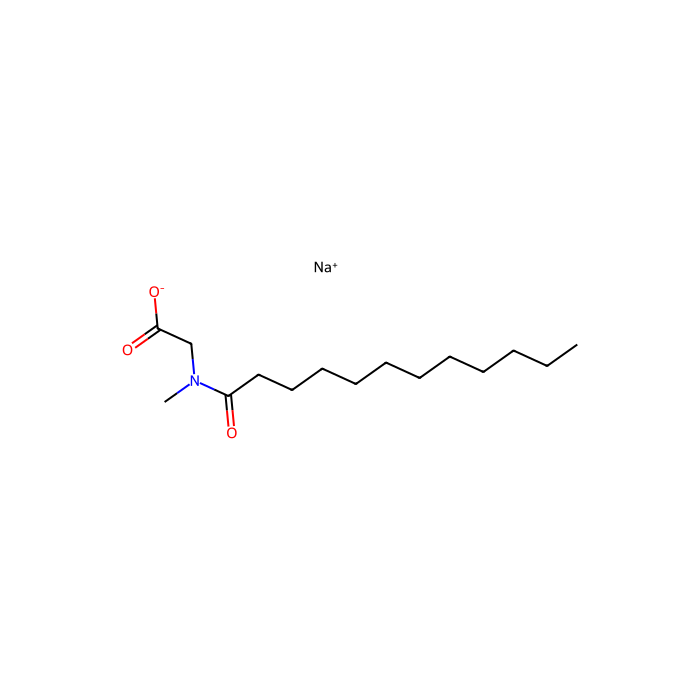
| Canonical Smiles | CCCCCCCCCCCC(=O)N(C)CC(=O)[O-].[Na+] |
|---|---|
| IUPAC Name | sodium;2-[dodecanoyl(methyl)amino]acetate |
| InChIKey | KSAVQLQVUXSOCR-UHFFFAOYSA-M |
| INCHI | 1S/C15H29NO3.Na/c1-3-4-5-6-7-8-9-10-11-12-14(17)16(2)13-15(18)19;/h3-13H2,1-2H3,(H,18,19);/q;+1/p-1 |
| Isomeric SMILES | CCCCCCCCCCCC(=O)N(C)CC(=O)[O-].[Na+] |
| WGK Germany | 1 |
| RTECS | MC0598960 |
| Molecular Weight | 293.39 |
| Beilstein | 5322974 |
| Reaxy-Rn | 5322974 |
| Reaxys-RN_link_address | https://www.reaxys.com/reaxys/secured/hopinto.do?context=S&query=IDE.XRN=5322974&ln= |
Comprehensive hazard, handling, storage, and regulatory compliance document.
Download SDS →Lot-specific quality data. Enter your lot number to retrieve the exact COA.
Look up COA →Full quality attributes and acceptance criteria for this grade.
View spec sheet →Taxonomy Tree
| Kingdom | Organic compounds |
|---|---|
| Superclass | Organic acids and derivatives |
| Class | Carboxylic acids and derivatives |
| Subclass | Amino acids, peptides, and analogues |
| Intermediate Tree Nodes | Amino acids and derivatives - Alpha amino acids and derivatives - N-acyl-alpha amino acids and derivatives |
| Direct Parent | N-acyl-alpha amino acids |
| Alternative Parents | N-acyl amines Tertiary carboxylic acid amides Carboxylic acid salts Monocarboxylic acids and derivatives Carboxylic acids Organopnictogen compounds Organonitrogen compounds Organic zwitterions Organic sodium salts Organic oxides Hydrocarbon derivatives Carbonyl compounds |
| Molecular Framework | Aliphatic acyclic compounds |
| Substituents | N-acyl-alpha-amino acid - N-acyl-amine - Tertiary carboxylic acid amide - Carboxamide group - Carboxylic acid salt - Carboxylic acid - Monocarboxylic acid or derivatives - Organic alkali metal salt - Organic zwitterion - Hydrocarbon derivative - Organooxygen compound - Organonitrogen compound - Organic oxide - Organopnictogen compound - Carbonyl group - Organic oxygen compound - Organic salt - Organic sodium salt - Organic nitrogen compound - Aliphatic acyclic compound |
| Description | This compound belongs to the class of organic compounds known as n-acyl-alpha amino acids. These are compounds containing an alpha amino acid which bears an acyl group at its terminal nitrogen atom. |
| External Descriptors | Not available |
| Activity Type | Relation | Activity value | Units | Action Type | Journal | PubMed Id | doi | Assay Aladdin ID |
|---|
| Activity Type | Relation | Activity value | Units | Action Type | Journal | PubMed Id | doi | Assay Aladdin ID |
|---|
| Activity Type | Relation | Activity value | Units | Action Type | Journal | PubMed Id | doi | Assay Aladdin ID |
|---|
| Activity Type | Relation | Activity value | Units | Action Type | Journal | PubMed Id | doi | Assay Aladdin ID |
|---|
| Solubility | H2O: 1M at20°C, clear, colorless |
|---|---|
| Sensitivity | Moisture sensitive |
| Flash Point(°F) | 512.6 °F |
| Flash Point(°C) | 267 °C |
| Melt Point(°C) | 46°C(lit.) |
| Molecular Weight | 293.380 g/mol |
| XLogP3 | |
| Hydrogen Bond Donor Count | 0 |
| Hydrogen Bond Acceptor Count | 3 |
| Rotatable Bond Count | 12 |
| Exact Mass | 293.197 Da |
| Monoisotopic Mass | 293.197 Da |
| Topological Polar Surface Area | 60.400 Ų |
| Heavy Atom Count | 20 |
| Formal Charge | 0 |
| Complexity | 260.000 |
| Isotope Atom Count | 0 |
| Defined Atom Stereocenter Count | 0 |
| Undefined Atom Stereocenter Count | 0 |
| Defined Bond Stereocenter Count | 0 |
| Undefined Bond Stereocenter Count | 0 |
| The total count of all stereochemical bonds | 0 |
| Covalently-Bonded Unit Count | 2 |
| 1. Yuying Zhang, Ying Wang, Xuhui Huang, Jie Zheng, Libo Qi, Baoshang Fu, Lei Qin. (2023) Nutritional value of different parts from sea eel (Astroconger myriaster) determined by untargeted-lipidomic approach. FOOD RESEARCH INTERNATIONAL, [PMID:37803738] [10.1016/j.foodres.2023.113402] |
| 2. Siwenjie Qian, Yanju Chen, Cheng Peng, Xiaofu Wang, Hui Wu, Yang Che, Huanying Wang, Junfeng Xu, Jian Wu. (2022) Dipstick-based rapid nucleic acids purification and CRISPR/Cas12a-mediated isothermal amplification for visual detection of African swine fever virus. TALANTA, [PMID:35149424] [10.1016/j.talanta.2022.123294] |
| 3. Mengle Huang, Yanjun Tang, Peng Zhu. (2021) Effect of sodium N-lauroylsarcosinate/hypromellose on the dispersibility and rheological behavior of carbon black for paper coating application. PROGRESS IN ORGANIC COATINGS, [PMID:] [10.1016/j.porgcoat.2021.106514] |
| 4. Yu Luo, Shenyu Huang, Lie Ma. (2021) A novel detergent-based decellularization combined with carbodiimide crosslinking for improving anti-calcification of bioprosthetic heart valve. Biomedical Materials, 16 (4): (045022). [PMID:33979785] [10.1088/1748-605X/ac0088] |
| 5. Yu-Ying Zhang, Yu-Xi Liu, Zheng Zhou, Da-Yong Zhou, Ming Du, Bei-Wei Zhu, Lei Qin. (2019) Improving Lipidomic Coverage Using UPLC-ESI-Q-TOF-MS for Marine Shellfish by Optimizing the Mobile Phase and Resuspension Solvents. JOURNAL OF AGRICULTURAL AND FOOD CHEMISTRY, [PMID:31293164] [10.1021/acs.jafc.9b01343] |
| 6. Shaoxin Deng, Chengxiang Shi, Xueyan Xu, Hui Zhao, Pingchuan Sun, Tiehong Chen. (2014) Synergy between Polyamine and Anionic Surfactant: A Bioinspired Approach for Ordered Mesoporous Silica. LANGMUIR, [PMID:24571136] [10.1021/la404478b] |
| 7. Liang Wang, Zheng Zhou, Ji Wang, Xu-Song Wang, Da-Yong Zhou, Lei Qin, Xu-Hui Huang. (2024) Mechanism of differentiated and targeted catalysis in complex lipid system under lipase and lipoxygenase mediation. FOOD CHEMISTRY, [PMID:39709915] [10.1016/j.foodchem.2024.142503] |
| 8. Li Zhang, Shanxia Jin, Xiaofeng Guo, Yi Yu, Ping Zhou. (2026) Laser-induced photochemical click reaction enabling on-line tagging and detection of phosphatidylethanolamine by MALDI-mass spectrometry. MICROCHEMICAL JOURNAL, [PMID:] [10.1016/j.microc.2026.116916] |
Our grade selection guide covers purity, stabilizer status, and application suitability for all variants in our catalog.
View Suitable for molecular biology grade guide → View UltraBio™ grade guide → View Ultra pure grade guide →