Determine the necessary mass, volume, or concentration for preparing a solution.
BioReagent BioReagent for sensitive chromatographic and analytical workflows requiring minimal baseline interference.
Protected from light,Room temperature,Desiccated Ships Normal Check lot-specific COA for exact specifications.
SDS, COA, datasheet, and spec sheet available for download. Lot-specific COA accessible via lot number lookup.
Cited in 310 peer-reviewed publications across chromatography, organic synthesis, and cross-coupling reactions.
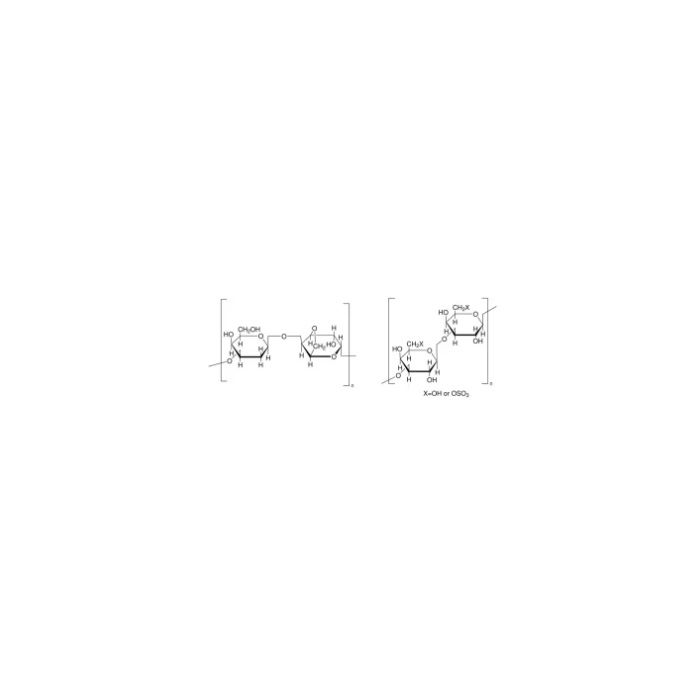
Agar disperses very easily in boiling water to form a sol, is insoluble in cold water but can absorb water and swell into gel-like lumps; the sol solution exhibits a neutral reaction. It is not broken down by enzymes during digestion and therefore has almost no nutritional value. Agar disperses readily in hot water, and even at a low concentration of 0.5%, it can form a firm gel. A 1% agar sol solidifies at 42°C, and the resulting gel does not melt even at 94°C, exhibiting strong elasticity. The gelation temperature of agar sol is relatively high, typically forming a gel at around 35°C. Agar has high water absorption and water retention capacity; when dry agar is soaked in cold water, it gradually absorbs water, swells, softens, and can absorb more than 20 times its weight in water. Agar gels have strong heat resistance. Agar is more acid-resistant than gelatin and starch, though less so than pectin. Agar can be used as a food thickener, a sizing agent for silk, a laxative, and as an adhesive, thickener, and capsule material in pharmaceuticals. It can also serve as a bacterial culture medium, a carrier for immobilized enzymes, a material for bacterial encapsulation, and a medium for electrophoresis. Additionally, it can be used for the filtration and separation of viruses, subcellular particles, and macromolecules, as well as for the observation of serum antigens or antibodies. The ADI (Acceptable Daily Intake) requires no special specification.
Comprehensive hazard, handling, storage, and regulatory compliance document.
Download SDS →Lot-specific quality data. Enter your lot number to retrieve the exact COA.
Look up COA →Full quality attributes and acceptance criteria for this grade.
View spec sheet →Taxonomy Tree
| Kingdom | Organic compounds |
|---|---|
| Superclass | Organic oxygen compounds |
| Class | Organooxygen compounds |
| Subclass | Carbohydrates and carbohydrate conjugates |
| Intermediate Tree Nodes | Glycosyl compounds |
| Direct Parent | O-glycosyl compounds |
| Alternative Parents | Disaccharides 1,4-dioxepanes Oxanes Tetrahydrofurans Secondary alcohols Oxacyclic compounds Dialkyl ethers Acetals Primary alcohols Hydrocarbon derivatives |
| Molecular Framework | Aliphatic heteropolycyclic compounds |
| Substituents | O-glycosyl compound - Disaccharide - Dioxepane - 1,4-dioxepane - Oxane - Tetrahydrofuran - Secondary alcohol - Oxacycle - Organoheterocyclic compound - Ether - Dialkyl ether - Acetal - Hydrocarbon derivative - Primary alcohol - Alcohol - Aliphatic heteropolycyclic compound |
| Description | This compound belongs to the class of organic compounds known as o-glycosyl compounds. These are glycoside in which a sugar group is bonded through one carbon to another group via a O-glycosidic bond. |
| External Descriptors | Not available |
Find and download the COA for your product by matching the lot number on the packaging.
| Lot Number | Certificate Type | Date | Item |
|---|---|---|---|
| Certificate of Analysis | Aug 04, 2026 | A109144 | |
| Certificate of Analysis | Mar 16, 2026 | A109144 | |
| Certificate of Analysis | Mar 16, 2026 | A109144 | |
| Certificate of Analysis | Aug 29, 2025 | A109144 | |
| Certificate of Analysis | Aug 29, 2025 | A109144 | |
| Certificate of Analysis | Aug 29, 2025 | A109144 | |
| Certificate of Analysis | Jan 20, 2025 | A109144 | |
| Certificate of Analysis | Jan 20, 2025 | A109144 | |
| Certificate of Analysis | Jan 20, 2025 | A109144 | |
| Certificate of Analysis | Jan 20, 2025 | A109144 | |
| Certificate of Analysis | Oct 14, 2024 | A109144 | |
| Certificate of Analysis | Oct 14, 2024 | A109144 | |
| Certificate of Analysis | May 10, 2024 | A109144 | |
| Certificate of Analysis | May 10, 2024 | A109144 | |
| Certificate of Analysis | May 10, 2024 | A109144 | |
| Certificate of Analysis | May 10, 2024 | A109144 | |
| Certificate of Analysis | Mar 22, 2024 | A109144 | |
| Certificate of Analysis | Mar 22, 2024 | A109144 | |
| Certificate of Analysis | Mar 22, 2024 | A109144 | |
| Certificate of Analysis | Mar 15, 2024 | A109144 | |
| Certificate of Analysis | May 15, 2023 | A109144 | |
| Certificate of Analysis | May 15, 2023 | A109144 | |
| Certificate of Analysis | May 15, 2023 | A109144 | |
| Certificate of Analysis | May 06, 2023 | A109144 | |
| Certificate of Analysis | May 06, 2023 | A109144 | |
| Certificate of Analysis | Apr 15, 2023 | A109144 | |
| Certificate of Analysis | Apr 15, 2023 | A109144 | |
| Certificate of Analysis | Apr 15, 2023 | A109144 | |
| Certificate of Analysis | Nov 01, 2022 | A109144 | |
| Certificate of Analysis | Nov 01, 2022 | A109144 | |
| Certificate of Analysis | Nov 01, 2022 | A109144 | |
| Certificate of Analysis | Nov 01, 2022 | A109144 | |
| Certificate of Analysis | Oct 10, 2022 | A109144 | |
| Certificate of Analysis | Sep 08, 2022 | A109144 | |
| Certificate of Analysis | Aug 27, 2022 | A109144 | |
| Certificate of Analysis | Aug 24, 2022 | A109144 | |
| Certificate of Analysis | Feb 14, 2022 | A109144 | |
| Certificate of Analysis | Feb 14, 2022 | A109144 | |
| Certificate of Analysis | Feb 14, 2022 | A109144 | |
| Certificate of Analysis | Feb 14, 2022 | A109144 | |
| Certificate of Analysis | Jan 19, 2022 | A109144 | |
| Certificate of Analysis | Jan 19, 2022 | A109144 |
| Sensitivity | Hygroscopic |
|---|---|
| Molecular Weight | 336.330 g/mol |
| XLogP3 | -2.200 |
| Hydrogen Bond Donor Count | 4 |
| Hydrogen Bond Acceptor Count | 9 |
| Rotatable Bond Count | 4 |
| Exact Mass | 336.142 Da |
| Monoisotopic Mass | 336.142 Da |
| Topological Polar Surface Area | 127.000 Ų |
| Heavy Atom Count | 23 |
| Formal Charge | 0 |
| Complexity | 408.000 |
| Isotope Atom Count | 0 |
| Defined Atom Stereocenter Count | 6 |
| Undefined Atom Stereocenter Count | 4 |
| Defined Bond Stereocenter Count | 0 |
| Undefined Bond Stereocenter Count | 0 |
| The total count of all stereochemical bonds | 0 |
| Covalently-Bonded Unit Count | 1 |
Our grade selection guide covers purity, stabilizer status, and application suitability for all variants in our catalog.
View BioReagent grade guide →