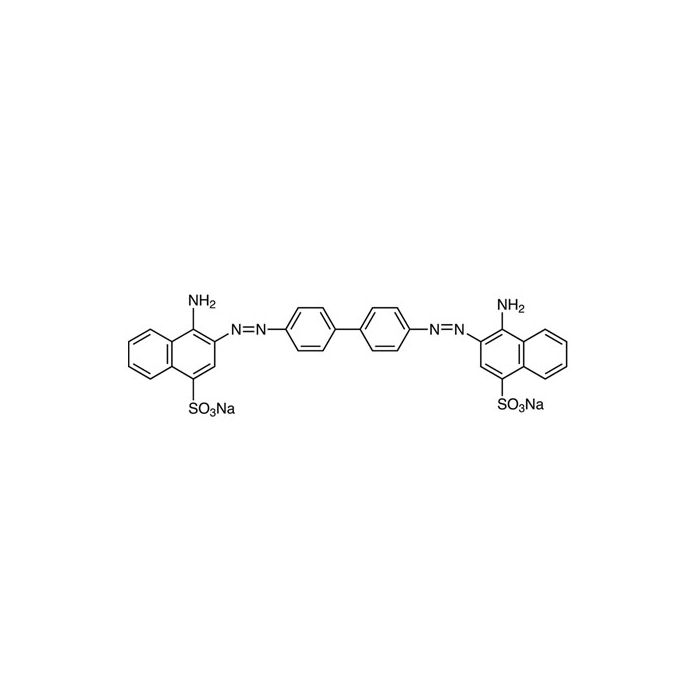
Congo Red - BioReagent, certified by the Biological Stain Commission , CAS No.573-58-0

CAS: 573-58-0 Cat. No.: C755702 Formula: C32H22N6Na2O6S2 Molecular Weight: 696.66 EC Number: 209-358-4
AVAILABLE TO ORDER
GRADE & PURITY BioReagent ? BioReagent grade — tested suitable for life-science and molecular-biology use. Use for cell culture, assays, and biochemical work needing biological compatibility. certified by the Biological Stain Commission
Synonyms
Direct Red 28
Storage
Room temperature
Shipped In
Normal
★
Size
USA
Germany (EU)*
Price
Qty
5g
C755702-5g
Made to order · 8–12 wks
$65.90
25g
C755702-25g
3 In stock
—
$416.90
Enter a quantity for the sizes you want to add.
🧪
Why this grade

BioReagent, certified by the Biological Stain Commission BioReagent for sensitive chromatographic and analytical workflows requiring minimal baseline interference.

🌡

Storage & shipping

Room temperature Ships Normal Check lot-specific COA for exact specifications.

📋

Quality documents

SDS, COA, datasheet, and spec sheet available for download. Lot-specific COA accessible via lot number lookup.

📚

Literature proof

Cited in 714 peer-reviewed publications across chromatography, organic synthesis, and cross-coupling reactions.

Overview

Certified for use as a counterstain for alum based hematoxylin and in the Highman or the Churukian modification of Puchtler′s amyloid stain.
Congo red has been used for the staining of β amyloid peptides. 

Biochem/physiol Actions:

Congo red is a benzidine-based anionic diazo dye. It is a histological dye which binds to many amyloid proteins and is used for the quantification of amyloid β-peptide aggregation. Congo red also interacts with β-D-glucans, polysaccharides containing continuous β-(1→4)-linked D-glucopyranosyl units and some hemicellulosic galactoglucomannans.

Specifications

Synonyms
Direct Red 28
Specifications & Purity
BioReagent, certified by the Biological Stain Commission
Biochemical and Physiological Mechanisms
Congo red is a benzidine-based anionic diazo dye. It is a histological dye which binds to many amyloid proteins and is used for the quantification of amyloid β-peptide aggregation. Congo red also interacts with β-D-glucans, polysaccharides containing cont
Storage
Room temperature
Shipped In
Normal
Grade
BioReagent
Names and Identifiers
Canonical Smiles
C1=CC=C2C(=C1)C(=CC(=C2N)N=NC3=CC=C(C=C3)C4=CC=C(C=C4)N=NC5=C(C6=CC=CC=C6C(=C5)S(=O)(=O)[O-])N)S(=O)(=O)[O-].[Na+].[Na+]
IUPAC Name
disodium;4-amino-3-[[4-[4-[(1-amino-4-sulfonatonaphthalen-2-yl)diazenyl]phenyl]phenyl]diazenyl]naphthalene-1-sulfonate
InChIKey
IQFVPQOLBLOTPF-UHFFFAOYSA-L
INCHI
1S/C32H24N6O6S2.2Na/c33-31-25-7-3-1-5-23(25)29(45(39,40)41)17-27(31)37-35-21-13-9-19(10-14-21)20-11-15-22(16-12-20)36-38-28-18-30(46(42,43)44)24-6-2-4-8-26(24)32(28)34;;/h1-18H,33-34H2,(H,39,40,41)(H,42,43,44);;/q;2*+1/p-2
Isomeric SMILES
C1=CC=C2C(=C1)C(=CC(=C2N)N=NC3=CC=C(C=C3)C4=CC=C(C=C4)N=NC5=C(C6=CC=CC=C6C(=C5)S(=O)(=O)[O-])N)S(=O)(=O)[O-].[Na+].[Na+]
Molecular Weight
696.66
Reaxy-Rn
3894858
Reaxys-RN_link_address
https://www.reaxys.com/reaxys/secured/hopinto.do?context=S&query=IDE.XRN=3894858&ln=

Documentation

📋 Safety Data Sheet (SDS)

Comprehensive hazard, handling, storage, and regulatory compliance document.

Download SDS →

✅ Certificate of Analysis (COA)

Lot-specific quality data. Enter your lot number to retrieve the exact COA.

Look up COA →

📊 Datasheet

Quick-reference summary of product specifications and applications.

View datasheet →

🔬 Specification Sheet

Full quality attributes and acceptance criteria for this grade.

View spec sheet →

Advanced Data

Taxonomic Classification

Taxonomy Tree

KingdomOrganic compounds
SuperclassBenzenoids
ClassBenzene and substituted derivatives
SubclassBiphenyls and derivatives
Intermediate Tree Nodes Not available
Direct ParentBenzidines
Alternative Parents 1-naphthalene sulfonic acids and derivatives  1-naphthalene sulfonates  1-sulfo,2-unsubstituted aromatic compounds  Sulfonyls  Organosulfonic acids  Azo compounds  Propargyl-type 1,3-dipolar organic compounds  Primary amines  Organopnictogen compounds  Organic sodium salts  Organic oxides  Hydrocarbon derivatives  
Molecular FrameworkAromatic homopolycyclic compounds
Substituents Naphthalene sulfonate - 1-naphthalene sulfonic acid or derivatives - Naphthalene sulfonic acid or derivatives - 1-naphthalene sulfonate - Benzidine - Naphthalene - 1-sulfo,2-unsubstituted aromatic compound - Arylsulfonic acid or derivatives - Organic sulfonic acid or derivatives - Organosulfonic acid or derivatives - Organosulfonic acid - Sulfonyl - Azo compound - Propargyl-type 1,3-dipolar organic compound - Organic 1,3-dipolar compound - Organic alkali metal salt - Amine - Organic salt - Organic sodium salt - Primary amine - Organosulfur compound - Organonitrogen compound - Hydrocarbon derivative - Organic oxide - Organopnictogen compound - Organic oxygen compound - Organic nitrogen compound - Aromatic homopolycyclic compound
DescriptionThis compound belongs to the class of organic compounds known as benzidines. These are organic compounds containing the benzidine skeleton, made up of a biphenyl ring system substituted at the 4- and 4'-positions with a unsubstituted amine group.
External Descriptors azo compound
3D Structure
Interactive Chemical Structure Model


Certificates(CoA,COO,BSE/TSE and Analysis Chart)
C of A & Other Certificates(BSE/TSE, COO):
Analytical Chart:

Find and download the COA for your product by matching the lot number on the packaging.

2 results found

Lot NumberCertificate TypeDateItem
F2625144Certificate of AnalysisOct 22, 2025 C755702
J2515135Certificate of AnalysisOct 22, 2025 C755702
Chemical and Physical Properties
SolubilityH 2 O: 10 mg/mL
SensitivityMoisture sensitive
Melt Point(°C)>360°C
Molecular Weight696.700 g/mol
XLogP3
Hydrogen Bond Donor Count2
Hydrogen Bond Acceptor Count12
Rotatable Bond Count5
Exact Mass696.084 Da
Monoisotopic Mass696.084 Da
Topological Polar Surface Area233.000 Ų
Heavy Atom Count48
Formal Charge0
Complexity1180.000
Isotope Atom Count0
Defined Atom Stereocenter Count0
Undefined Atom Stereocenter Count0
Defined Bond Stereocenter Count0
Undefined Bond Stereocenter Count0
The total count of all stereochemical bonds0
Covalently-Bonded Unit Count3
Documents & Articles
Quick Reference Guide to “Red” Reagents in Biological Experiments: Classification, Uses, Key Risks, and Selection Logic
Microscopic Interpretation and Taxonomic Value of Iodine Staining Reaction in Fungal Spores
Microbial Morphological Identification: Observation Systems, Staining Methods, and Result Interpretation
Structural Characteristics, Color-Change Mechanisms, and Application Selection of Azo Dye-Type Indicators
Bennhold Congo Red Staining Protocol for Amyloid Substances
Plant Tissue and Cell Wall Staining Methods: Selection of Light Green, Safranin, Fast Green, and Composite Staining Systems
Bacterial Special Structure Staining Techniques: Comparison of Spore, Capsule, Flagella, and Cell Wall Staining Methods
Summary of Cell Staining Methods
Citations of This Product
Solution Calculators
Reviews

Customer Reviews

Shall we send you a message when we have discounts available?

Remind me later

Thank you! Please check your email inbox to confirm.

Oops! Notifications are disabled.