
Simple allele discrimination PCR
Simple allele discrimination PCR
Simple allel-discriminating PCR, which is based on the principle of amplifi-cation refractory mutation system (ARMS), in which primers are designed to introduce an additional mismatched base at the penultimate base of the 3' end of the primer if the primer is paired with the corresponding nontarget template, has been named simple allel-discriminating PCR (SAP), which is simple, low-cost, powerful and reliable compared with CAPS. This method, named simple allel-discriminating PCR (SAP), is simple, low-cost, powerful, and highly reliable compared with CAPS. Currently, there is one main method used for simple allel-discriminating PCR: simple allel-discriminating PCR.
Principle
The basic principle of simple allele discrimination PCR is that in order to discriminate base changes between wild-type and mutant alleles, one upstream primer is designed to pair only with the wild-type and another upstream primer is designed to pair only with the mutant in the SAP analysis, and each of these two allele-specific primers is used in a standard PCR reaction with a downstream primer. Primer design is based on the principle that if an SNP mismatch between an allele-specific primer and a non-template target sequence results in weak instability, a strong destabilizing mismatch is introduced at the penultimate site at the 3' end of the primer. Conversely, if the SNP mismatch already has a strong destabilizing effect, a weak destabilizing mismatch should be introduced at the penultimate position. If there is a moderately strong destabilizing effect at the SNP mismatch, introduce a weak or moderately strong mismatch at the penultimate position.

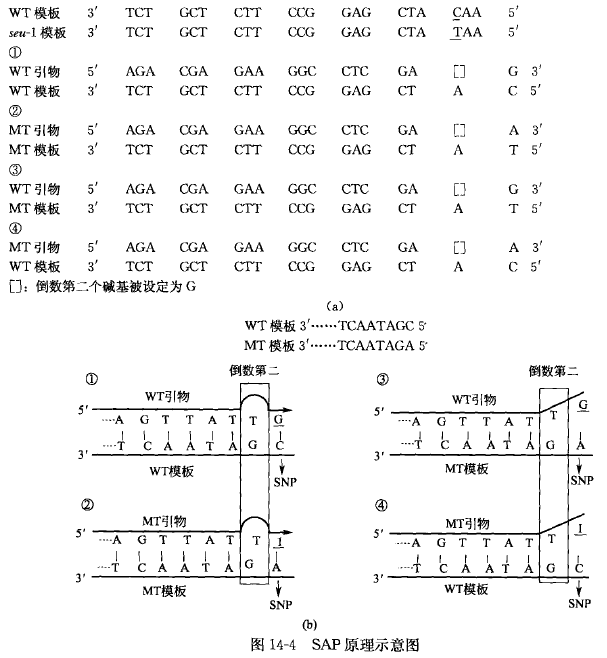
When designing allele-specific primers, the base to be introduced at the penultimate position of the 3' end of the primer should be determined according to Table 14-2. Figure 14-4 (a) illustrates the steps in primer design for detection of mutants in the seu-1 gene. In this example, the terminal mismatch is weakly unstable (G-T, A-C), so a strongly unstable mismatch (G-A) is introduced at the penultimate position of the 3' end of the primer. In Fig. 14-4 (b), assuming that the gene is mutated from C to A, a weakly unstable mismatch (T-G) is introduced at the penultimate position because the terminal mismatches (G-A and T-C) are strongly unstable. 1) It shows the correct pairing of the WT primer to the WT template and PCR can be performed; 2) It shows the stable pairing of the MT primer to the MT template and PCR can be performed normally; 3) The unstable pairing of the WT primer to the MT template is shown. PCR can be performed because of two consecutive mismatches of the WT primer with the MT template; (iv) PCR cannot be performed because of the unstable pairing of the WT primer with the WT template.
Operation method
Simple allele discrimination PCR
Principle
The basic principle of simple allele discrimination PCR is that in order to discriminate base changes between wild-type and mutant alleles, one upstream primer is designed to pair only with the wild-type and another upstream primer is designed to pair only with the mutant in the SAP analysis, and each of these two allele-specific primers is used in a standard PCR reaction with a downstream primer. Primer design is based on the principle that if an SNP mismatch between an allele-specific primer and a non-template target sequence results in weak instability, a strong destabilizing mismatch is introduced at the penultimate site at the 3' end of the primer. Conversely, if the SNP mismatch already has a strong destabilizing effect, a weaker destabilizing mismatch should be introduced at the penultimate site. If there is a moderately strong destabilizing effect at the SNP mismatch, introduce a weak or moderately strong mismatch at the penultimate position.
Materials and Instruments
Equipment: PCR amplifier. Move The basic process of simple allele discrimination PCR can be divided into the following steps: Using the genomic DNA extracted from the kit, 10 ng can be used for a 20 μl PCR reaction, or a sample with genomic DNA from the specimen can be used.
Reagents:
① Template: genomic DNA;
② dNTP mixture: 2.5 mmol/L for each deoxyribonucleic acid;
③ Three specific primers: the concentration is 10 μmol/L. ④ Taq DNA polymerase;
④ Taq DNA polymerase;
⑤ 10 × PCR buffer: 15 mmol/L MgCl
⑤ 10 × PCR buffer: 15 mmol/L MgCl2
⑤ 10 × PCR buffer: 15 mmol/L MgCl2, 500 mmol/L KC1, 100 mmol/L Tris-Cl, 0.1% (v/v) Triton X-100;
(vi) Autoclaved deionized water;
(vii) Reagents for agarose gel electrophoresis.
The WT primers and MT primers should be designed with similar Tm values as much as possible so that the annealing temperatures are the same; usually the amplified fragments are 200~600 bp in size.
3. Operation method① Set up 50 μl of PCR reaction system, at least two parallel PCR reactions are required for SAP analysis, add the following ingredients into a 0.25 ml PCR tube.
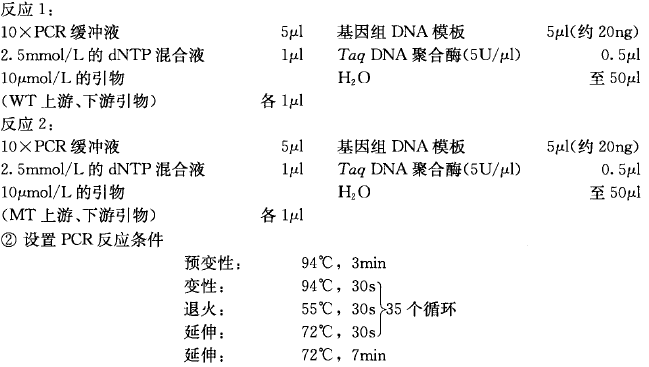
② When SAP analysis is first used for specific SNPs, try different annealing temperatures in order to determine the optimal conditions for PCR amplification. Ideally, the wild type should be annealed at the same temperature as the mutant so that one PCR reaction can be performed. However, in some cases these conditions are difficult to obtain and different PCR reactions with WT and MT primers are required.
After the reaction is completed, 10 μl of the reaction solution is analyzed by 1% agarose gel electrophoresis. If the experiment is successful, the WT and MT primers should be amplified on their respective templates.
Caveat
① Primers that are too stable cannot discriminate between target and non-target sequences. Conversely, unstable primers do not amplify the target sequence efficiently. In order to reduce the unwanted stability of the primer to the non-template target sequence, the length of the primer can be reduced or the annealing temperature of the PCR reaction can be increased. Usually, the primer (G+C) content is 36%~66%, the length of primer is 18~22 bases, the size of amplified fragment is 200~600 bp, and the annealing temperature is 55~60 ℃.The length of WT primer and MT primer should be the same in order to set the same PCR reaction conditions. When the last base of the primer is G or C, it often increases the non-specific reaction of the PCR reaction, in which case increasing the annealing temperature or shortening the length of the primer is required.PCR conditions should be optimized using wild-type and mutant DNA templates against each other. When performing a new SAP analysis, optimization of reaction conditions using gradient PCR is necessary. Further optimization of reaction conditions can also be performed by adjusting the appropriate primers and dNTP concentration.
For more product details, please visit Aladdin Scientific website.