
Determination of phenolic content in plant tissues
Determination of phenolic content in plant tissues
Phenolic substances in plant tissues are oxidized to Da by polyphenol oxidase, and Da can automatically polymerize into colorful substances and browning occurs. Therefore, the quantitative determination of phenolics in plant tissues is of certain significance and is often used as an index in the physiological study of plant resistance. The purpose of this experiment is to learn the principle and method of determining the content of phenolic substances.
Principle
The basic principle of the determination of phenolic substances in plant tissues is that the Folin-phenol method is often used for the determination of phenolic substances. Phenolic substances can react with phosphorus bustardic acid and phosphorus key acid in the Folin-phenol reagent under alkaline conditions to form bustard blue and key blue compounds, which have the maximum light absorption at 700 nm, and the magnitude of their absorbance is directly proportional to the content of phenolic substances. The absorbance is directly proportional to the phenolic content. Therefore, the content of phenolic substances in plant tissues can be determined by measuring the absorbance.
Operation method
Determination of phenolic content in plant tissues
Principle
The basic principle of the determination of phenolic substances in plant tissues is that the Folin-phenol method is often used for the determination of phenolic substances. Phenolic substances can react with phosphoribustic acid and phosphorus key acid in the Folin-phenol reagent under alkaline conditions to form bustard blue and key blue compounds, which have the maximum light absorption at 700 nm, and the magnitude of their absorbance is directly proportional to the content of phenolic substances. The absorbance is directly proportional to the phenolic content. Therefore, the content of phenolic substances in plant tissues can be determined by measuring the absorbance.
Materials and Instruments
Material: Various plant tissues. Move The basic procedure for the determination of phenolic content in plant tissues can be divided into the following steps: Caveat Phenolics are extracted to avoid being oxidized. For more product details, please visit Aladdin Scientific website.
Apparatus: spectrophotometer, centrifuge, mortar and pestle, test tubes, test tube racks, pipettes etc.
Reagents:
(1) Folin-phenol reagent: weigh 25 g of sodium tungstate and 5 g of phosphomolybdic acid, put them into a reflux flask, add 12.5 mL of phosphoric acid and 188 mL of distilled water, and boil them together at reflux for 2 h. Cool them down, and then dilute them with distilled water to 1 000 mL.
(2)10% Na
2
CO
3
Weigh 10 g of Na2CO3 and dissolve in 100 mL of distilled water.
(3) Standard phenol solution: 0.45 mmol L
-1
catechol solution.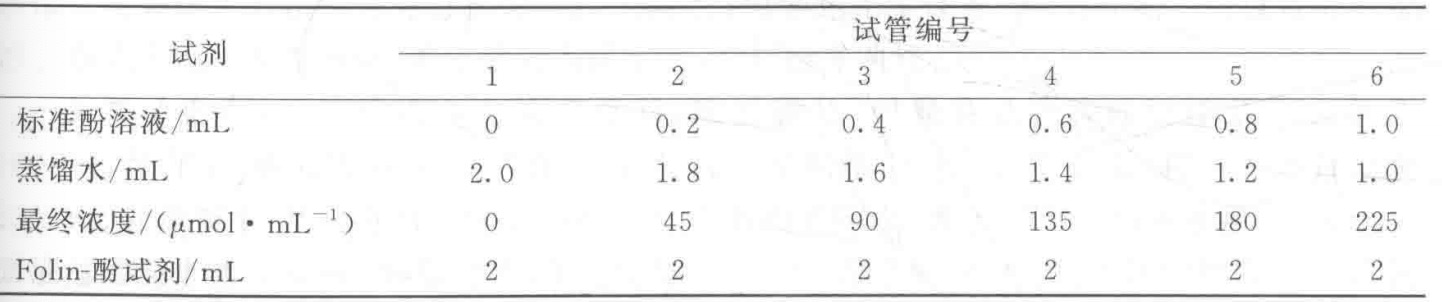 3. Determination of phenol content of the sample: Dilute the extract appropriately, put 2 mL in a test tube, add 2 mL of Folin-phenol reagent, after 3 min, add 2 mL of 10% Na2CO3, shaking, and let it stand at room temperature for 1 h. Determine its absorbance at 700 nm, and then find out the corresponding concentration of phenol on the standard curve.4. Calculation of results:
  Where: c I is the phenol concentration found on the standard curve, μmol・mL-1;V - is the volume of the sample, mL;W - is the sample mass, g.