
Determine the necessary mass, volume, or concentration for preparing a solution.
| Activity Type | Relation | Activity value | Units | Action Type | Journal | PubMed Id | doi | Assay Aladdin ID |
|---|
Moligand™, ≥97%(HPLC) Moligand™ for sensitive chromatographic and analytical workflows requiring minimal baseline interference.
Protected from light,Store at -20°C Ships Ice chest + Ice pads Check lot-specific COA for exact specifications.
SDS, COA, datasheet, and spec sheet available for download. Lot-specific COA accessible via lot number lookup.
Cited in 1 peer-reviewed publications across chromatography, organic synthesis, and cross-coupling reactions.
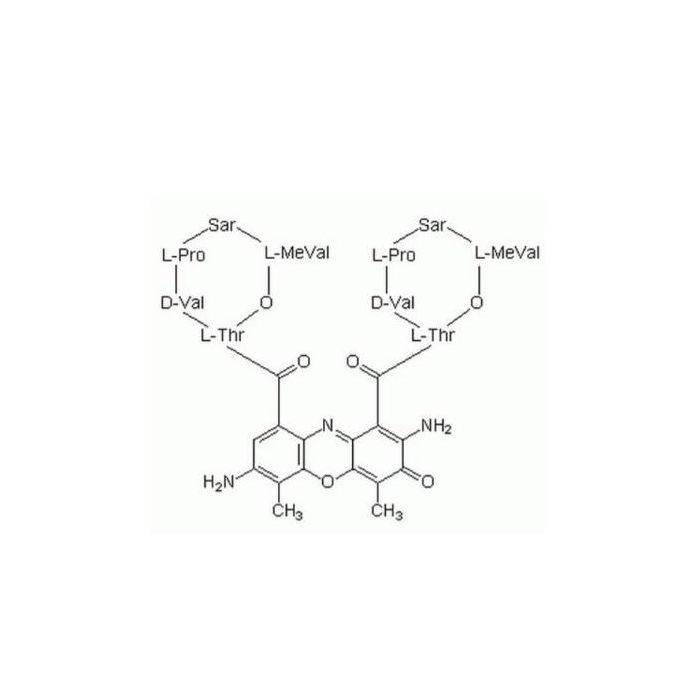
7-Aminoactinomycin D ,an analog of the antibiotic actinomycin D ,is a fluorescent DNA dye which is useful for quantifying apoptosis. 7-AAD has also been used in studies on cellular necrosis, chromosome analysis and in cell cycle studies. As a fluorescent DNA dye, 7-AAD is able to intercalate DNA via binding to the GC regions. When used in flow cytometery, 7-AAD can be used to discriminate between live cells as well as early and late apoptosis. Additionally, 7-AAD can also be combined with other staining procedures for analysis of intracellular and cell surface antigens enabling multiparametric analysis. When utilizing 7-AAD with flow cytometery, early and late apoptosis can be studied by varying the concentration of 7-AAD. During apoptosis, the cellular plasma membrane is altered progressively, which allows the cell membrane to become permeable to 7-AAD. 7-AAD staining can also be adapted to include staining with other dyes for intracellular and cell surface antigens. 7-Aminoactinomycin D is an inhibitor of DNA Polymerase and RNA Polymerase
A fluorescent DNA dye for apoptosis and flow cytomtery studies.
| Pubchem Sid | 504767737 |
|---|---|
| Pubchem Sid Url | https://pubchem.ncbi.nlm.nih.gov/substance/504767737 |
| Canonical Smiles | CC1C(C(=O)NC(C(=O)N2CCCC2C(=O)N(CC(=O)N(C(C(=O)O1)C(C)C)C)C)C(C)C)NC(=O)C3=CC(=C(C4=C3N=C5C(=C(C(=O)C(=C5O4)C)N)C(=O)NC6C(OC(=O)C(N(C(=O)CN(C(=O)C7CCCN7C(=O)C(NC6=O)C(C)C)C)C)C(C)C)C)C)N |
| IUPAC Name | 2,7-diamino-4,6-dimethyl-3-oxo-1-N,9-N-bis[(3R,6S,7R,10S,16S)-7,11,14-trimethyl-2,5,9,12,15-pentaoxo-3,10-di(propan-2-yl)-8-oxa-1,4,11,14-tetrazabicyclo[14.3.0]nonadecan-6-yl]phenoxazine-1,9-dicarboxamide |
| InChIKey | YXHLJMWYDTXDHS-IRFLANFNSA-N |
| INCHI | 1S/C62H87N13O16/c1-26(2)42-59(85)74-21-17-19-36(74)57(83)70(13)24-38(76)72(15)48(28(5)6)61(87)89-32(11)44(55(81)66-42)68-53(79)34-23-35(63)30(9)51-46(34)65-47-40(41(64)50(78)31(10)52(47)91-51)54(80)69-45-33(12)90-62(88)49(29(7)8)73(16)39(77)25-71(14)58(84)37-20-18-22-75(37)60(86)43(27(3)4)67-56(45)82/h23,26-29,32-33,36-37,42-45,48-49H,17-22,24-25,63-64H2,1-16H3,(H,66,81)(H,67,82)(H,68,79)(H,69,80)/t32-,33-,36+,37+,42-,43-,44+,45+,48+,49+/m1/s1 |
| Isomeric SMILES | C[C@@H]1[C@@H](C(=O)N[C@@H](C(=O)N2CCC[C@H]2C(=O)N(CC(=O)N([C@H](C(=O)O1)C(C)C)C)C)C(C)C)NC(=O)C3=CC(=C(C4=C3N=C5C(=C(C(=O)C(=C5O4)C)N)C(=O)N[C@H]6[C@H](OC(=O)[C@@H](N(C(=O)CN(C(=O)[C@@H]7CCCN7C(=O)[C@H](NC6=O)C(C)C)C)C)C(C)C)C)C)N |
| WGK Germany | 3 |
| RTECS | AU1579000 |
| Molecular Weight | 1270.43 |
| Reaxy-Rn | 36726997 |
| Reaxys-RN_link_address | https://www.reaxys.com/reaxys/secured/hopinto.do?context=S&query=IDE.XRN=36726997&ln= |
Comprehensive hazard, handling, storage, and regulatory compliance document.
Download SDS →Lot-specific quality data. Enter your lot number to retrieve the exact COA.
Look up COA →Full quality attributes and acceptance criteria for this grade.
View spec sheet →Taxonomy Tree
| Kingdom | Organic compounds |
|---|---|
| Superclass | Organic acids and derivatives |
| Class | Peptidomimetics |
| Subclass | Depsipeptides |
| Intermediate Tree Nodes | Not available |
| Direct Parent | Cyclic depsipeptides |
| Alternative Parents | Macrolide lactams Phenoxazines Macrolactams Alpha amino acid esters N-acyl-alpha amino acids and derivatives Aminobenzamides Dicarboxylic acids and derivatives Pyrrolidines Heteroaromatic compounds Vinylogous amides Tertiary carboxylic acid amides Secondary carboxylic acid amides Lactones Lactams Cyclic ketones Carboxylic acid esters Azacyclic compounds Oxacyclic compounds Organopnictogen compounds Organic oxides Primary amines Hydrocarbon derivatives |
| Molecular Framework | Aromatic heteropolycyclic compounds |
| Substituents | Cyclic depsipeptide - Macrolide lactam - Phenoxazine - Alpha-amino acid ester - N-acyl-alpha amino acid or derivatives - Macrolactam - Alpha-amino acid or derivatives - Aminobenzamide - Dicarboxylic acid or derivatives - Benzenoid - Heteroaromatic compound - Pyrrolidine - Tertiary carboxylic acid amide - Vinylogous amide - Carboxamide group - Lactam - Carboxylic acid ester - Secondary carboxylic acid amide - Amino acid or derivatives - Cyclic ketone - Lactone - Carboxylic acid derivative - Oxacycle - Azacycle - Organoheterocyclic compound - Amine - Organic oxygen compound - Organic nitrogen compound - Hydrocarbon derivative - Carbonyl group - Organic oxide - Organopnictogen compound - Primary amine - Organooxygen compound - Organonitrogen compound - Aromatic heteropolycyclic compound |
| Description | This compound belongs to the class of organic compounds known as cyclic depsipeptides. These are natural or synthetic compounds having sequences of amino and hydroxy carboxylic acid residues (usually α-amino and α-hydroxy acids) connected in a ring. The residues are commonly but not necessarily regularly alternating. |
| External Descriptors | chromopeptide |
| Activity Type | Relation | Activity value | Units | Action Type | Journal | PubMed Id | doi | Assay Aladdin ID |
|---|
| Activity Type | Relation | Activity value | Units | Action Type | Journal | PubMed Id | doi | Assay Aladdin ID |
|---|
| Activity Type | Relation | Activity value | Units | Action Type | Journal | PubMed Id | doi | Assay Aladdin ID |
|---|
Find and download the COA for your product by matching the lot number on the packaging.
| Lot Number | Certificate Type | Date | Item |
|---|---|---|---|
 F2609074 F2609074 | Certificate of Analysis | Dec 05, 2025 | A131295 |
| L2509135 | Certificate of Analysis | Dec 05, 2025 | A131295 |
| L2509136 | Certificate of Analysis | Dec 05, 2025 | A131295 |
| L2509137 | Certificate of Analysis | Dec 05, 2025 | A131295 |
| I2301055 | Certificate of Analysis | Jun 10, 2025 | A131295 |
| I2301056 | Certificate of Analysis | Jun 10, 2025 | A131295 |
| I2301057 | Certificate of Analysis | Jun 10, 2025 | A131295 |
| I2301058 | Certificate of Analysis | Jun 10, 2025 | A131295 |
| I2301059 | Certificate of Analysis | Jun 10, 2025 | A131295 |
| E2424063 | Certificate of Analysis | Jun 03, 2024 | A131295 |
| J1929175 | Certificate of Analysis | Jun 07, 2023 | A131295 |
| D2127035 | Certificate of Analysis | Feb 09, 2023 | A131295 |
| K2208073 | Certificate of Analysis | Nov 24, 2022 | A131295 |
| Solubility | Soluble in DMSO (20 mg/ml), ethanol, chloroform (1 mg/ml), and dichloromethane (20 mg/ml). |
|---|---|
| Sensitivity | Moisture & Light sensitive |
| Melt Point(°C) | 252-253°C |
| Molecular Weight | 1270.400 g/mol |
| XLogP3 | 3.100 |
| Hydrogen Bond Donor Count | 6 |
| Hydrogen Bond Acceptor Count | 19 |
| Rotatable Bond Count | 8 |
| Exact Mass | 1269.64 Da |
| Monoisotopic Mass | 1269.64 Da |
| Topological Polar Surface Area | 382.000 Ų |
| Heavy Atom Count | 91 |
| Formal Charge | 0 |
| Complexity | 3070.000 |
| Isotope Atom Count | 0 |
| Defined Atom Stereocenter Count | 10 |
| Undefined Atom Stereocenter Count | 0 |
| Defined Bond Stereocenter Count | 0 |
| Undefined Bond Stereocenter Count | 0 |
| The total count of all stereochemical bonds | 0 |
| Covalently-Bonded Unit Count | 1 |
| 1. Jiaqi Lu, Shuting Fang, Qiaoli Lu, Chang Liu, Baohua Huang, Changqing Yao, Yanchun Hong, Qijun Ruan, Huihui Ti. (2026) Lactoferrin amyloid-templated gold nanozymes combat pathogenic Bacteria via a synergistic assault of oxidative stress and metabolic collapse. JOURNAL OF COLLOID AND INTERFACE SCIENCE, [PMID:] [10.1016/j.jcis.2026.140292] |
Our grade selection guide covers purity, stabilizer status, and application suitability for all variants in our catalog.
View Moligand™ grade guide →